
World · taz · · 5h
+++ News in the Iran War +++: Revolutionary Guards attack oil tankers
Deutsch (original) · Auto-translated to English
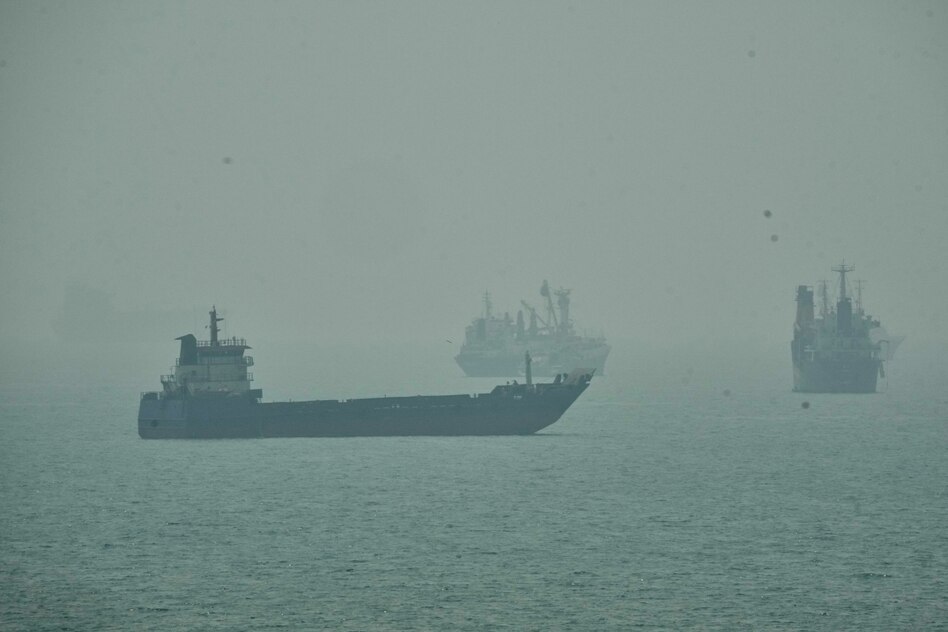
Iran's Revolutionary Guards have attacked an oil tanker in the Strait of Hormuz, according to state media. The state news agency Irna reported on Friday that the Togo-flagged tanker “Trend” was “attacked and detained” during its “illegal passage” through the strategically important strait. A fire had previously broken out on board.
The British shipping authority UKMTO reported a “security incident in the Strait of Hormuz” on Thursday. Accordingly, it occurred almost 30 kilometers northeast of the Omani coastal town of Chasab. The authority did not provide any information about the ship affected; it was initially unclear whether it was the tanker named by the Revolutionary Guards.
The Strait of Hormuz is at the heart of the conflict between the US and Iran. It is extremely important for global trade in oil and gas. Tehran has largely blocked the strait since the start of the Iran War at the end of February with US-Israeli attacks on the Islamic Republic. In return, the USA imposed a naval blockade of Iranian ports. Ships must present a permit to transit the Strait of Hormuz. Iran also wants to charge fees for passage, which the USA and the countries in the region reject. (afp)
According to President Lee Jae Myung, South Korea will not send troops to the Middle East that could involve the country in the conflict related to the Iran War. However, given the military presence of several countries near the Strait of Hormuz, the government is considering whether to expand its role in protecting shipping there, Lee said at a news conference. Minimal activities to secure South Korean economic interests and citizens are possible, he explains. (rtr)
Despite the unclear situation in the conflict in the Middle East, oil prices fell for the third day in a row. The North Sea oil Brent and the US oil WTI fell by more than 1 percent on Friday to 103.29 and 100.76 dollars per barrel respectively. Since Tuesday, the prices have each fallen by around 4.5 percent. “Recent efforts to restore Saudi export capacity have somewhat alleviated immediate supply fears,” said Priyanka Sachdeva, head of market research at Phillip Nova.
Earlier this week, oil prices rose to a four-month high as attacks by Yemen's Houthi militia in the Red Sea weighed on the oil business. Saudi Arabia also had to cancel some deliveries to Europe after the important east-west pipeline was damaged in a drone attack. The pipeline runs across the Arabian Peninsula and has recently served as the main route for oil from the Middle East, as the Strait of Hormuz is largely blocked due to the Iran War. Reports about alternative delivery routes for oil exports from Saudi Arabia have recently eased the situation somewhat. (rtr)
The cost of transporting sea freight between China and the US East Coast has risen rapidly as a result of the Iran War. Prices for short-term bookings on this route reached $10,948 per 40-foot container, data from pricing platform Xeneta showed on Thursday. This means that costs have more than quadrupled since the conflict began on February 28th. Freight rates on this important trade route are now just below the all-time high from the time of global supply chain problems during the corona pandemic, said Xeneta chief analyst Peter Sand. A record value of $11,900 was reached in January 2022. The route from Shanghai to New York is one of the busiest and most profitable for global shipping companies such as Maersk and Cosco.
The background to the development is the sharp increase in crude oil prices due to the escalation in the Middle East. After the USA and Iran attacked and sank oil tankers in the Strait of Hormuz and Saudi Arabia had to close an important pipeline, fuel for container ships became significantly more expensive. According to the Ship & Bunker specialist service, the global average price for the low-sulfur fuel used by many ships rose to $901.50 per ton. On February 27th the value was still at $543.50, but on Thursday it remained below the March 20th high of $1053. The shipping companies pass these additional costs on to their customers through surcharges.
Sand explained that it cannot be ruled out that the pandemic record will be exceeded given the rising fuel surcharges. A new high is most likely this month. The reason for this is the so-called Golden Week in China at the beginning of October. Retailers like Walmart and Amazon are currently trying to get their goods shipped out of the country before the government-imposed factory holidays.
Prices for short-term bookings from Shanghai to New York rose nearly 7 percent week-on-week to $10,394 per 40-foot container, according to data from the Drewry World Container Index (WCI) on Thursday. The research company Drewry also expects rates to continue rising due to the holiday effect. At the start of the pandemic, the company had seen rates of up to $16,000 on the Shanghai-New York route as consumers spent government relief money on furniture, big-screen TVs and fitness equipment. (rtr)
According to its own statements, the major US bank JP Morgan no longer has a clear forecast for the oil markets for the first time since the start of the Iran war. “We simply don’t know how to model the outcome,” the bank’s analysts wrote in a study published Thursday. Six months after the conflict began, many economic red lines had been crossed with no solution in sight. The price of oil has risen above $100 per barrel and diesel prices in the USA have reached an all-time high before winter.
However, despite the massive supply shortfalls of an estimated ten million barrels per day, the price of oil has not risen as much as expected. According to analysts, this is primarily due to a global decline in demand. Global oil demand fell by around 4.4 million barrels per day compared to the previous year. “By relying much more on falling consumption and much less on destocking, the market was able to absorb an extraordinary supply disruption without a sustained increase in crude oil prices,” the report said.
However, the bank warns that prices could rise later this year if supply disruptions in the Middle East continue. There are currently still sufficient stocks, especially in China, Europe and Japan, which serve as a buffer. However, these could run out. “In short, there is still enough dry powder left to keep prices in check – for now.” (rtr)
Chancellor Friedrich Merz (CDU) and US President Donald Trump spoke on the phone on Thursday about the attacks of September 11th, the war in Ukraine and the situation in the Middle East. Both commemorated the attacks of September 11, 2001 in the USA, which marked the 25th anniversary last week, said government spokesman Stefan Kornelius. The Chancellor emphasized the special bond between Germans and Americans.
Merz and Trump also discussed next steps to end the war in Ukraine. “Chancellor Merz appreciated the passage of the Graham sanctions law by Congress,” Kornelius continued. In the USA, after the Senate, the House of Representatives also voted for the sanctions law in order to put more pressure on Russia because of the Ukraine war. The law was pushed forward by US Senator Lindsey Graham, who recently died.
The situation in the Strait of Hormuz and the Red Sea was also reportedly discussed. There was agreement that both waterways needed to be opened quickly. Because of Merz's criticism of the USA over the Iran war, relations with US President Donald Trump had recently deteriorated. Customs conflicts are also straining relations between the two countries. (dpa)
According to a US media report, US President Donald Trump wants to meet representatives of several Gulf states on the sidelines of the United Nations (UN) General Assembly in New York on Tuesday to discuss the Iran war. The Axios portal wrote that Trump made it clear in an interview that he wanted to use this conversation to explore next steps with allies in the region. Axios wrote that participating states in the possible meeting include Saudi Arabia, the United Arab Emirates (UAE), Qatar, Bahrain, Kuwait and Oman. Trump will give a speech at the United Nations on Tuesday.
US President Donald Trump has announced a “big decision” in the deadlocked Iran war - without being specific about the timing. It is imminent, the Republican told the Axios portal. It's about whether there will be annihilation or not. Trump did not say who exactly he meant. Axios referred this to the Iranian leadership in the report. In the past, Trump had repeatedly threatened destruction in the conflict. The US and Israel jointly attacked Iran on February 28, which responded with counterattacks in the region. The conflict has now been going on for almost seven months.
Because of critical statements by Chancellor Friedrich Merz (CDU), the government in Tehran summoned the German ambassador to Iran. Ambassador Axel Dittmann was summoned because of “inappropriate statements made by high-ranking German government officials against Iran,” the Iranian Foreign Ministry said on Thursday. There were also “interventionist actions” by the German embassy in Tehran.
At a meeting with Iraqi Prime Minister Ali al-Saidi in Berlin on Tuesday, Merz demanded that Iran lift the blockade of the Strait of Hormuz, end its military nuclear program and end its support for armed groups in the region. (afp)
Italy is preparing a possible naval mission to protect its merchant shipping amid growing security concerns in the Bab el-Mandeb Strait. Defense Minister Guido Crosetto said he had instructed the Navy to prepare “everything necessary” to ensure the safe passage of Italian ships. The background is concerns about shipping in the Red Sea after the Iran-aligned Houthi rebels took control of parts of the Yemeni coast. Disruptions to key shipping routes would drive up transportation costs, delay deliveries and ultimately lead to higher prices for families and businesses, Crosetto explains. (rtr)
After expelling an employee of the Iranian embassy in Stockholm, Tehran in turn expelled a Swedish diplomat. The Swedish ambassador was summoned to protest against the Swedish government's "unjustified and contrary to international law" move, the Iranian Foreign Ministry said on Thursday. The Swede has 48 hours to leave the country.
Sweden announced on Wednesday that it had summoned the Iranian ambassador and ordered the expulsion of an employee of the diplomatic mission. Stockholm justified the expulsion with “activities that endanger security in and of Sweden and are directed against both Iranian regime opponents and Jewish and Israeli interests in our country.” Iran described the allegations as “unfounded.”
Swedish intelligence had already accused Iran in May of recruiting Swedish gang members for "acts of violence" against Israeli facilities - after several incidents near the Israeli embassy in Stockholm. Tehran rejected the allegations at the time. (afp)
The leader of Yemen's Houthi militia has firmly rejected Saudi Arabia's claims of an attempted drone attack by its fighters on Mecca, Islam's holiest city. This is an “absolutely disgusting lie,” Abdul Malik al-Houthi said in a televised address on Thursday. He called for mass protests on Friday in the Yemeni capital Sanaa and other Houthi-controlled regions of the country to show support for protecting holy sites.
In addition, Houthi supporters should demonstrate against the fact that Saudi Arabia has imposed a blockade on Yemen. The Houthis recently attacked several energy facilities in Saudi Arabia and ships in the Red Sea. On Wednesday, the military alliance led by Saudi Arabia, which is fighting alongside the internationally recognized government in Yemen against the Iran-backed Houthi militia, said it had intercepted a drone near Mecca. On Thursday, the Saudi Civil Defense announced that one person had been killed by fallen drone debris. (ap)
Read the full story at the source
Source: taz