
World Socialist Project
Israeli Settlers Violently Seize and Occupy Palestinian Homes
The takeover by Israeli settlers of homes inside a Palestinian city in the occupied West Bank represents a dangerous escalation.
English (original) ·Read in Deutsch ⇄
Katrine Dige HoumøllerNov 07, 20262721160ShareDrop Site is a reader-funded, independent news outlet. Without your support, we can’t operate. Please consider becoming a paid subscriber or making a 501(c)(3) tax-deductible donation today.
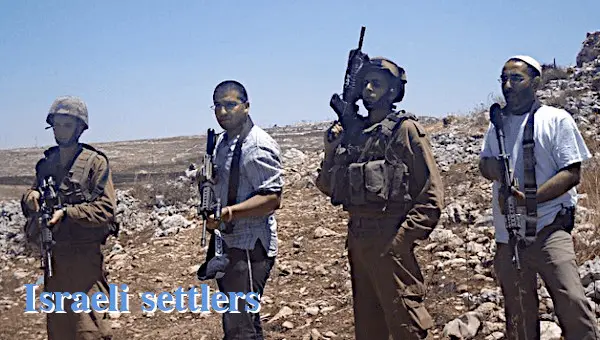
An Israeli soldier places his hand on the shoulder of an armed Israeli settler in the Al-Duyuk Al-Tahta neighborhood of Jericho, in the occupied West Bank, on November 5, 2026, a day after settlers violently seized Palestinian homes in the neighborhood. Photo by Katrine Dige Houmøller for Drop Site News.JERICHO, Occupied West Bank—“They beat all of us. Children, women, and men,” Mustafa Kaaba said, standing on a dusty street in the city of Jericho in the occupied West Bank. The night before, November 4, armed Israeli settlers burst into his home and the homes of his neighbors, ransacking them, violently forcing the families out, and warning them not to return.
Kaaba clutched his head and struggled to lift his arm, which was visibly swollen and bruised after settlers beat him with sticks. Around him, his family’s belongings lay scattered across the street. Kaaba’s pregnant wife, Fatima, gathered what was left of their clothes and stuffed them into plastic bags. After being expelled from their home, the family of seven was forced to sleep in their car and on the street.
“They ripped up the children’s schoolbooks and books written in Arabic,” Fatima told Drop Site. “They didn’t even leave our children anything to study with.” Fatima said the settlers took their refrigerator, washing machine, television, and entire bedroom set to another apartment seized by the settlers.
Around her, children ran between piles of rubble and scattered sheep that wandered out from a nearby corrugated metal shed. The couple’s young daughter had been in a playful mood, running up to people for hugs. Then, without warning, she burst into tears, screaming and running away from those around her. Her father tried in vain to comfort her. “She is having a panic attack,” Kaaba said. “I think it’s triggered by the trauma from last night.”
The family is now afraid to walk around Al-Duyuk Al-Tahta, their neighborhood on the outskirts of the city. “It’s dangerous, even just getting to the end of this street. I swear, it’s dangerous. What if they come after us?” Kaaba said. “We don’t have anything left.”
Fatima stood nearby clutching a piece of clothing. “Our house is still standing, but they told us not to come back,” she added. “They say it belongs to them now.”
LEFT: Mustafa Kaaba and Fatima Kaaba’s children look through the belongings of their home in Jericho after Israeli settlers stormed the family’s home the previous night and forced them out. RIGHT: Mustafa and Fatima Kaaba’s youngest child looks through her empty schoolbag shortly before suffering a panic attack, which her father attributed to the previous night’s raid, in Jericho, occupied West Bank. November 5, 2026. Photos by Katrine Dige Houmøller for Drop Site News.According to residents, at least 13 Palestinian households were driven from their homes in Jericho by some 30 Israeli settlers, some of them masked, who rampaged through the neighborhood.
The next morning, the settlers made their occupation known. They hung Israeli flags from the balconies and entrances of multiple houses—a standard marker of a Palestinian home taken over by settlers. Armed men patrolled between the newly occupied homes—with rifles slung over their shoulders or pistols tucked into their waistbands. Israeli women and children wandered along the gravel roads. Young men sat outside reading the Torah while gunmen stood guard at every property.
The expansion of Israeli settlements and outposts across the occupied West Bank over the past three years has been rapid and increasingly violent. More than 6,400 Palestinians, including over 3,100 children, were displaced between January 2023 and August 2026 as a result of settler attacks and restrictions on access to their land, according to the UN Office for the Coordination of Humanitarian Affairs. At least 48 Palestinian communities were completely emptied of their residents during that period.
Even in that context, the takeover by Israeli settlers of homes inside a Palestinian city in the occupied West Bank represents a dangerous escalation in Israel’s dispossession of Palestinians across the territory. Some Palestinians are comparing it to the situation in Hebron, the largest city in the West Bank and the only one to have Israeli settlements inside the heart of the city.
Most Israeli settlements surround Palestinian towns and cities, usually on the surrounding hilltops, but in Hebron armed Israeli settlers live in the midst of Palestinian residents and are guarded by a permanent and large deployment of Israeli troops, making Hebron one of the most tightly controlled and ethnically segregated urban areas in the West Bank with Palestinians even prevented from walking down certain streets.
“Establishing a settlement inside Jericho poses a security threat and constitutes a geopolitical disaster that must not be allowed to happen. This move is designed to deepen friction and violence, entrench an apartheid regime, and foreclose any possibility of a future political agreement,” the Israeli group Peace Now, that organizes against settlements in the West Bank, warned in a statement.
The violent home seizures on Wednesday came after a gradual buildup. The neighborhood of Al-Duyuk Al-Tahta had been experiencing repeated attacks by settlers, often from a nearby outpost called Palace Farms, according to Peace Now. Settlers also demolished around 13 homes in the area in February and again in July. Rubble is still scattered throughout the neighborhood.
By October 27, the day of the Israeli elections, settlers had already begun fencing off parts of the neighborhood and installing infrastructure, according to Peace Now, which also reported a number of break-ins, thefts, and assaults on residents. A gate was erected to block access to an entire street, cutting off dozens of Palestinian homes. Now, the settlers have taken over some of those homes.
The Israeli military did nothing to stop the violent takeover, with multiple Palestinian residents telling Drop Site that troops stood by as families were forced out.
The following morning, Israeli military vehicles repeatedly drove through the neighborhood. Uniformed soldiers warmly greeted the settlers, shook hands, and embraced them. Some entered the occupied houses, appearing familiar with the settlers inside.
Outside one of the newly occupied properties, a settler sat in a chair keeping guard. “They’re good friends of the families now,” he said as soldiers walked into the house. “Since last night,” he added.
LEFT: Israeli settlers move into Palestinian homes in Al-Duyuk Al-Tahta neighborhood of Jericho, in the occupied West Bank, on November 5, 2026. RIGHT: Israeli soldiers visit Israeli settler families throughout the day in Al-Duyuk Al-Tahta neighborhood of Jericho, in the occupied West Bank, after the settlers occupied several homes in the Palestinian city the previous night. Photos by Katrine Dige Houmøller for Drop Site News.The properties are located on the outskirts of Jericho and technically in Area C—a designation under the Oslo Accords of the 1990s where Israel retains full civil and military control—right on the border of Area A, where the Palestinian Authority has nominal security and civil control, and where most of Jericho city is located.
The takeover was reportedly coordinated by the settlement organization Nachala and the Binyamin Regional Council. Both organizations claim that the properties were legally purchased. Jericho Governor Hussein Hamayel disputed the claims, saying in an interview with Raya Media Network that the land belongs to Jordan’s state treasury and describing the alleged sales as forged.
In response to an inquiry from Drop Site, about the Israeli military’s role in the takeover, accounts of violence and looting by settlers, and the settlers’ continued occupation of the Palestinian homes, a military official said in a written response that “Upon the entry of Israeli civilians into homes in the area adjacent to Jericho, situational assessments and field patrols were conducted to examine the incident. In the coming week, the examination of the settlers’ claims regarding the purchase of the lands will continue.” The official also said “the action was carried out without prior coordination or approval from the IDF.” They added, “The mission of the soldiers stationed at the military outpost in the area is to safeguard the security of all residents in the area and to prevent terror and additional confrontations.”
Yet following the Israeli settlers’ takeover of the homes, the Jericho neighborhood is increasingly off limits to Palestinians or perceived supporters. The morning after the attacks, settlers in an ATV recklessly chased Palestinian journalists through the streets, relentlessly pursuing them until they managed to escape the area.
Mahmoud Faridat, a resident of Al-Duyuk Al-Tahta, owns two farms directly adjacent to the newly occupied properties. The following morning, Faridat went to herd his sheep inside one of the farms with his brother, Jamal, and his nephew. They were stopped by settlers, who beat Jamal and the nephew and sprayed them with tear gas, Faridat said. Settlers had also erected another makeshift barrier, arranging chairs and wooden planks across the road to block access to Faridat’s farmland.
“[A settler] told us not to go through it, but our water ponds and farm are all in front of the house,” Faridat told Drop Site immediately after failing to reach his land.
“From the moment they [the settlers] came, they have attacked us.” Even the main roads in the neighborhood have become dangerous.
“The street we’re standing on now is still accessible, even though the army stops us to ask questions,” Faridat said. “But tomorrow, Allah knows, they may not let us pass at all.”