
Politics · Real Media · · 3h
Bar by Bar Inside the 21-Day Protest to Free Luna
English (original) · Read in Deutsch ⇄
Animal rights campaigner caged day and night in Trafalgar Square
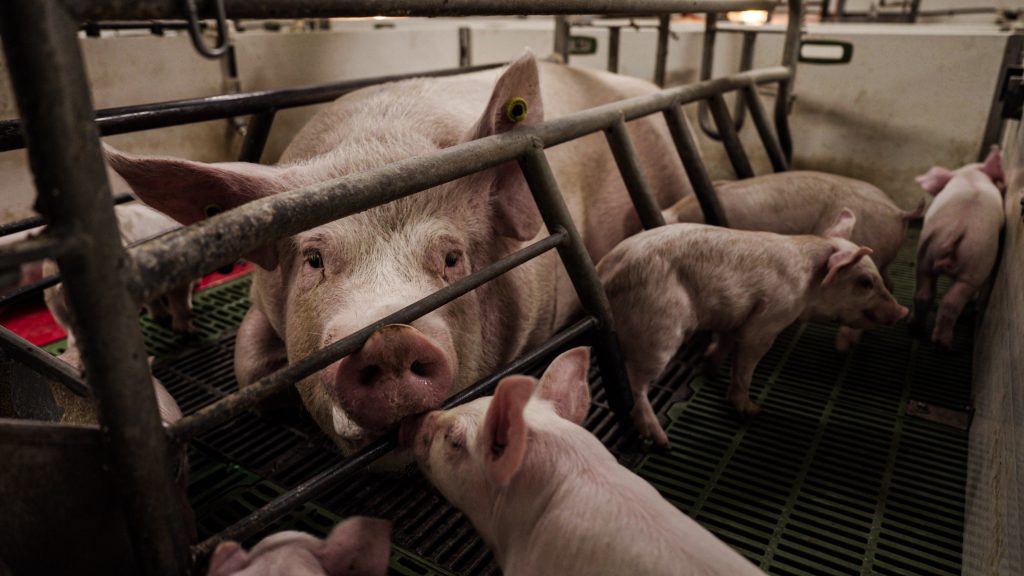
Every morning, a pig called Luna chews the bars of her crate.
Held at Red Court Farm in Suffolk, Luna is three years old and tagged through her right ear – sow number 684. She has no way to turn around. She cannot take a step sideways. Twice a year, for weeks at a time, a metal cage the width of her own body is her entire world.
Her story might have remained hidden, as the stories of the more than 200,000 mother pigs who pass through farrowing crates in British farms each year remain unseen. But hidden cameras placed by animal rights group Animal Rising documented Luna’s life for a month – watching as she gave birth, as her piglets were born into the bars of the crate and could only reach her by squeezing through the gaps to press their faces against hers. As is standard practice, the piglets would have their teeth clipped and tails cut without anaesthetic – dead ones discarded into bin bags. Luna remained confined just feet away, unable to intervene, unable to comfort them, unable to do anything that would come natural to a mother. Eventually, her piglets were taken from her for good.
The footage, narrated by Animal Rising campaign lead Michelle Farnham, has now been seen by tens of thousands of people, and at time of writing more than 20,000 have signed a petition calling for Luna to be released to a sanctuary.
Before a pig gives birth, she would naturally walk kilometres from the herd to find a quiet, safe place of her own. She would gather straw, grass and branches, and build a nest for her piglets – behaviour that domestic sows have retained for thousands of years. Luna’s instincts are no different to those of any other pig. In the farrowing crate, she can do none of it.
The crate is the width of her body. It is legal. Someone approved this.
That legal approval is precisely what Farnham and Animal Rising are challenging — not as an isolated welfare problem, but as an emblem of an entire system they say must end.
On 1 September, Michelle Farnham climbed into a replica farrowing crate outside the National Gallery in London. She has not left it since. She will not leave it, day or night, until 22 September.
She eats inside the crate. She sleeps inside it, with a tent placed over her at night for warmth and shelter against the rain. A team of coordinators is with her at all times. Each evening, a privacy screen is put in place so she can brush her teeth and change her clothes. Warm water is brought to her each morning to wash her face. Bathroom arrangements require the same careful logistics. A doctor checks in on her daily, monitoring both her physical health and her mental wellbeing.
“I entered this crate for Luna,” Farnham said. “We documented her life in a crate just like this for a month. This is one of the hardest things I’ve ever put myself through, but when my time is up, I can walk away for good. Around 200,000 mother pigs go into farrowing crates in the UK every year, and they don’t have that choice.”
The response from the public, she says, has been overwhelming. Passers-by stop. They talk. They are shocked when they discover that what they are looking at is not a dramatic exaggeration but an accurate replica of a standard feature of British pig farming.
On 9 September, wildlife presenter Chris Packham visited Farnham in Trafalgar Square, joining her inside the crate on her ninth consecutive day there.
“Any animal being subjected to this level of confinement is horrific,” he said. “And we have to remember that farrowing crates are not some fringe practice — they are routinely used across the British pig industry. This crate shows us what happens when animals are reduced to units of production, rather than recognised as individuals with needs of their own.”
Packham went further, placing the crate within a wider critique of intensive farming. “Factory farming has become deeply embedded in the way we produce food, causing immense suffering to the animals on these farms and taking a devastating toll on our environment. We urgently need to move away from these animal factories and towards a more sustainable future. We can’t keep accepting this as normal. It’s a broken system, and it needs to end.”
Luna is still at Red Court Farm in Suffolk. Animal Rising is petitioning for her to be released to a sanctuary that has already offered her a home. A letter has been sent to the farm – they have yet to respond.
Farrowing crates are currently used in approximately 92% of indoor pig production systems in the UK. Animal Rising‘s call is not simply for Luna’s release, but for the Government to commit to ending factory farming entirely by 2040.
For now, outside the National Gallery, Michelle Farnham continues to wait inside her crate – and somewhere in Suffolk, Luna continues to chew the bars of hers.
To sign the petition to free Luna, visit https://act.animalrising.org/free_luna_pet
Watch the film produced by Animal Rising [DISCRETIONARY WARNING – SCENES OF ANIMAL ABUSE}
— © 2026 Sul Nowroz – Real Media staff writer – Insta: @TheAfghanWriter
Read the full story at the source
Source: Real Media