
Politics Pressenza
When the British Colonists in America Threw Tea Into Boston Harbor — 1773
From the Boston Tea Party to Venezuelan Oil, Through Louisiana, Mexico, Indigenous Peoples, Hawaii, and the Philippines: The History of a Nation That Was Born Defying an Empire and Ultimately Acquired
English (original) ·Read in Deutsch ⇄
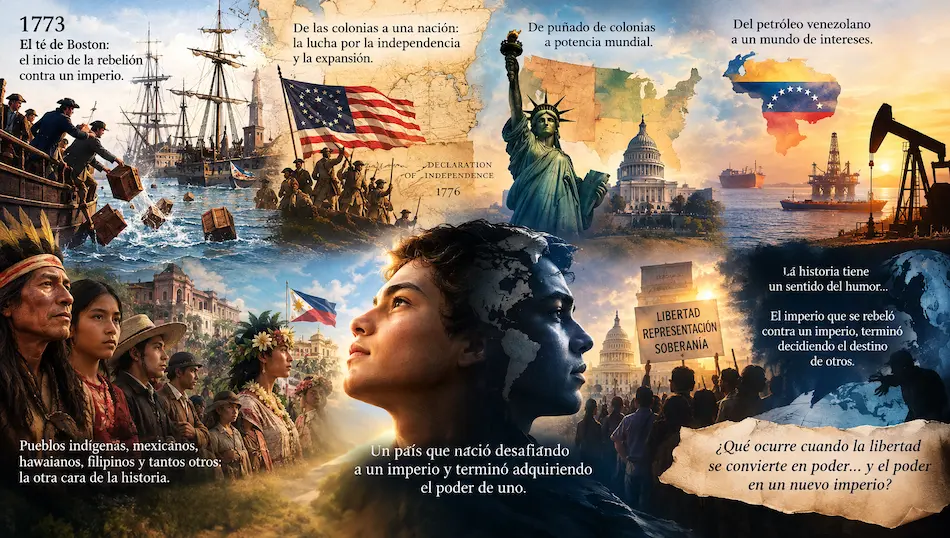
From the Boston Tea Party to Venezuelan Oil, Through Louisiana, Mexico, Indigenous Peoples, Hawaii, and the Philippines: The History of a Nation That Was Born Defying an Empire and Ultimately Acquired the Power of One.
“Empires tend to forget that many of the rebellions they condemn bear an uncomfortable resemblance to those they once celebrated.”
“Before becoming a world power, the United States was also a handful of colonies that rebelled against an empire. Two centuries later, it seems to have forgotten that small historical inconvenience: when someone else held the power, resistance was called freedom.”
“The United States was born challenging an empire that sought to decide its destiny. Two centuries later, having become a world power, it discovered the advantages of deciding the destinies of others. History has a truly exquisite sense of humor.”
“July 4, 1776: The Declaration of Independence was adopted, using the name United States of America.”
“May 4, 1607: The founding of the first permanent English settlement in North America, Jamestown, Virginia, with 104 English colonists.”
AUTHOR’S NOTE
This column was written to examine history without asking the victors for permission and to recover what has too often remained hidden behind their victories. It was written because behind maps, treaties, military victories, territorial purchases, and grand national speeches are human beings who invariably disappear when history begins to be written from the victor’s desk.
Indigenous peoples exterminated and expelled from their lands, Mexicans who woke up living in another country without having moved their homes, Hawaiians whose monarchy was overthrown, Filipinos who exchanged one colonial power for another, civilians trapped in wars decided far from their homes, and entire generations forced to accept borders drawn by powers that never asked for their consent.
The United States proclaimed principles of freedom, representation, and sovereignty while, throughout its expansion, it also invaded territories, displaced and exterminated peoples, annexed lands belonging to others, and extended its power far beyond its original borders. Both dimensions belong to the same history and must be told without selecting only the more comfortable parts.
This column attempts to follow one question from Boston Harbor in 1773 to Venezuelan oil in 2026.
“History ceases to be history when it begins protecting the reputation of whoever wrote it.”
“What happens when a nation born rebelling against an empire’s right to decide its destiny ultimately becomes a power seeking to decide the destinies of others? Nothing extraordinary: freedom remains sacred, provided it is exercised by whoever has the power to grant it.”
“The United States was born questioning an empire’s right to impose its will. Two hundred and fifty years later, it discovered that the principle was admirable, but had one inconvenience: it could also be invoked by the peoples upon whom it now seeks to impose its own will.”
“Why do victories have monuments?” “Losses, all too often, barely have a memory.” “And victories always conceal the losses of others.”
I. THE NIGHT OF THE TEA IN BOSTON
Boston, December 16, 1773. Three ships lay anchored in the harbor: the *Dartmouth*, the *Eleanor*, and the *Beaver*. Their holds contained hundreds of chests of tea belonging to the British East India Company.
“On the night of December 16, 1773, those who boarded the three British ships in Boston were not generals, presidents, or the future architects of American institutions. They were ordinary citizens, British colonists in America: artisans, carpenters, merchants, sailors, and workers who knew perfectly well that they were challenging the authority of Great Britain. They did not arrive by accident, nor did they throw 342 chests of tea into the harbor because they were unaware of the political consequences of their actions. They participated in a deliberate act of resistance against decisions they considered unjust. And therein lies a fundamental dimension of that event: before Washington commanded an army, Jefferson drafted the Declaration of Independence, and future leaders built the institutions of the new country, ordinary men without titles had carried out one of the most significant challenges to imperial power. The Boston Tea Party was a decisive event in the process that would lead to independence. That night, American history belonged to anonymous people who decided to act, without waiting for the great names of future capitals, states, and thinkers of the emerging American nation to take center stage.”
“The United States did not yet exist as an independent nation in 1773. They were the British colonists in America.”
“But its history and eventual independence were beginning there. ‘Two ears and a tail’ for those anonymous people who ignited the country.”
“Sometimes a revolution begins when a commodity no longer has a real price and its value acquires the political meaning of independence…”
II. THE PROBLEM WAS NEVER JUST THE PRICE OF TEA
The Tea Act of 1773 transformed tea into the visible symbol of a struggle over power. The problem was not the commodity, but the authority that sought to make decisions about the colonies from London. Behind every tax lay a much larger political question: who governs, by what right, and how far can that authority impose its will upon those who have no say in the decision?
“Sometimes a revolution does not begin over the price of a commodity, but over the humiliation of discovering that others have decided how much obedience should cost.”
That was, in essence, what the inhabitants of the colonies that would later form the United States were saying: no one should make decisions about them without their participation, and no distant power could transform obedience into legitimacy simply because it possessed sufficient force to impose it. The dispute was not limited to trade; it touched directly upon the principle of sovereignty.
“When obedience is imposed from afar, it stops looking like government and begins to look like domination.”
The slogan “No taxation without representation” encapsulated a dispute far greater than a tax. If the British Parliament could impose taxes on the colonies without effective representation for their inhabitants, it was also asserting its authority to govern them. The real cargo concealed inside those chests was not merely tea: it was power.
“When a tax determines who governs, it ceases to be merely a fiscal matter and becomes a declaration of sovereignty.”
Accepting the tax meant acknowledging, at least partially, the political principle supporting it. That is why the colonists were not merely arguing about money. They were debating sovereignty: who decided, who obeyed, and where the right to command originated. London’s ability to impose a rule did not automatically make that ability legitimate.
“Two and a half centuries later, the question remains unchanged.”
“Since when does having the power to do something mean having the right to do it?”
III. A CORPORATION SEATED BESIDE THE EMPIRE
There was another protagonist that night. It wore neither a crown nor a military uniform, but it possessed ships, capital, commercial networks, and a close relationship with British power: the East India Company. It was not merely a British company trading in tea. In India, it exercised territorial powers, collected revenues, maintained armed forces, and became a powerful economic instrument of imperial expansion.
“When a company acquires political power, commerce begins to resemble government far too closely.”
The inhabitants of the colonies were not confronting London’s decisions alone. They were also confronting a privileged corporation whose economic interests were protected by imperial power. When the company’s interests and those of the state coincided, the boundary between business and geopolitics could practically disappear. The tea arrived as merchandise, but accompanying it were privileges, taxes, authority, and power.
“Empires do not always arrive accompanied by soldiers; sometimes their companies disembark first.”
Two and a half centuries later, the products and technologies have changed, but not necessarily the underlying logic. Yesterday it was tea; today it may be oil, copper, lithium, rare earths, semiconductors, gas, ports, or critical minerals. When a resource becomes indispensable to a power’s security, industry, or technological supremacy, it ceases to be merely a commodity and becomes part of its strategy.
“Resources change their names; the struggle to control them changes far less.”
The British East India Company belongs to the eighteenth century, but the question it left hanging in the air remains extraordinarily relevant. When corporations, strategic resources, and great powers begin sharing interests, it becomes increasingly difficult to determine where business ends and foreign policy begins. Boston encountered that uncomfortable proximity between commerce and power very early.
“Where does a corporation’s interest end, and where does the empire’s interest begin?”
IV. 1773 — DESTROYING PROPERTY IN BOSTON TO DEFEND THE FREEDOM OF THE BRITISH COLONIES IN AMERICA (THE FUTURE UNITED STATES OF AMERICA IN 1776)
Here we encounter one of the great paradoxes of American history. An act of deliberate destruction of property ultimately became part of the founding narrative of a nation that would later make the defense of private property one of its most visible political and economic principles. The men who boarded those ships violated a law, destroyed merchandise, and openly challenged imperial authority.
“When a rebellion succeeds, history often stops calling it a crime and begins calling it a birth.”
The question then becomes unavoidable: were they vandals or patriots, rebels or founders, criminals or men defending a right they considered superior to the law they were breaking? The historical answer ultimately depended, to a considerable extent, on the outcome. Had independence failed, many of those names would probably have remained associated with sedition and crime.
“The victor does not merely conquer territories; he also acquires enormous influence over the words with which the past will be remembered.”
Boston therefore obliges us to examine cautiously the labels applied to other rebellions. Revolution, resistance, insurrection, vandalism, and terrorism are not interchangeable words, but neither are they always free from political power.
“Whoever controls the narrative usually decides which action deserves a monument and which deserves condemnation.”
“History often changes the name of the same act when the identity of the victor changes.”
V. LONDON MADE THE MISTAKE EMPIRES MAKE
The British response to Boston’s challenge was swift and punitive. In 1774, London enacted the so-called Coercive Acts, known in the colonies as the Intolerable Acts, a series of measures intended to punish Massachusetts and restore imperial authority. Boston Harbor was closed, and the colonial government was subjected to new restrictions.
“Empires tend to respond to defiance with punishment before understanding.”
London wanted to demonstrate who was in charge. The problem was that the punishment directed against Massachusetts began to be perceived by the other colonies as a warning to them all. What was supposed to isolate Boston ended up generating solidarity. The punishment ceased to appear local and began to demonstrate the possibility that any colony could be subjected to similar measures if it challenged British authority sufficiently.
“When punishment is intended to discipline one, it sometimes ends up awakening everyone.”
The Crown possessed ships, soldiers, laws, and vastly superior material resources. But it confused force with legitimacy and obedience with consent. It could close a port, restrict an assembly, and punish a city, yet each repressive measure widened the political distance it intended to reduce.
“Power can force people into silence for a time, but that does not mean it has persuaded them.”
Boston ultimately taught a lesson that empires repeat with surprising frequency: the ability to punish is not the same as the ability to govern.
“An empire begins to lose when it believes that imposing silence is the same as securing obedience.”
VI. THE 342 CHESTS BEGIN TO CREATE THE UNITED STATES
After Boston, the sequence of events leading toward freedom and independence accelerated rapidly. In 1774, the First Continental Congress convened, where representatives from several colonies coordinated a common response to British measures. What had begun as a localized dispute was becoming a genuine American political organization.
“When a protest by ‘ordinary people’ finds coordination, it ceases to be merely a protest and begins to transform itself into power.”
In April 1775 came Lexington and Concord. Gunfire transformed political tension into open warfare. The colonies that had debated taxes and representation now began confronting British power militarily. The conflict had traveled an increasingly irreversible path: the beginning, the seed of independence planted by the Boston Tea Party, taxes, solidarity, organization, and finally the decision to take up arms directly.
“Empires often discover too late the precise moment when a protest, which began in Boston with chests of tea thrown into the harbor, stopped demanding changes and began challenging sovereignty.”
On July 4, 1776, the Declaration of Independence transformed that rupture into an explicit political project. The colonies were no longer merely demanding better conditions within the empire: they were asserting their right to leave it and establish another state.
“The rebellion had stopped debating the rules of power and had begun debating who had the right to exercise it.”
That is why the 342 chests matter far more than their contents. Their destruction helped set in motion a political chain that would culminate in victory three years later.
“The tea, by itself, created the United States, because it ignited the process—which was already politically and militarily prepared—setting in motion the revolution that ultimately made American independence possible.”
VII. NAPOLEON SELLS LOUISIANA, A TERRITORY INHABITED BY OTHERS
In 1803, Napoleon Bonaparte sold the Louisiana Territory to the United States for US$15 million. The transaction covered approximately 828,000 square miles and practically doubled the young country’s territory. On maps, it could appear to be an extraordinary transaction between two governments. On the land itself, however, lived Indigenous peoples who had not signed the sale, had not negotiated the price, and had not authorized anyone to dispose of their territories.
“Maps change with a signature; the lives that exist within them rarely enjoy that same ease.”
The question is unavoidable:
“Who authorized Napoleon to sell lands belonging to peoples who already inhabited them?”
But there is another equally uncomfortable question:
“Who authorized Thomas Jefferson and the United States to purchase them as though sovereignty could be transferred along with the soil?”
Two governments negotiated millions of hectares while Indigenous nations were excluded from a transaction that would radically alter their future.
“When two powers agree on a border, the peoples living within it often discover afterward that someone negotiated on their behalf.”
The Louisiana Purchase was celebrated as one of the great territorial expansions of the United States. But it also represents a form of expansion through fraudulent purchases from the perspective of the dispossessed peoples: Napoleon sold and Jefferson bought territories inhabited by communities that had never surrendered their rights or authorized the transaction. Louisiana thus reveals a less celebrated side of American expansion: lands negotiated between governments while the people living on them were excluded from the table.
“When others sell the land you inhabit without asking for your consent, the transaction may bear an official seal and still amount to dispossession.”
VIII. MEXICO — WHEN THE UNITED STATES DECIDED THE PACIFIC BELONGED TO IT, TOO
“Mexico ceded approximately 525,000 square miles, around 55% of its prewar territory. Texas, California, Nevada, Utah, New Mexico, and vast stretches of what is now the southwestern United States.”
Texas was Mexican territory. In the early 1820s, Mexico permitted foreign settlers to establish themselves under certain conditions, and Stephen F. Austin continued the project begun by his father, Moses Austin, to bring in hundreds of families. Immigration from the United States grew rapidly and eventually altered the region’s demographic and political balance. By 1832, the colonies associated with Austin alone had approximately 8,000 inhabitants.
“Mexico opened its lands to settlers; a few years later, it began to understand that this colonization could become a threat to its own sovereignty.”
Mexico’s concern was not imaginary. The United States had shown interest in acquiring Texas, and as Anglo-American settlers continued arriving, Mexico attempted to slow the process through the 1830 law restricting further American immigration. Tensions increased until they culminated in the rebellion of 1835–1836 and the proclamation of the Republic of Texas. Mexico never accepted that separation as a legitimate and definitive territorial loss.
“What began as authorized settlement ultimately became territorial separation and, afterward, annexation by the neighboring power.”
In 1845, the United States annexed Texas. Mexico broke diplomatic relations, and war began the following year. American troops penetrated deep into Mexican territory and occupied Mexico City in September 1847. This was not an innocent march westward: it was a war between two states in which the American army invaded its neighboring country and occupied its capital.
“Calling an invasion expansion is an elegant way of erasing from the map the army that made the expansion possible.”
The Treaty of Guadalupe Hidalgo of 1848 came after Mexico’s defeat. Mexico ceded approximately 525,000 square miles, around 55% of its prewar territory. California, Nevada, Utah, New Mexico, and vast areas of today’s southwestern United States passed to the victor. California was Mexican before it became American; the same was true of immense territories that today appear inseparable from the map of the United States.
“National maps often appear eternal only after we forget how much it cost to draw them.”
“Mexico did not experience a simple ‘territorial expansion’ by the United States.”
“It experienced the dispossession of an enormous portion of its territory following the annexation of Texas, a war, an invasion, and the occupation of its capital.”
“From the perspective of Mexican historical memory, there is a much less comfortable word for what happened: usurpation…”
IX. THE INDIGENOUS PEOPLES OF THE UNITED STATES WHO LIVED THERE BEFORE THE AMERICANS ARRIVED
Before the United States extended its borders westward, those territories were already inhabited. Indigenous peoples lived there with their own nations, languages, authorities, routes, economic systems, religions, and understandings of the land. American expansion did not advance into a geographical void: it advanced into territories occupied by communities possessing sovereignty, memory, and rights long before Washington existed.
“The map could call them available territories; those who lived there called them home.”
The Indian Removal Act of 1830 turned displacement into federal policy. During the following decades, numerous nations were forced to abandon their ancestral lands and move westward. The Trail of Tears remains one of the most brutal symbols of that policy: Cherokee, Choctaw, Creek, Chickasaw, and Seminole peoples were displaced, and thousands died during those marches.
“When a state forces a people to abandon the land of their ancestors, the word relocation barely begins to describe what happened.”
Then came reservations, new wars, and treaties that were broken or replaced all too often when Indigenous lands once again became desirable for expansion. Between 1887 and 1934, allotment policies reduced lands under Indigenous control from approximately 138 million acres to barely 48 million. The American government itself acknowledges that this process caused a devastating loss of land.
“The frontier advanced for some precisely because it retreated for others.”
The loss was not merely territorial. Boarding schools and federal policies sought to assimilate Indigenous peoples, eroding languages, cultures, family structures, and traditional ways of life. The United States did not make those nations disappear: many survived and continue to exist. But for them, the country’s territorial development meant generations of lost land, sovereignty, property, and freedom.
“The expansion of a nation may appear as progress in its textbooks and as extermination in the memory of those who were already there.”
X. HAWAII — A NATION IN THE MIDDLE OF THE ROUTE
Hawaii was not an island without sovereignty, waiting for a great power to decide its destiny. It was an independent kingdom, internationally recognized, including by the United States. It had a monarchy, a government, diplomacy, and its own political identity long before becoming part of the American map. Its location in the middle of the Pacific, however, began transforming it into something far too valuable to be regarded merely as an independent country.
“When geography turns a nation into a strategic position, its sovereignty begins to inconvenience those who wish to control the map.”
During the nineteenth century, American economic interests expanded, particularly around sugar. Businesspeople and landowners connected to the United States acquired enormous economic and political influence. In 1893, a group of them participated in the movement that overthrew Queen Liliʻuokalani. American troops landed in Honolulu during the crisis, and Washington’s representative quickly recognized the provisional government. The queen herself declared that she was yielding to the superior force of the United States to avoid an armed confrontation.
“A monarchy fell while a foreign power stood armed only a few steps away from its destiny.”
Annexation did not occur immediately. President Grover Cleveland initially rejected incorporation and questioned what had happened during the overthrow. But the situation changed in 1898. The United States was at war with Spain, was projecting power toward Asia, and Hawaii offered an extraordinary position in the Pacific. That same year, Washington formally annexed the islands.
“Hawaiian independence ultimately carried less weight than Hawaii’s strategic usefulness to a power beginning to look far beyond its own shores.”
Sugar had provided the economic interest; Pearl Harbor and the position in the middle of the Pacific provided the military and geopolitical interest. Hawaii could serve as a naval stopover, defensive platform, and bridge toward Asia. The independent nation ultimately became American territory because it was located exactly where an emerging power needed to be.
“Hawaii did not change its position in the ocean; what changed was the power of those who understood how valuable it was to occupy that position.”
XI. THE HUMAN COST OF THE UNITED STATES BECOMING AN EMPIRE
Cuba, Puerto Rico, Guam, and the Philippines
The war between the United States and Spain in 1898 marked a decisive transformation. Cuba ceased to be under Spanish sovereignty; Puerto Rico and Guam were ceded to the United States; and the Philippines also passed into American hands under the Treaty of Paris. Spain received US$20 million for the Philippine archipelago. On paper, it appeared to be a transfer between powers. Millions of people lived on those islands, however, and had authorized neither Madrid to sell them nor Washington to buy them.
“Empires tend to negotiate territories as though no one lived within them.”
The Philippines did not simply accept exchanging one colonial power for another. Filipino nationalists, who aspired to independence, ultimately confronted the United States militarily in a war that began in 1899. Approximately 20,000 Filipino combatants died, and American historical estimates themselves place civilian deaths at as many as 200,000, principally from violence, hunger, and disease.
“A flag can change in a matter of hours; for those living beneath it, the price may be measured across generations.”
The war was brutal. American forces burned villages, implemented policies of civilian population reconcentration, and used torture against people suspected of collaborating with the resistance. But the fundamental asymmetry was evident: an industrial and naval power situated across the Pacific was imposing its domination upon a people seeking to govern themselves.
“Independence promised in opposition to one empire can quickly become subordination when a new empire appears.”
From 1898 onward, the United States was no longer merely a nation extending from coast to coast. It possessed territories in the Caribbean and the Pacific, controlled strategic positions thousands of miles from its continental territory, and could project military force toward Asia. Puerto Rico, Guam, and the Philippines demonstrated that the American frontier had ceased advancing solely over land.
“The United States had once fought against a distant empire; now it was beginning to discover how much power came with becoming one.”
XII. FREEDOM ALSO HAD BORDERS IN THE UNITED STATES
The United States Declaration of Independence in 1776 proclaimed words that would eventually travel around the world: freedom, equality, rights, and the consent of the governed. Its historical importance is beyond dispute because it helped transform political principles into a universal language capable of inspiring subsequent independence movements, constitutions, and other political movements. But from its very beginning, there was a contradiction difficult to ignore between the breadth of those words and the narrow circle of people who could actually exercise those rights.
“Principles can be born universal on paper and profoundly limited in the society that proclaims them.”
While people spoke of freedom, slavery continued to exist. While it was asserted that all men had been created equal, millions remained subjected to bondage, and women were excluded from political participation. At the same time, Indigenous peoples suffered displacement and territorial losses, while westward expansion transformed the sovereignty of others into available space for a growing nation.
“American freedom was born with moral boundaries far narrower than the geographical boundaries it would eventually conquer.”
The historical power of those ideals does not disappear when their original limitations are acknowledged; on the contrary, it becomes more comprehensible. For generations, formerly enslaved people, women, Indigenous peoples, civil rights movements, and other communities would use precisely that language to demand that the United States fulfill what it had proclaimed from the beginning.
“The contradiction was not in the words of freedom, but in deciding for far too long who deserved to be included within them.”
XIII. WHEN THE UNITED STATES ACQUIRED THE POWER IT HAD FOUGHT
The twentieth century completed the transformation of the United States. Two world wars weakened the old European powers while Washington accumulated industry, capital, technology, and military capabilities. After 1945, the country that had been born confronting imperial authority had become a superpower capable of influencing entire continents.
“The United States was no longer standing before power: it was beginning to occupy its center.”
The dollar acquired a dominant position in the international monetary system; Wall Street became one of the planet’s major financial centers; and American corporations extended their interests across global markets, resources, and production chains. Influence no longer needed to advance exclusively behind armies. It could advance through banks, investments, loans, technology, and access to the financial system.
“Modern power learned that some borders could be crossed without moving a single soldier.”
But the soldiers were there, too. The Pentagon, military bases spread across different continents, ocean-going fleets, and aircraft carriers gave Washington a power-projection capability that very few states had previously possessed. Economic sanctions, technological controls, and enormous influence over international financial networks added to that capability.
“A twentieth-century empire could punish with ships, but also with banks.”
The historical transformation was complete. Those colonies that denounced the authority of a distant power in 1773 now belonged to a nation capable of exercising authority and influence thousands of miles from its shores. It was no longer Boston confronting London. Washington now possessed the dollar, military bases, corporations, technology, and weapons.
“History had changed the actors: those who once fought power had finally learned how to exercise it.”
XIV. TEA BECOMES VENEZUELAN OIL
Two hundred and fifty-three years after Boston, the strategic commodity is no longer tea. In 2026, it is oil. Donald Trump announced an agreement under which American interests would obtain an extraordinarily powerful position over 17 Venezuelan oil fields linked to more than 65 billion barrels of proven reserves. The White House itself presented it as an instrument for securing American energy dominance for decades.
“Commodities change; the relationship between strategic resources and power remains surprisingly recognizable.”
The agreement contemplates investments that could reach US$100 billion to restore infrastructure, increase production, and develop fields that have long been underexploited. Venezuela needs capital, technology, markets, and the recovery of a deteriorated industry; the United States seeks oil, energy security, supplies for its refineries, and a privileged position over one of the planet’s largest reserves. There are, therefore, interests on both sides, but that does not eliminate the question of the balance of power under which negotiations take place.
“Two countries can sign the same document without arriving at the negotiating table with the same power.”
The announced terms have raised legal, economic, and political questions: the duration of concessions, the absence of competitive bidding, American control rights, preferential prices, public participation, and Venezuela’s future ability to review commitments made under extraordinary circumstances. This is not to claim that Venezuela is Massachusetts or that Trump is George III. The eras, actors, and circumstances are radically different.
“History rarely repeats itself; what reappears is power’s temptation to regard whatever it can impose as natural.”
Adding to this new geography of power is Essequibo, a territory of approximately 160,000 square kilometers administered by Guyana and historically claimed by Venezuela, whose dispute remains before the International Court of Justice. Its strategic wealth and the enormous offshore oil discoveries along Guyana’s coast have transformed the territorial controversy into an issue of growing energy importance. While Washington strengthens its position over Venezuelan oil through the agreement announced in August 2026, its economic and strategic interests also extend into Guyana, where major American companies operate. Sovereignty remains the subject of legal and political disputes; oil, meanwhile, already has investors, contracts, and international markets.
“In 1773, ordinary citizens threw an empire’s tea into the sea because they rejected the right of others to decide what happened to their wealth. In 2026, their political heirs celebrate agreements to control foreign oil. Two and a half centuries of democratic progress have produced an extraordinary innovation: the empire no longer needs to transport the tea; it merely needs to secure the rights to the oil.”
That is why Boston returns here as a question, not an equivalence. In 1773, the colonists debated who had the right to decide matters of taxation, commerce, and authority. In 2026, Venezuela compels us to debate who decides matters of resources, contracts, and sovereignty when an enormous imbalance of power exists between the parties.
“When a great power possesses sufficient capacity to impose conditions extraordinarily favorable to its interests, at what point does it begin confusing its power to do so with its right to do so?”
XV. WHOEVER DESTROYS GETS TO DECIDE THE NAME
Let us return to Boston for a moment. Imagine that today a group of protesters boards American ships, opens their holds, and throws millions of dollars in merchandise belonging to a major corporation into the sea. Images would circle the planet within minutes. What would those responsible be called? Patriots? Defenders of freedom? Vandals, extremists, criminals?
“The act may be identical; the first thing that changes is who possesses the right to name it.”
In 1773, destroying British property was an act of defiance against imperial authority. After independence, those who participated in that resistance entered America’s founding memory. Victory also changed the vocabulary through which the event would be remembered. Rebellion could become revolution; disobedience could become resistance; and those who had broken the law could eventually become national symbols.
“History does not merely remember events: it also decides which words survive alongside them.”
That does not mean revolution, resistance, insurrection, and vandalism are necessarily the same thing. It means something more uncomfortable: political words are never completely separate from relations of power. Whoever governs possesses institutions, courts, media, diplomacy, and the capacity to impose the first definition of events.
“Power does not merely attempt to control what happens; it also attempts to control what we are supposed to call it.”
The 342 chests of Boston therefore allow us to ask a question that crosses the centuries. If destroying property to resist an authority considered illegitimate could become a founding episode of the United States, who decides when a similar action deserves remembrance, condemnation, or a monument?
“Victors conquer territories; they invariably conquer the dictionary as well.”
XVI. BEFORE THE END, LET US COUNT THOSE WHO DO NOT APPEAR ON MAPS
Before reaching the end, it is worth setting aside maps, treaties, and figures for a moment. Behind every territorial expansion, every war, and every annexation stood real people: Indigenous peoples expelled from their lands, Mexicans who woke up under another flag, Hawaiians who lost their kingdom, Cubans caught between empires, and Filipinos who fought for an independence that others decided to postpone.
“Maps change with a signature; lives change through wounds that no border can erase.”
There were also American soldiers sent to fight far from their homes, many of them too young to fully understand the political decisions that had placed them opposite peoples they had never known. And there were civilians: women, elderly people, and children forced to survive amid occupations, displacement, hunger, disease, and cities transformed into military theaters.
“Those who decide on a war almost never sleep where the bombs eventually fall.”
But even that human accounting remains incomplete. Wars also swept up horses, mules, dogs, livestock, and animals used for transportation, carrying loads, food, or companionship—creatures incapable of understanding why human beings had turned a road, a village, or an island into a battlefield.
“Human wars also kill creatures that never knew borders, flags, or enemies.”
“That is why the cost of an empire can never be fully expressed in square kilometers, dollars, treaties, or military victories.”
“Behind every new line on a map remain altered lives, wounded cultures, separated families, and memories that survive decades after the generals have died.”
XVII. THE 342 CHESTS OF TEA STILL FLOATING IN BOSTON
Let us return to Boston Harbor. December 1773. Three ships, 342 chests of tea, and a group of men convinced that a distant authority had no right to make decisions for them. Those chests were opened and thrown into the water because, for those who carried out the act, obedience had ceased to be legitimate.
“History began there with a simple and dangerous question: who has the right to rule over whom?”
Then came Louisiana, Mexico, the Indigenous peoples, Hawaii, Puerto Rico, Guam, and the Philippines. There were purchases, annexations, wars, expulsions, broken treaties, occupations, and new borders. The United States grew into a continental power and then a superpower capable of projecting military force, capital, and technology on a global scale.
“The 342 chests were still floating, although the water was no longer the same.”
The twentieth century brought the dollar, Wall Street, the Pentagon, military bases, aircraft carriers, corporations, and the financial system. The twenty-first century brings oil, critical minerals, semiconductors, sanctions, supply chains, and strategic resources. And in 2026, Venezuela once again places on the table questions that Boston knew very well.
“The objects change; the struggle for power retains an extraordinarily long memory.”
“Power always finds arguments to explain why what it can do is also something it should be entitled to do.”
Two hundred and fifty-three years later, those 342 chests are still floating. They no longer contain tea. They contain territories, oil, minerals, contracts, bases, treaties, and memories that no victor managed to sink permanently.
“Boston remains because its question was never merely British or American.” “It was universal…”
“Some countries revere the revolutions that made them free, but become deeply uncomfortable when other peoples begin remembering how revolutions start…”
SPECIAL NOTE
I will soon write a column about the ordinary, anonymous people who began the road toward American independence in a Boston harbor: workers, artisans, and ordinary citizens who, long before earning a place in history books, had the courage to challenge the British Empire without wearing military uniforms. A history of facts, not monuments; of the real protagonists who initiated American independence, not of its future founding fathers.
BRIEF BIBLIOGRAPHY
American Historical Perspective
1. National Archives and Records Administration — Louisiana Purchase Treaty, 1803.
A fundamental document concerning the Louisiana Purchase: US$15 million for approximately 828,000 square miles, a transaction that practically doubled the territory of the United States.
2. U.S. Department of State, Office of the Historian — The Mexican-American War and the Treaty of Guadalupe Hidalgo, 1846–1848.
On the annexation of Texas, the war between Mexico and the United States, the occupation of Mexico City, and the enormous Mexican territorial loss that followed the Treaty of Guadalupe Hidalgo.
3. U.S. Department of State, Office of the Historian — The Spanish-American War and the Philippine-American War.
On the transformation of the United States into an overseas power, Puerto Rico, Guam, the Philippines, the US$20 million payment to Spain, and the human cost of the Philippine-American War.
4. The White House — President Donald J. Trump Announces Historic Oil Agreement to Secure American Energy Dominance and Drive Venezuela’s Economic Recovery, 2026.
On the announced agreement concerning 17 Venezuelan oil fields and more than 65 billion barrels of proven reserves, a central element in the column’s contemporary return from Boston to Venezuela.
Mexican Historical Perspective
5. Josefina Zoraida Vázquez — Mexico at the Time of Its War with the United States (1846–1848).
A fundamental Mexican reference for understanding the war from the other side of the border: Mexico’s political situation, the American invasion, the military conflict, and the territorial consequences of defeat.
6. Gastón García Cantú — The American Invasions of Mexico.
A Mexican perspective particularly appropriate for this column because it examines American interventions and pressure on Mexico within a broader history of expansion and profoundly asymmetric relations.
7. Ángela Moyano Pahissa — Mexico and the United States: Origins of a Relationship, 1819–1861.
Especially useful for understanding the process that preceded and accompanied Mexico’s territorial losses: Texas, American territorial ambitions, the war of 1846–1848, and the complex development of relations between the two countries.
Historical and Political Thought
8. Howard Zinn — A People’s History of the United States*, 1980.
An account of American history from the perspective of those who generally appear less prominently in official narratives: Indigenous peoples, workers, enslaved people, minoritas, and populations affected by territorial and military expansion.
9. Hannah Arendt — The Origins of Totalitarianism*, 1951.
Especially useful for its reflections on power, imperialism, expansion, and the transformation of economic and strategic