
World Pressenza
This is the world they have left us with but the future is back
The modern times were characterized by the French philosopher Rene Descartes’ thinking and its famous expression, Cogito, ergo sum—(Latin) I think, therefore I am from his work Discourse on Method 163
English (original) ·Read in Deutsch ⇄
The modern times were characterized by the French philosopher Rene Descartes’ thinking and its famous expression, Cogito, ergo sum—(Latin) I think, therefore I am from his work Discourse on Method 1637. Descartes is considered one of the founders of modern philosophy. As AI is capable of intelligence and is evolving very fast we are far removed from Descartes’ conception of mankind.
If some beings from another planet were to show up on Earth today, they would be astounded by the number of threats hanging over our heads, despite our intelligence.
In fact we would need to explain to these beings:
This is the world they have left us with—those who claimed for decades they could provide solutions and answers to fix things.
Yet, however tragic the situation may be, it seems there are opportunities for significant changes—and even a global cultural revolution. Because in life we need to resolve problems, and because we resolve them, humanity advances. If we don’t resolve them things get worse for everyone and even to those who are part of the problem.
The good news
The good news is certainly the fundamental question that this situation have left us with:
Is this the kind of world we want to live in? Living in constant fear? Fear of AI, climate changes, not being able to pay for groceries and housing and fear of more conflict?
We already have to contend with state-imposed restrictions on our freedom—just imagine what the future might look like, if AI is run by technocrats who consider human beings like ants and where plutocrats are mostly seeking profit while climate disasters weigh down on us!
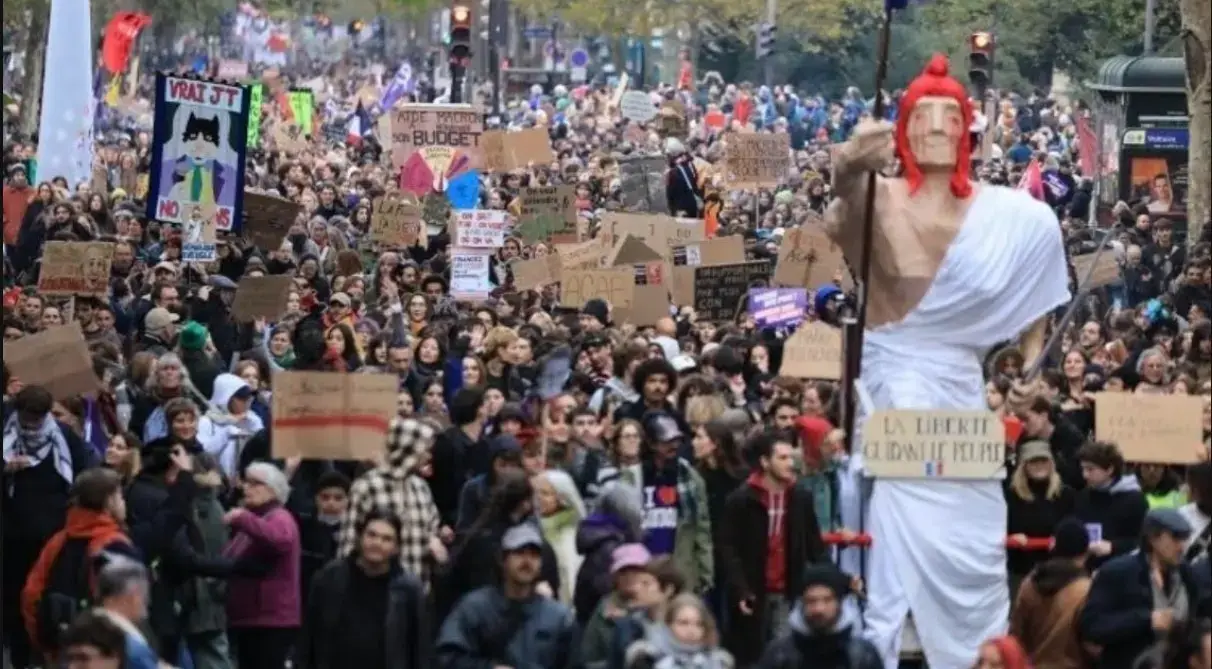
Across the world, the youth are mobilizing to denounce the cost of living, corruption, and cuts in education. This broad youth movement in Europe, Asia and South America reminds us that real power does not reside in the hands of the State nor in big capital but in the hands of the people.
The uprising of young people reveals the extent to which we had come to believe that the State could ‘save the situation ’—and resolve the difficult situation in which we globally live.
Over the last decades we assumed that as the State expanded its reach, things would improve— at least that is what some ideologues and politicians from the left believe and toll us. But in reality, the opposite has occurred: the people have become more submissive as our freedom progressively was limited as our living conditions deteriorated.
In fact, we were living under an enormous false hope:
The State could fulfill our collective aspirations !
Then others came along and told us that what was needed was less State involvement, more privatization, they told us the State should invest in capitalist ventures. In reality, they simply got their hands on taxpayers’ money and generated enormous State deficits.
Ultimately, we have come to understand the schemes of these politicians and understood that their ideologies haven’t resolved the situations.
Young people know what is at stake right now – it’s their future. It is not merely a struggle between the forces of capital nor the State; it is a struggle between the historical anti-humanist (1) and humanist (2) forces – between the mechanical forces of dehumanization and our intention to humanize life and society.
The hundreds of thousands of young people marching in the streets, in cities on various continents want to break free from the condescending treatment they are receiving from the State during their short life. They are asserting their intentions loud and clear to prioritize a vision of a better future. Their vision is carrying a charges and an energy which makes any revolution and change possible.
Today, it has become fairly clear that the State and money serves only a select few, rather than the majority. The only way to reverse the centrifugal forces of the State and the money that are currently at work in the world—and to rein in this grotesque State—is for the people to self-organize and oversee their own affairs through collective solidarity, free from the pervasive paternalism of any single faction.
It is commonly understood that a nation is a legal entity, composed of all the inhabitants of a country and governed by a State. Yet, a nation is defined, first and foremost, by the mutual recognition among individuals who share similar values and aspire toward a common future; in essence, a nation has nothing to do with the State, its institutions, or its laws. Human activities can be managed by the people themselves, without the intervention of the State or the big capital.
A people that is capable of increasing their own genuine power from the street, to the neighborhood, schools and working place—independent of the State or the influence of minority power structures or an ideology—are best positioned to look toward the future. They become the vanguard for the emergence of a new world, a new universalism based on the human being – and not on the State, an ideology, a moral, money or some god.
___________________________________________________________________________
Source (1) : Anti-humanist forces – practical and/or theoretical positions that tend to support a structure of power based on the anti-values of discrimination and violence. Anti-humanist attitude is a personal emplacement or stance in the world, an “objectifying” mode of relationship characterized by the negation of the intentionality and liberty of other human beings.
As people continue to be suffocated by the forces of big capital, the State and various ideologies with incoherent proposals we are seeing the rise of exploiting people’s discontent, focusing it on various scapegoats which is at the root of all such neo-fascism and are a profound negation of human values given by dishonesty and bad faith which these moments have reach an extremes.
(2) Humanist forces: struggle the forms of violence and discrimination that limit human freedom.
The forces of humanism are to be found everywhere across organizations and associations. Humanists are optimists and believe in freedom and social progress, they fix their gaze on the future, while striving to overcome the general crisis of today. Humanists are internationalists, aspiring to a universal human nation. While understanding the world they live in as a single whole, humanists act in their immediate surroundings. They don’t seek a uniform world but a world of multiplicity. Humanists do not want masters, they have no fondness for authority figures or bosses. Nor
do they see themselves as representatives or bosses of anyone else. Humanists want neither a centralized State nor a Para-state in its place. Humanists want neither a police state nor armed gangs as the alternative.