
World · Pressenza · · 47m
The Great Unraveling and the Humanist Leap
English (original) · Read in Deutsch ⇄
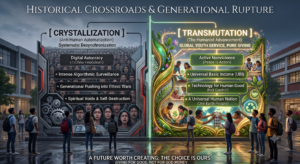
Generations, AI, and the Threshold of a New Epoch
Special In-Depth Analysis: Humanist Historiology, Cliodynamics, and the Technological Acceleration of Civilizational Transition
“History is not the blind unfolding of mechanical forces, nor is it written in external determinisms. History is the drama of human intentionality—the relentless, generational struggle of consciousness to overcome pain, transcend physical limits, and open the future.”
— Inspired by the historiological thought of Mario Rodríguez Cobos (Silo)
Introduction: The Crisis of the Landscape
We all enter an already-constructed physical and social world. In fact, we inherit far more than roads, buildings, and legal statutes. We also inherit an intangible architecture of beliefs, institutional hierarchies, and existential horizons. Mario Rodríguez Cobos, known as Silo, called this the Formative Landscape (paisaje de formación). Specifically, this landscape shapes how a rising generation defines justice, success, and human potential.
Today, however, this formative landscape suffers a profound fracture.
For three generations, a clear social promise anchored middle-class life. Young people earned university degrees, traded skills for financial stability, and built families within secure institutions. Yet, that historic promise has dissolved into gig precarity, algorithmic surveillance, unaffordable housing, and ecological dread.
Simultaneously, generative artificial intelligence directly challenges the supremacy of human intellect. In the past, industrial machines targeted physical toil. Today, however, autonomous cognitive systems transform creative and analytical careers.
Therefore, we must ask an urgent question: Are we witnessing routine economic friction, or does this crisis signal the death of an entire historical configuration?
To understand this transformation, we propose an integrated Tripartite Model. First, we examine Silo’s generational dialectic. Second, we analyze Peter Turchin’s structural-demographic cliodynamics. Third, we measure the technological acceleration of artificial intelligence.
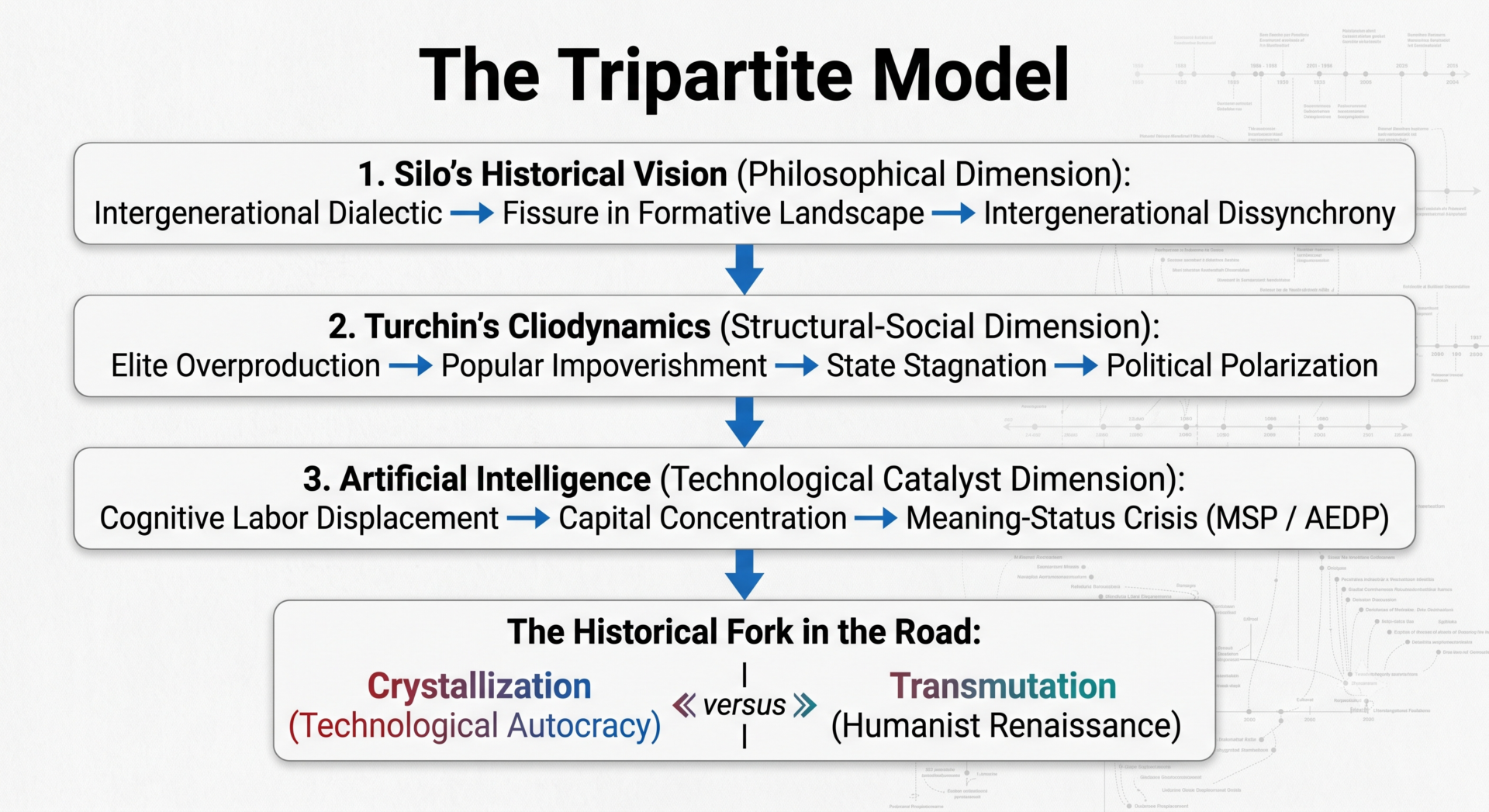
The Tripartite Epochal Transition Model
I. The Dialectic of Generations: When Time Accelerates
In Historiological Discussions, Silo revealed that history moves through generational dialectics rather than smooth linear progress. A generation represents a shared existential situation. In fact, members of a generation share a common formative landscape. In any historical period, three distinct generations share social space:
- The Established Generation: Leaders holding institutional, political, and financial authority. Consequently, these leaders protect aging structures and preserve systemic inertia.
- The Generation in Mediation: Professionals occupying mid-career roles. As a result, they experience growing institutional friction daily.
- The Ascending Generation: Young people entering public and economic life. In fact, youth view entrenched institutions as suffocating obstacles rather than sacred pillars.
Under normal historical pacing, continuous dialogue harmonizes these generational perspectives. When historical velocity accelerates, however, this vital bridge collapses. Thus, a destructive generational desynchronization emerges. Ultimately, the youth withdraw moral belief from the dying paradigm.
II. Cliodynamics: The Measurable Skeleton of Instability
Silo described this psychological shift, while evolutionary anthropologist Peter Turchin explains its structural mechanics. Turchin’s Structural-Demographic Theory (SDT) proves that state breakdowns follow measurable historical pressures. Specifically, four structural forces trigger civilizational crises:
- Popular Immiseration: First, economic stagnation crushes common living standards despite rising headline gross domestic product.
- Elite Overproduction: Second, extreme wealth concentration multiplies credentialed aspirants far beyond available prestige positions.
- Elite Intra-Competition & Polarization: Third, bitter intra-elite competition polarizes public discourse and shatters institutional norms.
- Fiscal Distress and Institutional Paralysis: Finally, severe fiscal debt and bureaucratic corruption paralyze state administration.
Together, these structural pressures destroy systemic resilience. As a consequence, a single shock can trigger widespread contagion.
III. Artificial Intelligence: The Cognitive Shockwave
Artificial intelligence now strikes this volatile social matrix. Historically, mechanization displaced manual labor while expanding administrative employment. Today, AI reverses that historic trajectory by automating cognitive labor.
Recent empirical data from the Stanford AI Index, the International Labour Organization (ILO), and the World Economic Forum (WEF) highlight this disruption:
- The Squeezing of the On-Ramp: Corporate adoption of automated tools has sharply reduced junior hiring across software engineering, legal analysis, and design. Therefore, automated systems eliminate the traditional entry-level ladder.
- The AI Elite Displacement Pressure (AEDP): Furthermore, credentialed graduates proliferate worldwide while high-status cognitive roles shrink.
- Capital & Compute Concentration: At the same time, a tiny corporate oligopoly controls over ninety percent of frontier computing infrastructure. Consequently, capital returns soar while the labor share of income stagnates.
This imbalance breeds intense Meaning and Status Pressure (MSP). Economic hardship hurts, but the loss of human purpose stokes an explosive existential fury.
IV. The Crucible of Criticism: Epistemological and Structural Reality
Nevertheless, an honest research framework must address its sharpest critics. We must candidly examine each core pillar:
1. The Critique of Turchin’s Cliodynamics
First, critics like Yascha Mounk argue that Turchin’s cliodynamics relies on broad generalities that defy scientific falsification. When an analytical model incorporates numerous fluid variables, analysts can adjust weights retroactively to explain any historical outcome. Furthermore, Turchin often treats elites as an undifferentiated mass. In reality, unemployed humanities graduates, entry-level programmers, and venture capitalists possess vastly different degrees of coercive power.
2. The Empirical Reality of AI: Nuance Versus Hyperbole
Similarly, we must avoid technological hyperbole. As the ILO emphasizes, Silicon Valley metrics overestimate job displacement across the developing world. In addition, labor markets experience friction, institutional lag, and task restructuring rather than immediate mass unemployment. Furthermore, status anxiety remains a qualitative reality, so mathematical formulas must not claim false scientific precision.
3. The Methodological Status of Silo’s Model
Finally, we must recognize Silo’s philosophical purpose. Silo did not build an econometric forecasting tool. Instead, he offered an existential phenomenology of human intentionality and nonviolent resistance. His historiology provides an ethical compass when mechanical systems collapse.
V. The Defensible Hypothesis: A Refined Humanist Synthesis
When we combine structural metrics with technological data and empirical critique, a clear hypothesis emerges:
“The rapid diffusion of cognitive automation, converging with existing wage stagnation and institutional decay, accelerates generational desynchronization. This systemic crisis cannot resolve through business-as-usual policies. Instead, it will either harden into technocratic authoritarianism or compel a profound reorganization of society around human-centered values.”
In Silo’s historiology, this displacement leads to two diametrically opposed historical paths:
1. The Path of Crystallization (The Fall into Mechanical Violence)
If established elites preserve an obsolete system at all costs, society undergoes crystallization:
- First, the state hardens into authoritarian technocracy.
- Next, elites deploy AI for mass surveillance, narrative manipulation, and border militarism.
- In addition, leaders distract frustrated youth with digital circuses and nationalist conflicts.
- Ultimately, this path produces spiritual desolation, nihilism, and systemic ruin.
2. The Path of Transmutation (The Humanist Leap)
In contrast, Transmutation demands a bold humanist leap organized by the ascending generation:
- The Central Value of the Human Being: Above all, society must declare the human being as the supreme value. Technology, capital, and legal codes must serve human welfare.
- Active Nonviolence as Methodology: Furthermore, communities must practice active nonviolence across political and social struggles.
- The Liberation of Human Time: In addition, we must socialise automated productivity through an unconditional Universal Basic Dividend. By liberating human time from survival anxiety, society can foster science, philosophy, art, and inner reconciliation.
- The Construction of the Universal Human Nation: Finally, humanity must build a decentralized, multi-cultural global community beyond border chauvinism.
VI. The Call to the New Generation
We are not living through an ordinary economic downturn or a routine election cycle. Instead, we are living through the birth-pangs of an epoch.
The older generation cannot guide us with obsolete blueprints. Their industrial formulas have expired before our eyes.
Therefore, the ascending youth must carry the responsibility of transformation:
- Reject mechanical fatalism: First, resist the cynical belief that algorithms or corporations have pre-written human destiny.
- Refuse reduction to training data: Second, remember that you are creative agents of meaning and solidarity, not biological fuel for neural networks.
- Build solidarity across borders: Finally, prevent factional elites from weaponizing youth frustration into xenophobia or digital tribalism.
The old world will fall because its foundations have decayed. How it changes, however, will not depend on machines. Instead, the awakening of human intentionality, organized through active nonviolence, will humanize the Earth.
Read the full story at the source
Source: Pressenza