
Politics Pressenza
Takaichi’s foreign policy through three dimensions of security
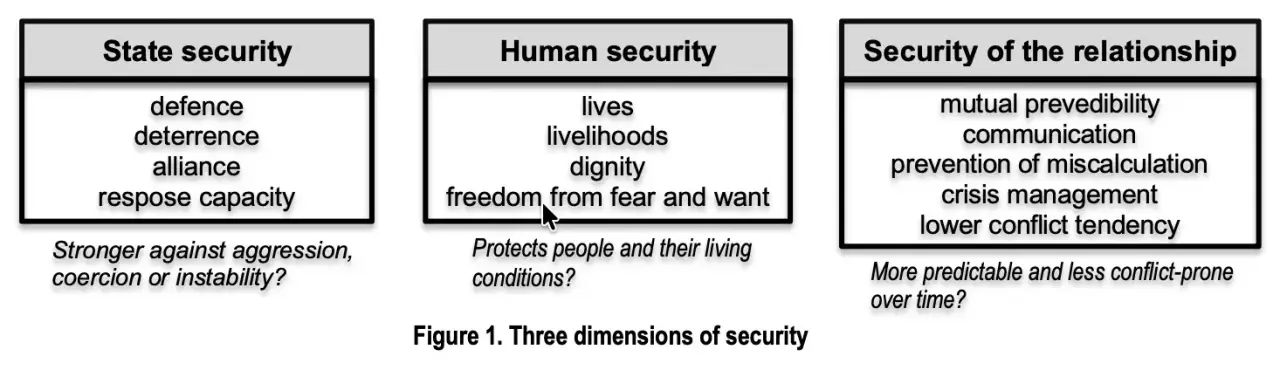
The third article proposed three dimensions: state security, human security and relationship security. The question is whether a policy strengthens the state, protects people and makes relationships m
English (original) ·Read in Deutsch ⇄

The third article proposed three dimensions: state security, human security and relationship security. The question is whether a policy strengthens the state, protects people and makes relationships more predictable and less conflict-prone.
Applied to the Takaichi government, this lens leads to a clear judgment. The other two dimensions exist but remain subordinate: the center of gravity is deterrence, alliances and military capabilities. If they remain weak, even state security may deliver less than expected.
In her policy speech of 5 October, Takaichi reaffirmed that the alliance with the United States is the cornerstone of Japan’s diplomacy and security and that deterrence and response capabilities must be strengthened.[1] The strategy also includes “counterstrike capabilities” that, under certain conditions, allow strikes on targets in an adversary’s territory.[2]*
In April 2026 the government abolished, for finished products, the five-category limit on “transfers of defense equipment” — in plainer terms, exports of arms and other military equipment.[3] On 9 November, Japan made the first defense-equipment transfer under OSA (Official Security Assistance), a security-aid program normally for developing countries: coastal surveillance radars and surveillance drones for the Philippines.[4]
Ignoring growing coercive capabilities would be unrealistic. So would ignoring how the other side reads the response. Defensive measures can appear threatening and provoke countermeasures: the security dilemma.[5] If deterrence, reassurance and prevention do not advance together, deterrence can feed what it is meant to contain.
The three dimensions interact
The three dimensions do not simply add up. If human security and relationship security are fragile, greater military capabilities may be seen mainly as a threat: one side’s deterrence becomes the other’s reason to rearm.
The reverse also holds. Reliable communication, stable ties, mutual knowledge and credible signals of non-aggressive intent reduce the risk of the worst interpretation. Treating the other two dimensions as complements can therefore weaken state security as well.
Signals in the other two dimensions
These elements are not absent. In Hanoi in May 2026, Takaichi presented a vision of a free and open Indo-Pacific based also on autonomy, resilience, diversity and inclusiveness.[6] With South Korea, “shuttle diplomacy” between Takaichi and Lee Jae-myung strengthened personal trust and continuity of dialogue.[7]
With China, a communication mechanism exists between defense authorities, including a hotline.[8] Between 2007 and 2009, ship visits and high-level military contacts resumed.[9] Professional ties, under civilian control, can keep a channel open when politics hardens.
In March 2026 the Foreign Ministry established an International Peace Mediation Unit; on 1 November Takaichi also highlighted Japan’s diplomatic efforts toward de-escalation in the Middle East.[10] Such tools can protect lives, generate trust and strengthen reputational capital, but remain less central than the military component.
The test of the “rule of law”
The International Criminal Court offers another test. At the September summit with Donald Trump, Takaichi reaffirmed Japan’s support without saying she had asked for US sanctions to be lifted.[11] On 9 October the Foreign Minister expressed “deep concern”; the next day Japan joined an eight-country statement expressing “strong disagreement” with the sanctions.[12]
The “rule of law” gains force if it also applies to one’s own camp. The case shows a more explicit position, but also the difficulty of upholding it with equal firmness when it comes into tension with Washington.
A diplomatic asset not to lose
Liberalizing arms exports also carries a less visible cost. The transfer principles recognize that postwar restrictions played “a certain role” in Japan’s path as a peace state.[3] Relaxing them may bring military and industrial benefits, but erode reputational capital useful for mediation, dialogue and ties with countries seeking to avoid alignment.
In 1977 the Diplomatic Bluebook said Japan should not become a major military power and that security and prosperity depended on friendly relations with all countries.[13] In 1981 “comprehensive national security” combined diplomacy, defense, economics and other policies, placing crisis prevention at the center.[14] In 1988 the International Cooperation Initiative combined peace, ODA and cultural exchange.[15]
This was not a policy without alliances or defense: relationships, understanding and cooperation were part of security. Regional expertise and human networks also widened diplomatic options.
Where the scope for evolution lies
The Three Non-Nuclear Principles also deserve attention.[16] Self-restraint can increase predictability; but the “non-introduction” principle is now under discussion in the strategic-document review.
The overall picture, however, remains too concentrated on state security and, within it, military deterrence. Human and relationship security have promising instruments, but not the same strategic weight. As long as they remain complementary, Japan risks becoming stronger without the region or Japan itself becoming proportionately safer.
The issue is not only the balance among instruments. The kind of regional relations Japan wants to help build fifteen or twenty years from now, and the path from that vision to today’s choices, remain underdefined. Without a clear destination, even reasonable measures can accumulate as responses to urgency.
Economic, cultural, parliamentary, administrative, civil-society and defense ties, together with durable legal and institutional foundations and active citizen participation, already offer material for a broader design. The fifth article will ask how to organize them, alongside military resources, into a portfolio aligned with the future Japan wants to build.
*The government says preemptive strikes remain prohibited. Since 1956 it has accepted that, if no other means exist, missile bases may lawfully be struck, while choosing until 2022 not to acquire that capability. The new “counterstrike capability” now makes strikes on adversary territory possible once an attack is judged to have begun, even before damage occurs in Japan. The key dispute is the criterion for judging an attack already “begun”: that judgment bears directly on whether such a strike is regarded as a counterstrike or a preemptive strike.
Main sources
[1] Kantei, policy speech, 5.10.2026.
[2] Ministry of Defense, “counterstrike capabilities”, 2022.
[3] Ministry of Defense, Three Principles on Transfer of Defense Equipment, 21.4.2026.
[4] MOFA, OSA: first defense-equipment transfer, 9.11.2026.
[5] R. Jervis, “Cooperation under the Security Dilemma”, 1978.
[6] Kantei, Foreign Policy Speech, Hanoi, 2.5.2026.
[7] MOFA, Japan–ROK Vice-Ministerial Strategic Dialogue, 2.11.2026.
[8] Ministry of Defense, Japan–China Communication Mechanism.
[9] NIDS, China Security Report 2011.
[10] MOFA, Peace Mediation Unit, 17.3.2026; Manama Dialogue, 1.11.2026.
[11] Kantei, Japan–US summit, 25.9.2026.
[12] MOFA, ICC sanctions and Joint Statement, 9–10.10.2026.
[13] MOFA, Diplomatic Bluebook 1977.
[14] MOFA, Diplomatic Bluebook 1981.
[15] MOFA, Diplomatic Bluebook 1988.
[16] FNN, strategic-document review, 10.11.2026.
Publicly available materials consulted through 10 November 2026.