
World Pressenza
Moscow Summit aims at expanding Russia-Africa economic ties
(Moscow Bureau) Russia has consolidated its economic influence across Africa, with late October Russia-Africa Summit, where a total 146 documents were signed. This re-enforces the 240 agreements in Ju
English (original) ·Read in Deutsch ⇄
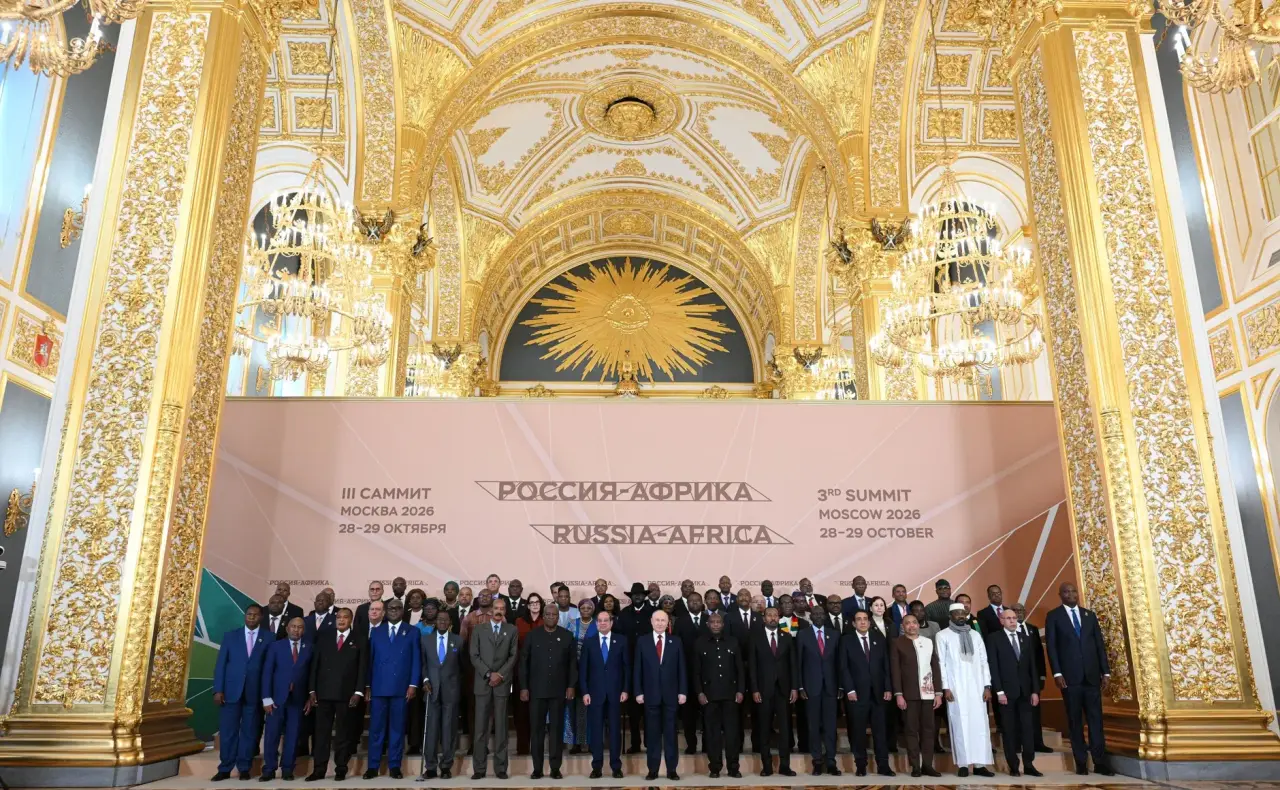
(Moscow Bureau) – Russia has consolidated its economic influence across Africa, with late October Russia-Africa Summit, where a total 146 documents were signed. This re-enforces the 240 agreements in July 2023, and 92 bilateral agreements in 2019. More than 3,500 participants from some 74 countries, including 1,200 business representatives showed up at the Gostiny Dvor venue summit. According to official reports, Moscow welcomed 21 Africa leaders, while bolstering as a reliable geopolitical power. The first-class and highly-successful summit portrays Russia’s economic status, and its capability to broaden investment and influence, and display a risk-readiness in its journey back to Africa.
The implications of the third Russia-Africa summit
Noticeably, African leaders interacted with thousands participants during the two-day Russia-Africa Summit. Most significant aspect was separate bilateral meetings with Russian President Vladimir Putin in the Kremlin. The relationship predates the current competition for influence in Africa. Without doubt, Putin values the friendly relations between Russia and African nations. “Russia and Africa stand together in international affairs,” he underlined, in his statement, at the plenary session.
Russia inherited Soviet-era ties, and committed to sustaining the relationships. African leaders diplomatic talks with Putin covered economic investment, agriculture, industry, nuclear energy, health and trade, education and humanitarian issues, alongside bilateral and multilateral cooperation.
But the economic partnerships extend beyond rhetoric at summits. Geographical facts are unchangeable, Africa’s second-most populous country and consequently offers a substantial market. And of course, there currently exists rivalry and competition. African states are aware that the continent becomes a focus of geopolitical competition. This competition gives African governments room to seek suitable alternatives, in terms of foreign partners for investment, while maintaining broadly diplomatic ties around the world. In fact, regardless of Russia’s friendly relations, majority of African states simultaneously have relations with United States and Europe. Russia has, consistently, condemned for exploitation of natural resources and neo-colonial practices across Africa.
Putin specifically underlined Moscow’s efforts to help African states in “maintaining internal stability and security, and in strengthening their defense and law enforcement capabilities,” adding that Russia has intergovernmental agreements on military and military-technical cooperation with 45 African countries.
Russia’s commercial interests also matter. Russia is in the brisk business of making money through arms and weaponry supplies, exports of grains and fertilisers. These are Russia’s main primary exports to Africa, while Putin plans to support Africa to strengthen their economic sovereignty.
Reports shows that nearly 20 African countries listed for grains and chicken meat. Russia delivered over 18 million metric tons of grain to Africa in 2025, and another 13 million metric tons in the first nine months of this year, with Putin casting the supplies as a “concrete and tangible contribution to ensuring food security across the entire African continent.”
Russian exports are increasing, dominating its promise of ensuring food security and to raise revenue, these include also export of mineral fertilizers that reached approximately 1.5 million metric tons in 2025, and have already exceeded 2.2 million metric tons so far this year.
Putin pointed to Russia’s trade with African countries, which topped $27 billion in 2025, and vowed to expand it to $50 billion, noting further that Russian companies have pursued major investment projects in Africa in such spheres as energy, mining, industrial cooperation and logistics. “Our business community approaches cooperation with African partners with honesty, respect, and integrity, conducting business on an equal footing,” Putin said.
“Rather than siphoning off profits in the manner of the colonial practices by former imperial powers, they reinvest their earnings into the development of your national economies, they readily share advanced technologies and expertise, broadly engage local subcontractors, and help create new production facilities and jobs,” he said.
“Russia and Africa are united by truly strong bonds of friendship and close partnership. We are natural allies in building a multipolar, genuinely democratic world order, free from diktat and double standards and based on respect for the norms of international law and the fundamental principles of the United Nations Charter,” Putin told the African leaders.
He mentioned Moscow’s support for the African nations’ anti-colonial fight during Soviet times. “Russia has always been and remains committed to seeing African nations defend their sovereignty, achieve steady growth, and strengthen their economies and social sectors,” the Russian leader said. “We stand ready to continue working together with you across all these areas to achieve these goals.”
On the sidelines: Putin with African leaders
On the sideline of Russia-Africa summit, the extensive bilateral talks by Russian President Vladimir Putin in the Kremlin with African leaders, include Algeria, Burundi, CAR, Egypt, Equatorial Guinea, Ethiopia, Eritrea, Ghana, Kenya, Madagascar, Mali, Mozambique, Namibia, Republic of Congo, South Africa, Sudan and Togo.
Egyptian President Abdel Fattah el-Sisi presented his country’s cooperation with Russia, including the El-Dabaa nuclear plant construction, and the planned Suez Canal industrial zone, as a model for wider partnership. The flagship project – the construction of the El Dabaa Nuclear Power Plant in Egypt – is proceeding on schedule, at the cost of US$28 billion (loan) provided by a Russian bank. Trade between Russia and Africa is growing. Since 2022, its total volume has increased by 50 percent and now exceeded $27 billion, with Egypt accounting for a significant share of this total, despite regional tensions in the North Africa and the Mediterranean. In the first six months of this year, more than 1.2 million of Russian tourists visited Egypt, with the total for the whole of 2025 reaching approximately 1.5 million.
An agreement on financing economic projects and a working document with Burkina Faso, Mali and Niger was signed. As Russia competes with the United States, Europe and China for greater influence across Africa, it also has relied on its military contractors to strengthen its sway on many fronts, from the economy to security and politics. Putin with Interim President of the Republic of Mali, Assimi Goita, underlined to continue as previously, within the framework of several bilateral agreements. Goita expressed gratitude, and for Sahel partners – Burkina Faso and Niger, adding concretely that Moscow’s hospitality serves as a testament to the high level of friendship that exists and continues to develop between Mali and Russia.
On Russian-Ghanaian relations, President John Dramani Mahama, has acknowledged, with satisfaction, the intensification of contacts at various levels: the political consultation mechanism is functioning, and dialogue between our parliaments and political parties is developing. Ghana ranks twelfth among all African countries in terms of trade with Russia. Yet trade is among the largest in sub-Saharan Africa. Furthermore, Mahama commended Russia’s solidarity with Africa during the period of decolonisation. Russia was by Africa’s side in the fight against apartheid. Russia was a solid supporter in getting Africa out of apartheid.
As early as 1958, Russia recognised Ghana and established diplomatic relations. In 1961, first president, Dr Kwame Nkrumah, visited Russia and met with Nikita Khrushchev. It was a historic visit, the first pan-African leader, and since then the entire relations have grown from strength to strength. Mahama stressed: “We believe that the time has come for us to move from just political cooperation to economic cooperation, and the environment is right for mutual investments between Russia and Ghana. We are going to hold the permanent joint commission for cooperation meeting next year, in 2027, and we are hoping that it will provide us with a proper framework for our cooperation going forward.”
Putin’s meeting, in the Kremlin, with President of the State of Eritrea, Isaias Afwerki, on the sidelines, offered an opportunity to discuss bilateral relations. Similar to many African states, Russian-Eritrean relations are progressing. It has generally the potential in such sectors as energy, mining, infrastructure, agriculture, and fisheries.
In remarks, President Afwerki told Putin that the capability of African economies and African governments to make their contributions is, indeed, limited. His perception about the situation in Africa is very dire. That Russia could be stronger to make its contribution to any partnership with Africa. His suggestion was to come up with a set of rules that will have to be put on the ground for every nation on the African continent, to start implementing programmes in a number of sectors. Today, the relations with Eritea and Ethiopia, Russia sells military weapons and equipment to both, and step by step earning revenue.
There are significant, yet largely untapped, opportunities for expanding trade and economic ties, including in energy, geological exploration, transport and logistics in Central African Republic (CAR). The Intergovernmental Commission on Trade, Economic, Scientific and Technical Cooperation was held in Bangui and marked a decisive step towards deepening partnership.
Russia and CAR have both been operating since 2017, in a barter system agreement, Russia exploiting natural resources in exchange for providing security in the country. President of the Central African Republic, Faustin-Archange Touadéra, has personal Russian security guards and at the presidential office. The road CAR has travelled began under difficult circumstances. In 2017, the Central African Republic was in the grip of a severe crisis.
The Association of Graduates of Soviet and Russian Universities has been established in capital of CAR, and a Russian House cultural centre and a Centre for Open Education in Russian are now operating there, in the cultural and education sphere. For the 2026–2027 academic year, Moscow has considerably increased the state scholarship quota for students, and further providing military training for CAR’s armed forces.
President of the Republic of South Sudan, Salva Kiir, attended the first summit in Sochi in 2019, and the second in July 2023. In his most substantive talks, asked for Russia’s support in stabilising the situation in the Eastern region of Africa. Currently Russia plans to open an embassy in Juba – a step that will undoubtedly benefit interstate ties. Together, then to continue exploring ways to strengthen bilateral trade and economic engagement.
Bilateral cooperation is friendly and constructive and, despite the difficulties Sudan has faced, relations continue to strengthen, including in the trade and economic sphere. The volume of Russian–Sudanese trade more than doubled last year. In January–August 2026, it grew by a further 25 percent, which is a very positive trend. Sudan is one of Russia’s top ten trading partners in Africa. Despite this, Russia is closely monitoring the situation in Sudan, where an armed conflict has been ongoing for over three years. Sudanese people find themselves in a highly difficult situation. According to an authentic data, the number of refugees and internally displaced persons has now exceeded 13 million. The country’s economy and infrastructure have suffered significant damages. Moscow has agreed to discuss, a bit later, these sensitive issues one-on-one and exchange views on what else Russia can do to help normalise the situation in Sudan, as well as on other pressing matters.
Reports from the discussion suggested that Kremlin could establish a free economic zone in the Red Sea, where it could set up storage facilities for fuel and wheat. There is considerable demand for wheat and fuel in Sudan and across the African continent as a whole. Sudan also has a railway line, and there are plans to extend it from Port Sudan towards Chad. This route could form the basis of a logistics network, and Russia could participate in its development. Thus, in the territory multiple opportunities, including investment in infrastructure and to cooperate with Russia in this area. There are also significant opportunities and potential for cooperation in the mineral resources sector, including deposits of copper, gold and other metals.
Kenyan William Samoei Ruto has examined and reviewed several issues, relating to signed five memoranda of understanding – five instruments – between two countries. One of them is on economic cooperation, and that provides an opportunity for economic cooperation between Kenya and Russia. He also referred to a national infrastructure fund that provides opportunities for investment both by the public and the private sector in some of our key infrastructure projects: the airport, the Port of Mombasa, road infrastructure, rail infrastructure.
Zimbabwe President Emmerson Mnangagwa highlighted the need to turn agreements into action while processing more minerals domestically. Russia and Zimbabwe are interested in collaborating on small modular reactors and floating nuclear power plants, and in deepening our partnership in specialised industrial sectors, such as the extraction of uranium and rare metals. President made a clear distinction. “Diversifying partnerships is not about choosing sides: it is about strengthening freedom of decision-making in the service of the populations,” he said.
Russia and Madagascar looked across a broad range of issues. The potential for bilateral trade and economic cooperation is, of course, far from exhausted. Trade turnover remains rather modest in absolute terms, but it is gaining momentum, and the trends are positive. Nearly 5,000 students have already received an education in Russia. In April, the University of Antananarivo signed a cooperation agreement with St. Petersburg State University, and in June, a memorandum of understanding was signed between MGIMO University and the Ministry of Foreign Affairs of Madagascar.
The Russian Orthodox Church was granted legal entity status in Madagascar. There are more than 1,500 Russian Orthodox parishioners on the island. Madagascar Michael Randrianirina, noted in comments, the prospects for further strengthening the friendly relations between Madagascar and the Russian Federation, and set the stage to mark a new stage in the development of economic cooperation.
First President of the Council of Ministers of the Togolese Republic, Faure Gnassingbé, asked for more Russia’s investment. Togo’s leadership devotes to enhancing cooperation with Russia. In August, the Russian Embassy in Lomé resumed its operations, and preparations are now underway to open a Togolese Embassy in Moscow. According the intergovernmental commission’s report, bilateral trade reached US$852 million in 2025. Both Putin and Gnassingbé agreed on forging mutually beneficial cooperation across a range of areas, such as energy, transport and logistics, geological exploration, and agriculture.
As the Chairperson of the African Union (AU), Burundi Evariste Ndayishimiye was the closest with Putin. Besides, discussing aspirations for the African Union to become a full member of the G20, other questions were outlined relating to the continental development, ethnic conflicts in the continent and how Russia could support in ensuring peace and stability. In this, Russia supports the Africa’s bid to become a full member of the UN Security Council, while Ndayishimiye throttled for Russian economic cooperation with the continent. Specially for Burundi, Ndayishimiye called for building a mutually beneficial partnership, create value chains and concrete projects – socioeconomic projects in particular.
Putin and African leaders toured the “Platform for Sovereign Development” exhibition, showcasing energy, healthcare, agriculture, and digital technologies. Here too, it was indicated to promote long-term infrastructure financing and initiatives on modern technology across Africa. The exhibition shows both political and entrepreneurship are gaining practical substance in the current relations.
Wrapping up the summit, Putin emphasized the potential for multifaceted cooperation, while Ndayishimiye pressed for mutual benefits, with the statement that “Africa has not come to ask for aid”, and this explicitly indicated investing in partnership for Africa’s economic growth rather than pursuing largely geopolitics in the continent. In the end, Russia and Africa have adopted a comprehensive declaration, and a plan for action document 2026 -2029.
Originally published byPressenza
Read the original
Want more of this in your Google feed?Add Faultline as a preferred source — it'll show up more often in Top Stories.
Add as preferred source