
World · Pressenza · · 3h
Learning Continuity in Pugo, Baculongan Norte, Buguias, Benguet: Sustaining Education Amid Monsoon-Related Disruptions
English (original) · Read in Deutsch ⇄
By: Jocelyn S. Pilas
Education is a fundamental right and an essential component of individual and community development. However, maintaining education continuity becomes particularly challenging in communities frequently affected by natural hazards and extreme weather conditions. In mountainous areas, where geographical conditions already present barriers to accessibility, prolonged rainfall can further disrupt the delivery of educational services.
In Pugo, Baculongan Norte, Buguias, Benguet, the southwest monsoon, locally known as Habagat, is a recurring environmental condition that significantly affects the school and its surrounding community. Heavy and prolonged rainfall may result in landslides, blocked roads and pathways, reduced visibility due to thick fog, power interruptions, and unstable communication services. These conditions prevent learners from safely reaching school and limit teachers’ ability to conduct regular face-to-face instruction.
The situation becomes more challenging when unfavorable weather conditions persist for an extended period, for weeks. Classroom facilities may be affected by leaking roofs and water intrusion. Learning materials, the printers and TVs may be exposed to moisture. Weak internet connectivity and power interruptions make technology-dependent learning difficult.
Despite these challenges, the school community continues to develop practical ways to sustain learning. Teachers adjust instructional strategies, learners continue accomplishing school activities at home, parents provide support, and community members participate in recovery and school maintenance activities. These experiences demonstrate that learning continuity is a shared responsibility that requires flexibility, preparedness, and collaboration among the school, home, and community.
The Mountain Environment and Its Challenges to Education
Pugo is situated in a mountainous environment where roads and pathways are particularly vulnerable to the effects of prolonged rainfall. During the southwest monsoon, heavy rains may trigger landslides and make pathways difficult or unsafe to pass. In some instances, learners may become isolated in their respective sitios because of blocked roads and pathways.
Thick fog is another challenge. Visibility along roads and pathways can become significantly reduced, making travel more difficult and potentially hazardous. Fog is usually accompanied by chilly and moist air. Moisture contributes to the growth of mosses, ferns, and other vegetation commonly found in damp mountain environments. The combination of low temperature, rain, and poor visibility creates additional difficulties for learners and school personnel.
Strong winds may also make using umbrellas impractical. During particularly cold periods, temperatures may become very low, adding another challenge for learners who need to travel outdoors.
These environmental conditions demonstrate that access to education is influenced not only by the availability of teachers and learning materials but also by the physical environment in which learners live.
Effects on School Operations and Learning
Weather-related disruptions affect the physical learning environment and the delivery of instruction. Persistent rainfall may cause roofs to leak and classrooms to experience water intrusion or flooding. Such conditions can limit the availability of safe and comfortable learning spaces.
Learning resources are also vulnerable. Textbooks, printed materials, furniture, and ICT equipment may be damaged by water and moisture. Power interruptions prevent the use of electronic devices, while weak or unavailable internet connectivity limits communication.
For learners and teachers, the most immediate concern is often accessibility. Landslides and blocked pathways can prevent them from safely traveling to school. When these conditions persist, face-to-face classes may be suspended for several days or even longer.

Teachers need to walk from their sitio and report to school. The writer has to walk for almost 2.5 to 3 hours to school when vehicles cannot traverse.
Repeated interruptions can also make it difficult for learners to maintain their usual study routines. While the effects vary from learner to learner, prolonged disruptions may contribute to difficulties in maintaining motivation, concentration, and engagement with school activities.
These realities underscore the need for learning continuity strategies that are responsive to the actual conditions of geographically isolated and environmentally vulnerable communities.
Teachers’ Adaptation and Commitment
School personnel in Pugo demonstrate adaptability when regular classroom instruction is disrupted. When classes are suspended, teachers modify lesson plans and activities to accommodate modular or other alternative learning arrangements.
Printed modules and self-paced activities allow learners to continue studying even when they cannot physically attend class. Teachers may also extend submission deadlines when road closures and other weather-related conditions prevent learners from completing their requirements on time.
Learning continuity involves more than academic requirements. Wellness check-ins and encouraging messages provide opportunities to monitor learners’ general well-being and maintain their connection with the school.

CTTO-Jamica.
Communication, however, becomes difficult during power outages and periods when internet or mobile signals are unavailable. Teachers then conduct home visits to reach learners and their families, despite the thick fog. These visits provide opportunities to check on learners, communicate important information, and determine how they can continue their studies under the prevailing conditions.
Such practices illustrate the importance of teacher flexibility in responding to disruptions. Rather than relying on a single mode of instruction, teachers adapt their approaches to what is feasible and safe for learners.

CTTO-Jamica.
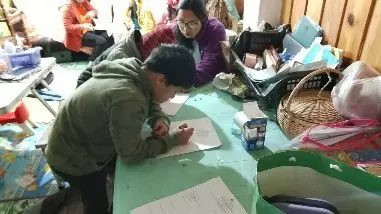
CTTO-Martin. School personnel providing learning assistance through a home visit during a weather-related disruption. August 2025.
Learners’ Resilience and Participation
Students are active participants in learning continuity. Many continue to accomplish their schoolwork at home.

CTTO-Eloisa. A learner accomplishing schoolwork at home during a period of disrupted face-to-face instruction.
Some learners study during power interruptions using candles or other available light sources. Others create temporary study areas at home. In some households, learners also need to balance their school responsibilities with household chores and other family responsibilities.
These experiences demonstrate learner perseverance and commitment to education. But learner resilience should not mean that learners are expected to endure difficult conditions without adequate support. Their ability to continue learning is strengthened when teachers provide appropriate materials and flexibility and when parents and other household members provide encouragement and assistance.
Learning continuity is therefore most effective when learners are treated not simply as recipients of learning materials but as active partners in the educational process.
Community Support and the Spirit of Bayanihan
The community is another important element of learning continuity in Pugo. Parents and community members provide support to learners at home, when face-to-face classes are suspended.
When weather conditions improve, community members also participate in cleaning and restoring the school environment. With the bayanihan spirit, they help clear roads and pathways leading to the school, sweep leaves and debris, repair damaged gutters, return scattered facilities to their proper places, and clean floors, tables, and chairs.
These activities help restore the school environment and prepare it for the resumption of regular learning activities.
The strong relationship between the school and the community demonstrates that education is a shared responsibility. During emergencies, the collective efforts of teachers, parents, barangay officials, and community members can help reduce the effects of disruptions and facilitate recovery.
Learning Continuity Through Practical and Low-Technology Approaches
In a community where electricity and internet connectivity may be unreliable, printed learning modules remain an important strategy for sustaining education. Teachers can distribute learning materials before or during anticipated periods of class suspension, so students can continue studying independently at home.
Consequently, low-technology approaches remain important. Printed modules, teacher-guided activities, home-based learning, and direct communication with families provide dependable alternatives.
Psychosocial Support and Learner Well-being
Prolonged disruption of regular schooling may affect learners beyond their academic responsibilities. Changes in daily routines, limited interaction with classmates, uncertainty about when classes will resume, and difficulties in completing schoolwork may influence learners’ emotional well-being.
Teachers can help address these concerns by maintaining communication with learners, providing encouragement, conducting wellness check-ins, understanding learners who have difficulty completing requirements during emergencies.
Simple actions such as asking about a learner’s situation or visiting the learner at home can help maintain the connection between the learner and the school.
This aspect of learning continuity is important because education during emergencies should address the whole learner. Academic progress and emotional well-being are interconnected, specially when disruptions continue for an extended period.
Experiences During the 2025 Typhoon
Challenges experienced during severe weather events are not new to the community. During the December 2025 typhoon, the school and its surrounding community experienced disruptions that required coordinated recovery efforts.
The experiences provide important lessons for future preparedness. Severe weather can affect not only classroom instruction but also transportation, communication, school facilities, learning materials, and the overall routine of learners and teachers.
Recovery requires cooperation among school personnel, parents, community members, and local authorities. The experience also emphasizes the importance of preparing learning continuity measures before emergencies occur, not just relying solely on responses after the disruption.
Continuing Challenges and the Need for Systemic Solutions
Although the school community has developed various strategies for maintaining learning continuity, significant challenges remain.
Extended periods of southwest monsoon conditions can result in prolonged difficulty accessing school. Landslides may block mountain roads and pathways, while heavy rainfall may damage school facilities. Power interruptions and weak internet connectivity continue to limit communication and the use of digital learning resources.
Infrastructure is another concern. Roof leaks, classroom flooding, damaged gutters, and moisture exposure can affect the safety and functionality of learning spaces. Educational resources and ICT equipment also require appropriate protection from water and moisture.
Community resilience should be supported by systemic interventions. Teachers and learners can adapt to disruptions, but they cannot independently address infrastructure limitations, road accessibility, unreliable electricity, or weak telecommunications systems.
Long-term solutions may include improving school roofing and drainage systems, strengthening roads and pathways, protecting learning resources and ICT equipment, improving communication systems, and ensuring the availability of emergency learning materials.
Strengthening Climate-Responsive Learning Continuity
The experience of Pugo highlights the importance of integrating disaster preparedness and climate responsiveness into school planning. Learning continuity should not only be treated as an emergency response but as an integral part of educational planning in communities that regularly experience environmental hazards.
Schools can prepare emergency learning kits containing printed modules and other essential materials. Teachers can develop flexible learning activities that learners can complete independently when face-to-face instruction is suspended.
Regular disaster preparedness activities and coordination with parents, barangay officials, and local government units can also strengthen the school’s capacity to respond to emergencies.
Most importantly, learning continuity plans should be based on the community’s actual conditions. In mountainous areas such as Pugo, plans should consider road accessibility, landslide risks, weather conditions, electricity, internet connectivity, household circumstances, and the availability of learning resources.
About the Author:
 The author is a native of Buguias, Benguet, and currently serves as a school head, a role she has dedicatedly held for nearly two years at her current station. Driven by the conviction that continuous learning is essential to dynamic and responsive leadership, she is currently pursuing her doctoral degree. Beyond her professional achievements, she is a proud mother of four.
Read the full story at the source
Source: Pressenza