
Germany Perspektive Online
Left Literature Fair 2026: Debates inside, protests outside
At the 31st Left Literature Fair in Nuremberg, publishers and visitors discussed the current political situation and left-wing strategies. At the same time, thousands of young people protested at “Gen Z r
Deutsch (original) ·Auto-translated to English
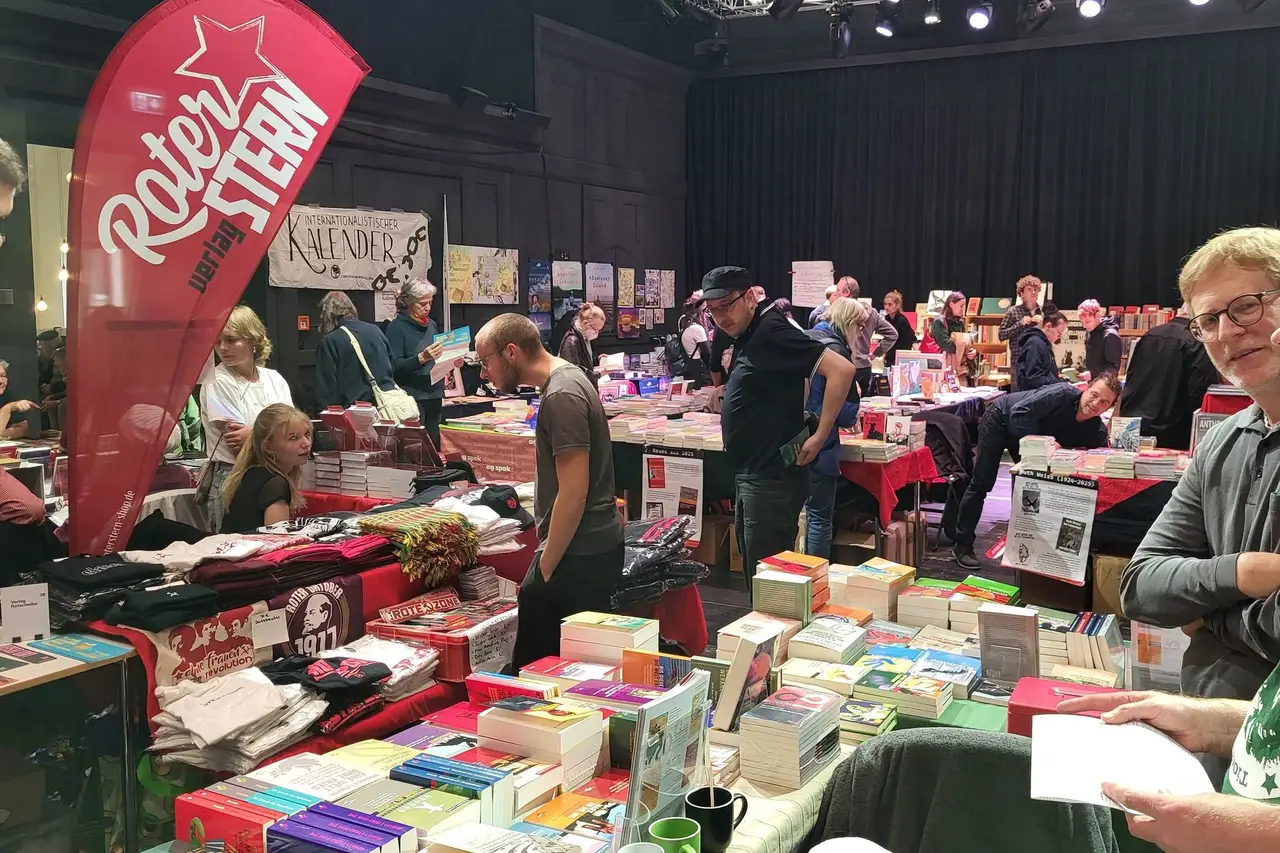
At the 31st Left Literature Fair in Nuremberg, publishers and visitors discussed the current political situation and left-wing strategies. At the same time, thousands of young people protested on the streets in “Gen Z regulates”. Both events were characterized by rearmament and austerity policies.
The 31st Left Literature Fair took place in the Nuremberg Künstlerhaus from October 30th to November 1st, 2026. Over 60 left-wing publishers presented their program, and more than 65 book presentations and readings were on the agenda. Around 2,000 visitors came to the events and stands over the weekend. The fair remained true to its character as a cross-current meeting point for the left-wing movement.
The Left Literature Fair sees itself as a sales fair, event location and political meeting place at the same time. For over two decades, the Metroproletan Archive and the Libresso Literary and Cultural Association have been organizing the event on a voluntary basis, without state or city funding. The spectrum of participants ranges from the Left Party to trade unionists to autonomous and openly revolutionary groups. Admission is traditionally free.
Preparation for war and social clear-cutting as determining themes
In terms of content, the connection between rearmament and social cuts ran like a common thread through the weekend. The opening event on Friday evening made this clear: under the title “Social clear-cutting, preparation for war, shift to the right and reactionary state restructuring – what to do?” Options for action beyond mere protest were discussed. The question of the means – vote, boycott, block, strike – was at the center of the debate.
Martin Schirdewan, who also spoke in favor of the coalition negotiations in Berlin, spoke for the Left Party. He called for understanding why one has to accept major cuts in coalition negotiations so that one can even talk about left-wing positions at government level. Even so, left-wing politics are not guaranteed, which is why, in his opinion, a strong left-wing party is needed.
Frank Kugler from Organized Autonomy presented the boycott method using the example of the AEG boycott that accompanied the Nuremberg AEG strike. It was about experiences and insights from the connection between strikes and boycotts as well as the question of how pressure can be built up through such forms of action. Dominik Dogu from the Interventionist Left used “Disarming Rheinmetall” and “Resisting” to address the blockade as a form of action for nationwide mobilizations. Duygu Kaya, former Gorillas rider and co-organizer of the strike there, spoke about her experiences with labor disputes as well as the means of political strikes and general strikes.
Antimilitarism, history and international solidarity
In addition, the political spectrum of the trade fair was reflected in a number of other program items. On Saturday, Unrast Verlag presented the anthology "Refuse Yourself! Antimilitarist Perspectives on the Warlike Present" with activists from the Interventionist Left Frankfurt. Jörg Kronauer presented his book “The Arsonlayers – The Advance of the Transatlantic Right”. Further events deepened historical perspectives from Germany. The Ostwind Verlag event “Rediscovering Rosa Luxemburg” was dedicated to the reappropriation of the revolutionary theorist and her analyzes of capitalism, war and social cuts.
Also the book presentation “History of the communist and workers’ movement in Germany 1800–1956” byRed Star Publishingoffered historical access to the struggles of the working class and its forms of organization - from the beginnings of the workers' movement through the Weimar Republic to the dismantling of its structures. It was always emphasized that examining the history of the movement was not an end in itself. We have to learn from it for today.
A special feature was the Cuba solidarity campaign on Sunday: an auction of Cuban caricatures took place in the Künstlerhaus, the proceeds of which went to a solidarity project for solar systems in Cuba. The 31st Literature Fair thus combined the confrontation with war and social cuts in one's own country with international solidarity.
The 30th edition last year, as an anniversary event, attracted significantly more visitors. But the trade fair was also well attended in 2026 - the rooms in the Künstlerhaus were filled on all three days, and individual lectures such as the opening discussion met with keen interest. Nevertheless, the crowds remained behind those of the previous year.
Gen Z protests march past the fair
A special feature arose on Saturday due to the Gen Z protests taking place in Nuremberg at the same time. The nationwide mobilization of the “Gen Z regulates” initiative also brought 7,000 people onto the streets in Nuremberg. The protest march also led past the Künstlerhaus in the city center, where the literature fair was taking place.
From the balcony of the trade fair and from the entrance, trade fair goers waved to the young people passing by, many visibly showing solidarity with the protesters. The young people, in turn, were out and about on both levels this weekend: in the rooms of the trade fair with theory and book presentations, on the street with practical protests against rising living costs, rearmament and for social justice.
The postLeft Literature Fair 2026: Debates inside, protests outsideappeared firstperspective.