
Labour Perspektive Online
IG Metall decides to hold 24-hour warning strikes in the metal and electrical industries for the first time in eight years
For the first time since 2018, IG Metall wants to hold all-day warning strikes again. After the negotiations so far have not brought an agreement, all-day warning strikes are to be carried out to meet the demands of A
Deutsch (original) ·Auto-translated to English
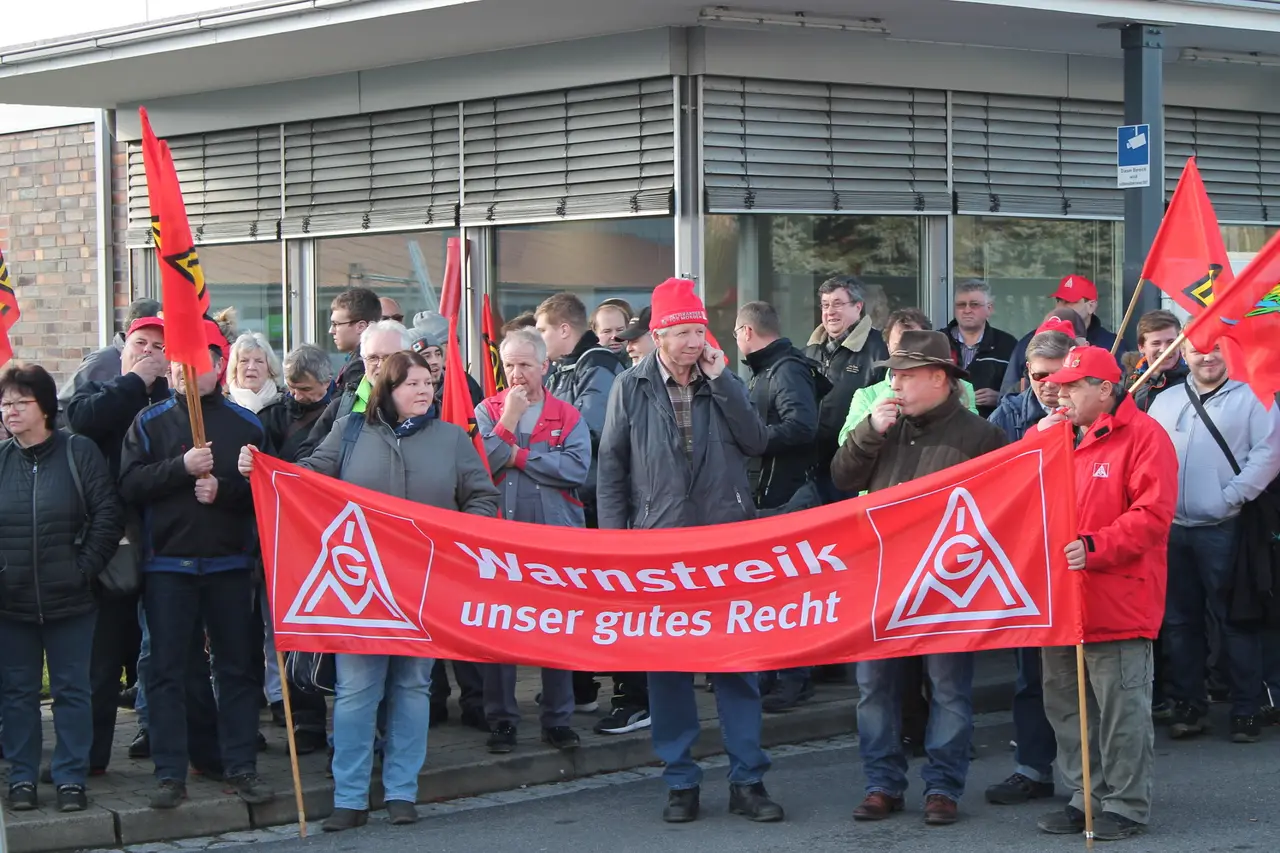
For the first time since 2018, IG Metall wants to hold all-day warning strikes again. After the negotiations so far have failed to bring about an agreement, all-day warning strikes are intended to emphasize the demands of the workers. While the union is demanding five percent more wages, the companies are sticking to an offer that would mean significant real wage losses for workers.
The board of IG Metall has paved the way forall-day warning strikesin the metal and electrical industries. The union is thus preparing the next phase of the collective bargaining dispute. In a three-digit number of companies, employees would be able to stop work for 24 hours in the future.
All IG Metall districts had previously requested 24-hour warning strikes. These are considered the last escalation stage before a strike vote and a possible indefinite strike. It is not yet clear which companies should be struck. The union board wants to select a three-digit number of companies. A simple majority of the respective workforce must then vote in favor of the strikes.
It is the first time since 2018 that IG Metall has resorted to this measure. At that time, around 500,000 employees in 250 companies took part in all-day warning strikes.
Metal and electrical: First round of collective bargaining begins
Offer from the other side means loss of real wages
The collective wage agreements in the metal and electrical industries expired on October 31, 2026. Warning strikes have been possible since November 1st. In the current tariff rounddemandsIG Metall pays five percent more for a term of twelve months. In addition, the union advocates for workers to have a greater participation in the profits of economically well-positioned companies and for securing jobs and locations.
TheOfferthe opposite side is significantly lower. A one-off payment of one percent of the collectively agreed annual gross salary is planned in July 2027 and a salary increase of 1.3 percent from July 2028. The one-off payment can also be revoked for economically weaker companies. With a term of 26 months, the offer would mean a significant loss in real wages given the expected inflation.
The employers' associations justify their position with the difficult economic situation in the metal and electrical industries. The union counters that the order situation has improved in numerous companies. According to surveys among works councils, around 62 percent of companies have a good to very good order situation.
Especially in the auto industry: attacks on wages, working hours and jobs
The collective bargaining round is taking place at a time when several large industrial groups - particularly from the auto industry - are questioning existing collective bargaining standards and are planning cuts in wages, working hours and jobs.
MercedesIn the run-up to the collective bargaining round, for example, had called for an increase in weekly working hours from 35 to 38 hours without corresponding wage compensation. Special payments such as Christmas and holiday bonuses were also discussed. Around33,000 workersprotested against it.
Volkswagen goes even further: According to the works council and IG Metall, the group has its human resources managers worldwideZero roundscommitted until 2030. Around 660,000 employees could have to survive without pay increases for years. At the same time, VW plans to cut 100,000 jobs worldwide. In Germany, several locations are facing an uncertain future.
Salary freeze until 2030: VW is putting employees under pressure before collective bargaining
The planned cuts are also in the context of high profit distributions. Volkswagen paid out around 2.6 billion euros to its shareholders in June. Against this background, the claim that there is no money for higher wages at least needs to be explained.
The first chairwoman of IG Metall, ChristianeBenner, says: "The employers want to turn this round of collective bargaining into a fundamental dispute: It is no longer just about money and jobs; but about the question of whether collective bargaining standards, co-determination and reliable rules will continue to apply in the future."
All-day strikes as the next step
The previous warning strikes have already mobilized hundreds of thousands of employees. According to IG Metall, around 464,000 workers took part in the first wave of hourly work stoppages. But after three rounds of negotiations, there is still no agreement in sight. A fourth round of negotiations has not yet been agreed upon.
The employers' associations criticize the announced all-day strikes as disproportionate and warn of economic damage to the industry. In doing so, they are trying to increase the pressure on the union and shift the responsibility for a further escalation of the conflict onto the workers.
For them, however, it is not just about a short-term wage increase. In view of the rising cost of living, the threat of real wage losses, job cuts and attacks on existing collective bargaining standards, the question also arises as to who should bear the costs of the crisis.
With the decision to hold all-day warning strikes, IG Metall is now increasing the pressure. It will become clear in the coming weeks whether this will persuade employers to make a better offer. One thing is clear: the coming weeks will show whether the all-day warning strikes can persuade employers to offer improved services.
The postIG Metall decides to hold 24-hour warning strikes in the metal and electrical industries for the first time in eight yearsappeared firstperspective.