
World · Novara Media · · 60m
Goldsmiths University Hires ‘Fake Teachers’ for Arts Psychotherapy to Break Strikes
English (original) · Read in Deutsch ⇄
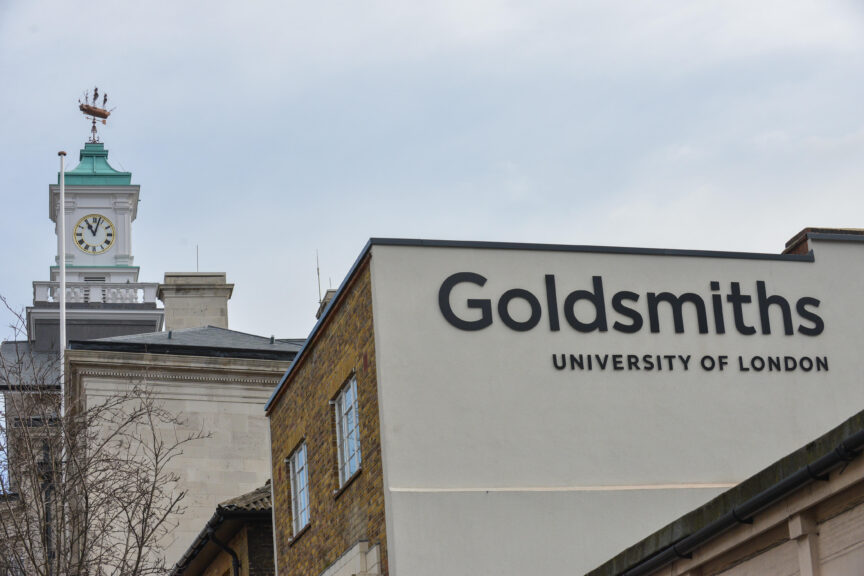
Art psychotherapy students are among the many new starters at Goldsmiths facing utter chaos at the start of the academic year, as their course appears to be virtually on the brink of collapse. For some, what should be an exciting new chapter has become a disappointing nightmare.
Goldsmiths is well known for alumni such as artist Damien Hirst, writer Mark Fisher, anthropologist David Graeber and Blur frontman Damon Albarn. But it has also become known as a particularly dismal example of the crisis facing universities. Lecturers are currently striking against the third massive round of redundancies in five years. With lecturers taking industrial action, Goldsmiths has resorted to hiring inexperienced substitutes in chaotic circumstances to break the strike.
One Art Psychotherapy student who did not give her name for fear of repercussions told Novara Media she turned up to her induction on 28 September to teachers who had been hired as recently as that very morning.
“I moved all the way to London for this, I’ve left everything behind,” she said. “I want to help people. I want to help people with eating disorders, I want to help veterans with PTSD. That’s what I want to read about, that’s what I want to learn about. I did not come to Goldsmiths to learn how to become an activist, and now my time is full of writing letters and attending protests and demonstrations.”
Des Freedman, professor of Media and Communication Studies at the university, said: “Some students are being offered modules that are not their core modules, some students are being taught by people who they weren’t expecting to teach, and in some cases, the university is hiring in replacement staff in lieu of striking staff.”
Concerns over the suitability of the temporary teachers on the Art Psychotherapy course have not been soothed by a recent job listing on the British Association of Art Therapists (BAAT) website for a temporary lecturer seen by Novara Media, which merely requires the candidates to have “an interest in teaching”. A previous job listing for a permanent role requires the candidate to have “experience of working within UK higher education and a track record of research or scholarship in art psychotherapy”.
Psychotherapy courses are intense, requiring students to be in psychotherapy themselves and be put on placements with severely mentally unwell people – making the unavailability of trusted teachers feel especially hard to deal with.
Kawther Luau, a second year Arts Psychotherapy student, said: “You kind of enter very deep, vulnerable processes with yourself and each other and with the tutors. For that safety and trust for that to be disturbed – for temporary staff to be brought in – is obscene and communicates a real lack of understanding of what our training requires.”
The first-year student who chose not to give her name said the temporary teachers had made matters worse, not better. “I completely stand with the strikes,” she said. “I feel like they [the strikes] could have been resolved, but the university is making it so much worse by getting these fake teachers. It has put our entire course in jeopardy.”
She fears that if the course becomes so poor that it doesn’t meet the requirements of the Health and Care Professions Council (HPHC), it could be scrapped altogether.
Last week, students organised an event where first, second and third-year students could meet. Here, a second-year student shared their first-year timetable with the freshers. ���They had about three times as many classes as we’re supposed to be having. Us first-years came together and realised that the university is really banking on us not having any knowledge of what our year is supposed to look like”, the first-year student said.
A Goldsmiths spokesperson told Novara Media that timetables are not directly comparable from year to year as “teaching delivery is different between cohorts”.
Other courses at Goldsmiths have also been affected. Joe Newman, the University and College Union (UCU) branch president at Goldsmiths, told Times Higher Education he found out that the optional module he runs in the music department had been dropped only when a student who attended the branch’s picket line told him.
The chaos in south London is part of a sector-wide crisis, which has seen tens of thousands of jobs cut across the country in recent years. Numerous branches of the UCU are taking strike action, including at the universities of Edinburgh and Nottingham. At the universities of Exeter, Dundee, Glasgow Caledonian, Essex, Sussex and Heriot-Watt, teaching staff have voted to take strike action too.
At Goldsmiths, the university’s programme Future Goldsmiths is a “plan to overcome financial challenges and secure our place as one of the world’s most distinctive and creative universities”. It involves £22m of cuts following two previous rounds of redundancy.
Cuts have decimated the university’s unique arts degrees, while degrees such as Business have grown. Student numbers at the university have fallen by over 25% in the last five years.
According to an FOI request by the UCU trade union, seen by Novara Media, the university has spent £14m on consultants since 2019. While consultants have been given hefty fees, students and lecturers trying to influence the future of their university have been met with an increasingly punitive response.
In April, lecturers began a marking boycott – an industrial action short of a strike. While marking is a small, albeit significant, proportion of their workload, the university docked 100% of their pay. In the same month, students who occupied the university library in protest at the cuts were threatened with a campus ban.
Freedman said he doesn’t buy the management’s “apocalyptic” argument that the university is about to go bust. “What they really need to do is open the books,” he said. “Show us these figures.”
While the university’s numbers remain hidden, Freedman has his own analysis. “The issue is the fall in income, it’s the fall in number of students coming, and you don’t address that by cutting back what brings students to the institution in the first place,” he said. “At the moment it just feels like they’re consistently just reaching for the nuclear button. It’s a self-fulfilling prophecy of decline.”
Freedman admitted that after numerous rounds of redundancies, striking academics are “ground down by this” but added, “there is still this real determination to preserve an institution that people find special.
“What I find so incredible is when you meet your students at the beginning of the year, they are such amazing Goldsmith students. They’re aware that this is a precious institution and that you can’t cut forever without destroying the soul of the place.”
A spokesperson from Goldsmiths refuted the characterisation of the start of term as chaotic and said “routine” adjustments to teaching and staffing had been made. They said: “Some staff are currently unavailable as a result of ongoing strike action. We have been and remain hopeful that the dispute will be resolved as soon as possible and that those staff will return to work. In the meantime, we are committed to ensuring students receive first-class teaching, and all our programmes are being taught as scheduled.
“With thousands of new students welcomed by Goldsmiths over the last few weeks, any disruption has been minimised through proactive planning and support for students across all of our programmes.”
In June, arts psychotherapy students held an art therapy large group in the square outside the main Goldsmiths building, in support of the strike. According to Luau, this involved “an amazing flurry of art-making” as buses zoomed past on the nearby Lewisham Way. “People were lying on the floor and we were drawing chalk around them. There was a lot of expression of grief through art,” she said. “It was really powerful.”
Read the full story at the source
Source: Novara Media