
Repression Mother Jones
Mamdani Launches a Promised Crackdown on Police Violence
New York City Mayor Zohran Mamdani announced Monday that he’s fulfilling a campaign promise to disband a controversial and violent New York Police Department unit: the Strategic Response Group, or SRG
English (original) ·Read in Deutsch ⇄
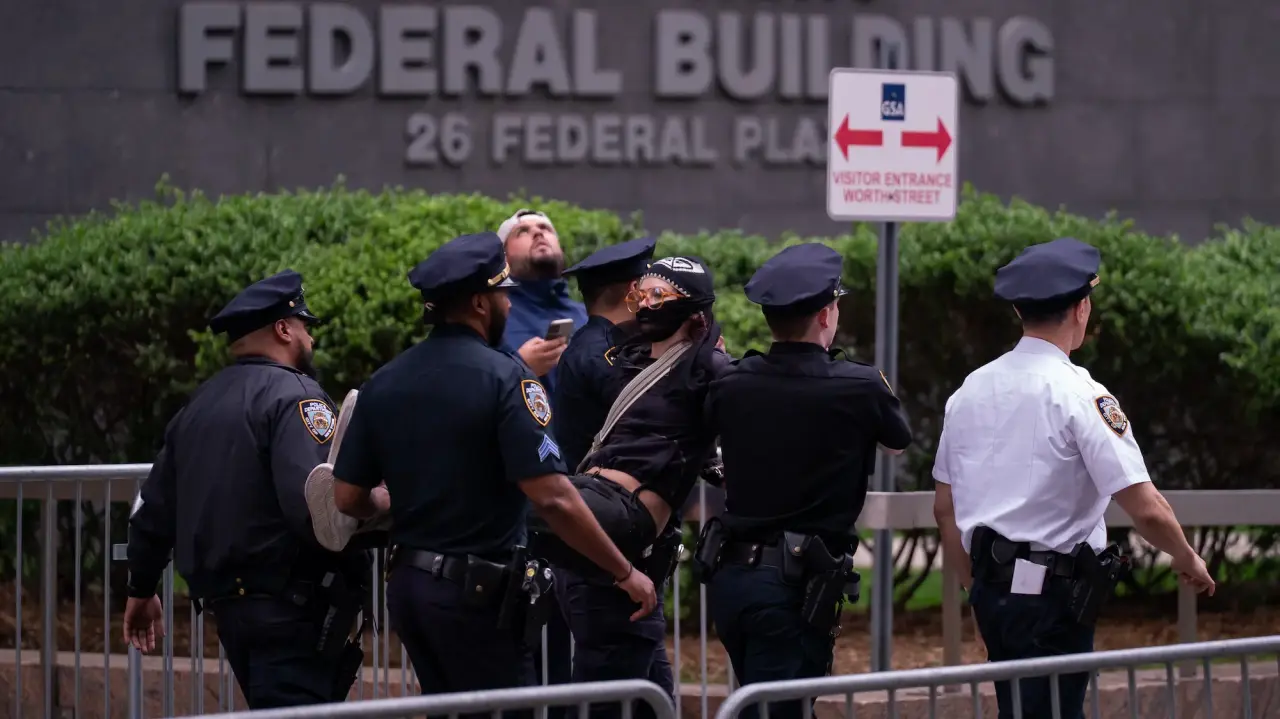
New York City Mayor Zohran Mamdani announced Monday that he’s fulfilling a campaign promise to disband a controversial and violent New York Police Department unit: the Strategic Response Group, or SRG.
The SRG was formed in 2015 in response to Black Lives Matter protests, ostensibly as a counterterrorism unit. But it primarily acted as a militarized protest policing force, deploying to suppress multiple Black Lives Matter rallies by the end of its first year of existence—during which time the SRG grew from 300 to 800 officers, equipped with long guns, body armor, and a reputation for excessive use of force.
“The plain intent of such a surge in police resources is to suffocate political dissent,” as the National Lawyers Guild wrote in a statement that year.
The SRG continued collecting a decade’s worth of abuse allegations, which included throwing reporters to the ground, kettling protesters at least 23 times, and keeping officers with dozens of misconduct complaints on the force. After the unit was once again deployed to suppress protests following the Minneapolis police murder of George Floyd in 2020, New York City’s Department of Investigation recommended that the NYPD “reevaluate the central role” of the SRG “in response to large protests given their orientation to handle counterterrorism, riots, and other serious threats,” and develop a new protest-policing protocol not involving the unit.
The Mamdani administration is replacing the SRG, which now numbers about 500 officers, with a civilian-led Community Dialogue and De-escalation Division, which won’t have arrest powers; a “First Amendment Support Team” of 30 officers “trained in communication and de-escalation”; and a Patrol Support Division of “vetted officers” with specialized protest training.
“New Yorkers exercising their constitutional right to protest should not be met with the same police response as a terrorism threat,” Mamdani said in a statement Monday alongside Police Commissioner Jessica Tisch. But in fulfilling this campaign promise, Mamdani is further alienating New York’s powerful Police Benevolent Association—a union that has already clashed with him over his hiring of a permanent chair for the NYPD’s Civilian Complaint Review Board, his non-condemnation of protests when Israeli Prime Minister Benjamin Netanyahu visited the city in September, and his “dismissal” of a “snowball attack against NYPD officers.”
“This is what the mayor said he would do, and he’s done it. He is ticking off the list quite systematically and in really important ways. “
“Mayor Mamdani is showing his true colors: he’s willing to put your safety and police officers’ safety at risk to appease his radical base,” PBA president Patrick Hendry said in a statement Monday.
Sociologist Alex S. Vitale, author of the 2017 book The End of Policing, has spent a lot of time thinking about whether aggressive policing can make people safer. His book, which argues for replacing police with non-law-enforcement alternatives, has become a symbol of left-wing excess to its detractors (once appearing, memorably, in Ted Cruz’s hand during a congressional hearing) and a essential text of the modern police-abolition movement to its supporters.
After Mamdani won his race for City Hall, Vitale was appointed to his transition committee in an advisory capacity, a move which prompted outrage among law-and-order conservatives. “I look forward to hearing his moderate defenders explain this one,” one Manhattan Institute employee groused on X, calling Vitale “New York’s most prominent police abolitionist.”
Vitale no longer has any formal role on Mamdani’s team. But as a Brooklyn resident, he keeps a close eye on policing in his hometown. I spoke with Vitale about what comes after the SRG—and how protesting in New York might be about to change.
Why now? What does the timing of this announcement tell us?
It’s been in the works for months, but there was accelerated public pressure over the last month or so, with some additional bad behavior by the Strategic Response Group around anti-ICE protests. While [before] it appeared that Mamdani was kind of giving the police a pass because it appeared politically easier…that focused everyone’s attention on getting this over the finish line.
The egregious case that got the ball rolling more quickly was in the Bronx, and this is a community that is both historically upset about ICE, but also historically upset about abusive NYPD treatment in general, and so to have it all kind of play out in the Bronx made a certain amount of sense.
Should we be expecting to see any kind of police backlash to this move, either rhetorically or in their actions?
We’re already seeing it, right? Bratton is out complaining. The police union is complaining. We saw from the get-go during the confidential negotiations; it was pretty clear that the police department was leaking stuff to the New York Post and trying to undermine the negotiations.
It’s not clear that it’s coming directly from the commissioner, but it is definitely coming from organized forces who have the ear of the New York Post. I think it’s both the union and leadership forces within the department.
The SRG’s been known for aggressive behavior toward demonstrators—do you expect that these reforms will meaningfully decrease police violence against activists?
I don’t think we can guarantee that. I think we can say that these are the kinds of incremental steps you would take to try to achieve that. It’s going to take us a year to get these civilian teams up and running, and then we’re going to have to see how it plays out.
But I do think that this is designed to achieve that end, by trying to change the overall posture that the city takes towards protest away from one of blanket suppression towards one of negotiation and accommodation.
You’ve characterized these changes as ‘non-reformist reforms.’ What does that mean?
A reformist reform is designed to basically restore legitimacy to the underlying institution. Something like “let’s give narcotics units anti-bias training so that we can hopefully reduce the racial disparities in the war on drugs, so that people will trust the police again.”
“This concretely removes police from a huge number of future First Amendment activities.”
Let’s give the cops body cameras instead of hiring fewer cops, that kind of thing?
Right. I’m not interested in restoring public trust in the police. I’m interested in producing justice and public safety, and it’s my view you do that by getting police out of the equation in as many ways as we possibly can.
But [Mamdani’s changes to NYPD] are what I’d call non-reformist reforms. They’re reforms that directly reduce the scope and power of policing. This concretely removes police from a huge number of future First Amendment activities.
It’s not complete. This is not a panacea. But establishing the very idea of a civilian alternative to using the police, to me, is a really important radical step. This will be the first such program in the country. It will give us the opportunity to create some proof of concept. If we can get it to work, it could become a national model.
And the restrictions on weapons and tactics reduce police power.
In terms of the power to beat people up in different ways?
Yeah. There are so many rallies and protests that are currently handled by the Strategic Response Group, where there is no violence. There’s no threat of violence. There’s no illegal activity, but people are subjected to abusive policing. They are put in kettles. They are harassed. They are denied the right to gather where they want to gather. They are criminalized for trying to hand out flyers in the wrong place. Even though that’s not the kind of thing that makes it to the nightly news with blood coming down people’s faces, that has been a significant restriction on people’s civil liberties.
I believe that this change will go a long way toward improving that.
What are other “non-reformist reforms” Mamdani could theoretically achieve?
The next thing on the agenda that he said he would do during the campaign, and where there’s a lot of organized momentum, is getting rid of the gang database.
About 12 years ago, the city made a strategic decision to start reframing the conversations about gun violence as being gang-related.
They couldn’t do mass stop-and-frisk anymore, so they said, well, we’re going to do gang suppression policing instead. They created this criminal group database, which is just a fancy way of saying a gang database. Ninety-nine percent of the people on it are young, Black, and Latino. There’s nothing a white person can do that would cause them to be on a gang database, basically. And it was just their new way of targeting young people of color in and around public housing developments. The police commissioner has made it clear that she thinks this is an essential tool for keeping violence down, though they’ve had to admit under oath that they have zero independent evidence of its effectiveness.
Mamdani also endorsed the CURB Act [Communities United to Reject Brutality Act, a city council proposal to regulate police protest response]. What would that accomplish?
It includes some additional oversight mechanisms and accountability mechanisms, but also, by making it a city law, it would make it harder for the next mayor to unwind. So it would institutionalize these changes. As it stands, it’s vulnerable to reversal by the next mayor.
“The everyday experience of going to a protest in New York, I feel, is going to get a lot better. “
What’s protesting in New York going to look like once these changes are implemented?
The everyday experience of going to a protest in New York, I feel, is going to get a lot better. It might take a year. But once we get that in place, it is going to feel very different going to a protest in New York. People are going to not face police intimidation at every type of protest. Even as a reporter, you wouldn’t necessarily be subject to abusive policing.
And what will happen to the officers who were in SRG? Are they just going to be transferred elsewhere?
The commissioner suggested that up to a third of the officers in SRG might move to counterterrorism. So that is itself a whole problematic ball of wax. You know, the NYPD has its own CIA, and has its hands in all kinds of stuff. They have a warehouse filled with officers who speak like 40 different languages, who monitor websites, newspapers, news reports around the world, and prepare daily intelligence briefings.
Would it be possible for the mayor to make cuts to that program, or would the political cost be too high?
There would definitely be political risks to doing that. I mean, he would be the person, right, to express skepticism about giving those responsibilities to the NYPD, as someone of African, South Asian, and Muslim descent. He would be in a position to point out the abuses of the demographics unit, of spying, of keeping files on people, of racial profiling that have characterized some of this anti-terrorism policing in New York.
Over the past several years, SRG has become shorthand for abusive policing in New York. Are there other units you think people should be paying more attention to now?
I mean, there’s the gang suppression policing squad—they spend a lot of time putting kids on the gang database, and then once the kids are on there, surveilling and harassing them. Then there’s the narcotics unit; there’s the vice squad that’s been terrorizing sex workers—the police in New York have literally killed sex workers.
The history of police abuse scandals and corruption scandals almost always revolves around one or more of these specialized units. They become insular, filled with cowboys, and are given a culture of impunity from the rest of the department and public oversight. And this just breeds abuse and corruption.
All of this should just be turned over to community violence intervention groups.
Do we have any data about how well that “civilianization” approach works?
This is brand new. This is going to be the first real attempt to do this. So it’s very fair to say we’re in uncharted territory. We’re going to have to see what’s possible. We want to be mindful of just reproducing a policing function through civilianization.
But this is what the mayor said he would do, and he’s done it. He is ticking off the list quite systematically and in really important ways.
This interview has been edited for length and clarity.