
World · Middle East Eye · · 2h
UN General Assembly 2026: War on Iran and Gaza genocide dominate
English (original) · Read in Deutsch ⇄
UN General Assembly 2026: War on Iran and Gaza genocide dominate
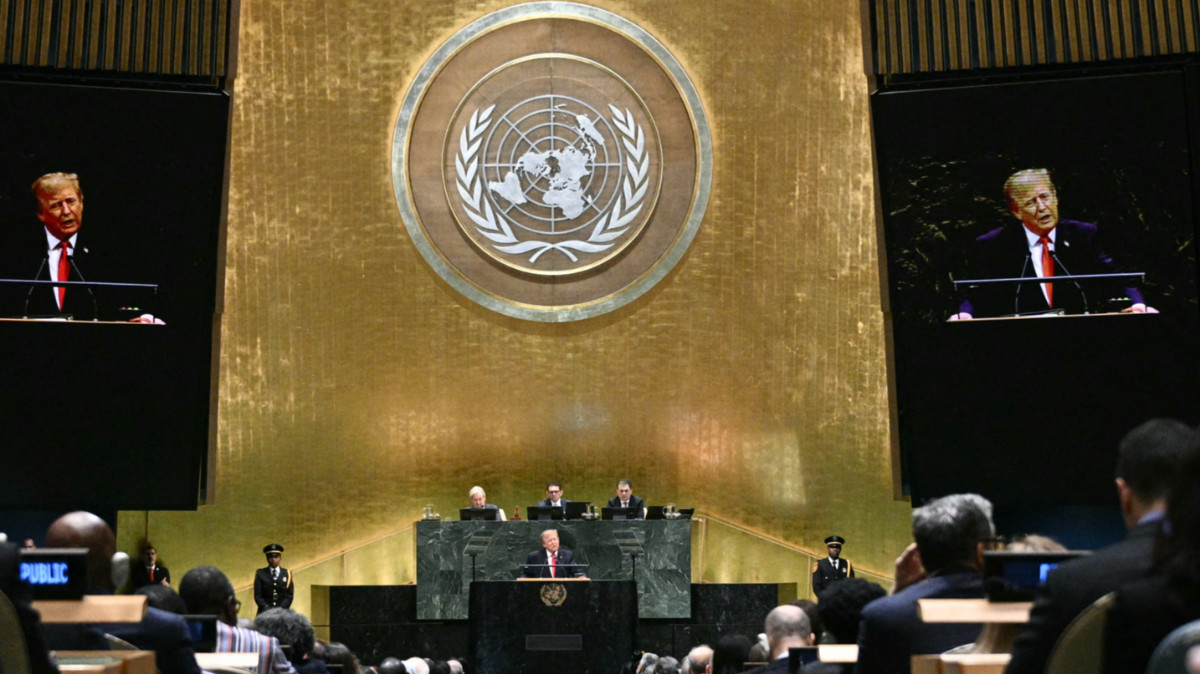
Submitted by Sean Mathews on Tue, 09/22/2026 - 15:18 Leaders condemned Israel's genocide in Gaza and criticised the weakening of global institutions like the United Nations US President Donald Trump speaks during the 81st United Nations General Assembly at the UN headquarters in New York City, on 22 September 2026 (Brendan Smialowski/Pool/AFP)
Off
US President Donald Trump speaks during the 81st United Nations General Assembly at the UN headquarters in New York City, on 22 September 2026 (Brendan Smialowski/Pool/AFP)
Off
United Nations secretary general Antonio Guterres kicked off the 81st United Nations General Assembly on Tuesday at UN headquarters in New York City, saying that we are entering "a multipolar world and that movement is irreversible”.
In what will be his last UN address, Guterres said that "superpowers were finding the limits of their power", as he called for fighting across the Middle East to stop.
"Military power alone cannot secure peace. Economic power alone cannot command stability. And technological power alone cannot guarantee security. A networked multipolar world can create the conditions for a much more balanced and representative global problem-solving. But it requires a multilateral system, centred in the UN, that is balanced and representative," he said.
He warned that the ceasefires announced in the Middle East were in name only, and that civilians were paying the price.
"So-called ceasefires have amounted to little more than ‘lesser fires’, with civilians continuing to pay the price. Enough is enough. I appeal to the leaders in this chamber to maximise this high-level week for de-escalation and dialogue. Let’s send a clear message from this hall: the fighting must stop," he said.
Guterres warned world leaders not to lose sight of what was happening in Palestine and to work towards a two-state solution.
"It has been nearly three years since the abhorrent terrorist attacks by Hamas on 7 October [2023]. But what followed was an onslaught on Palestinians in Gaza with a scale of killing and destruction unlike anything I’ve witnessed in my years as secretary general.
“Violence, displacement, and settlement expansion by Israel in the occupied West Bank are bulldozing the paths to peace and raising the spectre of ethnic cleansing. We cannot allow the two-state solution to disappear before our eyes.”
Brazil: Condemns US efforts to undermine ICC, UN
In keeping with a decades-long tradition, Brazil was the first country to address world leaders at the General Assembly.
President Luiz Inacio Lula da Silva did not name US President Donald Trump, but he issued pointed criticism at his efforts to undermine the International Criminal Court (ICC) and wage war on Iran.
Lula also put former Palestinian leader Yasser Arafat and Israeli Prime Minister Yitzhak Rabin at the heart of his speech, arguing they represented "statesmen" the world needs, as it faces a "scourge of war".
 'We are settling years of unfinished business': Trump talks up Iran, Gaza, Latin America strategy
Read More »
'We are settling years of unfinished business': Trump talks up Iran, Gaza, Latin America strategy
Read More »
“We are called to choose between multilateralism and unilateralism. Democracy or extremism. Sovereignty or subordination,” Lula said, warning that "trillions of dollars" were being used to fund a "new arms race".
“Yasser Arafat and Yitzhak Rabin were statesmen. They challenged the past to envision a future of peace. They were defeated by hatred," Lula said.
Arafat led the Palestine Liberation Organisation. After leading a two-decade resistance struggle, Arafat renounced armed resistance to Israel and signed the Oslo Peace Accords with Rabin.
The Oslo Accords were supposed to set the stage for the creation of an independent state for Palestinians, but were criticised by many Palestinians for concessions and undermined by Israel's refusal to return to its pre-1967 borders. Rabin was assassinated in Tel Aviv at the square which now bears his name, as he left a peace rally on 4 November 1995.
Lula condemned Israel's genocide in Gaza, where nearly 74,000 Palestinians, mainly women and children, have been killed.
“Generations of Palestinians will carry the pain and trauma left by the genocide of women and children perpetrated by Netanyahu’s government in Gaza. Israeli civilians pay the price for radicalism and intolerance of Hamas terrorist acts,” Lula said.
Lula did not name the US, but he criticised attempts to destroy the ICC, saying such efforts undermine accountability in Gaza.
"Persecuting the International Criminal Court and its members encourages these crimes to go unpunished," he said.
The ICC has come under the US's crosshairs after it issued arrest warrants in November 2024 for Israeli Prime Minister Benjamin Netanyahu and former Defence Minister Yoav Gallant over alleged war crimes and crimes against humanity in Gaza.
He also condemned moves to sanction the UN special rapporteur on the occupied Palestinian territories, Francesca Albanese. The Trump administration rolled out sanctions on Albanese earlier this year, but lifted them in May after a US federal judge ruled they violated her free speech.
“The UN special rapporteur must not be silenced for telling he truth," Lula said.
Jordan: Israel guilty of war crimes in Gaza and West Bank
Jordan's King Abdullah II opened his remarks with a blistering indictment of Israel, saying the country is guilty of war crimes in the occupied West Bank and Gaza, and that its territorial ambitions do not stop with Palestinian land.
Abdullah said Israel was inciting a "religious war" and falsely trying to frame its conflict with Palestine as a "war of religion with Islam on one side and Judaism and Christianity on the other”.
“This [Israeli] government’s sense of impunity has reached terrifying levels," he said. “No one in this assembly should assume this Israeli government’s appetite stops at Palestine," he said, pointing to Israel's attacks and occupation of parts of Syria.
 Israel trying to 'eliminate' living conditions for Palestinians in occupied West Bank, says report
Read More »
Israel trying to 'eliminate' living conditions for Palestinians in occupied West Bank, says report
Read More »
In his opening remarks, Abdullah said that the US-Israeli war on Iran offers an example of why conflict in the Middle East cannot be ignored by the international community.
"If anyone had any doubt that conflict in our part of the world stays there, just look at the energy and grocery bills from ordinary families from Mumbai to Madrid to Minnesota,” he said.
“The Iran war has shown how quickly instability can disrupt trade, investment and lives beyond the region,” he added.
Abdullah then said the international community had chosen to manage the [Israeli-Palestinian] conflict, "not confront it”, with dangerous ramifications.
He said Palestinians in the occupied West Bank are being "beaten, shot and terrorised”.
“It is time to see what is happening for what it really is,” he said. “Demolishing Palestinian homes to expand illegal settlements is not law enforcement; it is forcible transfer", he said.
Jordan's leader said Israel was conducting a“de facto annexation of the West Bank” and implementing “a system of subjugation” against Palestinians.
In the occupied West Bank, he said Israel was moving to “compel an entire population to leave their land", adding, "There is a name for that. Forced displacement, and that is a war crime.”
“Gaza and the West Bank are two fronts of the same Israeli strategy. In both, Palestinians are being killed. In both, the reality on the ground is being remade. Gaza through destruction, the West Bank through de facto annexation," he said.
Turkey: Israel guilty of 'state terror'
Starting off his speech, Erdogan said he was saddened to see that Palestinian President Mahmoud Abbas had been banned from attending the UN General Assembly for a second consecutive year, calling it an “injustice”.
“We will, as we did last year, continue to be the voice of a free and sovereign state of Palestine,” he said, as he urged states who have not yet recognised the state of Palestine "to reconsider their position”.
Noting that the past 12 months have been “one of the bloodiest periods in the last 30 years” worldwide, he drew attention to the killings in the besieged Gaza Strip.
“We lost them to what we regard as acts of state terror by Israel,” Erdogan said.
While a ceasefire deal in Gaza was reached with Israel in October 2025, with Trump and other countries such as Turkey mediating, the number of Palestinians killed in Gaza has still exceeded 1,500 since the agreement, he added.
Although the Palestinian resistance movement has agreed to move to the second stage of the peace plan, “the Israeli government refuses to stop the occupation”, he said, noting that the occupied West Bank is experiencing its “most severe period” regarding Israeli settler “violence and terror”.
Attacks by Israeli settlers across the occupied West Bank have surged to 63 percent during the first seven months of this year, as compared to the same period in 2025, according to the Wall and Settlement Resistance Commission.
Erdogan also urged reform at the UN, calling for a more inclusive structure, as it has more than 190 countries but is “subject to the whims of five countries”.
"The United Nations, established 81 years ago to maintain peace and security, has become unable to fulfil this mission, or rather it has been made unable to do so," he added.
Regarding the fighting between Saudi Arabia and Yemen’s Houthi movement, Erdogan said Ankara was continuing to work with all sides to bring the conflict to an end, stressing that prolonging the conflict served no one.
The Houthis have stepped up attacks on Saudi Arabia as fighting in Yemen has intensified, taking control of the Bab el Mandeb Strait, a vital waterway that served as an alternate route for energy from the Gulf.
Qatar: Calls for regional system of security
Qatar’s ruling emir, Sheikh Tamim bin Hamad al-Thani, has warned of an absence of a “regional system of collective security”, as the Gulf region undergoes “one of its most dangerous phases”.
“The crisis we are currently facing should come as no surprise to anyone. It is the cumulative result of years of postponing crisis management through temporary solutions and unrealistic policies,” he said.
He stressed the need to set up a system that respects the sovereignty, security and territorial integrity of states, one that promotes the peaceful settlement of disputes as well as non-interference in the internal affairs of states.
“In the absence of such a system, it becomes possible for a war to erupt,” he said.
“It has become possible for one party to drag its neighbours into a war that is not theirs, targeting their vital assets and installations despite their strenuous efforts to avert escalation.”
Qatar itself has been drawn into the conflict between the US, Israel and Iran despite its efforts to avoid escalation.
 US bans Palestinian president from speaking at the UN
Read More »
US bans Palestinian president from speaking at the UN
Read More »
Iranian attacks on the country’s Ras Laffan energy complex damaged two liquefied natural gas trains and a gas-to-liquids plant, temporarily disabling about 17 percent of Qatar’s LNG capacity, according to QatarEnergy.
The conflict has also severely disrupted shipping through the Strait of Hormuz, a vital route for Qatar’s energy exports. The strait, through which nearly a quarter of the world’s energy trade passes, has been closed since hostilities between the US, Israel and Iran began, disrupting global energy markets and complicating Qatar’s LNG shipments.
The emir noted that as a consequence, the costs of medicine and food have spiked on every continent, affecting “the livelihood of people who have nothing to do with this”.
He stressed that the crisis in the Gulf can be resolved through “peaceful” diplomacy, by reopening the strait and returning to negotiations to avert war.
Regarding the besieged Gaza Strip and the occupied Palestinian territories, he slammed Israeli leaders who “openly proclaim that the solution is to displace the population, which they call ‘migration’”.
He called on Israel to honour its commitments: cessation of operations and withdrawal from the besieged Gaza Strip, the lifting of the illegal blockade, and the unconditional delivery of humanitarian assistance.
“There can be not talk of a just international order as long as Palestine remains a blind spot within it,” he said.
“Dealing with Israel, putting an end to the harm it causes, and restraining its unlawful conduct constitutes the true test of the international community’s seriousness in upholding values and the rule of law. The law must apply equally to all.”
Diplomacy News Post Date Override 0 Update Date Mon, 05/04/2020 - 21:19 Update Date Override 0Read the full story at the source
Source: Middle East Eye