
World · Middle East Eye · · 1h
UN General Assembly 2026: Walkout during Netanyahu's speech, and Middle East wars in spotlight
English (original) · Read in Deutsch ⇄
UN General Assembly 2026: Walkout during Netanyahu's speech, and Middle East wars in spotlight
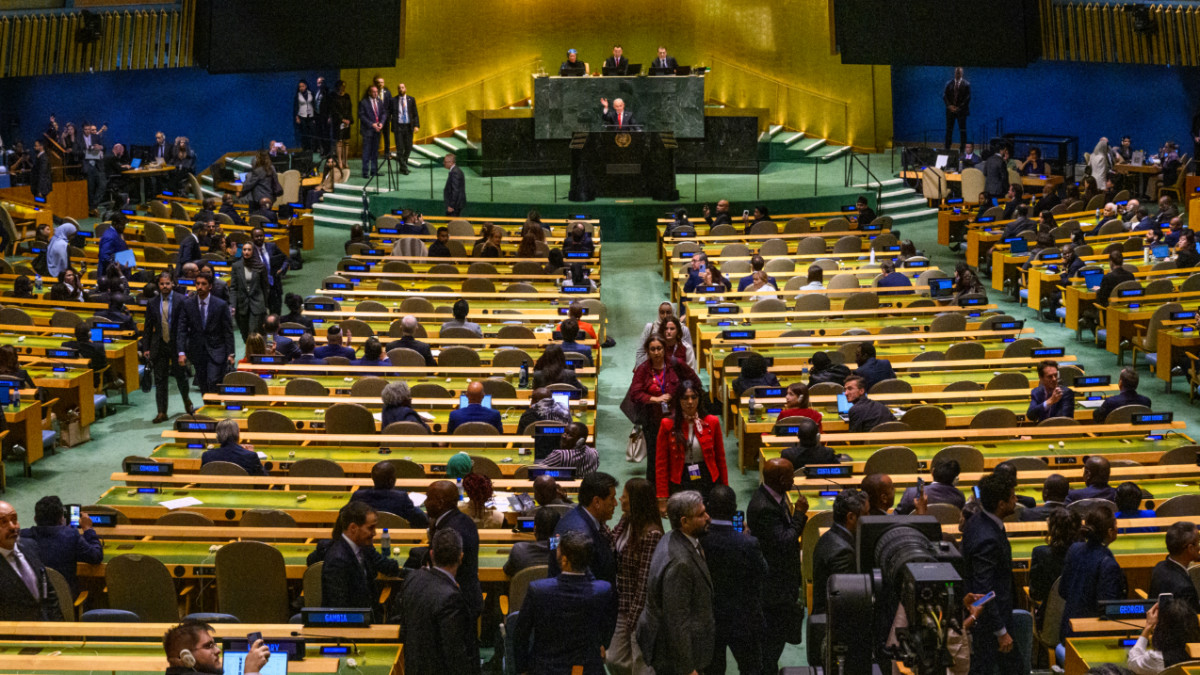
Submitted by Sean Mathews on Thu, 09/24/2026 - 22:04 Somalia said it is bearing the costs of US-Israeli war on Iran, while Yemen said its security is critical to freedom of navigation in Red Sea Israeli Prime Minister Benjamin Netanyahu waves to delegates from several countries as they leave the room before his speech during the 81st session of the United Nations General Assembly on 24 September 2026 in New York City ( Alexi J Rosenfeld/Getty Images/AFP)
Off
Israeli Prime Minister Benjamin Netanyahu waves to delegates from several countries as they leave the room before his speech during the 81st session of the United Nations General Assembly on 24 September 2026 in New York City ( Alexi J Rosenfeld/Getty Images/AFP)
Off
The US-Israeli war on Iran and the Israel-Palestine conflict continued to occupy prime positions on the fourth day of the UN General Assembly.
Somali President Mohamed Hassan Sheikh Mohamud said his country was “suffering” as a result of the US-Israeli war, which has driven up the price of energy and food, while denting customs revenue for the East African country, which has coped with years of internal conflict.
“The issue of the Strait of Hormuz… has serious economic and humanitarian consequences,” he said.
“As an import-dependent country reliant on the Middle East for much of our food, fuel and trade, Somalia is already facing rising prices,” he said, adding that the war had already hit the country’s customs revenue by “40 percent”.
“Ensuring free and fair navigation through the strait is essential to protecting vulnerable economies like Somalia,” he added.
Mohamud also said that “a just resolution to the Palestinian question remains essential to lasting peace in the Middle East and beyond”.
“Somalia stands firmly with the Palestinian people and their legitimate right to self-determination and statehood.”
European Union: 'We need multilateralism'
Antonio Costa, European Union Council president, began his speech to the General Assembly by defending “multilateralism”.
“Alone no country… can build lasting peace. This is why our message is clear. We need multilateralism,” he said.
Costa did not name the US’s attacks on the International Criminal Court (ICC) directly, but he warned over “double standards in international law” and said the European Union would defend the ICC and the International Court of Justice (ICJ).
 EU foreign policy chief says Israeli settlements should be treated like Russian-occupied Crimea
Read More »
EU foreign policy chief says Israeli settlements should be treated like Russian-occupied Crimea
Read More »
“We support these courts firmly, and we will defend their independence, integrity and ability to fully carry out their mandate,” he said, condemning “attacks” on the ICC.
Washington has already imposed sanctions on several ICC top officials, including court president Tomoko Akane, who was sanctioned in August along with senior trial lawyer Abdoulaye Seye.
Former chief prosecutor Karim Khan was the first to be sanctioned in February last year, followed by two deputy prosecutors and nine judges involved in the court’s Palestine and Afghanistan investigations.
The Wall Street Journal reported this week that the US is planning new sweeping sanctions on the court.
Costa also took an indirect jab at Trump’s claim to have brought a peaceful resolution to Israel’s genocide in Gaza. Israeli attacks on the enclave are continuing despite a ceasefire sealed in 2025.
“We regret the current stalemate in Gaza, and more broadly speaking in Palestine,” Costa said.
“The EU and its member states have made their position clear. The two-state solution is the only one that can secure lasting peace in the Middle East,” he added.
Costa did not criticise the US-Israeli war on Iran. Instead, he said the EU supports efforts to“find a solution to the conflict".
“It is essential that Iran never be allowed to acquire nuclear weapons,” he said. “We hope the Iranian people can live in peace, security and as free men and women,” he added.
“Freedom of navigation in the Strait of Hormuz must be preserved without conditions and without hindrance,” he said.
Yemen ties its stability to Red Sea navigation
Vice President of Yemen Abdullah Abdulkader al-Alimi-Bawzer condemned the Houthis in his address to the UN General Assembly and tried to rally the global community to help fight the group.
 Saudi war against Houthis displaces 130,000 Yemenis as hunger crisis deepens
Read More »
Saudi war against Houthis displaces 130,000 Yemenis as hunger crisis deepens
Read More »
“The people of Yemen, this great nation… [have] been enduring for 12 years the consequences of the coup carried out by the terrorist Houthi militia,” he said.
He said the government of Yemen had supported a peace initiative backed by the governments of Saudi Arabia and Oman, while the Houthis rejected it and “instead escalated their actions in the Red Sea and Bab el-Mandeb to serve an Iranian agenda”.
“Turning one of the world’s most important waterways into a tool of pressure and bargaining in Iran’s confrontation with the world,” he said.
He called for “decisive action” to degrade the Houthis and praised Saudi Arabia’s support for the internationally recognised government of Yemen.
“The Houthi militia’s use of the safety of navigation as a tool for blackmail threatens not only Yemen. It is taking hostage the entire global economy,” he said.
“Maritime security in the Red Sea, Bab el-Mandeb and the Gulf of Aden can’t be built while a non-state armed militia remains on the shores,” he said.
“Restoring the Yemeni state and restoring the security of Bab al-Mandeb are inseparable,” he said.
Kuwait condemns Iran attacks
Crown Prince of Kuwait Sabah Al Khaled condemned the “illegal Iranian aggression” in his address to the UN Security Council on Thursday.
“These attacks are a flagrant violation of international law,” he said. “These brutal attacks have systematically and repeatedly targeted civilian objects and critical infrastructure… revealing a hostile approach aimed at disrupting the foundations of life.”
“The security and stability of the Arabian Gulf region constitutes a fundamental pillar of regional and international security and stability, as demonstrated by the repercussions of the war and Iranian aggressions,” he said.
Kuwait was one of the Gulf states hardest hit by Iran in retaliation for the US-Israeli war on the Islamic Republic. Kuwait is home to tens of thousands of US troops and military bases. US facilities in Kuwait were attacked along with civilian sites like Kuwait airport and energy infrastructure.
Kuwait is one of the most exposed countries to Iran’s blockade in the Strait of Hormuz, as the country uses tankers to transport nearly all of its oil exports.
"The State of Kuwait reiterates its principled and firm position condemning the ongoing violations by the Israeli occupation forces against the brotherly Palestinian people," he said.
"The Palestinian people continue to suffer under difficult living conditions caused by policies of displacement, arrest and settlement," he added.
Kuwait also praised France and the UK for imposing sanctions on trade with Israeli goods from settlements.
Khaled also called for Security Council “reform”, citing changes in the global balance of power.
“There is an urgent need for the council to become more representative, effective and transparent in carrying out its responsibilities,” he said.
Israel
Israeli Prime Minister Benjamin Netanyahu gave a pugnacious speech at the United Nations General Assembly, attacking everyone from New York City Mayor Zohran Mamdani to Turkish President Recep Tayyip Erdogan and the leaders of Western Europe, as he tried to counter Israel’s growing international isolation.
Netanyahu did not hold back from taking an aggressive stance toward critics when the General Assembly hall erupted in boos as he took to the podium, with the majority of delegates walking out in protest.
 How loyalty between Iran and Kuwait gave way to mistrust
Read More »
How loyalty between Iran and Kuwait gave way to mistrust
Read More »
“Order in the hall, please. Order in the hall, please,” the president of the General Assembly could be heard shouting, trying to silence the room.
“If there are any other moral cowards who haven’t left this hall, please do so now,” Netanyahu said, smiling, before he began his speech.
Israel is locked in conflict with many of its neighbours - including Lebanon and Syria - even as it continues attacking the Gaza Strip and occupied West Bank. While Netanyahu addressed foreign policy, he spent a big chunk of his time attacking Mamdani, whom he accused of succumbing to “antisemitic mobs”.
“Mr Mamdani, since you were elected mayor of this city, many Jews no longer feel safe in New York,” Netanyahu shouted. “Mr Mamdani, you tried to stop me from coming here. You tried to silence me. Well, you can't silence me. You can't silence the truth,” he said.
Meanwhile, hundreds of protesters took up positions around the UN headquarters before his arrival and continued protesting while Netanyahu spoke inside.
Netanyahu’s remarks are a reminder of how much he geared his address to an American audience and also sought to play up politics within the diaspora ahead of Israel’s October elections.
United Nations News Post Date Override 0 Update Date Mon, 05/04/2020 - 21:19 Update Date Override 0Read the full story at the source
Source: Middle East Eye