
World · Middle East Eye · · 1h
‘Our land is not for sale’: Italian activists challenge Israeli-linked solar projects
English (original) · Read in Deutsch ⇄

‘Our land is not for sale’: Italian activists challenge Israeli-linked solar projects
Submitted by Stefania D'Ignoti on Mon, 09/21/2026 - 10:01 Farmers and campaigners raise concerns over suspicious foreign capital entering Italy’s renewables sector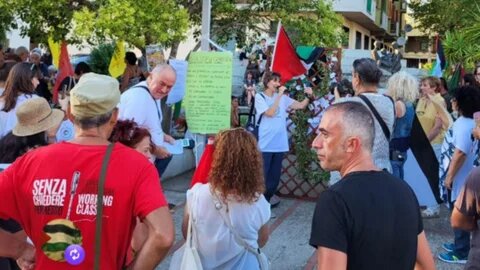 Italians protest against Shikun & Binui's agrivoltaics park project in Ribolla, central Italy (supplied/MEE)
Off
Italians protest against Shikun & Binui's agrivoltaics park project in Ribolla, central Italy (supplied/MEE)
Off
Italian activists in a small Tuscan town have been protesting against a planned agrivoltaics park after tracing its ownership to Shikun & Binui, an Israeli company with ties to Israel's military.
The campaign by Diritti In Palestina began in early September, when activists investigating the project in the town of Ribolla traced its ownership to the Tel Aviv-based group, which operates across real estate, energy and infrastructure.
Shikun & Binui Energy intends to build five solar power plants across Tuscany, a region in central Italy. To do so, the group has established five companies in Milan as special-purpose vehicles (SPVs), structures that make the projects’ ultimate ownership harder to trace.
In documents seen by Middle East Eye, the land lease contracts are formally signed by one such company, SPV Energy 3.
The activists' investigation found that it had no employees and share capital of just €2,500.
“This suspicious element is what prompted us to advance verifications, considering that there have been several Israeli investments in our region lately, especially in the renewable energy sector,” Alessandra Bertero, 72, co-founder of Diritti in Palestina, told MEE.
When the project was publicly announced last May, Bertero and four other activists used several freedom of information requests to uncover a pattern of Shikun & Binui operating across several EU countries under different European branch names, including SPV Energy 3.
In September 2025, the UN High Commissioner for Human Rights added the company to its blacklist over its illegal activities in the occupied West Bank and occupied Golan Heights.
 Italian activists escalate Mediterranean port protests over Gaza genocide
Read More »
Italian activists escalate Mediterranean port protests over Gaza genocide
Read More »
Shikun & Binui traces its origins to Solel Boneh, a construction company that collaborated with the Israeli army during the 1948 Nakba, which saw the violent expulsion of hundreds of thousands of Palestinians from their land.
The solar park project has drawn strong opposition from civil society, amid growing concerns about the area’s emerging strategic role, particularly given its proximity to the port of Livorno, about 110km away, which serves as a transit point for arms trade towards Israel.
“We still have time. To be implemented, the project still needs the Single Energy Authorization, whose decision falls under the responsibility of the region, for the construction of the 36,000 panels to begin,” Bertero explained.
Speaking to MEE, Michela Arricale, a jurist offering legal support to the group, said investment of capital verified to be linked to the Israeli occupation and the violation of international and humanitarian law “would violate the principle of non-recognition established by the opinion of the International Court of Justice issued in July 2024.
“There’s hope we can stop this from happening and set a precedent to inform citizens in other regions affected by this phenomenon and deter further projects,” Arricale added.
MEE reached out to Shikun & Binui for comment but did not receive a response by time of publication.
How agrivoltaics exploit the land
Agrivoltaics has been presented as a way to reconcile food production with renewable energy by installing photovoltaic panels high enough to allow crops and livestock to grow and graze underneath them.
Promoted by energy lobbies in Brussels as a green solution to land abandonment and climate change, the model is expanding rapidly across Europe. But critics warn that its implementation will determine whether it delivers genuine environmental and social benefits or becomes another form of greenwashing.
'This "green" approach masked as sustainability reinforces a neocolonial mindset in which rural areas in crisis are further exploited'
– Fabrizio Garbarino, president of Italy’s Rural Association
According to Fabrizio Garbarino, president of Italy’s Rural Association, the technology has so far proved ineffective.
“We have made many concrete experiments but none have turned out to actually benefit farmers and produce edible crops,” Garbarino told MEE.
“This ‘green’ approach masked as sustainability reinforces a neocolonial mindset in which rural areas in crisis are further exploited to meet the energy needs of multinational corporations with no connection to farming, who get praised for what they do, but just on paper,” he said.
Since 2021, Italy’s permissive land regulations and post-Covid funding for the green transition have created opportunities for international companies to acquire agricultural land.
In 2023, Amazon and ENGIE launched Europe’s largest agrivoltaics parks in Sicily, southern Italy. But three years later, promises to benefit local communities have yet to be fulfilled.
Meanwhile, with EU backing and funding, Israel is emerging as a leader in the sustainability industry, with evidence that the sector is contributing to apartheid in the West Bank.
The latest developments in Tuscany have prompted farmers and campaigners to argue that greater transparency is needed to establish who controls the land and who ultimately benefits from Italy’s energy transition.
“Israel has significant economic resources, so its investments in profitable greenwashing projects in our country are not surprising,” Garbarino said.
Through his role, Garbarino has reviewed dozens of contracts involving fellow farmers approached by suspicious foreign investors, usually startups such as SPV Energy 3.
These companies often have little share capital and no background in energy or farming, yet seek to buy or lease agricultural land, sometimes offering farmers attractive sums after reaching out through publicly accessible registers.
Farmers losing their land
Giancarlo Innocenti, the head of the retired workers’ association at one of Italy’s largest farming associations, has also traced several recent farmland acquisitions to Israeli investors or European branches acting on their behalf.
“Recently, I was contacted by a fellow farmer who asked me to mediate a conversation in English with an Israeli man about acquiring his land,” said Innocenti, a former mayor of Roccastrada, the area in Tuscany where the agrivoltaics projects are due to be built.
'Farmers are quietly being pushed out of our territories, forcibly, little by little, to make room for multinationals'
– Giancarlo Innocenti, former mayor of Roccastrada
In his position, he said he has spotted several intermediaries participating in bankruptcy auctions, where farmers struggling with low production and wildfires are forced to sell their land at low prices.
After 40 years in the farming sector amid Tuscany’s fertile green hills, Innocenti said he sees parallels between what is happening in Tuscany today and what has been happening in Palestine for decades, while stressing the profound differences between the two contexts, with Palestinians living under military occupation and subjected to ongoing land seizures.
He considers it a cautionary tale that Italians are collectively ignoring.
“Our farmland, meant to nourish our communities, is increasingly exploited for profit,” he told MEE.
“Farmers are quietly being pushed out of our territories, forcibly, little by little, to make room for multinationals, and our olive groves are succumbing to this violence.
“But actions like our protests are an attempt to defend and take back our land. It’s impossible not to see this as a metaphor.”
The race to legally stop the parks
With Giorgia Meloni’s government openly supporting Israel as one of its main allies in Europe, despite growing civil support for Palestine in Italy, the Ribolla agrivoltaics park is being presented as a symptom of a much larger phenomenon affecting the country – one that has gone largely unreported.
Israeli-linked investments in Italy’s agricultural and renewable energy sectors are now attracting attention in southern regions.
 'Something broke': Italy's Arab communities increasingly fearful of police violence
Read More »
'Something broke': Italy's Arab communities increasingly fearful of police violence
Read More »
In Puglia, one of Italy’s most important agricultural regions, foreign investors have shown interest in land for renewable energy projects, as well as real estate.
Just across the Strait of Otranto from Puglia, Albania has seen widespread protests against real estate projects backed by US President Donald Trump’s son-in-law, Jared Kushner, in protected areas.
The protests have raised further awareness of links between investments in vulnerable Mediterranean areas and foreign capital, including what campaigners describe as growing Israeli involvement.
Similar tensions have emerged in Sardinia, where the rapid expansion of large-scale renewable projects has prompted opposition from farming communities and local authorities concerned about land use and impact on landscape.
Sicily, meanwhile, has become a major target for solar projects after Amazon’s investments and Elon Musk’s remarks about the island’s energy production potential.
Arricale, the jurist, says she is currently monitoring two more SPVs linked to Israeli companies that are buying land in western Sicily under the names Nerello and Nero d’Avola. The companies are eyeing large-scale projects with a combined capacity of 126 megawatts.
'This battle concerns us all'
Bertero called for greater community awareness and stressed the importance of public gatherings to keep citizens informed, build networks and mobilise against foreign projects.
“Most of the time these things happen simply because of a lack of observation,” Bertero said. “The problem is how citizens are not informed, particularly in this political climate, about what’s happening around them.
'Our land… like Palestinians have shown us, should not be on sale for mischievous purposes'
– Alessandra Bertero, Diritti in Palestina
“Our land, the most precious thing we own, like Palestinians have shown us, should not be on sale for mischievous purposes.”
Inspired by the mobilisation in Ribolla, residents of Lavaiano, a town in the municipality of Casciana Terme Lari, are also taking action to stop an agrivoltaics project promoted by SPV Energy E32, which is also owned by Shikun & Binui. The project targets 22 hectares of land.
Meanwhile, Lorenzo Falchi, a regional councillor in Tuscany, has submitted a national parliamentary inquiry, hoping to secure the regional government’s rejection of the Israeli-linked project and establish a precedent for potential future cases.
According to Arricale, clearer legislation is needed to regulate agrivoltaics projects as infrastructure rather than simply as interventions on agricultural land, preventing them from attracting the wrong type of investors.
“This is a battle that concerns us all," she said. "The energy transition is a major challenge, one that we must overcome, but not at the cost of accepting large-scale speculative projects affecting workers forced to sell their land out of financial desperation, especially where there is a risk that this capital originates from the illegal occupation of Palestine and is accompanied by violations of international and humanitarian law.”
Energy Ribolla, Italy News Post Date Override 0 Update Date Mon, 05/04/2020 - 21:19 Update Date Override 0Read the full story at the source
Source: Middle East Eye