
World · Middle East Eye · · 2h
On Yom Kippur, Israel offers forgiveness to the killer of an unarmed Palestinian
English (original) · Read in Deutsch ⇄
On Yom Kippur, Israel offers forgiveness to the killer of an unarmed Palestinian
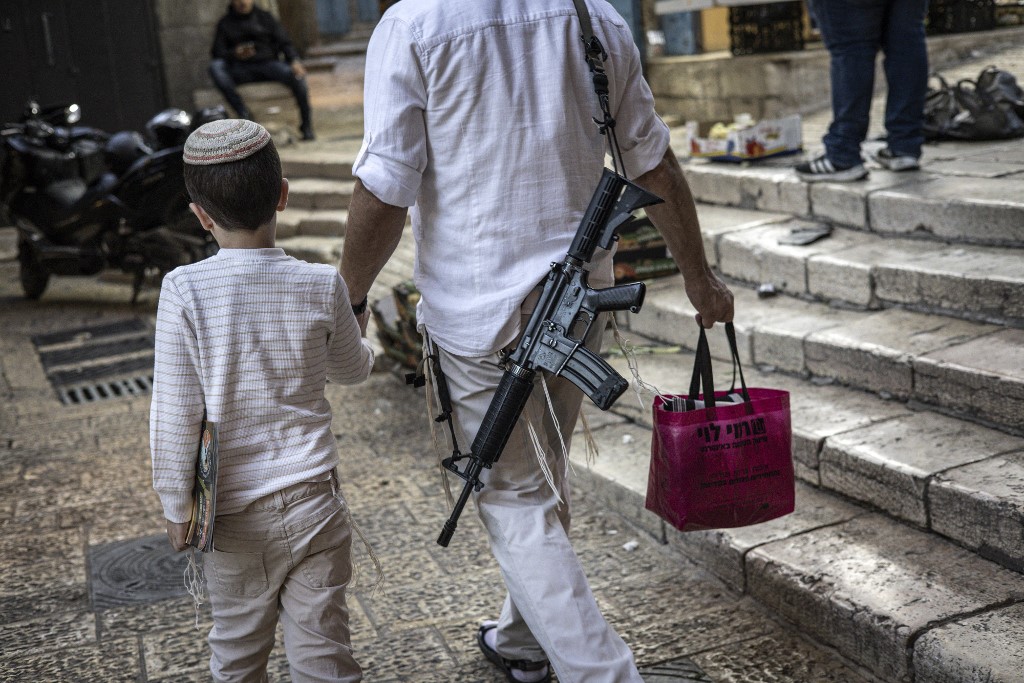
Submitted by Lubna Masarwa on Fri, 09/25/2026 - 09:45 Killing Palestinians, whether it’s done by the Israeli army, police or settlers, has become part of everyday life An armed ultra-Orthodox Jewish man holds a child by the hand as he walks in the Old City in Jerusalem at the start of the Jewish holiday of Yom Kippur on October 11, 2024 (John Wessels/AFP)
Off
An armed ultra-Orthodox Jewish man holds a child by the hand as he walks in the Old City in Jerusalem at the start of the Jewish holiday of Yom Kippur on October 11, 2024 (John Wessels/AFP)
Off
It’s Yom Kippur in Israel, the day of fasting.
A father is taking his two children to the local grocery store. An M16 assault rifle is hanging casually from his chest.
This is what passes for normal life in Jerusalem.
And besides, he is only following instructions.
Itamar Ben Gvir, the national security minister, told everyone to take their guns with them on this holy day - “even to the synagogues”.
This is the holiest day in the Jewish calendar. Kippur means forgiveness, and it’s the day when believers ask God and each other for forgiveness.
On this Yom Kippur, Israeli President Isaac Herzog, a lawyer by profession, thought the religious holiday was a good time to pardon a former soldier convicted of the killing of a wounded Palestinian in 2016.
He waited until 20 minutes before the holiday started before announcing the pardon, calculating, rightly, that this would minimise a media debate.
In March 2016, Elor Azaria, an Israeli soldier, shot 21-year-old Abdel Fattah al-Sharif, a Palestinian man, in the head while al-Sharif was lying unarmed on the ground.
Violence, vengeance and ruthlessness are no longer hidden behind the language of democracy and security. They have become virtues in their own right
The incident was captured on camera by a Palestinian photographer who worked for the Israeli human rights organisation B’Tselem.
The army arrested Azaria. But that was just the start of a national furore. Right-wing protesters demanded his release.
The then Defence Minister Moshe Ya’alon and Gadi Eisenkot, who was then chief of staff, condemned the Israeli soldier and insisted he would stand trial before a military court.
Today, Eisenkot is one of the main candidates to succeed Benjamin Netanyahu as prime minister.
Azaria was convicted of manslaughter and sentenced to 18 months in prison. He was released in May 2018 after serving just nine months.
On Saturday, Herzog cleared the former soldier of his criminal record, saying he was acting on a request by the current defence minister, Israel Katz.
Azaria has not expressed regret for his actions nor taken any responsibility for them.
Violence and vengeance no longer hidden
Killing Palestinians, whether it’s done by the Israeli army, police or settlers, has become part of everyday life. The president has now given his office’s green light.
In clearing Azaria, Herzog sent a message every Israeli Jew will understand: you can kill Palestinians and you will be forgiven.
Since 7 October, there has been a profound shift in the collective self-image Israelis have of themselves.
 As elections loom, Naza controversy strikes at the heart of Israel's crisis
Read More »
As elections loom, Naza controversy strikes at the heart of Israel's crisis
Read More »
This is not to romanticise what came before, which included the Nakba, occupation, apartheid, dispossession and decades of repression.
But before 7 October, Israelis were deeply invested in reconciling a violent reality with the image of a democratic, liberal and restrained state.
Over the past three years, the need to reconcile these opposites has disappeared.
Violence, vengeance and ruthlessness are no longer denied or hidden behind the language of democracy and security.
They have become virtues in their own right, to be publicly embraced and performed.
Days before the presidential pardon, Alaa Mahamid, a Palestinian-Israeli resident, was shot dead by traffic police.
Surveillance footage from the street in Umm al-Fahm shows police officers intercepting the car he was driving. He stepped out and one of the officers shot him at point-blank range.
Fahmi Mahamid said his brother had been executed in cold blood after being stopped for a traffic violation. Fahmi said his brother had mental health issues.
Police and settlers enjoy immunity
B’Tselem has logged 1,087 killings of Palestinians in the West Bank and East Jerusalem since the Hamas attack, including 242 children and 21 women.
It described these attacks as a sweeping assault, which is systemically dismantling the foundations of Palestinian existence.
It said that Israeli soldiers, police and settlers enjoy complete immunity from the law, noting that between 2016 and 2024, 2,427 complaints were filed against soldiers.
As president, Herzog should be worried by the increasing number of his compatriots who are openly calling for genocide
Indictments were opened in only 22.7 percent of these cases, and they were actually filed in only 0.9 percent.
“A blessed week. Thank God we have reached this moment,” Azaria said. “It is important that no fighter goes through what I went through.”
Katz welcomed Herzog’s decision, saying it was “right, humane and fitting”.
It’s also election time, and Ben Gvir’s supporters have been handing out gun-shaped key rings emblazoned with the words “Guns save lives” to students at high schools.
Ben Gvir beats this drum to advance his policy of arming private citizens. More than 250,000 private firearm licences have been issued.
At a time when Israel is facing intense international scrutiny for its war crimes and is very conscious of its plummeting image on the global stage, one would expect a head of state to adopt a different tone on a day which symbolises forgiveness.
As president, Herzog should be worried by the increasing number of his compatriots who are openly calling for genocide, particularly among youth.
He should think hard about where Israel is going.
Israeli Elections Opinion Post Date Override 0 Update Date Mon, 05/04/2020 - 21:29 Update Date Override 0Read the full story at the source
Source: Middle East Eye