
World · Middle East Eye · · 2h
Naza: Palestinian testimony should not need Israeli validation
English (original) · Read in Deutsch ⇄
Naza: Palestinian testimony should not need Israeli validation
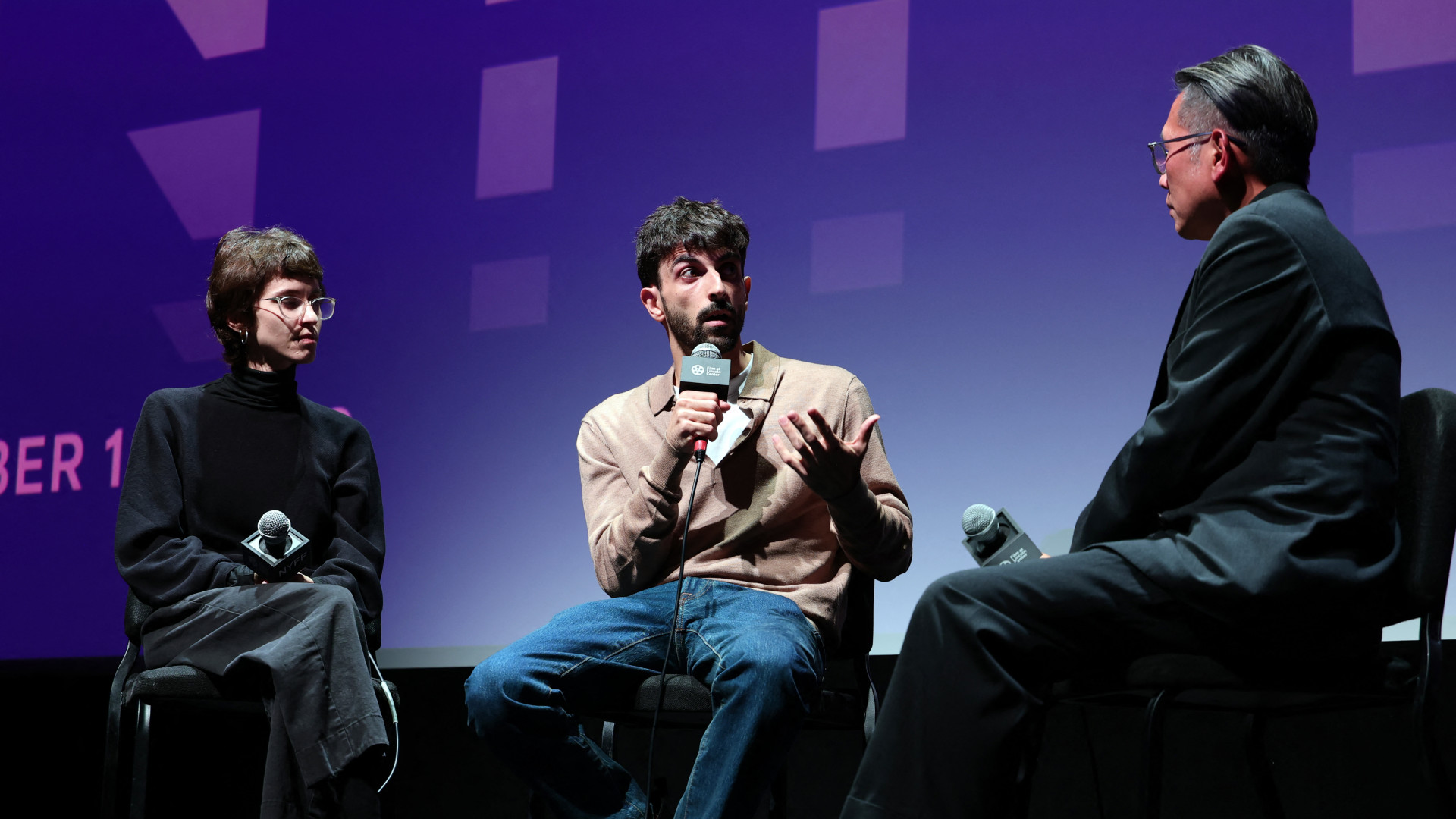
Submitted by Dr Omar Abdel-Mannan on Wed, 10/07/2026 - 07:30 A film built on Israeli soldiers' accounts wins acclaim, while the Palestinian doctors and journalists who documented the genocide in Gaza for three years struggle for recognition Rachel Szor and Yuval Abraham, with the festival's artistic director Dennis Lim, speak onstage at the premiere of Naza at the New York Film Festival on 26 September 2026 (Dimitrios Kambouris/Getty Images via AFP)
On
Rachel Szor and Yuval Abraham, with the festival's artistic director Dennis Lim, speak onstage at the premiere of Naza at the New York Film Festival on 26 September 2026 (Dimitrios Kambouris/Getty Images via AFP)
On
Would anyone be calling Naza a masterpiece if a Palestinian had made it?
The filmmaker Daniele Rugo and I were asking each other that as we walked out of a screening at the Zurich Film Festival of the new documentary in which 24 anonymous Israeli soldiers and intelligence officers describe how they killed Palestinians in Gaza. Daniele's own film, Life Support, which my organisation, Health Workers 4 Palestine, is proud to have backed as associate producers, was having its international premiere
Between us, we had watched Palestinian doctors, nurses and journalists document the destruction of Gaza in real time for three years, many of them at the cost of their lives. Neither of us could remember their work being received like this.
Since its premiere in Venice, where it won the Special Jury Prize, Naza has been greeted as a reckoning. Critics have called it essential, devastating, the new authority on what Israel has done in Gaza. Its directors, Yuval Abraham and Rachel Szor, made the Oscar-winning No Other Land with their Palestinian colleagues Basel Adra and Hamdan Ballal.
Their new film, produced by the Guardian with Jonathan Glazer as executive producer, sits its witnesses on Tel Aviv rooftops at night, faces hidden, and lets them explain, calmly and in detail, how the killing was done.
It is an important document, and it took courage to make, but our question would not go away. Had a Palestinian filmmaker brought us the same truth from the other end of the rifle, would it have premiered in Venice, been co-produced by a national newspaper and been talked about for the Oscars? We both suspected we knew the answer.
No confession needed
The title, Naza, is a Hebrew military acronym for collateral damage: the civilians Israel decides in advance it is willing to kill. The rules of engagement described in the film allowed for up to 20 of them per target. That number alone should end any remaining debate about intent.
What stayed with me, though, was less a statistic than the tone. These men and women are billed as whistleblowers, but whistleblowing implies conscience. What I heard instead was procedure: targets sketched on notepads, strikes recounted like shift handovers, homes full of families reduced to a ratio. Some had doubts about strategy, or about whether any of it worked, but remorse for the people they killed was almost entirely absent.
We never needed them to confess, because the genocide has been on camera, in full, from the beginning, filmed by the people living through it and by those who went in to treat them
Their faces are hidden and their names will never be known. Palestinians and their supporters who have criticised the film for shielding self-confessed war criminals are right to ask what accountability looks like when perpetrators are granted both anonymity and a festival premiere.
Doctors are trained to listen for what patients leave out. What these soldiers leave out is "sorry".
We never needed them to confess, because the genocide has been on camera, in full, from the beginning, filmed by the people living through it and by those who went in to treat them.
Gaza: Doctors Under Attack, directed by Karim Shah, documented the systematic destruction of Gaza's health system: hospitals besieged, medics detained, colleagues killed. The BBC commissioned it and then refused to broadcast it, and it took Channel 4 to finally show it, in July 2025.
Daniele's film, Life Support, follows international doctors who entered Gaza between October 2023 and September 2025. It is built from footage they shot on their phones in overwhelmed wards and from the work of two Palestinian cinematographers from Gaza, Mahmoud Abou Hamda and Suleiman Hejjy. You see children treated on hospital floors, and formula, pain relief and surgical instruments held at the border. More than 1,700 health workers have been killed. Nothing on screen needs explaining.
Yes, most of the doctors speaking are white and British, but they know exactly why they are on screen. They centre their Palestinian colleagues throughout, the ones working marathon shifts while grieving their own families, and describe themselves as a vessel for those colleagues to be heard.
That is the film's Trojan horse: a familiar face from an NHS hospital brings in audiences who would never otherwise sit through a film about Gaza, and then hands the story back to the Palestinians it belongs to.
Rather than asking you to infer genocide from the testimony of those who carried it out, these films show you its consequences on the bodies of children.
Believing Palestinians
Why does Naza get the red carpet when Palestinian testimony so rarely does? Part of the answer is uncomfortable, and we should say it plainly.
Western audiences have been trained to treat Palestinian testimony as suspect, and for three years Palestinian doctors and journalists were dismissed as propagandists. The death toll, now more than 74,000, was footnoted as "according to the Hamas-run health ministry" until it could no longer be denied. Palestinian journalists have been killed in record numbers telling this story, and still their reporting was treated as a claim rather than a fact.
When an Israeli filmmaker presents the same reality through the mouths of Israeli soldiers, it suddenly becomes credible, essential, Oscar-worthy. That is not the fault of Abraham and Szor, who have consistently used their platform to amplify Palestinian voices. Szor herself has acknowledged that "Palestinian journalists have been reporting this for the last years".
It is the fault of an industry and a press that will only believe Palestinians once an Israeli vouches for them, and no appeal to balance or to standards of evidence changes what that is: anti-Palestinian racism.
Look at how other films have fared. Built from footage his own medical team shot on their phones, The Mission follows the British-Iraqi surgeon Mohammad Tahir through Gaza's collapsing operating theatres. It is every bit as devastating as Naza and shows the genocide through the eyes of an Arab doctor, yet it was reportedly turned down by every major film festival.
Gaza: Doctors Under Attack was shelved by our national broadcaster and only reached audiences through Channel 4, before going on to win a Bafta. Meanwhile, a film centring the perpetrators was co-produced by a national newspaper and celebrated in its pages.
I am not asking anyone to boycott Naza. Watch it, and let it strip away the last excuse anyone has for saying they did not know, but do not mistake it for the definitive account. That belongs to the people of Gaza, and to the doctors, nurses and paramedics, Palestinian above all, who stayed and kept working while their hospitals were bombed around them.
If you watch one film about Gaza this autumn, make it three. Watch Naza to understand how the killing was organised, then Life Support and Doctors Under Attack to see who it was done to. Ask yourself afterwards which you were more ready to believe, and why.
The views expressed in this article belong to the author and do not necessarily reflect the editorial policy of Middle East Eye.
Film Opinion Post Date Override 0 Update Date Mon, 05/04/2020 - 21:29 Update Date Override 0Read the full story at the source
Source: Middle East Eye