
World · Middle East Eye · · 3h
Gaza: One year after ceasefire, killing and displacement of Palestinians persist
English (original) · Read in Deutsch ⇄
Gaza: One year after ceasefire, killing and displacement of Palestinians persist
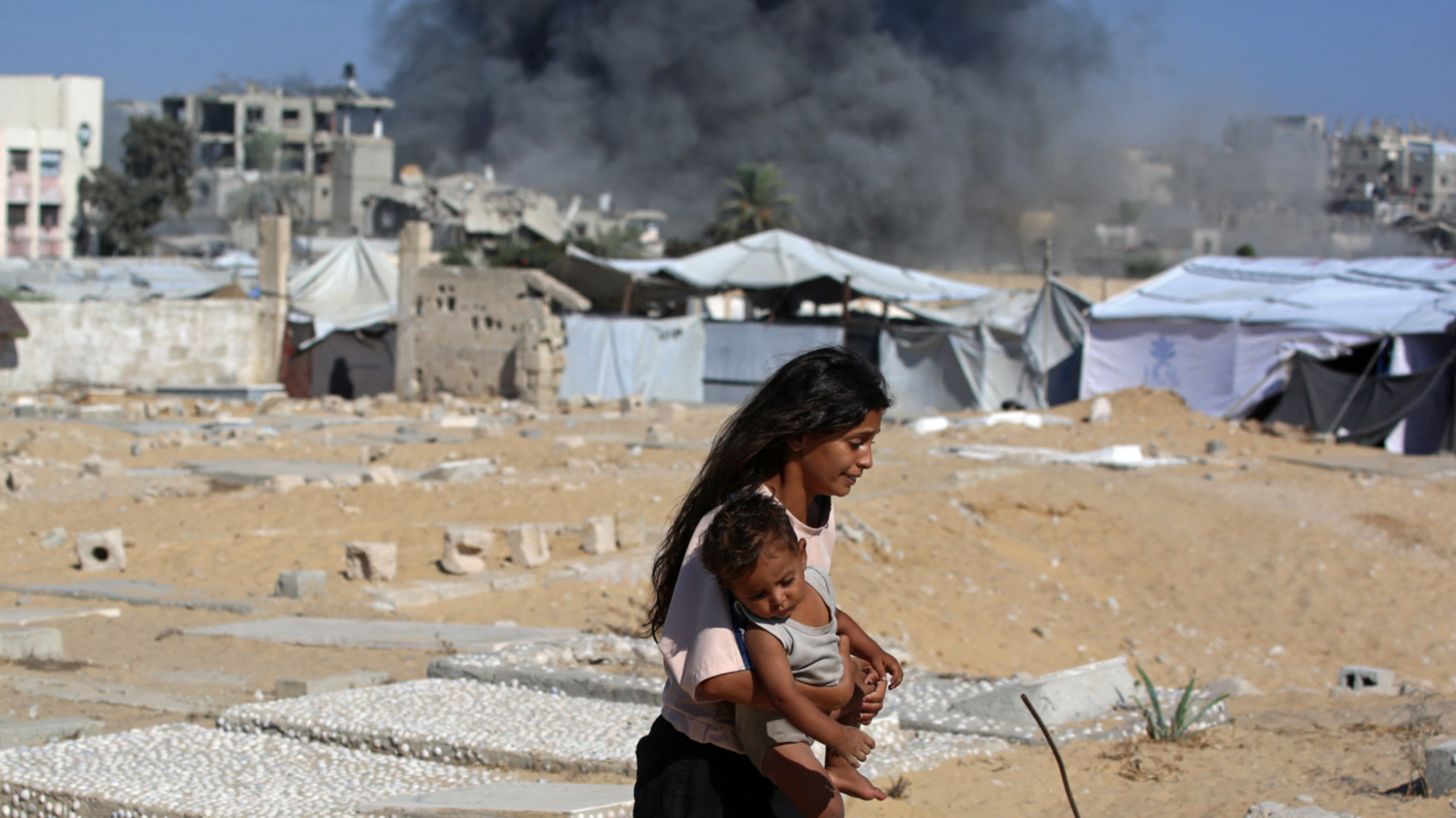
Submitted by Maha Hussaini on Wed, 09/16/2026 - 13:17 Israeli expulsion orders, incursions and the threat of renewed starvation are keeping Palestinians in a state of permanent insecurity despite the truce A Palestinian girl carries a child against the backdrop of smoke rising from a house that was targeted by an Israeli strike in Khan Yunis, southern Gaza Strip on 9 September 2026 (AFP/Bashar Taleb)
Off
A Palestinian girl carries a child against the backdrop of smoke rising from a house that was targeted by an Israeli strike in Khan Yunis, southern Gaza Strip on 9 September 2026 (AFP/Bashar Taleb)
Off
Om Siraj al-Muzeini was preparing soup for her sick child when she heard a commotion outside her tent in western Gaza City.
People were running and calling out to each other, repeatedly asking: “How much time do we have?”
The sound was familiar. She quietly prayed she was wrong.
“An evacuation order for the entire block,” a displaced neighbour told her, as she gathered her belongings and prepared to flee with her children.
Terrified and with no time to decide what to take, the widow grabbed her son and rushed out of the tent.
“I ran with my son to nowhere. I couldn’t decide where to go. I wasn’t prepared for this, especially since the last evacuation order in my area was issued before the ceasefire,” Muzeini, originally from the Shujaiya neighbourhood of eastern Gaza City, told Middle East Eye.
“The entire neighbourhood fled, including residents and people displaced in tents. Some went to relatives’ homes. I waited with my son in another neighbourhood until the threatened area was bombed.”
Shortly after the order was issued, an Israeli fighter jet bombed a building in the neighbourhood.
 There is no ceasefire in Gaza
Read More »
There is no ceasefire in Gaza
Read More »
The forced evacuation of al-Abbas block in western Gaza City on 8 September was one of a series of expulsion orders issued by the Israeli military across the devastated Gaza Strip in recent weeks.
Other orders were issued on the same day in different locations.
Orders like this were supposed to end in October last year, when a ceasefire was agreed to end Israel’s genocide in Gaza by stopping the daily attacks and allowing aid to flow into Gaza.
But Israel has repeatedly violated the US-mediated agreement, carrying out near-daily attacks and restricting the entry of much-needed aid.
Nearly a year on, residents say the genocide continues, albeit with far less media attention.
‘Reliving the war’
One manifestation of the ongoing war is the use of expulsion orders, perpetuating a displacement and shelter crisis fuelled by Israel’s vast destruction of homes during the war.
The orders typically give residents no fixed timeframe for leaving or returning. They may have only minutes or hours to flee, with no indication of when it will be safe to come back.
Yet even areas that receive no prior warning are frequently bombed, killing and wounding multiple civilians at once.
“The evacuation orders are meant simply to disrupt our lives and keep us in a constant state of insecurity, even during the ceasefire,” Muzeini said.
'There is really no purpose to these evacuation orders other than keeping the state of war going'
- Om Siraj al-Muzeini, Palestinian mother
“My sister was killed in an Israeli strike near her tent in eastern Deir al-Balah during the ceasefire.
“So there is really no purpose to these evacuation orders other than keeping the state of war going. Honestly, I feel like we are reliving the war all over again.”
Five days earlier, on 3 September, Kamal Adwan Hospital and its surrounding area in northern Gaza were forced to evacuate following a sudden Israeli incursion beyond the so-called “yellow line”, amid intense gunfire.
At least two Palestinians, including a child, were killed in the attack and many others were wounded.
Since the ceasefire agreement, 1,381 Palestinians have been killed in ongoing Israeli attacks - an average of roughly four people a day.
Another 4,757 Palestinians have been wounded, according to the Palestinian Ministry of Health in Gaza.
Constant threat of displacement
But the bombardment is only one of the “three worst sides of the genocide we have experienced”, Ahmed Jendiya, a resident of eastern Gaza City, told MEE.
“The other two sides are still ongoing: the constant incursions and forced displacement, and the starvation that continues to haunt us every day.”
Jendiya, 31, lost his home in eastern Gaza during the first year of the genocide. Since then, he has lived with his family in a tent beside its rubble.
Around two months ago, he prepared an emergency evacuation bag in case the yellow blocks used by the Israeli army to mark its “yellow line” were suddenly placed in his neighbourhood.
 Israel’s expanding ‘Yellow Line’ swallows Gaza districts and uproots families
Read More »
Israel’s expanding ‘Yellow Line’ swallows Gaza districts and uproots families
Read More »
“When we returned from the south following the ceasefire agreement, the yellow line was around one kilometre away from us. Today, it’s only around 200 metres away,” he said.
“Every night, it feels like the war has returned. The Israeli occupation forces open intense fire towards our areas, and we barely survive the bullets.
“The entire area turns into a battlefield, and all we can do is lie on the ground and cover our children’s heads.”
Jendiya said the neighbourhood’s evening conversations now revolve around where people could go if the “yellow line” reached their area.
“Every evening, the men in the neighbourhood gather to chat and discuss daily matters. In the first weeks of the ceasefire, our conversations revolved around whether our homes would be rebuilt, and whether we would rebuild them ourselves,” he said.
“For the past six months, our discussions have turned to asking each other whether we have somewhere to go and when we should decide to leave.
“These are the same discussions we used to have during the genocide before the ceasefire, exactly the same.”
The shadow of starvation
The “yellow line” is a military boundary unilaterally established and marked by Israeli forces inside Gaza following the US-brokered ceasefire in October.
It effectively designates a no-go zone, restricting Palestinian access to large areas of northern, southern and eastern Gaza under threat of lethal force.
Since the ceasefire took effect, the line has progressively moved westwards, cutting into civilian neighbourhoods and extending across roughly 70 percent of the strip.
Israeli forces mark each new expansion by placing yellow concrete blocks within populated civilian areas.
But for Jendiya, the greater fear is not displacement. It is being unable to feed his children again.
'If the borders are closed again, we will fall into starvation even faster this time'
- Ahmed Jendiya, Gaza City resident
Although Israeli authorities partially reopened the crossings for goods and international aid into Gaza following the ceasefire, around 1.4 million people - 64 percent of the population - are still experiencing crisis-level or worse acute food insecurity, classified as Phase 3 or above under the Integrated Food Security Phase Classification (IPC) system.
Before the ceasefire agreement, at least 453 Palestinians, including 150 children, died from severe malnutrition in Gaza, according to the Palestinian Ministry of Health.
Hundreds of residents continued to suffer from malnutrition-related health problems after the ceasefire.
“Many food items have been banned and permitted several times over the past few months. This leaves us in a constant state of uncertainty. Whenever we eat something today, we fear we may not find it tomorrow,” Jendiya said.
“Most of the farmland has already been destroyed and there is no livestock left. We are completely dependent on aid and goods permitted by the occupation.
“We know that if the borders are closed again, we will fall into starvation even faster this time.”
Israel's genocide in Gaza Gaza City, occupied Palestine ‘Reliving the war’: One year after ceasefire, killing and displacement persist in Gaza News Post Date Override 0 Update Date Mon, 05/04/2020 - 21:19 Update Date Override 0Read the full story at the source
Source: Middle East Eye