
World Left Voice
The Decline of Macronism and the Crisis of State Authority
October 17 opened a pre-revolutionary period in France. The question now is whether the students and their working class allies can expand, organize themselves, and win the political independence requ
English (original) ·Read in Deutsch ⇄
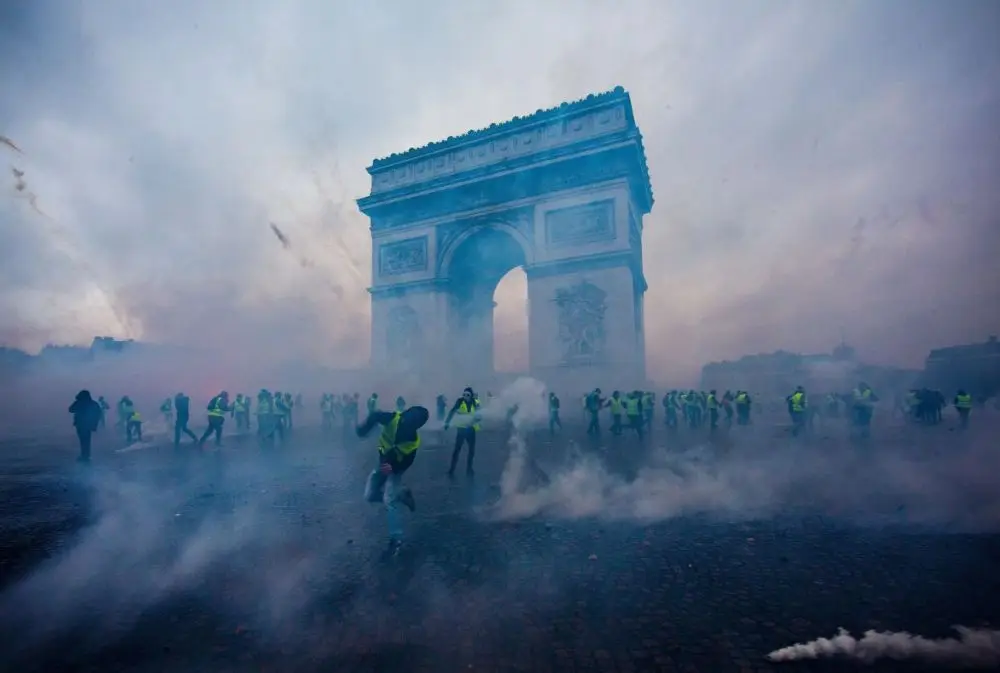
“Why did no one see it coming?” various analysts ask, following the mass demonstrations that rocked France on October 17. The bewilderment reflects the distance between the predictions of those in power and the depth of pent-up rage. Those who expected a limited protest found themselves facing a mass mobilization whose determination, in several places, broke through the security arrangements put in place to contain it.
The surprise has political roots. Successive governments have repeatedly mistaken the defeat of mobilizations for the disappearance of the capacity to rebel. They have interpreted weariness as resignation, and the difficulty of imposing an alternative as acceptance of the existing order.
This powerful upsurge reveals, once again, just how much had accumulated beneath that apparent normality. Since 2016, France has become a laboratory of class struggle. Different sectors have experimented with methods of struggle, confronted repression, and come up against the limits of their leaderships’ strategies. The events of October 17 draws on part of that experience and raises a decisive question: How can the willingness to confront those in power be transformed into a force capable of winning?
October 17 introduced an element that qualitatively transforms the advanced erosion of Macronism: sectors of the youth and popular classes went into action on a scale and with a determination that challenged the state’s ability to impose order.
We are witnessing one of the symptoms that Lenin identifies in The Collapse of the Second International when he defines a revolutionary situation: an extraordinary intensification of mass activity, with the masses drawn by the crisis and by the rulers themselves into independent historical action. Lenin links this phenomenon to a crisis of the ruling classes and an exceptional worsening of the suffering of the oppressed.
In the French case, the combination of a prolonged political crisis at the top and this independent irruption from below allows us to speak of the opening of a pre-revolutionary period. Its distinctive feature is that the erosion of power is beginning to collide with a social force capable of materially hindering the exercise of its authority. The still-uneven intervention of the workers’ movement and the weakness of the organs of self-organization leave open how far this dynamic can develop.
The significance of Lenin’s formulation lies in the fact that it places the initiative of the masses at the center of the analysis. The political crisis shifts when sectors that are usually subject to decisions made by others begin to intervene directly in those very decisions. This independent action does not yet presuppose a common program or its own leadership: it expresses the seizing of an initiative capable of altering the course of events.
Samuel Hayat sees the police being overwhelmed as part of a deeper erosion of state authority. The state requires its decisions and hierarchies to be recognized as legitimate. Among sectors of the youth, this acceptance is weakening.
Those entering the struggle today have known governments that turn a deaf ear to mass mobilizations, degrade public services, and protect the interests of the wealthiest. Even electoral rebukes seem unable to change the course of policy. The promise of upward mobility through effort in school loses credibility when educational credentials lead to uncertain prospects.
This experience calls into question the legitimacy of those in power to demand obedience. Mockery and images shared on social media help erode the distance that shields authority: a feared power now appears as something that can be challenged. Drawing on the work of historian Roger Chartier on the French Revolution, Samuel Hayat notes that “the end of the Old Regime had been made possible by a long process of desacralization of traditional authorities, notably through practices of sociability that escaped their control.” He suggests an analogy to the present day: “Everything seems to indicate that a similar process is at work today.”
The experience of resisting together also changes how those mobilized perceive themselves. Seeing for themselves that they can regroup, hold the streets and break through police lines fuels confidence in their collective capacity to act. The loss of authority of those in power thus finds its counterpart in protesters discovering and expanding a force of their own.
Data from the French research institute L’ObSoCo allow us to place this readiness within a broader social climate. Before October 17, 57% of those who expressed an opinion on the question believed that violent activist actions would be necessary to compel political leaders to take public opinion into account. This figure does not measure an individual willingness to take part in such actions, but it does show how widespread the perception is that the usual channels are insufficient to be heard.
The Gramscian notion of a “crisis of authority” helps us to understand how the erosion of political leadership can compromise broader relations between rulers and ruled. However, this concept loses its analytical power if it is reduced merely to the discrediting of political parties or a decline in consent.
The problem in France becomes more acute when this estrangement fuels action that materially hinders the exercise of power. Bans meet resistance; containment measures are overwhelmed; regaining control of public space requires greater effort than anticipated.
This does not mean that the repressive apparatus is fractured, nor that the state has lost control overall. There is a difference between an overwhelmed police operation, a prolonged crisis in maintaining order, and a rupture of state cohesion. Conflating these levels would lead to overstating the adversary’s weakness.
Nevertheless, reducing what occurred to technical failures would be equally mistaken. When the scale and determination of a mobilization render the usual means insufficient, the operational problem expresses a political relation: those in power meet a resistance that their ordinary mechanisms can no longer absorb.
Reconstructions of the day’s events show how the proliferation of protest flashpoints and the mobility of the protesters forced the police to pull back in several cities. An underestimation of turnout combined with the attrition accumulated over weeks of high school revolt. Planning errors mattered, but their significance can only be understood in relation to the force they came up against. The decline of Macronism is thus beginning to turn into a broader crisis of authority. Initiative from below deepens the crisis at the top and changes its very nature.
The government seeks to restore an obedience that has, in practice, been broken. The central role of the law-and-order response stems from this need: to regain control of public space, divide the mobilized sectors, and demonstrate that challenging its decisions carries an unbearable cost.
The repressive offensive also aims to impose its own standard for which forms of political action are legitimate. By recognizing certain interlocutors and criminalizing initiatives that outflank them, those in power try to steer mobilization back into channels that they can manage and negotiate within.
Repression can yield results. It can intimidate and wear people down, especially if labor organizations leave the youth isolated. But escalation carries growing risks. If the security deployment is overwhelmed, those in power display their powerlessness, which may encourage new challenges. If it multiplies its victims, it may spread outrage and draw in sectors that had so far remained on the sidelines. The images of dozens of young people crammed in appalling conditions at the Bobigny courthouse detention center; the attack on the right to protest that Emmanuel Macron openly embraced this week, or the deployment of the army and the elite tactical units RAID, GIGN, and BRI to control the marches –all of these could backfire on a delegitimized government. The outcome will depend on the social and political response it meets.
Act II on October 24 showed that intimidation had failed to stamp out the mobilization. From Paris to Marseille, crowds marched through the streets. Bans on demonstrations were defied, at least in part, in Nantes, Lyon, Bordeaux, Lille, Metz, Tours, Montpellier, Sens, Besançon, Caen, Annonay, Lorient, and Le Havre. Repression also fuels determination, as summed up by a slogan seen on several signs in Paris: “I was afraid to come; that’s why I’m here.”
In Paris, the massive turnout coexisted with a sense of bitterness over having been relegated to the area around the Périphérique, the ring road encircling the city. This dissatisfaction may also express a desire to go further: having marched is not enough when those in power manage to keep the protest at a distance. The government was able to channel the march geographically, but that containment does not mean the participants’ determination has been defused.
Furthermore, coercion requires resources, coordination, and cohesion. Sustaining an extraordinary effort over a prolonged period places a strain on the apparatus itself. Its capacity must be assessed concretely, without imagining it as an unlimited reserve of force.
The government may regain ground through repression. It is more difficult, however, to turn these gains into lasting authority while the causes of the revolt remain unresolved. The headlong rush into security measures displaces and concentrates the very contradictions it seeks to resolve.
One such contradiction lies in the economic foundations of the government’s policy. It aims to regain consent while maintaining an orientation that degrades living conditions and fuels the revolt. Financial pressure and commitments to deficit reduction narrow the scope for addressing social demands, while preserving the interests of big property owners. The demand for austerity thus clashes with a population that rejects further sacrifices. While those in power retain the option of making cosmetic concessions, a substantive response on education, wages, and public services would require confronting the interests of big capital that their policy protects.
This contradiction allows us to understand why the exhaustion of Macronism could jeopardize something broader than the fate of its president. Its potential successors would inherit the conflict between the demands of the ruling classes and the popular aspirations that the mobilization has brought to the fore. Their responses would differ, but they would all have to solve the same problem: which social forces to rely on and whom to make pay for the crisis. Hence a change of government does not, by itself, guarantee a lasting reconstitution of state authority.
The erosion of Macronism may offer the far right an opportunity to present itself as the force capable of reconstituting state authority. Its argument is to blame the crisis on the government’s weakness and to promise a capacity to command that, it claims, the government has lost.
A way out of the crisis led by Le Pen would seek to rely on the presidential, administrative, and police instruments of the Fifth Republic, deepening its authoritarian character and articulating it with a policy of national and racial exclusion. The promise of order would make it possible to bring together diverse aspirations and interests: propertied sectors concerned about instability, frightened fractions of the middle classes, and popular layers that would be offered a racist explanation for their social decline.
Le Pen’s project can be framed in terms of a Bonapartist reconstitution: an attempt to strengthen the executive power and its autonomy from society, presenting it as arbiter and savior of a threatened nation, while preserving the fundamental relations of domination.
Carrying it out would require rallying support among the ruling classes, building a social base for reaction and containing or defeating mobilized sectors. Winning executive power at the ballot box would not, by itself, accomplish those tasks.
The very depth of the crisis that creates an opening for the far right could also become an obstacle to stabilizing its government. The demand for authority does not guarantee the existence of a force capable of satisfying it lastingly, even less so when the current revolt reveals the strength of “anti-far right” sentiment, which is one of the main concerns at high school students’ marches or blockades.
For the time being, the far right appears to be channeling the expectations of the “party of order.” However, new leaps in the class struggle and, above all, the decisive entry of the workers’ movement into the struggle could strengthen another attempt to resolve the crisis: a left-wing governmental alternative that would channel popular aspirations toward an institutional way out.
Mélenchon could play a central role in such an attempt. It would take on the character of a popular front if it were to articulate workers’ and popular organizations with bourgeois political forces under a common governing strategy, subordinating independent mobilization to the preservation of that alliance and the continuity of the capitalist state.
Its strength would come from an understandable expectation: to translate the energy of the struggle into immediate gains, to halt the repression and to oust those who govern. But that expectation would come into contradiction with a strategy that, to preserve its alliances and institutional viability, would need to contain the initiative of the very people who had propelled it.
The promise to give political expression to the movement could thus turn into a mechanism for handing the initiative back to the institutions: moderating demands to retain support, calling off strikes to facilitate a transition, or subordinating the organs of struggle to the electoral calendar.
This outcome is not inexorable. A deeper mobilization could strengthen Mélenchon and, at the same time, generate experiences and aspirations that outgrow his strategy. The decisive question is whether workers and youth build and defend their own means of deliberation, organization, and action, maintaining their independence, including from those who present themselves as their representatives.
Mobilization can provoke movements of reaction in other social sectors. The reports of store owners preparing to defend their businesses, some by acquiring weapons or means of self-defense, deserve attention. For now, the available information does not allow us to establish the overall extent of these initiatives.
The racist attack in Trappes and La Verrière introduces a particularly grave dimension. According to Le Monde, the alleged perpetrator told police that he wanted to avenge the store owners whose shops had been looted on October 17, and that he selected his victims based on their skin color. The attack left one person dead and five others injured.
These statements show how the appeal to order can turn into a justification for racist terror: people selected for their appearance are held collectively responsible for social disorder. The purported defense of the store owners thus serves to legitimize reprisals against racialized populations, regardless of whether they actually participated in the events.
Private defense of property and racist violence are different phenomena, and their articulation should not be taken for granted. However, the motive attributed to the attacker reveals a concrete mechanism through which they can be connected: the racist identification of those deemed responsible for disorder transforms the demand to protect property into a will to punish entire sectors of the population.
This turn to violence does not, by itself, prove the existence of an organized reaction. But it gives concrete form to one of the dangers of the current situation: that the criminalization of the revolt and its identification with the enemy within could fuel violent initiatives against popular and racialized sectors. The demand for order can offer a meeting ground for social fears, defense of property, and reactionary projects.
Fighting this threat requires linking the defense of the movement against repression with the struggle against racism. Solidarity organized in workplaces, schools, and neighborhoods must prevent reaction from isolating the most exposed sectors and fracturing those who share conditions of exploitation and precarity.
The situation poses a twofold difficulty. Those in power face growing obstacles in enforcing obedience, while those who challenge them have not yet built an equivalent capacity to set the political course.
The irruption of the youth is also beginning to shift the position of union leaderships. On October 21, as she left Matignon, the prime minister’s office, CGT general secretary Sophie Binet called for moving to a new stage through strike action and for organizing workplace assemblies to generalize the strike on November 5 and beyond. The CGT, one of France’s two largest union confederations, formalized this call in its statement the following day.
This shift allows us to gauge the pressure that the mobilization is exerting on the traditional organizations of the workers’ movement. But it raises a decisive question: how to turn those statements into effective preparation for the strike without leaving the youth isolated until November 5. Cross-sector assemblies, known in France as interpros, can serve right now to decide on actions, organize solidarity, and establish direct links with mobilized youth.
The generalization of the strike needs to be built during this interval. One challenge is to set back in motion sectors that were in the vanguard of the struggles against Macron —oil refinery workers, rail and Paris public transit (RATP) workers, electricity workers, and sanitation workers— by drawing on their experience and discussing how to overcome the weariness and skepticism left by the 2023 defeat.
Another challenge is to bring in precarious workers, whose participation on the streets is suggested by the occupations of some of those arrested on October 17: delivery workers, cooks, temp workers, and others. The task is to build a link between that willingness to mobilize and collective organization in their workplaces.
Preparing November 5 as a genuine active strike requires discussing its organization now: assemblies, picket lines that sustain and extend the strike, outreach tours, and efforts to win over workers at the strategic centers of production, transport, distribution, and finance.
More strategically, the entry of the workers’ movement with its own methods of struggle can change the terrain of confrontation: extending it from the streets to the places where wealth is produced and circulates, bringing in sectors that still remain on the sidelines, and offering a common reference point for scattered demands.
The general strike would turn the difficulty of those in power in controlling the streets into a confrontation over the functioning of the country. As Trotsky writes in Once Again, Whither France?:
Whatever may be the slogans and the motive for which the general strike is initiated, if it includes the genuine masses, and if these masses are quite resolved to struggle, the general strike inevitably poses before all the classes in the nation the question: Who will be the master of the house?
This dynamic does not automatically follow from a one-day national strike. It entails a process of extension of the strike and the entry of new sectors into action, as shown, under its own specific historical conditions, by the chain of events linking the youth revolt and the workers’ strike in May 1968. Preparing for this perspective requires that workers discuss and decide in their workplaces, articulate their demands with those of the youth and build organs capable of sustaining the struggle and contesting its direction.
Workplace and school assemblies, mandated delegates, and interpro meetings serve a concrete function in this process. They make it possible to discuss objectives, decide on actions and build an authority born of the mobilization itself. They can also articulate the defense of democratic liberties and the struggle against racism with social demands, preventing reaction from fracturing those who share conditions of exploitation and precarity.
The fight for the release of those arrested and for amnesty for those persecuted for taking part in the movement can become a common rallying point for this organizing effort. In the face of the attempt to isolate and punish the most exposed sectors, solidarity must be rooted in workplaces and schools, making the defense of those targeted by repression the responsibility of the movement as a whole.
October 17 revealed a force whose political expression remains open. Its future will depend on whether the determination it displayed finds lasting forms of organization, extends workers’ intervention, and wins political independence. The crisis of authority opens up a possibility: to transform the capacity to challenge power into a force of the exploited capable of contesting the course of society.
Originally Published in Revolution Permanente on October 25, 2026