
World · Left Voice · · 1h
Rubio’s Imperialist Tour Signals a New U.S. Push for Control in Latin America
English (original) · Read in Deutsch ⇄
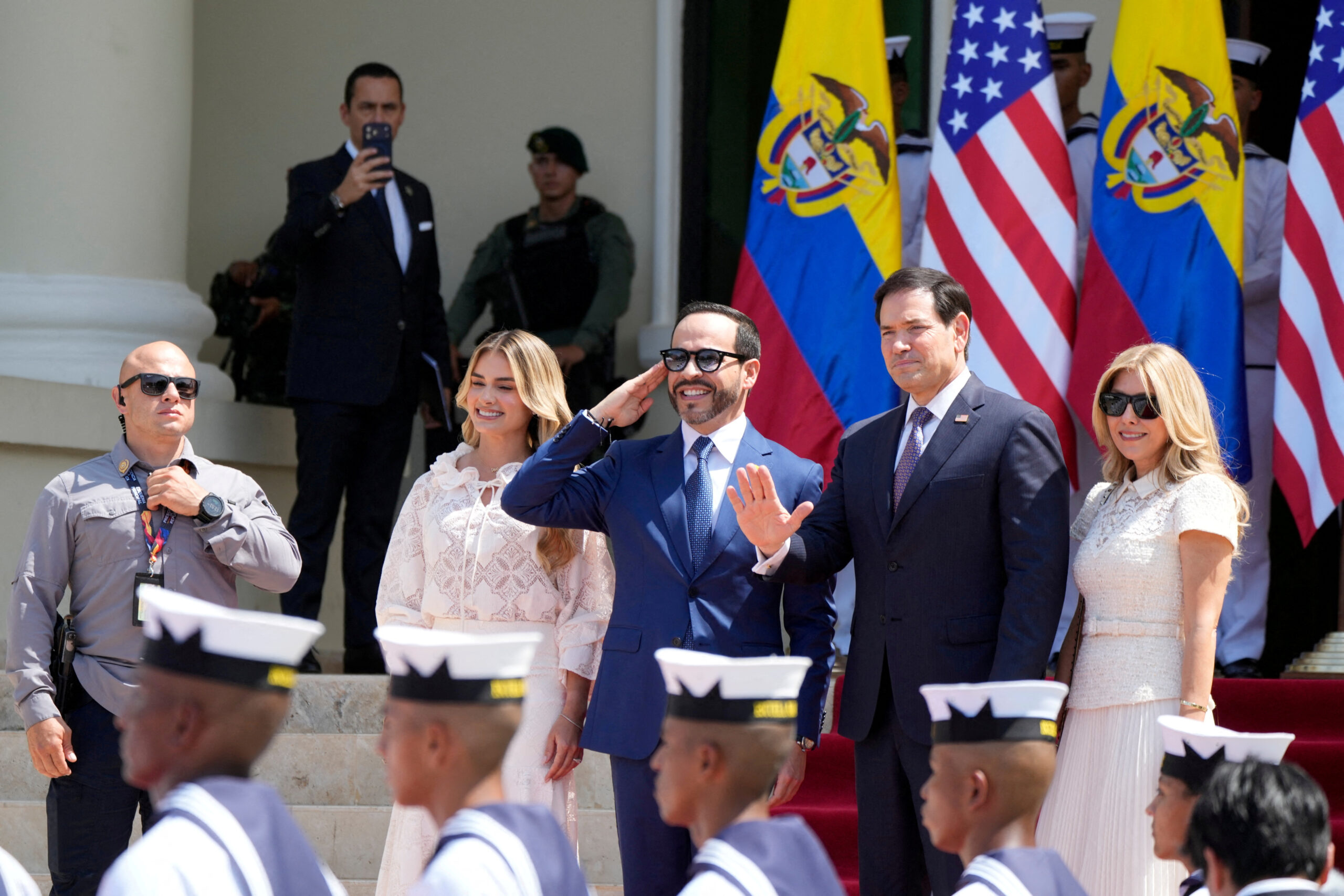
Marco Rubio toured Latin America from Tuesday, September 8 to Thursday, September 10, visiting Colombia, Ecuador, and Peru. The trip came at a time when Washington is accelerating an offensive to rebuild its dominance over the region, uniting right-wing and far-right governments around a common agenda of security, militarization, border control, and a supposed fight against drug trafficking, which also includes curbing China’s economic and political power.
Washington’s rhetoric remains focused on combating drug trafficking and organized crime. But the United States has been using the so-called “war on drugs” for decades as a tool to expand its military and political presence in our continent. What is new now is the scale and the speed.
Trump is advancing his revamped Monroe Doctrine, in which Latin America is once again considered an exclusive strategic space for the United States. The “Shield of the Americas,” politically designed by Rubio and backed by the Pentagon, is part of this strategy. The meeting of U.S., Ecuadorian, and Colombian military officials, held on August 28 in San Lorenzo, in northern Ecuador, was just one chapter in a much broader policy: the United States seeks to reorganize the hemisphere militarily and politically under its control.
The first stop was Colombia. In Barranquilla, Marco Rubio met with Colombian president, Abelardo de la Espriella, barely a month after the new far-right president took office. The chosen venue was also significant: the meeting took place at the Paraíso Battalion, which the Colombian president had converted into an alternate presidential residence. The image of the two leaders, surrounded by military personnel, aptly summarizes the nature of the new relationship Washington intends to establish with Bogotá.
De la Espriella proposed making Colombia the United States’ “principal hemispheric security partner” and declared that among his objectives is “to shield the hemisphere,” while presenting his so-called Patriot Plan 21st Century, an obvious reference to Plan Colombia of the late 1990s, which envisions the modernization of Colombian military capabilities through radars, drones, intelligence, and other equipment.
Colombia has already joined Operation Shield of the Americas, the coalition launched by Trump under the guise of fighting drug cartels and “narco-terrorism.” This didn’t happen in a vacuum. Just a few days ago, the head of the U.S. Southern Command, Francis L. Donovan, was in Colombia, visiting Tumaco and meeting with the military leadership. Discussions included the installation or relocation of radar systems to monitor the Pacific, the modernization of the Colombian air fleet, and the strengthening of intelligence operations.
The de la Espriella administration appears determined to make Colombia one of Washington’s main platforms in South America. This is due not only to its geographic location — with access to the Caribbean and the Pacific and borders with Venezuela and Ecuador — but also to its historical role as the United States’ principal military ally in the region. The new Colombian administration has also authorized joint U.S. military operations against drug trafficking on Colombian soil.
The next stop on the trip was Ecuador, one of the most advanced testing grounds for Washington’s policy. . President Daniel Noboa’s government long ago used the “war on drugs” as justification for permanent militarization. This is compounded by the active presence of U.S. forces and Ecuador’s participation in the Shield of the Americas operation. We are witnessing a militarization that is expanding while repression against Indigenous communities, farmers, and workers is increasing.
The last stop on the tour was Peru, where Rubio met with President Keiko Fujimori, who took office on July 28. Washington has already announced its intention to fully integrate Peru into this regional framework. The country is a key player in the Pacific dispute and maintains a strong presence of Chinese investment. Peru thus joins a growing network of governments aligned with Trump’s strategy, and its inclusion in the Shield of the Americas reinforces the South American dimension of the project.
Washington seeks to militarily secure a continent rich in oil, gas, critical minerals, biodiversity, water, trade routes, and strategic geographic positions. For this reason, the so-called Barranquilla Agreements, signed on Tuesday, also include memoranda of understanding on critical minerals and rare earth elements, as well as on civilian nuclear energy.
Before embarking on his tour, Rubio himself defended U.S. intervention in the Venezuelan oil sector, arguing that fields previously linked to Chinese, Russian, and Iranian companies could generate revenue through partnerships with the United States. This statement reveals that the dispute over strategic resources is part of the same offensive.
The border between Colombia and Ecuador, the Pacific Ocean, and the maritime routes to Central America constitute strategic areas for Washington. Military cooperation in this region allows for the coordination of intelligence, surveillance, radar, naval operations, and air capabilities. Therefore, the Southern Command meeting in San Lorenzo, joint military operations, Operation Shield of the Americas, Rubio’s tour, and the new trade and strategic resource agreements are all part of the same offensive.
Washington wants our countries to accept as normal the participation of U.S. military personnel in operations within their territories, the coordination of Latin American armed forces by the Southern Command, the transformation of borders into militarized spaces, and the placement of strategic resources at the service of U.S. geopolitical needs.
It’s not security, it’s imperialist subordination. It’s not a fight against drug trafficking, it’s the use of drug trafficking as a pretext to extend political and military control over the continent. It’s a relationship in which the United States defines the threats, establishes the military priorities, provides the weapons, and seeks to control strategic resource chains.
In this situation, we must confront this U.S. imperialist offensive. Faced with militarization, the surrender of sovereignty, and the plundering of our resources, it is necessary to strengthen anti-imperialism in our countries. The response cannot be left in the hands of so-called progressive governments that negotiate concessions with Washington, as Claudia Sheinbaum does in Mexico or Lula in Brazil. It must arise from the workers, the youth, the peasants, the Indigenous peoples, and all popular sectors.
Originally published in Spanish on September 8 in La Izquierda Diario. It has been lightly edited for clarity.
Read the full story at the source →
Source: Left Voice