
Labour Left Voice
France’s Million-Strong Protests Must Turn into a General Strike
November 5 brought 1.6 million to the streets in France and high strike rates on the railways and in education, confirming workers are joining the youth movement. While the government seeks to channel
English (original) ·Read in Deutsch ⇄
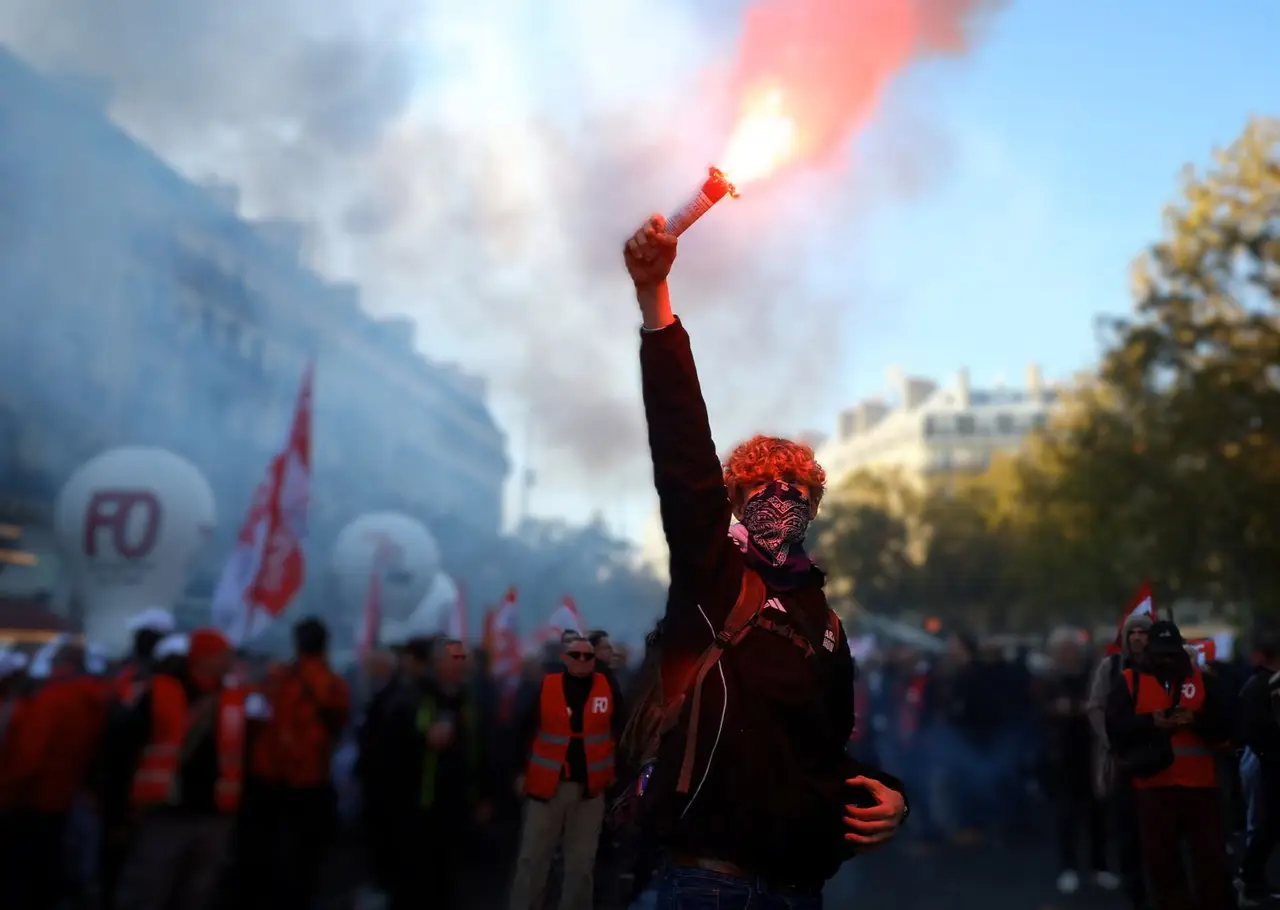
Public discontent was palpable, as the massive protests on October 17, 24, and 31 had already shown. But November 5 marked a leap forward, with nearly 1.6 million protesters, including 350,000 in Paris, according to the CGT labor federation. The mobilization was particularly strong in the major cities: 150,000 protesters in Marseille, 120,000 in Bordeaux, 100,000 in Lille, 80,000 in Toulouse, 55,000 in Lyon, 35,000 in Nantes and Rennes, 30,000 in Rouen, 28,600 in Grenoble, 26,000 in Caen and Strasbourg, 25,000 in Brest, 22,000 in Tours, and 20,000 in Orléans, according to the CGT.
The scale recalls certain days of the 2023 battle over pensions and reflects an outrage that extends far beyond young people and certain sectors of the workforce, sweeping across the entire country.
This widespread participation has led to major strikes across various sectors. At the SNCF (the French national railway company), strike participation was particularly high, ranging from 50 percent to 80 percent depending on the sector, according to management’s own figures.
In the national education system, according to the SNES-FSU union, 52 percent of secondary school staff joined the strike — marking the first majority strike since December 5, 2024 — compared to 38 percent on September 29. Having backed high school students since early October, education staff are thus taking their solidarity with young people a step further.
In the private sector, reports indicate that approximately 50 percent of refinery workers went on strike in Donges, La Mède, and Flandre. The striking workers’ main demands of the striking workers are support for young people and higher wages. Wages are also central for employees at Disneyland Paris, who took action on Thursday to demand raises that keep pace with inflation and lower gas prices.
This day marked a new phase in the convergence of the labor movement and the youth uprising. The latter remained a driving force behind the mobilization, with 1,000 high schools blocked or closed, according to student organizations. At universities, more than 50 campuses were already blockaded as of November 3, roughly half of all campuses, according to the same organizations. And on Thursday, numerous universities saw protests, blockades, and even occupations, such as Jussieu in Paris and Le Mirail in Toulouse.
This convergence was particularly evident in the rallies held across the country and called by interprofessional general assemblies. In Saint-Denis, at Paul-Éluard high school — where 80 percent of the staff were on strike to protest the administrative investigation launched after they opposed the intervention of the BAC (Anti-Crime Brigade) — strikers from the RATP bus depot at Barrage and students from Paris 8 University joined the rally organized by the city’s interprofessional union, before marching toward the Gare du Nord and then on to République.
About a hundred people gathered at 9 a.m. in front of the Châtillon maintenance depot to hear speeches and take part in a joint march organized by the Paris South Interprofessional General Assembly. In eastern Paris, hospital staff and social workers joined high school students and marched, despite police action that led to the arrest of an RP activist. These groups ended up at the head of the Paris demonstration, alongside anti-racist activists, drawing thousands of people around slogans calling for a “general strike” or opposing the Far Right, despite police repression.
The fight against repression has also been a major driver of this solidarity. In Montpellier, SNCF workers, hospital staff, teachers, and university students joined the picket line at Clémenceau high school at the call of the young people. Where police had deployed in large numbers every morning to break up the blockade, they withdrew when the workers and students arrived. In Le Havre, the arrest of four high school students on Tuesday strengthened ties with workers, and several demonstrations — some drawing as many as 1,000 people — were held to demand their release, joined by workers from CIM, Total, Sidel, Stillwater, and Safran. The issue is all the more pressing given that police violently suppressed the protests on Thursday, even charging the inter-union contingent in Toulouse and causing numerous injuries.
More broadly, however, this convergence rests on shared demands. At the Paris demonstration, teachers from Charlemagne high school accompanied their students in a show of support, saying that the students’ demands were also their own: “They want to improve our working conditions.” Wages, the high cost of living, public services, and the future of young people were common causes. In Sens, Lou, a high school student at the protests, summed up this link between generations: “I’m also fighting for my parents, for gas prices, for the cost of living — period.” All these factors could help build a genuine general strike, building on the momentum generated by young people, provided that the right plan of action is developed.
While the mobilization has taken on a new scale and shows a genuine desire to escalate the strike and build momentum, the government is seeking to regain control. On Thursday, Prime Minister Lecornu announced a “social conference” for Monday, responding in particular to a request from the CFDT, the largest labor federation. This initiative aims to steer the mobilization back into the realm of social dialogue, offering some concessions and relying on the union leadership’s willingness to negotiate.
This approach, which relies on the pressure of protests to secure some concessions, is a dead end for winning our demands, as the government’s proposals show, with an initial minimum wage increase of just a few euros. Meanwhile, CFDT General Secretary Marylise Léon is demanding a net increase of €100 in the minimum wage — which does nothing to address the “high cost of living” — and her CGT counterpart, Sophie Binet, is putting the onus on the government instead of calling for an escalation of the strike. What is needed is a battle plan equal to the moment, one that moves toward a general strike by bringing in sectors that have not yet joined the struggle and putting forward demands that inspire people to fight.
Grassroots organizing will be key to advancing this strategy, as Anasse Kazib explained ahead of the protest day. In recent weeks in Toulouse, more than 800 people gathered to prepare for the rolling strike and organize actions at Airbus, among sanitation workers, and at Tisséo (the public transit company); and on Thursday, the interprofessional bloc turned out in force at the demonstration.
In Bordeaux, students called for interprofessional general assemblies to join forces with the labor movement. All these initiatives serve as levers to fight for change and oppose the government’s attempts at negotiation; they should become concrete tools in the struggle, coordinate real sectors of society, help convey the radicalism of the youth to the workers, and combat repression. As a symbol of this potential, in Paris, the rally in front of the SNCF maintenance depot in Châtillon turned into a spontaneous march toward Montparnasse to confront Sophie Binet and fight for a general strike.
The strike rates reported in various sectors and the ties being forged with young people show that there is a foundation for moving this movement forward. Our strength lies in the streets, in workplaces, and in schools: we must use this mobilization to widen the movement. Now more than ever, we must set up interprofessional assemblies everywhere to organize joint actions, send delegations to workplaces, and bring new sectors into the strike.
The government is growing nervous; we must seize this opportunity to take the next step and organize a general strike capable of paralyzing the economy and imposing concrete demands, such as a net minimum wage of €2,000, a €400 raise for everyone, a ban on layoffs, major investment in public services, the repeal of Parcoursup (the French university admissions platform), the release of all detainees, and the government’s resignation.
Originally published in Spanish on November 5 in La Izquierda Diario