
Politics · Left Voice · · 1h
Berlin: The Left Party Wins by a Wide Margin, but We Can’t Rely on the RRG
English (original) · Read in Deutsch ⇄
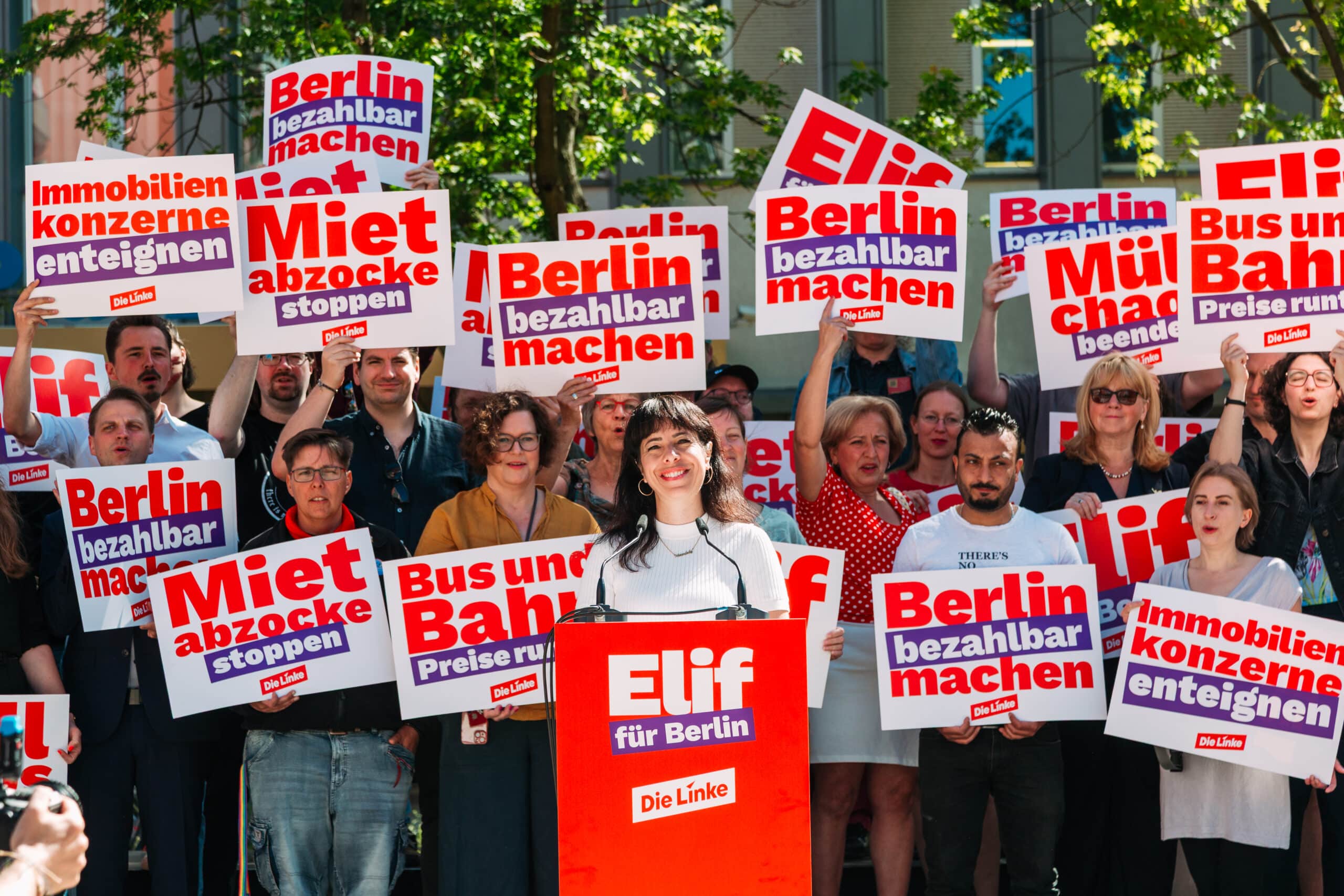
Germany’s Left Party, Die Linke, has won the election for the Berlin House of Representatives. The party received 25.7 percent of the vote, well ahead of Chancellor Friedrich Merz’s party, the Christian Democrats (CDU), which won 18.8 percent. The far-right AfD came in third, with 16.3 percent, followed by the Greens and the Social Democrats (SPD) with 14.3 and 12.1 percent, respectively.
The centrist Free Democratic Party once again failed to win a seat in the House of Representatives, while the BSW, led by former Left Party member Sahra Wagenknecht, did not clear the 5 percent threshold to enter parliament.
After the state election in Saxony-Anhalt, where the AfD nearly achieved an absolute majority with 43.8 percent, the election result in Berlin reflects the other side of the country’s political polarization. Many people viewed a vote for the Left Party as a vote against the Right, both against the AfD and against the CDU, which had previously held the office of Berlin mayor. Consequently, the party’s election victory was far more decisive than the polls had predicted. In the final stretch, the SPD and the Greens also tried to capitalize on this same sentiment, albeit with predictably less success.
This outcome cannot obscure the fact that the AfD achieved its best result by far to date in the Berlin House of Representatives. At the time of this article’s publication, results broken down by district were not yet available, but there are strong indications that the AfD secured results of well over 20 percent in some of the outlying districts.
Germany’s shift to the right is thus not bypassing Berlin, and the question of how to halt the rise of the AfD is becoming increasingly important for the capital as well. The election in Mecklenburg-Western Pomerania confirms the trend seen in Saxony-Anhalt: the AfD received a record result of 38.2 percent.
In Berlin, however, the Left Party did not merely run an anti-AfD campaign; with its “Red Metropolis” campaign (an allusion to New York City Mayor Zohran Mamdani’s election victory late last year), it promised to advocate for lower rents and the expropriation of real estate corporations, as well as more affordable public transit and neighborhood kitchens. In light of the federal government’s increasingly severe austerity measures — intended to finance the historic military buildup — this alternative appealed to many.
Even the Left Party, however, acknowledges that under the current circumstances, budget cuts will be virtually unavoidable. A Left Party–led Senate therefore risks repeating the same experience as the SPD-PDS Senate of the 2000s, which cut spending and implemented massive privatizations, outsourcing, and wage cuts. We can also look to the example of the Senate led by the SPD, Left Party, and Green Party (red-red-green, or RRG) coalition in 2021, which betrayed the referendum on expropriating the Deutsche Wohnen real estate company.
Why would an RRG Senate act any differently today, especially since the coalition partners — the SPD and the Greens — have driven the rearmament at the federal level?
The Left Party cannot simultaneously support the school strike against conscription and then, as a governing party, help shoulder the financial consequences of military buildup. This is also illustrated by the example of the state governments in Bremen and Mecklenburg-Western Pomerania: their Left Party ministers voted in the Bundesrat in 2025 in favor of more “investments” for the federal government’s military buildup appropriations.
The same applies to the fight against the AfD. A look at Thuringia, where the Left Party held the office of minister-president until the year before last, shows that the RRG coalition not only failed to slow the rise of the AfD but actually paved the way for the AfD with its government policies. Today, the AfD is polling at levels in Thuringia similar to those in Saxony-Anhalt. In the election in Mecklenburg-Western Pomerania, where the Left Party governs in coalition with the SPD, the Left Party received just 6.5 percent of the vote.
The problem lies precisely in leaving resistance to government policy to the AfD. This remains no less true if the “democratic front” manages without the CDU, as would be the case with an RRG Senate in Berlin. After all, the SPD and the Greens support military buildup, deportations, and budget cuts. As minister of finance, Lars Klingbeil (SPD) is responsible for the largest military buildup of the armed forces in the history of the Federal Republic of Germany, while his party colleague, Boris Pistorius, is gradually reintroducing the draft.
Together with Chancellor Merz, these figures share the goal of turning the armed forces into Europe’s largest conventional army. Are we supposed to form a coalition government with this party, whose Berlin lead candidate, Steffen Krach — currently under suspicion of bribery — has rejected any demand for the socialization of housing?
We must therefore tell the many Left Party voters that RRG will not provide the respite they had hoped for. If the Left Party, as part of the Berlin Senate, disregards its own campaign promises and instead goes along with privatizations, deportations, budget cuts, police repression, and much more, this not only strengthens the AfD but also paralyzes all those who want to fight and organize against these policies.
Instead, the role of a left-wing party must be in the opposition. Only there can it advocate for the expropriation of corporations — such as the implementation of the 2021 referendum — call for mobilizations and political strikes, and denounce capitalist barbarism.
As for the CDU, the House of Representatives election failed to overcome the party’s ongoing crisis. Although the party led by top candidate Stefan Evers did not suffer a record defeat in Berlin, it also failed to stage a comeback. Combined with the disastrous election result in Mecklenburg-Western Pomerania — where the party did not clear the 5 percent threshold — Merz remains in serious trouble.
Since the crushing election defeat in Saxony-Anhalt, speculation about the chancellor’s resignation has not ceased. The eight CDU state premiers still in office therefore felt compelled last week to issue a statement backing Merz, but whether that will be enough to save his chancellorship remains far from certain. In any case, we can assume that the instability of the Merz-Klingbeil government will continue and that a premature end to the coalition or a change in the chancellorship is becoming increasingly likely.
Election night in Berlin once again underscored the crisis facing the so-called mainstream parties: The loss of votes for the CDU and SPD points to shifting majorities and far greater political instability. The coalition negotiations will not be straightforward: Even though an RRG coalition in Berlin is the more likely option in light of Left Party candidate Elif Eralp’s victory, a CDU-SPD-Greens coalition would also have a narrow majority. As a result, the SPD and the Greens will have significantly more leverage in the coalition negotiations than the Left Party leadership would like.
The pressure to accept any negotiation outcome — to ensure that Evers is not ultimately elected mayor — will be enormous, which is why the Left Party leadership had already lowered the price for participating in the government even before the election. For example, in Eralp’s presentation of the “five-point plan,” the expropriation of Deutsche Wohnen— which had previously been described as a “red line” for forming a coalition — did not appear at all.
In particular, Eralp’s attacks on the “rebellious” Neukölln district association and its positions in solidarity with Palestine spoke volumes: in exchange for a seat in government, the Left Party continues to submit to Zionist state interests. That is why critical voices had to be silenced even before the election, so that they would not stand in the way of forming a government.
It is precisely these critical voices that now have a special role to play. Coalitions such as the “Left in the Left” network or the Left Party’s youth wing, Linksjugend , have issued statements opposing potential government participation. The Neukölln grassroots group hosted a well-attended event against joining the government on Friday, and various grassroots organizations within the Left Party, such as the BO Sonne, are also critical of the prospect of joining the government. In addition, candidates such as Vedi Emde have stated that they would “rather be in the opposition in the right way than in the government in the wrong way.”
Now is the moment of truth: all those who oppose the Left Party’s joining the government must advocate for detailed discussions and votes on the coalition negotiations in all and Left Party grassroots groups and organizations. A strong campaign is needed to ensure that as many Left Party members as possible vote against accepting the coalition agreement in a membership referendum. All Left Party candidates who were elected to the House of Representatives on the basis of a “rebellious campaign” must publicly declare that they will vote against the RRG Senate.
All those who voted for Die Linke so that the big real estate corporations would be expropriated, so that cuts would stop, and so that more money would be available for social programs must not be deceived: regardless of whether Berlin is led by Die Linke or the CDU in the future, the Senate will not implement any of our demands unless there is a massive movement on the streets pushing for their implementation. That is why we must take to the streets starting on day one after the election: on September 21 with the “Gegenwehr jetzt” initiative for IG Metall’s nationwide day of action, on September 25 for the student strike against conscription, and on September 26 for the protests against the government’s austerity policies.
Despite the Left Party’s election victory, now is not the time to sit back and relax. Now is the time to build pressure and bring down the entire agenda of the Merz-Klingbeil government. To do this, we must organize ourselves in our workplaces, our schools, and our universities — without placing any trust in the incoming Berlin Senate.
Originally published in German on September 20 in Klasse Gegen Klasse.
Read the full story at the source
Source: Left Voice