
Germany · labournet.de · 50m
Will the autumn of resistance – preventing social cuts be made up for in the summer of 2026?
Deutsch (original) · Auto-translated to English
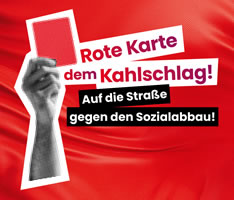
dossier
“…Instead of counteracting rising poverty, the government wants to pit workers with average or low incomes against the unemployed, pensioners and other people with little money and is planning further redistribution from bottom to top. (…) But we won’t allow ourselves to be played off against each other. Solidarity instead of division! Because in this country there is enough money for poverty-proof basic services…” The (not followed enough)Call from the “Insist on Law” alliance in October 2025A lot of things were right about an autumn of resistance and yet things got even worse by the summer of 2026, still without sufficient protests. Next to oursDossier on the unions' social policy resistanceStrategy debates and calls as well are hereAppointment overviewscollected from social movements:
- Appeal from the Zimmerwald Committee: We call for a strike in Germany!

"We are calling for a strike in Germany! Not simply for a strike against greedy bosses, poor working conditions and low wages. Not simply for the refusal of draft notices and military service. We are calling for a strike in all places that keep this state, Germany and its interests running. (...) The German government has implemented unprecedentedly brutal legal changes in the last year. In almost all areas of life. (...) The reason for the politicians' actions is not the lack of information about misery and... Environmental destruction. Rather, it lies in the necessities that arise when a capitalist state like Germany fights for its own functioning and existence as a leading power in Europe or a global economic power (...) Without questioning the nation state itself, i.e. the fact that all citizens are ideologically and materially committed to the success of their “own country”, even though they are in competition with one another and have to pursue completely opposing interests, and that is the real problem address, protest against the “social cuts” and the new military service law must remain toothless and ultimately ineffective. Because the existence and functioning of such a “community of adversaries” means the need for a functioning state apparatus, from the judiciary to child care, and thus the existence of the means to keep all of this running – money. And in a capitalist society, money only exists through successful capitalism.(…) We must recognize and name who the subjects behind the capitalist organization of societies are (the states) and how these subjects defend their sovereignties in constant competition with one another and are prepared to sacrifice population and nature for this. We therefore call for refusal. To refuse the German state, which, with its claims to success in the world, creates all the constraints that people here are confronted with. In a world where there are only its own kind, Germany must demonstrate capitalist success in order to function as a state. We call for a strike against Germany and its standards of success. To the strike in industry, in care, in offices and daycare centers. For the refusal of muster or call-up notices. We call on people not to confuse dependence on the state and its institutions with a community of interests for whose success in the world people's health and survival should, if in doubt, be sacrificed. And we hope for similar calls from people in France, England, Russia and Ukraine, the USA and China and in all other countries around the world. This call is not intended to weaken Germany in order to give other states an advantage. What we want is to overcome a world order in which states compete against each other and use and exploit their populations for this purpose. We appeal to all people who live from nothing but the sale of their labor to organize across national borders and refuse to serve the states and capital!” Appeal from the Zimmerwald Committee of August 29, 2026 as a discussion contribution including contact address
 - Before the fall: editorial team of Sozial.geschichte on the near future of the protests against the attacks on the social reproduction of the working classes
“There is a lot at stake in September. On the first weekend of the month, the AfD is trying to gain government power in the state elections in Saxony-Anhalt. The development of a discourse of a thousand dangers, in which everyone has to be constantly on guard, plays into their hands. It is a discourse that is hegemonic in current politics and whose foundations are the militarization of everyday life, the paradigm of endless war and the attack on the living conditions of the working classes. On the last weekend of the month, criticism of this hegemonic tone could intensify: strikes and protests have been announced everywhere. For once, the editorial team of Sozial.geschichte is not looking at the history of the present, but rather at a – very near – future. (…)
The focus of the considerations is a continuation and deepening of the fragmentation of the social reproduction of the working classes: cuts in youth welfare, school companions, long-term care insurance, health care, further attacks on the pay of people who are employed in care and health care, the worsening of the situation of single parents, etc. Overall, three tendencies can be seen in the current federal government's “reform program”. They could be described with the keywords fragmentation, loss of solidarity and segregation. (…)
According to the prevailing politics, we do not live in a class society. Everyone has a chance to make their own happiness. As far as the keywords fragmentation and segmentation are concerned, class politics are of course very consciously pursued. For example, by holding out the stick to IG Metall that says “save the German export industry” (through a reversed arms conversion). And at the moment it looks like people are trying to jump over this stick in the high-rise union headquarters on the Main. (…)
These are still individual positions and initiatives, and it is unclear what will develop from them and whether we will later speak of a larger and perhaps even transnational issue. And it is also unclear whether after the state elections in Berlin, unlike probably in Saxony-Anhalt, a parliamentary alternative to the authoritarian fragmentation of a solidarity-based society will emerge. But compression is possible. What is clear is that the rabbit can no longer be content with looking the snake in the eyes. Understanding capitalism is not enough, we have shaken our heads enough. It's finally time for exercise.” Very worth readingStatement from the editorial team of the magazine Sozial.geschichte on August 30, 2026
- “We should lose track and think that we are not affected” – cuts, resistance from below and why the attacks on the welfare state affect everyone
“The current cuts are hitting, among other things, the social services sector hard (see also the article by Ulrich Schneider in this issue). Resistance is forming against this – in many places and in a variety of forms. One example is the #unshortenable alliance initiated by ver.di in Middle Franconia. Many different people have come together there to defy social deforestation. We had the opportunity to speak to an active member of the movement, the interview was conducted by Erik Funke. (…)
Nevertheless, one can only hope that the unions become a little more vehement and stand in the way, otherwise it will look really bitter. As I said, and I never tire of emphasizing this: it's not just the social associations, it's not just the social providers and the people at the bottom who are affected, but these cuts affect us all. We have to get out of our comfort zone and onto the street. Otherwise things will look very bleak at some point - the less welfare state, the stronger the right. They always like to say that themselves: the worse Germany is doing, the better the AfD is doing. (…) But this time all areas are really affected, whether you are an employee or a pensioner, a migrant or not - and children and young people are also affected. This extends to those who are more well-off, such as doctors and psychologists. That's why you can see the situation as an opportunity, because these attacks on the welfare state are really not a niche issue.”Interview with Benedikt Rößnerinexpress – newspaper for socialist company and trade union workIssue 7-8/2026. Benedikt Rößner is chairman of the works council at a youth, social and integration assistance provider in Nuremberg. As an administrative employee, he is responsible for the initial contact with new clients. He is a ver.di member and is also involved outside the union in anti-racist and internationalist contexts and in district work. - Protests against social cuts: necessity and opportunity - and 6 reasons why we (so far) are not significantly fighting back
- Protests against social cuts – necessity and opportunity
“In theresolution, which was adopted at the founding conference of the Care Revolution network, states, among other things: "A good life is in contradiction to the competition and profit logic of capitalism. We no longer want to accept this subordination. In the Care Revolution, people and their living conditions are at the center. Together we can create conditions under which different, individual, collective and social needs and interests can be realized: A good life for everyone - worldwide!" That was twelve years ago, in the spring of 2014. (…) Now the situation has changed dramatically: Instead of moving closer to a solidarity-based care economy, we are experiencing a comprehensive attack on social rights and social security as the government's reaction to economic stagnation and the increasingly brutal struggle for global spheres of influence. This attack cuts across SGB legal circles and labor laws, affecting all households that rely on wages and transfer income. (…)
Our fundamental criticism from 2014 remains current. The goal of a society in which concern, solidarity and the appreciation of the ecological limits of production are the focus also remains valid. But at the moment it is also about warding off the threat of ever further tightening. There is also an opportunity in this: to say out loud what money has to be there for, what resources and working time are needed for, which are now disappearing into the construction and purchase of weapon systems, into dividends or luxury consumption. To convey our ideas of a solidarity-based, care-centered society. To ensure that the crisis is not carried out at the expense of the weakest, most vulnerable, least visible, and thereby gain self-confidence and strength.”Contribution from the Care Revolution network from August 3rd, 2026 - 5 reasons why we do not defend ourselves against social cuts - one is being hushed up
“The federal government has decided on the largest social cuts since Agenda 2010. Tens of thousands took to the streets against the AfD party conference, but hardly anyone took to the streets against the austerity policy. Why do leftists also keep quiet about what is behind the clear-cutting?
The federal government decides to deliver what is probably the most violent blow to the welfare state since Agenda 2010 - and there is hardly any resistance in the country. This can hardly be due to a lack of concern, as there is hardly a social group among wage earners that is not affected: the unemployed, who have to expect harsher sanctions; those with statutory health insurance who have to dig deeper into their pockets; those in need of care and their relatives; Families with children. Why does almost no one defend themselves against their own impoverishment?
The Left party is at least trying to give a voice to the frustration that exists among the population. Since the beginning of June, she has been organizing rallies and demonstrations against social cuts across the country. But so far the protests have not caught fire. That can change quickly, as protest movements can hardly be designed on the drawing board. They often appear spontaneously, but they almost never come out of nowhere. The transition from calm to protest requires conditions that must be created in the long term. There are at least five reasons why resistance to the dismantling of the welfare state has so far failed to take off. (…)
Perhaps the most worrying thing about our present day is not the systematic dismantling of the welfare state, not the intensified class struggle from above, not even the accompanying all-round carefree package for the New Right, which has almost tripled in the polls since the beginning of the current economic crisis. The most depressing thing is that large parts of society, including many on the left, seem to have resigned themselves to the political priorities. Anyone who stays silent about rearmament will not stop social cuts.”Guest article by Sebastian Friedrich on August 3, 2026 in the Forum Trade Union Left Berlin, first published on Friday July 14th. 2026. The reasons given are:
1) Decades of neoliberalism are not without consequences
2) The individualization of social problems dominates
3) Anyone who has repeatedly fought without hope will eventually give up
4) The fear of an AfD government stabilizes the existing one
5) The unions are too close to the SPD
- Protests against social cuts – necessity and opportunity
- Trade unionists on social protests: “The government wants to make our lives worse”
“The left-wing scene is too isolated from ordinary people, says Sebastian Grambow from the anarchist union FAU - and calls for protests. (…)
Grambow: Of course we have demands. But let's assume the government will give a shit about it. What we really want is for people to empower themselves and not give their anger to anyone who dictates it. That's why we train each other in labor and social law in Magdeburg, run a neighborhood community with a neighborhood shop, have an unemployed association and set up company groups. We know that we will not be successful overnight. But that's what we want to promote.
taz: Why should this work now?
Grambow: The entire legitimacy of this state is breaking down: the promise that we are being exploited, but that we are still doing quite well and that the weak are being helped. Many capital factions and the politics associated with them are now spitting on this state legitimacy. We have to take advantage of this to show that there is another way, apart from tightly organized parties and the DGB, which is often only interested in employees in collective bargaining. (…)
Grambow: I think a lot of what left-wing groups in Germany are doing is not really sustainable. Many alliances carry out their actions over a weekend and then disappear again. What sets us apart is that we offer a truly long-term organization and that many of us actually see themselves as workers. At flyer campaigns or at the Maloche, I experience again and again that ordinary people no longer have any contact with leftists. They don’t know us at all as normal colleagues. The left-wing scene is simply too insular. This is the sticking point that we want to break through. (…)
If more company groups were formed, that would be a start. Because of us, the big wildcat strikes will not break out now, nor will we be able to organize a general strike, even if that were necessary. But we can encourage people to organize where they work - because that's where they have the most power to change things. It doesn't matter whether this happens in a kindergarten, in the factory kitchen or in a large industrial company. If we start to organize ourselves as colleagues, the government can become afraid of us again.”Interview by Timm Kühn from July 24th, 2026 in the taz online - The government is dismantling the welfare state - but there is hardly any massive resistance. Why? Protest researcher Manès Weisskircher lists several reasons for this
"Hundreds of thousands took to the streets against Hartz IV in 2004. Today the government is planning cuts in the welfare state - but things remain quiet. Protest researcher Manès Weisskircher explains why trade unions mobilize less often when the SPD is in government. (...) However, they cannot be completely ruled out - we are still in the political announcement phase. Mobilization can follow in the course of legislation. But there is some evidence to suggest that protest on the streets will remain limited. (...)
Hartz IV was a clear enemy; The Left later founded itself expressly as an anti-Hartz IV party. In the current debate on cuts, the problem is more diffuse. In addition, the debate is becoming technocratized: the government is using commissions to justify cuts with expertise. This approach makes politicization and critical debate more difficult. (…) Outrage about unfair conditions is necessary, but not sufficient. We know from protest research: grievances do not automatically lead to protest. Otherwise we would have to see regular protests from the most disadvantaged groups in our societies, for example homeless people.
[What else is needed?]
Firstly, a clear framing: Political actors must convincingly state what is being mobilized against and how this could be changed. Secondly, strong organizations and groups are needed to support the protest and have the necessary resources such as members, money and infrastructure. We hardly see either at the moment. (…) The political left is increasingly unable to aggressively emphasize its own economic and social policy demands and thus shape the discourse. Instead, the mobilization against right-wing actors ties up their forces. This conflict is very important; it is about the democratic quality of the country. The AfD offers a clear image of the enemy - similar to Hartz IV back then... (...)
Isolation and the weakening of collectives certainly play a role - just think of the long-term weakening of trade union organizations. More specifically: When debates about cuts are so broad, it is difficult to unite groups. Labor market liberalization, pensions, health and care produce different impacts. A strong political left could also see this as an opportunity; Currently, this constellation has a rather demobilizing effect.
[Parental allowance, co-insurance, care – women are particularly hard hit by the planned cuts. Apparently the government is not afraid that the female part of the population will take to the streets en masse.]
That is to be assumed. Issues such as care have not sparked widespread street protests in the past. Social and economic policy demands continue to be an important part of the feminist movement. But the topics with which it has recently attracted a lot of attention were not primarily economic and social policy questions, not the “bread and butter” topics. Economically marginalized groups - and this still includes women - are usually particularly affected by austerity policies. (…)
How do you mobilize against government policies without cooperating with or being co-opted by the largest opposition party? This has already posed problems for some social movements. On the other hand, it is also a strategically clever way for government representatives to demobilize: to discursively connect the potential protest against their own politics with the AfD and Co. (…) Street protests can have an impact, but even with large mobilization this is by no means certain. And looking at the current reform debate, you can see that the SPD is trying to involve the DGB. (…)
The DGB leadership was only partially rhetorically confrontational and was criticized by other trade unionists, such as the chair of the ver.di trade union council, for not distancing themselves from the federal government. Local branches and individual member unions in particular are organizing protests, but are not yet able to mobilize masses. (…)
I don't expect a new organization to emerge out of nowhere that suddenly mobilizes hundreds of thousands. For the future, existing groups will have to come together: climate movement, trade unions, women's movement, social associations, other civil society organizations. They would have to reflect with each other on what the problem is, what alternatives they can formulate and how they can organize protests together. It's about broad coalitions of different groups and their joint mobilization.”Interview by Bascha Mika from July 20th, 2026 in the FR online(“Where are the protests against social cuts?”) - Clear-cutting with a chainsaw: The targeted demolition of the welfare state, fundamental rights and employee rights
“The welfare state is being dismantled with a chainsaw by the black/red government. Almost every day, politicians and associations close to the Union outdo each other with new proposals for cuts, repressive laws and worsening conditions for the population. Whether in basic security, housing benefit, health insurance, pensions, the immediate child allowance, care, labor law, parental allowance or maintenance advances - the social ax is being applied at every turn for no reason.Every day we see a new step in the dismantling of the welfare state. Nobody denies that reforms can be necessary and useful. But what is taking place here and now is not a reconstruction - it is the systematic demolition of the social network. At the same time, our fundamental rights are being curtailed, tightened or even actually abolished bit by bit. This can be seen in the right to assembly, the new police laws, the restrictions on freedom of information laws, the promotion of democracy and the frontal attack on the right to asylum.
This destructive “reform policy” will continue mercilessly until noticeable protest and massive resistance arise. It is precisely this resistance that is now more urgently needed than ever! In some areas it is already moving, but still far too timidly. The various interest groups and those affected must now pool their strengths, work together and raise their voices clearly.We should and must work on this with all our might from now on!“Call inThomé Newsletter 23/2026 from July 12, 2026 - Free Workers Union starts the campaign “The government doesn’t care about you” – first day of action on July 25th. in several cities
“Dear colleagues, these are really not pleasant times. Our economic system no longer has a future because we have overstretched the carrying capacity of our planet, the world powers are obviously gathering for the third world war - no one seems to believe in the promise of a good future anymore. Instead of using the big questions that are on the table for a social awakening, those who still benefit rule with tried and tested means of maintaining power: stepping down, sowing discord, building up enemy images, polarizing, tightening the thumbscrews and militarizing. (…)What we can do, must do, is:
– to bring discontent back onto the streets. To make it clear that the government is not acting on our behalf.
– to join together to cushion the aggravation in everyday life.
– Organize together to fight for improvements in our businesses and neighborhoods.
– create a movement that asks the system question independently of parties, lobbies, NGOs and state money and answers it with solidarity, grassroots democracy and forms of sustainable demand economy.
Our protest is an invitation. Organize with us, grassroots democratic and independent. We must not allow ourselves to be played off against each other. (…)We as the Free Workers Union want to fight for this. For a free, just society. We can and must organize and manage production socially, collectively. Not to increase profits, but to meet the needs of everyone…”FAU campaign pageand theAppointment list in addition - Action alliance “Together for a strong and sustainable welfare state” in Bavaria
“Bavaria's broadest social alliance to date calls for a strong and future-proof welfare state: 25 organizations and initiatives are sending a visible signal to Bavaria: "Welfare state is the future"
In view of the current debate about welfare state reforms and possible benefit cutsAction alliance “Together for a strong and sustainable welfare state”made a visible statement today on Munich's Theresienwiese. Under umbrellas with the inscription “Welfare state is the future,” the members of the broadest social policy alliance to date in Bavaria made it clear: The welfare state is not a cost factor, but rather it protects people, strengthens democracy and ensures social cohesion. (…) The action alliance “Together for a strong and sustainable welfare state” brings together 25 organizations and initiatives from trade unions, social associations, welfare organizations, church initiatives, clubs, associations of those affected and other areas of civil society. This makes it the broadest social-political alliance in Bavaria to date. Together, those involved want to defend the welfare state, develop it further and make it future-proof.”Press release from DGB Bavaria from July 13, 2026and theShort version of the central demands - Is the “hot autumn” coming this year?
“The government is attacking eight-hour days, pensions and social benefits, while VW and Mercedes are cutting jobs en masse. But the unions are hesitant to resist. What is now needed is an offensive against social cuts. (…)
The unions had already announced protests for late 2025 after the federal government under Chancellor Friedrich Merz put the eight-hour day up for discussion. It remained remarkably quiet. Now there is talk of a “hot autumn” again. But where are the unions? Are they forced to keep quiet due to their members' fear of unemployment and their reluctance to take action against a government that positions itself as the last bulwark against the AfD? On the contrary: especially in the face of the massive right-wing turn, trade unions have the task of countering it with a policy of solidarity. (…) Many employees rightly complain about suffering at work, fear of decline, broken social systems and the fact that elections do not change anything because every government pursues the same (allegedly no alternative) policies. This is the stuff of powerlessness, frustration and being kicked to the bottom - at least as long as these class experiences are not processed as such and represented politically. (…)
The government distributes ammunition for the fight of all against all, thereby deepening inequality and fueling competition for work and in work. This only benefits right-wing parties. Trade unions, on the other hand, stand for the opposite: for collective rights that limit the power imbalance between employees and companies as well as competition between workers, and for politics based on solidarity. How they should respond to the attacks is controversial.
Social partnership even without a partner?
IG Metall chairwoman Christiane Benner describes the latest “reform package” as a “bag of tricks and treats.” Frank Wernecke, chairman of Ver.di, criticizes the fact that a “culture of mistrust” does not create growth, but only hesitantly explains in the ARD interview that they will “formulate resistance.” That doesn't sound like a "hot autumn." Apparently there is hope of returning to the negotiating table, because the 34 points contain an invitation to trade unions and business associations to talk about supporting “the industries particularly affected by the current crisis” and “deviating” (tariff) regulations for fixed-term contracts, sick leave or reporting obligations. The problem: There are hardly any “partners” for social partnership anymore. The proportion of employees with a works council and collective bargaining agreement is now below 30 percent in West Germany and below 25 percent in East Germany - and the trend is falling. (…)
The outrage among employees about the federal government's policies is enormous. The attack on the eight-hour day in particular is seen as a slap in the face by people who work longer, more flexibly and more intensively and pay for it with their private lives and health. Things are simmering in many companies. (…) But how can unions go on the offensive?
Five starting points for a solidarity-based work policy
Firstly, what seems to be self-evident must be questioned: that VW needs at least 6.5 percent profit; that wealth cannot be taxed; that billions flow into special funds for rearmament, while the debt brake strangles budgets for work, education, health or social security; that “social reforms” should relieve the burden on companies and that labor rights should ensure they have flexible access to labor – these are not constraints, but rather politics. Another policy is possible.
Secondly, it is important to counteract campaigns of de-solidarization. (…)
Thirdly, the unions need projects that unleash imagination - that mobilize wage earners around common interests, that make it clear who the counterpart is and that make another society conceivable. “Short full-time for everyone” is one such project. (…)
Fourthly, nothing helps combat powerlessness better than the experience of achieving success together - and this is achieved not least in labor disputes.
And fifthly, the battle for minds is not yet lost. Because in these minds there is always both: starting points for competition and stepping down, but also for mutual support and solidarity.
A solidarity-based labor policy is no guarantee against the turn to the right. But it helps to think beyond the unbearable status quo and move beyond it…”
Article by Nicole Mayer-Ahuja from July 8, 2026 in Jacobin.de– in view of climate change and heat waves, a label other than “hot autumn” should be found… - About the need to save and do without: But the hardships just have to be there - or do they?
"... If you believe the politicians and leading media, the state is lacking money at both ends. The lack of money is said to represent something like a material constraint that forces the state to save on services for its citizens. Doubts do not appear to be raised by the fact that the 2026 federal budget alone contains a record amount of 524.54 billion euros - 22 billion euros more than in the previous year - to which the budgets of the states and municipalities are also added. (...) Astonishing, that hardly any expert comes up with the idea that the claim of a lack of money in the state cannot be true, that is, that the citizens are obviously being lied to. There is an unlimited amount of money available for politics, but apparently not for services that make everyday life bearable, but rather a simple matter of setting political priorities.Because contributions to [social insurance] (…) form part of wage costs, they are always too high; They put a strain on the company's profit statements. They increase the cost of any business. For the state, they are part of personnel costs and put a strain on its budget. So there is always something to reform. (…) The demand for justice in renunciation makes it easy for politicians to play groups in the population off against each other. (…) If you believe the opinion polls, dissatisfaction with the government is widespread among citizens in the country. Nevertheless, there is largely calm and there is hardly any protest against the planned burdens on wages and salaries in the form of higher social security contributions, against cuts in benefits, etc. (…) There is no organized protest to speak of, as both trade unions and parties agree with the government that things have to get better in Germany again, so that cuts to citizens in one form or another are necessary and have to be accepted...” Article by Suitbert Cechura from July 8, 2026 at untergrundblättle - Time for what we want
“Social cuts and rearmament: The federal government has recently made its priorities clear. The opponents of this policy lack counterstrategies – and a new utopia. (…) But in order to counter this historical attack on what the working class has fought for, utopia would be needed instead of fear of decline. A concrete one, like the desire for eight hours of free time 150 years ago. And a utopia on the horizon, which not least serves as a threatening backdrop for the state and capital.
Despite enormous increases in productivity in the work process, there has recently been no mass demand for a four-hour day. Instead, workers in the Global North were suffocated with a previously unimaginable amount of consumer goods.
Today, the spread of AI brings not a promise of more time to do what we want, but fear of job loss and degradation. In capitalism this is a completely justified fear. Because technical development in this economic system does not bring less work, but in case of doubt even more of it. New technology usually leads to a falling rate of profit. In order to secure profits, work is increased: the working day then becomes even more stressful and burnout occurs more quickly.
The fear of the consequences of AI is justified. At the same time, this technology highlights the gaping gap that makes it difficult to collectively counteract this fear: the idea of a good life without capitalism - with long hours to do whatever we want to do.”Article by Sina Reisch and Indigo Drau from July 8th, 2026 in ND online– the two tell each other in their history podcast“History of the Worlds to Come”of people who fought for a better world to come - Reforms? What the hell…?! A call for resistance – It is absurd: attacks on the working class are supposed to be “reforms”?
“When politicians tinker with “reforms” these days, the working population is on red alert. Today this means: frontal attacks on pensions, wage levels, working conditions and health care. According to mainstream propaganda, there is now only one way out of the crisis: taking from the poor to give to the rich. Reduce unit labor costs and additional wage costs. Anyone who opposes this is seen as “guarding the status quo” and “stopping things”, as “out of touch with reality” and “eternally yesterday”. (…) The corrective is missing. Those up there believe they can do anything. They lose touch with reality, dream of Mars and the Olympic Games. They can't even get bridges and schools repaired. Counterpressure from below, from the street, has been missing for a long time. We have nothing against reforms in the original sense. We are for improving living conditions. We reject attacks on the working population - exactly what is being sold to us as reform today. It’s time for us to come together and take action…” Call for labor injustice in Germany from June 2026
Appointment overviews
- andAppointment list the FAU campaign The government doesn't care about you
- tabularOverview of IG BAU Nationwide demos against social deforestation in 2026
- Protest actions against social cuts –Overview of the NGG
- Remain stable – shape things socially: How we save the welfare state:ver.di campaign page with regional rally dates
- The Left Party organizes actions against the dismantling of the welfare state: "Enough is enough! Making life affordable."
- Personal reports:Nationwide social protests on chefduzen.de
- Redistribution instead of social cuts : Information about ongoing demonstrations, rallies and actions can also be entered by the editorial team express
- See also the union dates in the dossier:Trade unions, social cuts and resistance: almost 25 years of theory and practice
Basic information:
- Social-legal self-defense in times of inflation and social cuts
Overview from July 11, 2026 of the Social Professions Working Group at FAU Freiburgabout current social benefits and political assessment - Against social deforestation
The list of unreasonable demands from July 12, 2026 from RaS Freiburg - You don't have to worry about the cuts. Except when...
Great lineup“Agenda “2030” – An art project.”
See background:
- Dossier:Trade unions, social cuts and resistance: almost 25 years of theory and practice
- Dossier:Autumn of resistance - Preventing social cuts: The “AufRecht Persist” alliance is calling for a nationwide decentralized week of action from October 20th to 24th, 2025 and afterwards
- Dossier:“The turning point”: 100 billion (ONLY!) for rearmament – the turning point 2.0: whatever it takesto the socio-political attacks
- Hardly any resistance to social cuts. Hallmark of aggressive capitalism: “Everyone is worn out, but everyone is different”
- Article by Harald Rein and Uli Wesserin express - newspaper for socialist company and trade union work, issue 5/2026
- The Merz government is launching attack after attack against precarious people, but apart from class war rhetoric, there is no left-wing strategy in sight
- Target of the welfare state. Life is hard and it is getting even harder: powerful capital interests and their political allies are torpedoing our welfare state.
The postWill the “Autumn of Resistance – Preventing Social Cuts” take place in the summer of 2026?appeared firstLabourNet Germany.
Read the full story at the source →
Source: labournet.de