
Labour · labournet.de · · 39m
Why are more and more workers in Germany voting for the AfD?
Deutsch (original) · Auto-translated to English
dossier
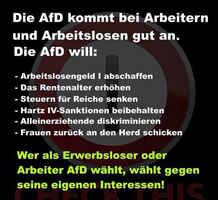
“... Workers are among the professional groups that particularly support the AfD. (…) Party research has been discussing for some time whether the particular success of the AfD makes it a new workers' party. It is largely undisputed that their election program cannot necessarily be described as worker-friendly. The fact that it is still above-average successful among workers is attributed, among other things, to the way it addresses discontent and protest. (…) Working conditions have a direct influence on political decision-making. The study suggests that dissatisfaction in working life leads to a turn to parties that promise radical change, as is the case with the AfD…”Contribution by Bernd Müller from December 3rd, 2023 in Telepolis  (“Why are more and more workers in Germany voting for the AfD?”) about the WSI study on AfD voters – see more about this and the topic:
- [“Trade union advice” and “Megazoom” from the Workers Against Fascism initiative] Not everyone is on the right

“A few days after the state elections in Saxony-Anhalt, in which six out of ten workers voted for the AfD, over 140 trade unionists, works council members and employees met for the “Megazoom” of the Workers Against Fascism initiative. Colleagues from completely different industries: care, logistics, media, education and science.
What began as an idea from a Berlin intensive care nurse is taking concrete form:A nationwide conference under the motto “Understanding, Networking, Arranging” will take place in Halle (Saale) from January 22nd to 24th, 2027– i.e. in Saxony-Anhalt, where the AfD won the most votes. Mobilization takes place without large financial resources, through personal and collegial networks in the companies - this is exactly what the organizers see as their greatest strength.
Two meetings within a week
On September 8th, two days before the mega zoom, 114 colleagues met for what was now the second “union council”. Under the title “Defending the welfare state – making the rich pay”, the focus was on the exchange on the social protests, with reports from a ver.di representative and a works councilor about the mobilization from the companies. (…)
Various sectors were also represented here: a sports therapist from Berlin moderated the video conference, an intensive care nurse, a colleague from the Berlin city cleaning service, and a works council member from the Lufthansa ground staff presented themselves as initiators. “We are the ones who keep this country running,” the city cleaning colleague summed it up. “If we defend ourselves, then no one can stop us.”
A colleague who has been involved with the AfD for a long time provided scientific input to the “Workers Against Fascism”, which now has more than 500 colleagues on its information channel. At the center is the “AfD paradox”: above-average support among workers for a program against their interests - made worse by the fact that many even know it.
The AfD exploits the myth of the “hard-working population”, the party of “achievers”, and at the same time stigmatizes recipients of social benefits: 66 percent of AfD voters consider receiving citizens’ benefit to be a “comfortable life at the expense of society”. The party is also openly hostile to the organized labor movement.
A possible point of attack against the AfD would be its campaign against “culturally alien skilled workers”, which is directed against so many colleagues without whom the care and logistics companies would come to a standstill. The speaker's diagnosis: The party-state's legitimacy crisis has its epicenter in the working class. The answer must be democratic self-efficacy in the workplace: solidarity, change, the ability to act. (…)
There was also criticism of the unions themselves: a Verdi colleague complained about passive structures and appealed to top officials: “If it continues like this, you will no longer exist in two years.” And from the chat came the suggestion to make the campaign against dismissals on suspicion as a legacy of National Socialist labor law the topic of anti-fascist company group work.
The conference in Halle is also seen as a prelude to the upcoming elections next year: workshops to understand the dynamics of the crisis, networking between companies - including against the fascist "center" organization - and concrete agreements on actions...”Article by Gerhard Klas from September 12, 2026 in the SoZ Online, see also:
- MegaZoom of workers against fascism
“On September 6th the AFD clearly won the state elections in Saxony-Anhalt with more than 40 percent of the votes. The AFD even achieved around 60 percent of the vote among workers. Fears arise that fascism could become socially acceptable again. But how to deal with this worry? TheWorkers against Fascism conference organizedon Thursday, September 10th at 6 p.m., a mega zoom for workers who want to exchange information about the results of the state elections in order to counteract collective powerlessness. Radio Corax spoke to Anja Voigt, co-initiator of the MegaZoom of Workers Against Fascism. “Interview from September 10, 2026 on Radio Corax 
- MegaZoom of workers against fascism
- “My buddy is voting for AfD”: AfD is courting the “little people” and is thus scoring points with workers – despite recently even tighter market-liberal policies
- Alternative for workers? – My friend votes for AfD
"The AfD is stronger among workers than any other party. In terms of economic and social policy, it represents an economically liberal course. Why does the party still manage to score so strongly among workers?(...)
A study by the University of Tübingen on behalf of Panorama comes to the conclusion that the AfD's economic and social policy positions are anything but worker-friendly. The party can be classified “clearly at the market-liberal-business-friendly-fiscal-conservative pole” of the party spectrum and is therefore between the Union and the FDP. (…) Despite this strongly economically liberal orientation, according to political scientist Biskamp, the AfD would like to specifically address the group of workers. (…)
[AfD social politician René] Springer names “home, family and achievement” as specific worker interests, but admits that these values are not only shared by workers. (…) Political scientist Biskamp points out that one's own economic interests are not necessarily the decisive factor in an election decision. Overall, it can be said that the distributional conflict between top and bottom, which concerns, for example, the level of wages or the taxation of assets, has become less important in political competition. According to Biskamp, this is also due to the fact that today's workers socialize less and less in the workers' movement, i.e. in classic trade unions or in their own organizations for workers, such as workers' sports or workers' singing clubs. The crisis of the SPD can also be traced back to the loss of importance of the workers' movement. (…) Instead of the classic distribution conflict of “top versus bottom”, which is central to the workers’ movement and classic social democracy, the AfD offers an alternative interpretation. René Springer says in an interview with Panorama: “The social question of the 21st century is no longer the question between below and above, but it is the question between inside and outside.” The focus should therefore be less on the rich and wealthy, but rather on migration and globalization. According to Springer, it's about "protecting yourself from those who come here and end up exploiting the social system." The conversation with Andreas and Thomas shows why this narrative can get confusing. He hardly has anything to do with rich people in everyday life, says Andreas.On the other hand, he sees immigrants every day who he assumes do not work or live at state expense. This is more tangible for him. Andreas also explains the success of the AfD by the fact that it picked up on the dissatisfaction of many people. Thomas sees the party's political statements as a successful attempt to play economically weaker population groups off against each other. The AfD is thus asking the social question - but is redirecting the answer to it: away from the distribution between top and bottom, towards the distinction between inside and outside, between those who belong and those who are considered outsiders. Text and video of the article by Sebastian Friedrich and Isabel Schneider from August 13, 2026 in Panorama magazine  on NDR (27:33 min. video length)
 - Study by the University of Tübingen: AfD scores with workers – despite market-liberal policies
“The AfD gets a particularly large number of votes from workers. According to a study commissioned by Panorama, it is sticking to the market-liberal course of its founding - and has recently even tightened it. (…)
The study by political scientist Biskamp concludes that it is not enough if other parties want to score points in competition with the AfD with social policy offers alone. “You must also work to ensure that voters once again perceive the state in general and the welfare state in particular as something that contributes to improving living conditions and from which they themselves benefit.” This perception has been significantly weakened in recent decades.”Contribution by Sebastian Friedrich and Isabel Schneider, NDR, from August 13, 2026 on tagesschau.de - See the 17-page study"The economic and social policy positioning of the AfD. Data analysis for the ARD magazine Panorama."
 by and with Dr. Floris Biskamp from August 12, 2026
- Alternative for workers? – My friend votes for AfD
- The meaning of the work: From the sociologist Arlie Russell Hochschild we can learn why people vote right - and what that means for anti-fascist strategies
"The economist Isabella M. Weber has a clear answer to the question of why Donald Trump won the 2024 election against Kamala Harris: "Unemployment weakens governments. Inflation is killing them." The Biden administration did not understand how to take timely measures to combat price developments. Accordingly, Weber advocates for statutory rent caps and price brakes, but also for state-controlled, green reindustrialization. She calls this "anti-fascist economic policy." Her line of argument is reminiscent of a slogan used by Bill Clinton's camp was launched in the 1992 presidential election campaign: "It's the economy, stupid". was known throughout the country in the 1960s as a hotbed of left-wing activism and counterculture - here, in eastern Kentucky, almost everyone was white and devoutly Christian. And here, in the last three presidential elections, over 80 percent of those eligible to vote voted for Trump (...)
Among Trump's supporters, Hochschild suggests, anger over rising prices is combined with a general feeling of decline. In Eastern Kentucky, this feeling is fueled by the upheavals in the world of work that are linked to the loss of economic importance of mining. According to Hochschild, in 1990 the coal industry employed around 30,000 people across the state; in 2020 it was just under 4,000. However, the raw numbers obscure the fact that work is by no means just a source of income, i.e. an economic activity in the narrow sense. According to Hochschild, it is also embedded in people's living environments, structures them and is linked to social interpretations, values and emotions. The decline of industries and the associated loss of jobs also means that these living environments are lost, which in turn creates a specific repertoire of negative emotions. (…)
According to Hochschild, Donald Trump – a political figure who represents total shamelessness – allows his followers to shake off their shame. He transforms it into the feeling of having been cheated and stolen from and thus into hatred and racism. He uses a political technique that Hochschild calls an “anti-shame ritual”: he provokes with incitement, is shamed by his opponents, acts as their victim, and then switches to attack and retaliates. (…)
The US anti-fascists are therefore faced with the task of aggressively raising the issue of income and the Trump regime's responsibility for the rise in the cost of living. It would be hoped that they will not forget to appreciate the economic and social significance of the achievements of workers - whether in wage work or unpaid reproductive work; to confirm that their commitment is seen. Zohran Mamdani did this mantra-like in his election campaign in New York City last fall and was very successful.” Review by Alexander Gallas from June 17, 2026 in Neues Deutschland onlinefrom:
- Arlie Russell Hochschild: Stolen Pride. Loss, Shame and the Rise of the Right. Hamburger Edition 2025, 360 pages, hardcover, €30.
- The injured worker pride is certainly one of the important factors, but - instead of being structurally conservative - it should definitely point to the current exploitation situation and emphasize non-capitalist living and working conditions
- Study: Social decline encourages turning to right-wing populists. According to researchers, “xenophobia” only plays a minor role
"According to a study, people who are worse off professionally than their parents are significantly more likely to vote for right-wing populist parties, regardless of income. Data from 89,000 respondents from eleven Western democracies, including Germany, were analyzed over a period of almost two decades, as the Hertie School announced on Thursday in Berlin. The results were evaluated together with the University of British Columbia. According to study co-author Mark Kayser from the Hertie School, twelve percent of people who are significantly less successful than their parents voted, a right-wing populist party. That is more than twice as many as among those who have risen (4.6 percent). However, career advancement has little impact on voting behavior. This means that loss of status is far more politically effective than gain of status (…) At the same time, the study shows that people with experience of decline have lower levels of trust in politicians and are less satisfied with democracy, but do not develop greater xenophobia or resentment towards refugees right-wing populist voters,” said Kayser. Above all, the loss of social status and not just economic hardship or cultural resentment led to support for right-wing populist parties. “This helps to explain why these parties have gained so much support in very different countries and social groups,” said the professor of comparative politics. “Those who fall tend to feel let down by the political system and look for alternatives,” said Kayser.” Report from August 17, 2025 in MiGAZINtostudy “Downward Mobility and Far-Right Party Support: Broad Evidence” by Alan M. Jacobs and Mark A. Kayser - WSI study: How the AfD benefits from crises, fears and feelings of disadvantage and penetrates new layers of voters
"... Anti-immigrant and anti-democratic parties are on the rise worldwide. In Germany, the AfD, which is at least partially right-wing, received 20.8 percent of the second votes in the last federal election - exactly twice as many as in the election before last. How did the party achieve such growth - what are the driving factors and what roles do the recent political and economic crises play? How does the core electorate differ from the AfD voters who have recently joined? This is what Dr. Andreas Hövermann, who researches the topics of transformation and democratic integration at the Hans Böckler Foundation's Economic and Social Sciences Institute (WSI). Feelings of disadvantage and fear of decline, which are associated with insecurities, play an important role. The answer to this uncertainty should be a “positive, democratic plan for the future that focuses on social security for those who are particularly affected by the change in the labor market,” analyzes the WSI. It is important to offer people real alternatives instead of scapegoats. (…) More often than the old squad, those who have switched to the AfD represent “more left-wing” positions in addition to the demand for immigration restrictions on economic policy issues. For example, they are more likely to advocate for a reduction in inequality or a higher minimum wage. However, distribution issues are not the ones that most concern AfD voters.Migration remains the number one issue, as this study shows. AfD voters also express little compassion and willingness to support people who have fled the war in Ukraine - although solidarity with refugees from Ukraine has also significantly decreased among voters of other parties. (…) The resentment is not only directed at refugees who are supposed to “take a back seat” – 85 percent of AfD voters saw it that way in the penultimate wave of the labor force survey last December. Rejection also dominates towards those who receive citizen's benefit: two thirds of AfD voters agree with the statement that people who receive social assistance or citizen's benefit have "a comfortable life at the expense of society." (…)
WSI researcher Hövermann speaks of “perceived relative deprivation” as an important amplifier of feelings of injustice. Workers in particular, among whom the AfD has particularly high approval ratings - which does not mean, however, that they make up the majority of AfD voters - often feel a “break in the moral economy”. Even working hard and under difficult conditions triggers anger and feelings of injustice in some, which are then directed against political decision-makers, but especially against those who are supposedly favored and supposedly do nothing. The political crises of the recent past may also have contributed to the AfD becoming more attractive in the eyes of many eligible voters. Using different waves of the workforce survey, it can be shown that personal stress during the corona pandemic and dissatisfaction with political measures are associated with higher approval ratings for the AfD. (…) "A portion of the workforce perceives transformation processes, such as social-ecological change and digitalization, primarily as a threat to their own status. The answer to this understandable uncertainty should be a positive, democratic plan for the future that focuses on the social security of those people who are particularly affected by the change in the labor market." (…)
And time is running out. Evaluations of other studies based on constituencies, which show where the AfD has gained particularly strongly, make it clear that the AfD was particularly good at reaching new supporters where it was already strongly represented. “Where you meet neighbors, colleagues and acquaintances in the sports club who vote for the AfD, and where, for example, there is probably less offense if the streets are lined with AfD election posters.” In other words, there where “the normalization of the AfD and the right-wing hegemony” are particularly advanced.” Press release from the Hans Böckler Foundation from August 1, 2025
- to the complete 70-pageStudy by Andreas Hövermann : “The doubling of the AfD electorate” (WSI Study No. 42, August 2025)
- Note: To be honest, we are frustrated by studies that correctly analyze the current situation, but ultimately only offer a socially well-functioning and sustainable capitalism as a solution. Is it really true that capitalism in crisis only produces fascist ideology - even in the minds of workers? However, the confrontation with racism and the class situation is currently a very important debate topic for the left. It seems clear that the clean image of the worker always immune to this can also be viewed as an intellectual class analysis. The study actually shows very clearly that - with or without the AfD - the nonsense about the "dangerous refugee" does not stop at class barriers - and should therefore not be limited too much to the AfD.
- to the complete 70-pageStudy by Andreas Hövermann
- Anchor of the workforce? The left's ties to its former core clientele can be renewed
"In the aftermath of the federal elections, analyzes of the voting behavior of workers are increasing. Everything indicates that the right-wing populist to right-wing extremist AfD is emerging as their new party political home. The numbers are clear: with a share of 38 percent, the right-wing far-right party mobilized more workers than the SPD for the first time in a federal election. In addition, the AfD is not only successful in winning over voters from other parties, it is also particularly successful in To encourage non-voters to go to the ballot box and thus tap into a group in which workers are significantly overrepresented. Against this background, the question arises as to why center-left parties have lost touch with workers and how they can succeed in becoming the anchor of the workforce again in the transformation society. Current research and as yet unpublished study data from the Progressive Center suggest the answer: instead of adopting right-wing narratives, parties to the left of the center should become the core of the left-wing program In concrete terms, this means placing the workplace as a place of social security and co-determination as well as the conflicts of interest between wage earners and capital owners more at the center of their politics (…) A policy that wants to regain the lost trust in the responsiveness of the political system to workers' interests must focus on the experience of democratic action by strengthening co-determination and self-determination in the workplace (…) The workplace represents a place of social security, especially in times of shrinking spaces for social encounters represents.Here, problems can be dealt with collectively and experiences of solidarity and democratic participation can be gained. This is underlined by current empirical studies, including those from the Otto Brenner Foundation, as well as still unpublished survey data from the Progressive Center. These prove a positive connection between a so-called “industrial citizenship”, i.e. subjective experiences of solidarity and the ability to act through self-determination and co-determination in the workplace, and democratic attitudes. The other way around is: If employees cannot organize and plan their work independently, if they do not feel capable of acting in the company and are exposed to economic developments as passive actors, this increases their susceptibility to anti-democratic attitudes. It follows from this: If the political left wants to win back the workforce for the democratic party spectrum, it must increasingly see the workplace as a place of democratic self-efficacy and participation and address it as a field of political action. (…) The sociologists Thomas Lux and Linus Westheuser see the potential of a left-wing response to the division of wage earners from the far right in the repoliticization of the top-bottom conflict line. It is important to remember the strength of left-wing programs, namely the prioritization of the concerns of a less privileged majority. This includes a mobilization of the common interests of wage earners against companies and the rich.Citizen benefit recipients, migrants, service workers, production workers, skilled workers and employees are equally dependent on the sale of their labor and employment in a secure job. In the address about employee interests, the sociologists see a unifying moment for a cross-class social constellation of working people and the cultural middle class, which characterizes left-of-center parties. A narrative with a clear definition of opponents in the form of super-rich, shareholders and large corporations enriching themselves at the expense of the general public should be combined with concrete political measures for redistribution (such as greater taxation of wealth and corporate profits). The political left can only succeed in regaining credibility and lost trust through a material improvement in living and working conditions among the workforce.” Article by Johanna Siebert and Mara Buchstab in Neue Gesellschaft / Frankfurter Hefte 4/2025– However, improved living and working conditions after the war led to an increased identification with the principle of capitalist exploitation. And where is the internationalist side? But at least the opposition between capital and labor is emphasized here... - Why do which workers choose a right-wing extremist perspective? Before the “counter-strategies” comes the analysis
“The latest election results, and not just in Brandenburg, are clear: among workers there are a particularly large number of voters from right-wing extremist parties. The seemingly unstoppable rise of right-wing radical parties, which have grown to an average of 20 percent across Europe over the last 40 years and are now at least “government candidates” in numerous European countries, is also based on a particularly high share of the vote from wage-earning people. These are former strongholds of the labor movement such as “Thuringia, Billancourt, East Flanders or the suburbs of Vienna” that have been virtually conquered by the extreme right in recent years. Have the workers of Europe changed sides? Are we experiencing a proletarian shift to the right similar to that of the 1930s?…”Article by Renate Hürtgen, published inexpress – newspaper for socialist company and trade union work– Issue 1/2025 - The Lost Honor of Workers: How Populists Exploit Society's Problem Resources
"The feeling of being socially disadvantaged, devalued and dishonored is widespread among workers. New-right ideologues and their political followers know how to use the frustration to their advantage and are met with a response. Klaus Dörre gives an assessment of which counter-strategies could be effective. (...) Overall, it can be stated that the social image of workers who tend to the extreme right is often already a relatively entrenched worldview that is not easy to change. The pioneers of the New Right and their political mouthpieces have obviously succeeded in anchoring a meta-narrative in everyday consciousness that is suitable for ethnicizing social (class) conflicts (…) For a significant number of those who sympathize with the AfD or even further right-wing organizations, what the sociologists Beaud and Pialoux write about the employees of the Peugeot factory examined still applies: “The foreigners are becoming The crystallization point of a multi-layered threat, the subjective side of which consists of fear. It is the fear of the future and of social marginalization and disregard. However, while French sociologists are still assuming a relatively open situation, strong ties to extreme right parties have now developed in both France and Germany. For this reason alone, there are no patent recipes for successful counterstrategies. However, our research points to starting points that need to be discussed:FirstA lot depends on the basic attitude and willingness to conflict of company opinion-forming personalities. This is demonstrated by the example of a trade unionist who aggressively makes her sexual orientation an issue in everyday disputes with right-wing colleagues. Successfully dealing with right-wing employees takes place at the level of personal relationships. Not numbers, data, facts, but social proximity and friendship become the starting point for an examination of political consequences. This becomes possiblesecondly, because the trade unionist can trust that she will receive support from the works council and IG Metall. In other words: opportunities for co-determination and active union shop stewards create the conditions for a successful debate with workers who sympathize with the AfD or other radical right groups. The main problem is therefore not right-wing union members, but the fact that, for example, in the small and medium-sized supply industry, there are increasingly areas where there is no co-determination. At Opel Eisenach or VW Kassel-Baunatal, everyone who supports the AfD faces headwinds. This is not the case where there are neither works councils nor committed union members. (…) That is changingthird, when class solidarity is experienced in practice. For Opel workers, a day of action to protest against a feared factory closure is almost a day of celebration because it made the forgotten and their concerns publicly visible for a brief moment. A highlight of the event was the meeting between the Eisenach Opel employees and a trade union delegation from the Peugeot factory in Sochaux. This example can be generalized to the extent that drastic experiences with labor disputes can actually change basic attitudes.FourthAfter all, honesty is the order of the day. One may be outraged by workers who see the “green government” as their main opponent. But the excitement over such attitudes becomes unbelievable if the problem of class-specific decision-making power over the what, the how, the wherefore and the wherewith of production is ignored. (…) What would be necessary is a radical democratization of production decisions, which are currently reserved for tiny elites, because this is the only way producers can take responsibility for their products. (…) An emancipatory education that offers a democratic framework of interpretation for everyday social and capitalism criticism by workers could help. (…) We are currently a long way from a worker consciousness that aggressively demands that we take responsibility for what we produce. It could be the task of workers' education for the 21st century to at least put such a demanding, positive understanding of freedom up for discussion. Such an approach could be helpful in giving back to the workforce what they miss most – their honor and dignity not only in the work process, but especially in society.”From theArticle by Klaus Dörre from November 20, 2024 at the Federal Agency for Civic Education(bpb) - [Study] Class consciousness and voting decisions: Class as a political compass?
“Which party is the “natural” point of contact for workers? (…) Because what we are observing in recent elections and surveys is a crisis of legitimacy in the party system, which has its social epicenter in the working class. The support of the established parties, including the parties to the left of the center, is eroding here even more than in the rest of society. It is primarily the AfD that is filling this gap. (…) Increasingly, right-wing radical parties are also succeeding in winning over a significant and growing minority of the working class. (…) The feeling of being at the bottom of society, either materially or in terms of social recognition, seems to be increasingly linked to a political trend towards the radical right. (…) We first trace the connection between class consciousness and voting intention for the entire population and then look more closely at the working classen…” From the introduction ofStudy by Linus Westheuser and Thomas Lux from September 2024 at the Friedrich Ebert Foundation
- See the summary inThread by Linus Westheuser on Sep 25th
- See the summary inThread by Linus Westheuser on Sep 25th
- The local elections in East Germany: On the way to the “Workers’ Party”?
“…A look at the local elections in Saxony shows the bitter picture of a “demobilized class society”: the AfD candidates list their profession as a bus driver, warehouse logistician, geriatric nurse, educator, master carpenter and hotel manager. A higher number of the over 2,000 candidates are entrepreneurs. Quite a few engineers. But what particularly catches my eye as a member of IG Metall is the high number of mechanics, industrial mechanics, car fitters, mechanical engineers and mechanical engineers. Others say they are machine shapers, materials testers, industrial foremen (metal) or plant mechanics in welding technology.Overall, there is a low three-digit number of AfD candidates and Free Saxons who can be assigned to the organizational area of the industrial unions in Saxony. In Saxony-Anhalt there is no different picture: In the Börde district, for example, the AfD candidates list their profession as mechanical engineer, locksmith, electronics technician, engineer or precision mechanics fitter. This raises practical questions. What does it mean when a large number of colleagues not only agree with the AfD's politics, but are also actively involved in an authoritarian right-wing party? (…) The election results in Saxony have shown that the AfD cannot even fill the mandates it has won in some municipalities with candidates. In most cases, the candidate “colleagues mechanical engineers and industrial foremen” are now involved in community matters after work and learn political agenda setting and parliamentary tools. They discuss the AfD's political programs, network with the party's big names and its frontrunners from the right-wing media landscape, the Identitarian Movement or the Zentrum association, which claims to be a trade union. Center works councils like Lars Bochmann and Jörg Reichenbach (VW Zwickau) are also running for the AfD or like Frank Neufert (former BMW Leipzig) and Andre Krüger (former BR at VW Zwickau) for the Free Saxony.
How does this affect companies? Will right-wing lists spring up like mushrooms for the 2026 BR election? Do they possibly also have influence in the DGB unions? And what does that have to do with us? We will have to face these questions.
The AfD candidates in Saxony are not union officials. As you can hear, they are not particularly noticeable in the company, and in most cases they separate the “small world of the company” from the world of politics “out there.” The IGM also has the premise of a “clear edge”, according to which AfD activists are to be kept away from decision-making power and influence on local and company committees and are to be isolated operationally. This is case-by-case work.But in view of the high number of AfD officials in industrial companies, I have another concern: the unitary unions are not prepared to deal with opponents within their own ranks and companies. (…)
The eradication of what has for years been referred to under the heading of “post-democracy” as phenomena or experiences of halved democracy, operational realities and multiple crises, but also the eradication of experiences of social and political emancipation, often generates a defensive reaction, a strong mistrust that these instruments are intended to deepen the power of order over the workers. Or to put it another way:Capitalism, which keeps the masses of people away from central democratic decision-making processes, will not be able to be integrated into the “democratic consciousness” of the individual worker, no matter how broad campaigns to defend democracy are. Civilian half-education and individualistic approaches will not work against an organized opponent who exposes these contradictions. (…)
While the Automobile Center openly attacks the DGB unions, things are a little more nuanced with the AfD: There is currently still a largely truce with the unions, but as AfD elected representatives become increasingly entrenched in the companies, the likelihood of a change from quantity (number of officials) to quality (open attack) increases. What separates party strategists from calling on their colleagues for the next campaign? Let's take the issue of de-industrialization as an example: What if the AfD encourages its party base in the workplace, at works meetings or in the canteen to launch a major attack on the industrial policy of the old parties and the unions? The motives of an operating strategy can be found in its new-right thinkers. Motives, emotions and bonds are built up in the company that can be turned politically. (…)
If we are honest, the path of fossil production, fossil unions, mass automobile production as the basis of the Federal Republic of Germany's welfare state will come to an end. There is huge unease about this in the industrial sector. Disenchantment with politics has given way to real disenchantment with the system. There is work suffering, monotony and alienation, there are sales crises, overproduction crises, inflation, uncertainties, relocations and restructuring, lack of recognition and deskilling of experiential knowledge. “Green capitalism,” no one believes in it. “Improvement of site conditions”, who benefits from this above all?
Conversion and workers' self-management are empty words for most workers - who should be blamed for the fact that the hunger strike at GKN in Florence is not considered a success? There is no longer any trust in the state, which has withdrawn for years - but there are many examples that do not work. Employees can discuss this for hours. The stable colleagues who face this dispute deserve every respect! But at the end of the day, what are they supposed to do against it? They also lack a plan. (…)
The attack surfaces are huge. Even if the right does not organize a majority, the pressure that they can exert on stable colleagues in committees, at work meetings, as opposing lists, in every single company is enormous - including on institutional compromises that they challenge and exploit. We should prepare for a fight. There is currently a great danger that many colleagues will give up and seek a ceasefire. It is very lonely in the storm center of development. Where is the solidarity?
Because the situation is what it is, this text will not find a conciliatory end. The industrial unions and the social democrats are on the verge of defeat. The fossil fuel path is coming to an end. The promises of technological and social progress tend to fall into disrepair. Since industrial value creation continues to dominate, the service sector is also subject to increasingly precarious redistribution. The socialism that would be necessary is socially discredited and its supporters isolated. On the horizon: ecological catastrophe and a new barbarism…”Article by Alf Anschütz in Soz No. 09/2024 - [Klaus Dörre in an interview] What specific reasons are there for employees in the automotive industry to vote for AfD?
“…In some companies in the automotive industry, a third of employees vote for the AfD. The Jena sociology professor Klaus Dörre studied the topic in detail and also interviewed employees at the VW plant in Baunatal for a study on the transformation of the auto industry. On Tuesday he will discuss “right-wing radicalism in companies” at an event in the DGB building in Kassel. In the interview, the 66-year-old explains why CDU leader Friedrich Merz's call for a move away from combustion engines further strengthens the AfD. (…)
Right-wing populists and national radicals are winning voters in all groups and strata of society, but there is this surplus among workers, especially men. What is new is that even active union members can have sympathies for the AfD. This is often justified with the argument: If the right and the left come together, the unions could be really strong. (…)The automotive industry has long resisted the necessary socio-ecological transformation. VW management is now also focusing on green growth. But many people who work on the assembly line are very skeptical about e-mobility. They point to the dirty production of batteries and would like to believe that with e-fuels we can simply continue as before. Many people don't go along when the Baunatal component factory relies on sustainable mobility concepts. And when politicians like CDU leader Friedrich Merz and Sahra Wagenknecht call for a move away from combustion engines, they feel vindicated. (…) The AfD has always spread the thesis that it is a conspiracy against German industry if the supposedly clean diesel no longer exists. Merz, Wagenknecht and the FDP are now repeating this. Implementing their demands would have devastating consequences. While various components are manufactured at the VW factory in Baunatal, ten thousand employees in Zwickau depend on e-mobility for better or for worse. (…)At Opel in Eisenach, around a third of the workforce votes for AfD. In Baunatal the proportion will not be quite as high. There are few who openly support the AfD, but many express their anger towards Green. 80 percent of the employees at the Baunataler factory live in the countryside and most of them have long journeys. Many people would have to travel a long time to work by bus and train. And yet they hear politicians often talk about public transport, which cannot be an alternative for them. Those affected complain about double standards. That creates anger. Many people also consider the AfD to be a democratic party because it is not banned. They find it wrong and undemocratic that everyone is banding together against them. (…)At Opel in Eisenach there is a queer shop steward on the works council. She sometimes starts conversations with colleagues with the question: “Do you like me?” She then explains to her colleagues what family image the party propagates and what that means for people like her who don't fit into this worldview. She is often successful with this. You should meet people at eye level and not just confront them with facts and figures. There are also great trade unionists in Baunatal who talk to people without labeling them…”Interview by Matthias Lohr from July 8, 2024 in hna.de(“Sociologist explains: That’s why so many workers vote for the AfD”)
- The occasion is the event in Kassel: “Right-wing radicalism in companies – causes and consequences for democracy”, discussion with Klaus Dörre and Orry Mittenmayer (trade unionist, SPD): Tuesday, July 9th (6 p.m.), DGB House (Spohrstraße 6-8). Moderation: Michael Lacher. Organizer: Initiative Nachgefragt, DGB, Work and Life, GEW, Evangelical Forum. SeeInformation from the DGB North Hesse
- The occasion is the event in Kassel: “Right-wing radicalism in companies – causes and consequences for democracy”, discussion with Klaus Dörre and Orry Mittenmayer (trade unionist, SPD): Tuesday, July 9th (6 p.m.), DGB House (Spohrstraße 6-8). Moderation: Michael Lacher. Organizer: Initiative Nachgefragt, DGB, Work and Life, GEW, Evangelical Forum. SeeInformation from the DGB North Hesse
- Meeting on the topic of “Antifascism and Class Struggle” in Berlin in June 2024 debated the “rebellion against the mainstream and the system”
“The election results are in the news, the right-wing AFD won a lot of votes in Germany, especially among younger working class voters in the eastern parts of Germany - what's going on? These notes from a recent meeting shed light on current conditions in workplaces and worker communities, as well as the state of the political left. Further debates are necessary: Is “honest syndicalism”, i.e. a militant syndicalism at the grassroots level, sufficient to counter the right? Do we need alternative political positions when it comes to war, crisis, the neoliberal destruction of working class communities – including the increase in poor-on-poor violence and crime? How can we avoid the trap of defending democracy when certain rights and fought-for freedoms, such as the right to abortion or the freedom to kiss one's same-sex partner on the street, are under attack? Are the “fascists”, e.g. the Meloni government in Italy, actually fascists or rather authoritarian neoliberalists? How can we discuss the “communist revolution” as a realistic and pragmatic social alternative so that the rebellion of the working class has an actual direction at a time when the “rebellion against the mainstream and the system” is being hijacked by the right? Many thanks to our comrades from the Angry Education Workers who helped us edit the text…”Introduction to the June 25, 2024 Minutes of AngryWorkers(“Notes from a meeting on the topic of “Antifascism and Class Struggle” in Berlin in June 2024″, English, machine translated), an electrical engineer, an anarcho-syndicalist from East Germany, a union secretary of the food union NGG Ost and a union secretary of the service union Verdi from Jena have their say
- THE AFD’S SURVEY HIGH. Current findings about AfD willingness to vote from the WSI employment panel
“This report uses ten survey waves from the WSI employment panel to analyze AfD willingness to vote against the backdrop of the AfD's current polling high. In addition to the voter migrations, the AfD voters are profiled both in terms of their demographic and work-relatedCharacteristics as well as their concerns, their trust and their perspective on the pandemic and the war in Ukraine are presented. In addition, it is analyzed how newly added AfD voter groups differ from established regular voters in these points. It turns out that the AfD has recently also addressed groups of voters that it has previously been unable to reach and who differ from more established AfD voters. However, AfD voters uniformly appear to be highly stressed, suspicious and highly worried. Immigration restrictions seem to be the unifying theme that also appeals to newly arrived groups of voters who share other AfD positions less strongly and who have not yet built up much trust in the AfD…”Study by Andreas Hövermann as WSI Report No. 92 from November 2023 - In the extensiveWSI press release from November 30, 2023 It says, among other things: “… “The study shows that the AfD has succeeded in penetrating the middle of society even more than before. This party is elected not despite, but because of its anti-migrant positions. At the same time, it becomes clear that experiences of a lack of social and democratic participation, especially in the context of paid work, as well as material concerns, are associated with the election of the AfD," says Prof. Dr. Bettina Kohlrausch, scientific director of the WSI, classifying the new results. (...) "The study examined various dimensions of dignity in the work context, for example, being proud of one's own work or being able to carry out a varied job. It becomes clear that, in addition to the experience of material security “These experiences, as well as the experience of social recognition and democratic participation in the context of gainful employment, also have an influence on whether people decide to vote for the AfD,” says WSI director Kohlrausch. "Gainful employment is an important mechanism of social integration. If people there have long-term experiences of disintegration, it damages democracy.”…”
See also on this topic:
- Dossier:Carrot and stick: AfD association wants to lure employees and pensioners with socially colored market rhetoric. What are unions doing about it?
- Dossier:AfD & Co: After the heads now also in companies and works councils?!
- the individual reports on the election results in the sectionTrade unions against right-wingers/Nazis
The postWhy are more and more workers in Germany voting for the AfD?appeared firstLabourNet Germany.
Read the full story at the source
Source: labournet.de