
Labour · labournet.de · · 3h
Venezuela: Not only workers in the public sector and especially in the education system are protesting in defense of wages and collective bargaining rights
Deutsch (original) · Auto-translated to English
dossier
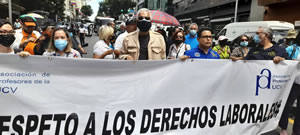
“Venezuelan public sector unions held a rally on Tuesday to demand higher salaries and respect for workers' rights. The march in the center of Caracas was directed against a directive from the National Budget Office (ONAPRE), which overrides a number of collective bargaining rights and, among other things, provides for the 50 percent reduction in wage supplements for experience or level of education, which leads to a flattening of salary scales. (…) Public sector pensioners, nurses, teachers and university employees were some of the sectors that were well represented at the rally. Another union that took part in the march represented workers at SUPRA, the waste management company in Caracas. (…) The SUPRA union has staged a series of protests in recent weeks and temporarily occupied the municipal company's headquarters on the outskirts of Caracas...” From the EnglishArticle by Ricardo Vaz on July 14, 2022 in venezuelanalysis.com  , see more information about the ongoing protests:
- September 24th: Demonstration in Caracas and in all 24 states of Venezuela to again - after 4 years - demand an increase in wages and pensions

“There has been no increase in wages, salaries or wages for four years nowPensions more. On the other hand, the prices of food are rising every day,Medicines, services and transport. Meanwhile, the country willplundered and among those in power, the US government and theirsdivided into oil companies. The employees do not have oneliving income, and we can't handle this situationaccept longer. Let's fight for wages and the denialput an end to our rights!“ SpanishCall from CNCTL to Laborsolidarity(machine translated) also to the rally in support of the demands of the retired workers of the state-owned telecommunications company CANTV on Friday, September 4, in Plaza Caracas in front of the Ministry of Labor with original and videos - After ongoing protests, the President of Venezuela announced an increase in the minimum wage and pensions, mobilizing broadly against the “mockery” on May 1st
- Workers protest in Caracas after a wage increase
“More than a thousand workers demonstrated in the Venezuelan capital on Friday, May 1, to protest against a wage increase announced the previous day that they consider a “mockery.”
The so-called "comprehensive minimum income" has been raised from $190 to $240 a month, an increase of 26%, Venezuela's acting president, Delcy Rodríguez, announced on Thursday, without providing further details.This income consists of a premium model that does not affect employees' social security contributions and is therefore not taken into account in the calculation of the old-age pension or in the calculation of social benefits. The minimum wage, frozen since 2022, is less than 30 cents, a ridiculous amount in a country with runaway inflation.
On Friday, around 1,500 workers, trade unionists and pensioners marched around four kilometers through downtown Caracas under the slogan “Allowances are not wages”. Dozens of riot police cordoned off some streets, but there were no clashes. “This is a mockery, this is fraud,” said Franklin Velásquez, a 61-year-old union leader. “Today we workers in Venezuela do not know what the minimum wage is and that, I repeat, is a mockery,” he added.The government is resorting to vouchers to boost the income of workers earning the region's lowest minimum wage, which has been frozen for four years. (…)
However, the first adjustment after the fall of Nicolás Maduro falls short of the cost of a basic food basket for a family of five, which amounts to almost $700 a month. (…)
According to AFP, smaller demonstrations were also recorded in other places in the country, such as in the border town of San Cristóbal and in Barinas, a former stronghold of Chavismo. “Workers must no longer bear the burden of a crisis that they did not cause,” said trade unionist José Patines from the homeland of the popular late President Hugo Chávez (1999-2013)...” span.AFP report from May 2, 2026(machine translated), see also:
- “…Thousands of workers gathered in Venezuela's capital Caracas for four star marches. The central topic was the salary increases announced the day before by interim president Delcy Rodríguez, which will come into force together with a package of bonus payments. According to France24, the measures at the demonstration were criticized because the bonus payments are not included in social security contributions and therefore do not contribute to increasing pensions and social benefits. The paper quotes trade unionist Franklin Velásquez, who described the salary increases as a “fraud”. “Today, Venezuelan workers no longer even know what the minimum wage is and that, I repeat, is a farce,” Velásquez was quoted as saying.
Carsten Hanke from the World Peace Council told Amerika21 from Caracas that many union members had described the announced measures as “very complex” and that this “needs to be analyzed in detail”. However, many things correspond to the demands of the unions. A festival for peace that took place almost simultaneously caused discontent among many union members because it was organized by the government and interim president Rodríguez. Many saw this as an “affront” and “a deliberate competition with the union actions,” said Hanke…" from thePost by Thorben Austen on May 2nd, 2026 in Amerika21(“Solidarity with Cuba characterizes May Day in Latin America”)
- “…Thousands of workers gathered in Venezuela's capital Caracas for four star marches. The central topic was the salary increases announced the day before by interim president Delcy Rodríguez, which will come into force together with a package of bonus payments. According to France24, the measures at the demonstration were criticized because the bonus payments are not included in social security contributions and therefore do not contribute to increasing pensions and social benefits. The paper quotes trade unionist Franklin Velásquez, who described the salary increases as a “fraud”. “Today, Venezuelan workers no longer even know what the minimum wage is and that, I repeat, is a farce,” Velásquez was quoted as saying.
- The incumbent president of Venezuela announces wage increases and a social package
“Acting President of Venezuela Delcy Rodríguez announced an increase in the comprehensive minimum income to $240 on Thursday, April 30, at the conclusion of the Great National Pilgrimage in Caracas.
The adjustment, described by the President as the most significant increase in recent years, will come into effect retroactively from the time of announcement. As part of Labor Day, Rodríguez also announced that pensions for seniors have been set at $70, an increase of 40%. The wage measure follows the signing of an agreement at the round table on labor and social issues, which was attended by trade unions, opposition and business representatives. Rodríguez called on the private sector to respect this minimum wage and apply it if current wages are below it…” span.Report from April 30, 2026 on telesurtv(machine translated) - At the last major rally against sanctions in Venezuela, the government announced a wage increase
“Government closes series of rallies against US sanctions. Delcy Rodríguez announces $240 minimum income. Pensions rise by 40 percent (…)On the occasion of the large demonstration in Caracas, Delcy Rodríguez announced an increase in the “integral minimum income” to the equivalent of 240 US dollars per month. Old-age pensions are to increase by 40 percent to $70. Rodríguez also called on the private sector to raise wages to this level. Rodríguez stated that another goal of the government was to formalize employment relationships. As in many other Latin American countries, a significant proportion of the workforce in Venezuela works in the informal sector. This also affected the development of wages and pensions, said Rodríguez. “We need to formalize the work so that people have the protection of the law and the state,” said the acting president.”Contribution by Philipp Zimmermann from May 1st, 2026 at Amerika21(“Major rally against sanctions in Venezuela, government announces wage increase”)
- Workers protest in Caracas after a wage increase
- After 4 years of “starvation wages”: Massive marches in Venezuela against the “responsible wage increase” that Delcy Rodríguez is offering on May 1st
“The workers don't believe Delcy Rodríguez about the "responsible" wage and take to the streets to march to Miraflores
Trade unionists and citizens gather in Plaza Venezuela to march into the capital's city center.
Hundreds of workers, trade unionists, teachers, pensioners and students have been gathering in Plaza Venezuela since the early hours of this Thursday to march to the Palacio de Miraflores. They demand a living wage and reject the announcement of a “responsible wage increase” by incumbent President Delcy Rodríguez.
The demonstration, organized by the National Trade Union Coalition and various unions, began at around 9:00 a.m. The demonstrators consider the wage increase announced for May 1 to be insufficient and inaccurate, since Delcy Rodríguez has not announced the amount of the increase nor a specific date for its entry into force.
"The salary has no political color. We are here to demand answers from the Rodríguez brothers," José Patines, union leader at the Ministry of Foreign Affairs and one of the main speakers at the march, told media covering the demonstration.
Workers complain that the current minimum wage is around 130 bolívars (less than a dollar), which has turned incomes into “starvation wages” after four years of freezing. (…)
The minimum wage in Venezuela has remained unchanged at 130 bolívars per month since March 2022. While it was equivalent to about $30 back then, its value is currently only about 27 cents according to the official exchange rate of the Central Bank of Venezuela. In recent years, the government has prioritized the payment of allowances that do not affect benefits and amount to about $160 a month for civil servants alone. This policy has been criticized by unions, who are demanding formal wage increases, respect for collective agreements and an end to the persecution of union leaders.
This is the fourth demonstration for higher wages this year and the first to target the Miraflores Palace. The call coincides with a rally organized by the Chavistas in the same neighborhoods of Caracas, said to be for “peace” and to mark the 20th anniversary of the local councils.” SpanishReport from April 9, 2026in the dossier at Correspondencia de Prensa with further information (machine translated) - On Monday, February 2nd, Venezuelan trade unions are calling for a rally for economic and social rights and wage adjustments
“The affiliates of the International Trade Union Network for Solidarity and Struggle support and disseminate the call for popular mobilization signed by the Venezuelan trade unions that signed the joint text of December 17.
On February 2, Venezuelan trade unions are calling for a rally in support of the petition to be submitted to the Supreme Court to respect Article 91 of the Constitution: wages have not been adjusted for three years! They also demand that the arbitrary “subsidies” that supplement starvation wages (less than 3 euros per month) be integrated into the actual wage.
On the other hand, the Human Rights Committee in Defense of Pensioners, Pensioners and the Elderly calls on "to continue the fight for economic and social rights", adding: "This is not the moment to back down or live by legends or external illusions. Democracy, freedom and prosperity depend on us! Let us leave fear behind us and save our homeland!"
The comrades of the National Conflict Committee of Struggling Workers welcome the announcement of an amnesty law, which represents a first success for those who have been fighting for respect for democratic rights and against oppression for years. 367 prisoners were released, some of whom had been imprisoned for four or five years, but about 700 remain. The families of political prisoners continue to have a permanent presence in front of the prisons.” SpanishStatement documented on January 31, 2026 at Laborsolidarity(“February 2nd: a new day of social struggle in Venezuela!”, machine translated) with poster
- See the dossier for the current background:Again #NoBloodforOil: The International Trade Union Confederation and others condemn the military aggression of the USA and the violation of Venezuela's sovereignty
- and also the post from January 2026:Secretary General of the United Federation of Petroleum Workers of Venezuela: “The Maduro government has established an open dictatorship against the working class”
- Venezuela: Sidor steel workers demand better wages and end to criminalization of protests after arrest of two union leaders
“Venezuelan metal workers are calling for the immediate release of two union leaders arrested during recent protests at state-owned steel company Siderúrgicas del Orinoco (Sidor).Daniel Romero and Leonardo Azócar were arrested on June 11 in Ciudad Guayana, Bolívar state, after staging a five-day sit-in with hundreds of metal workers. The goal was to get management to adjust wages to the rising cost of living and to reinstate health insurance and collective bargaining rights.Last Wednesday, Sidor workers, together with social and political activists, marched to the Attorney General's Office in Caracas. There they handed over a letter demanding the union leaders' release. Protesters are also demanding protection for all workers protesting for their constitutional rights, as well as an end to the company's military occupation.According to lawyer and human rights activist Eduardo Torres, the union leaders were charged with incitement to hatred, criminal association and boycott in a “rigged hearing” in a court in Bolívar state. A local judge also issued an order banning protests on June 13, threatening both union leaders and metal workers with prison sentences. The order contains a list of 15 people who are not allowed to strike, Torres said.Since June 7, hundreds of Sidor employees have walked off the job after the board refused to sit down and discuss labor issues…”Contribution by Andreína Chávez Alava in the translation by Vilma Guzmán on June 19, 2023 in Amerika21, see also:
- Support for the Committee on Conflicts of Workers in Struggle - Organization denounces persecution and criminalization of union and popular mobilizations
“The National Conflict Committee of Struggling Workers of Venezuela was involved in organizing the support action for the workers of Sidor, who were arrested on Wednesday (21) for their fight for their rights. The demonstration took place in Caracas in front of the Ombudsman's office. The committee calls for “respect for human and labor rights and compliance with the Venezuelan Constitution.” The organization also denounces the attack on the right to demonstrate and freedom of association. The International Trade Union Network of Solidarity and Struggle expresses its full solidarity with the working class in Venezuela, especially with the persecuted workers of Sidor.” SpanishDeclaration of solidarity from June 21, 2023 at laborsolidaritywith link toPictures of the June 21st event on Instagram
- Support for the Committee on Conflicts of Workers in Struggle - Organization denounces persecution and criminalization of union and popular mobilizations
- Venezuela: Strikes and protests in the state oil company PDVSA for higher wages and health insurance
"Workers in Venezuela's oil industry have been on strike in recent days for better wages and labor rights. Since June 1, employees of the Puerto La Cruz refinery in the state of Anzoátegui, eastern Venezuela, have demonstrated in front of the company's headquarters and other oil industry facilities. Employees from other branches of the state oil company PDVSA also took part. José Bodas Lugo, general secretary of the Union of Petroleum Workers (FUTPV), said that the refinery workers were in a “Standing meeting” until they receive a response from the authorities. “The social and economic situation of workers and pensioners in the oil industry is very precarious,” explained Bodas. "Our collective agreement expired 18 months ago and there is no progress in negotiating a new one. Our wages are inadequate." (…) The main demand of the protests is the reintroduction of Sicoprosa health insurance for the industry. Bodas criticized the company for not keeping its promises to reactivate the program. “At the moment only the PDVSA board and top managers have access to it,” he said. “This leaves the rest of the workforce at the mercy of the public health system, which is in a dire state.” Two workers with decades of service recently died in state hospitals due to inadequate care. The Sicoprosa program provided PDVSA workers and their immediate families with generous health care, allowing them to receive free treatment in private clinics throughout Venezuela and even abroad.It was financed by a percentage of employees' wages as well as separate contributions from the company. The demonstrations in Puerto La Cruz follow a series of other protests in the public sector and state-owned companies demanding higher wages, the reintroduction of collective bargaining and other labor rights. Amid massive sanctions that accelerated the country's economic crisis, President Nicolás Maduro's government took a more liberal approach in an effort to stabilize the economy, slowing wage adjustments and offering benefits to private companies. On May 1, the government raised the minimum wage for public sector workers to $70. However, this took the form of non-wage bonuses. Trade unionists criticize that the measures are tailored to the interests of employers as they reduce social security contributions, holiday pay, severance pay and other benefits...” Contribution by Ricardo Vaz translated by Vilma Guzmán at Amerika21 on June 10, 2023 - Protests and wage demands in Venezuela: Social justice or destabilization plan?
"In Venezuela, protests for wage increases are increasingly taking place, which have triggered a great debate within the government and Chavismo. (…) As has been usual at least since 2020, the debate is leading to a strange phenomenon of not only political but also ideological polarization. That is, the dispute does not necessarily develop from left or right positions, but from orthodox monetarist and more heterodox positions, each belonging to both political spectrums. On the one hand, there are those who claim and argue that it is impossible, at least for the time being, to achieve the much desired solution to public sector wages. This view points to the imperialist practices of blockade and sanctions as the main culprit for the shortage that has caused serious damage to state revenues. These apologists of the blockade as the cause of the economic crisis consider it self-evident to tighten the belt until new resources are generated that make an adequate wage policy possible (…) We believe that out of respect for the most fundamental principles of solidarity with workers fall into the trap of blackmail, consent and pandering to official versions. For this we demand a return to the principles of protagonism and democratic participation in the shaping of politics, a principle that the Bolivarian movement has instilled in us.We who believe that the class struggle is not a fairy tale, but the most obvious element of our daily life, and who know the costs of “economic peace” (Pax económica) because we experience and suffer it, are obliged to raise our voices. Not for demagogic reasons, as some claim, but because of the facts themselves, or as one of the advocates of financial truth says, “due to the concrete analysis of concrete reality”. (…) To do this, we will use official data on some economic aspects that we consider important in relation to the wage debate. (…)We do not deny the more than $230 billion in losses that the blockade has caused to [state oil company] PDVSA, or the more than $20 billion in assets frozen in various international accounts and funds of the Republic. That is why we are strongly committed to calling for an end to the blockade and the unconditional return of the frozen assets. However, without a certain degree of resistance and offensiveness, this accusatory attitude remains ineffective in the face of reality. In this case, one must first acknowledge the immense efforts the government has made to overcome trade barriers to our main export, oil. Therefore, it must also be recognized that oil revenues in 2022 were almost six times higher than in 2020. In that year of deep despair, only $743 million was recorded for hydrocarbon marketing. In 2022, however, revenue was almost as high as in 2018 at over $4.7 billion.This last figure is truly remarkable because at the end of 2018 the minimum wage was $28 and at the end of 2022 it was seven dollars. Is this because the resources are used in a different way? (…) As part of the 2023 goals, the President emphasized the need to combat economic inequality. An inequality that, according to Maduro, is also caused by the blockade and the economic war. The latter is closely linked to the wage system and income dynamics. By definition, inequality in the economic sphere means unequal participation in the distribution of profit or wealth. (…) Within this framework there are two options for action. The first is the appropriation of the means of production by the proletariat. The second is to use the mechanisms of the bourgeois-liberal state to wage an indirect or conjunctural fight against inequality. (…) The fight for a decent wage is more than just a fight. It is the essential prerequisite for maintaining the model of a country, a prerequisite for the reconstruction or deepening of a real revolution on democratic foundations in the economic and social. As Chávez himself emphasized when he signed the decree on the labor law on April 30, 2012 (…): “No achievement of the workers has been achieved without a long process of resistance, struggle and even suffering”. Contribution by Carlos Dürich in the translation by Klaus E. Lehmann from March 22, 2023 at Amerika21 - Teachers in Venezuela demand higher wages, social security and health insurance
"Hundreds of Venezuelan teachers are currently taking to the streets to demand higher wages and the restoration of collective bargaining rights. The nationwide protests began on Monday. They are organized by the United Federation of Teachers and Unions from around 18 states. Other employees, administrators and pensioners from the public education sector also joined. In Caracas, the protesters gathered in front of the Ministry of Education to demand immediate answers to their months-long struggle for adequate salaries and the full payment of the agreed upon The head of the Venezuelan Teachers' Association, Raquel Figueroa, ruled out a nationwide strike but said its members would remain on the streets until they received a new collective agreement that respected labor rights and established a salary increase. Negotiations between the unions and the government ended in November after a year of discussions without results Gricelda Sánchez, president of the Union Leadership Education Center, stated that “last year a teacher earned between $90 and $100 a month, today it is less than $30.” This is due to the currency devaluation that began in the second half of 2022. “We realize that we are not a country that prints dollars, but the economy is managed under this currency.”Therefore, the teachers are demanding a salary that corresponds to this reality, said Sánchez. Under pressure from U.S. sanctions, Venezuela has undergone a virtual dollarization as the government tries to revive the economy to overcome a years-long recession. This, together with other economically liberal measures, has curbed inflation somewhat and reactivated industrial and commercial activities. The central bank reported economic growth of 17.73 percent for the first nine months of 2022 compared to the same period last year ( Amerika21 reported). However, salaries for public sector workers are stagnating; the last increase in the minimum wage took place in March 2022 to around 130 bolívares (then $30). Due to the recent devaluation, this is now equivalent to less than ten dollars. For comparison, the basic food basket is valued at over $492. Teachers are forced to take a second job, leave the public sector or emigrate.” Contribution by Andreína Chávez Alava in the translation by Vilma Guzmán from January 14, 2023 at Amerika21 - The wave of protests in Venezuela for higher wages and labor rights in the public sector continues massively throughout the country
"To combat inflation, benefits have been cut, wages lowered and the right to collective bargaining suspended. The result: the cost of living becomes unaffordable. Amid nationwide protests, the Venezuelan government has begun a dialogue with public sector unions to discuss their demands. Previously, it had announced the full payment of vacation pay for employees at state schools and universities. (…) However, the National Budget Office (Onapre) set this year's bonus the minimum monthly wage of seven bolivars (1.52 US dollars) of 2021 and not the rate of 126 bolivars (US$30) decided in March. The holiday pay was also divided into several payments, so that teachers only received a 25 percent share in July. The cuts sparked massive protests across the country Ministry of Economy, (…) The holiday pay is just one of many demands that have led to the nationwide mobilizations. Since the beginning of July, retired civil servants, nurses, teachers and university employees in the public sector have taken to the streets to protest against an Onapre policy that flattens the salary scale, eliminates the right to collective bargaining and cuts a range of benefits such as health care, loans and bonuses based on experience or educational level.Eduardo Sánchez, spokesman for the Central University of Venezuela Employees' Union, called the Onapre guidelines a "cruel policy" that puts employees in "terrible conditions" and forces them to take second jobs or leave the public service altogether. “In the case of university employees, we are talking about 40 to 70 percent cuts in real wages.” On July 12, protesters delivered a letter to the Ministry of Labor demanding the reversal of this policy and petitioned the Supreme Court for its immediate repeal. The verdict is still pending. The protesters also demanded higher salaries to cover living costs. The basic food basket is currently valued at over $392, while public school teachers earn around $50 a month. Many public sector employees have therefore switched to the private sector or emigrated, taken on several part-time jobs or are dependent on money transfers from relatives abroad..." Contribution by Andreína Chávez Alava and Ricardo Vaz in the translation by Vilma Guzmán in Amerika21 on August 23, 2022 - “In #Venezuela, protests by #education and health workers have been taking place for over two weeks for adequate pay. The background is cuts in salaries and, above all, additional wage benefits in the public sector. Wages in Venezuela are still very low after the end of hyperinflation and a slight economic recovery. Just in March there was a 1,700 percent increase in the minimum wage to around $30 a month. But the price level is very high.”Thread with video by Tobias Lambert from August 4th, 2022

- Almost 100 protests have been registered in Venezuela so far in August
“The Observatory of Social Conflicts reported that the demonstrations were organized by workers demanding better wage conditions from Nicolás Maduro's regime.
According to Efe, the NGO Venezuelan Observatory of Social Conflicts (OVCS), at least 96 protests were registered in Venezuela from Monday to Friday. The NGO highlights the demonstrations carried out by education sector workers to demand respect and compliance with their collective agreement.
This Friday, according to the organization, at least nine protests were organized in the states of Yaracuy, Falcón, Portuguesa, Anzoátegui, Bolívar, Guárico, Zulia and Monagas, raising demands in the areas of work, housing and public security.
The coordinator of the non-governmental organization, Marco Antonio Ponce, explained to Efe that in the first days there have been "about 100 demonstrations, mainly related to the situation of the country's workers", to which, as he said, "the government of Nicolás Maduro has not yet given a really satisfactory answer". “This sector has been joined by healthcare workers and retirees and pensioners,” he said.In his opinion, this crisis of workers "has a structural background and has to do, for example, with the situation of the minimum wage, which is inadequate since it is currently $23 per month", while a family needs almost $400 per month to cover its food needs.On the other hand, Ponce assured that "the security forces have tried on many occasions to hinder or prevent the demonstrations", but the "peaceful character of the demonstrators ensured" that these measures were "kept in this tone".
On Thursday, thousands of active and retired education workers took to the streets again to demand refunds and respect for their collective bargaining agreements - the fourth demonstration called by the union in the past two weeks.On that occasion, thousands of citizens took over the center of Caracas in a demonstration that stretched for at least three blocks to the Parliament, but which had to end at the entrance of the Ministry of Higher Education, where a contingent of security forces prevented the mobilization from progressing.
Last week, the OVCS released a report in which it stated that 3,892 protests were recorded in Venezuela in the first half of the year, an average of 22 per day and a 15% increase compared to the same period in 2021, when 3,393 demonstrations were documented.” Machine translation of SpanishPost from August 6th, 2022 at Infobaewith photos and a video - Education workers protest in the streets of Venezuela
“Thousands of active and retired workers in Venezuela's education sector took to the streets again on Thursday to demand reimbursement of their salaries and respect for their collective agreements - the fourth demonstration called by the union in the past two weeks.Protesters marched through central Caracas to cover at least three blocks to reach Parliament. However, the demonstration ended at the entrance of the Ministry of Higher Education, where armed forces prevented protesters from moving further."We are on the streets because the government's policies aim to destroy the knowledge society, that is, the entire education system. What the government is doing is unusual - it is reducing wages, it has suspended everything that has to do with pensions," Víctor Márquez, the president of the Association of Professors of the Central University of Venezuela, told EFE.In addition, the executive branch “abolished the contributions and retentions of the savings banks and destroyed the security and social security institutions of the university sector,” he continued.The professor stressed that this is a violation of the rights of active and retired workers and assured that they will remain on the streets until the measure is reversed.
"Is it true that the blockade has affected us? Yes, the blockade has affected us, but the looting that they have done to this country has also affected us, because they have looted this country, because corruption has caused us a lot of damage," said Eduardo Sánchez, president of the Federation of University Workers, who called for the resignation of the Ministers of Education, Higher Education and Planning.
Meanwhile, non-governmental organizations and union leaders reported on social media that the protest was repeated in other regions such as Lara, Zulia, Yaracuy, Sucre, Monagas and Portuguesa, where public sector employees demonstrated against a directive from the State Budget Office that foresees the cuts in several services.The issue of these protests came to parliament on Thursday when several opposition MPs asked to "accompany" or "lead" the negotiating tables in favor of the protesters, a proposal that was quickly rejected by the Chavista majority, which defended the executive and said that behind these demands were attempts to destabilize the government.” Machine translation of EnglishArticle from August 4, 2022 in La Prensa Latina - “This is the face of misery experienced by educators as well as health workers and other public institutions.”Tweet from Bladimir Martinez to the video of the protest on August 6, 2022
- See also: “From the once rich oil state to the poorhouse of Latin America” –Dossier at Blickpunkt Latin America
The postVenezuela: Not only workers in the public sector and especially in the education system are protesting in defense of wages and collective bargaining rightsappeared firstLabourNet Germany.
Read the full story at the source
Source: labournet.de