
Politics · labournet.de · · 2h
Right to strike based on national interest in Building Canada Strong Act C-39 stirs resistance from unions in Canada
Deutsch (original) · Auto-translated to English
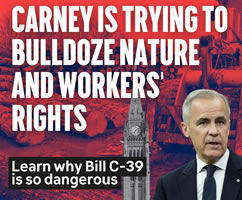
“On Monday, the Liberal government introduced Bill C-39 in the House of Commons. They claim the law is aimed at strengthening Canada's economy, but unions warn that parts of the bill undermine workers' rights enshrined in the Charter of Rights and Freedoms. Bill C-39, also known as the Building Canada Strong Act, is a sweeping omnibus bill that Mark Carney's government claims will stimulate the economy by helping expedite so-called projects of national interest. The bill also makes significant changes to the Canadian Labor Code…” EnglishArticle by Nick Seebruch from September 23, 2026 on rabble.ca  (“Unions call Bill C-39 an attack on labor, Charter Rights”, machine translated) – see more information, especially union reactions:
- Canada's unions unite against new restrictions on the right to strike
“OTTAWA — Canada's unions are uniting in calling on the federal government to remove new restrictions on the right to strike from proposed changes to the Canada Labor Code.
"Last night I met with the leaders of Canadian unions representing workers across the country and in every sector of our economy. We agree: any new restrictions on the right to strike are unacceptable," said Bea Bruske, President of the Canadian Labor Congress.
The bill includes important measures that workers and unions have fought for, including protections against contract substitution and wage theft, as well as additional funding for the Canadian Labor Relations Board and health and safety enforcement.
However, these measures come with a fundamental attack on the right to strike. The bill would give the minister exceptionally broad discretionary powers to end a lawful strike based on his assessment of the national interest.
“The so-called safeguards are, frankly, nonsense,” said Mark Rowlinson, an attorney at Goldblatt Partners. "The bill gives the minister unrestricted powers to end a strike based solely on his personal opinion. Such a concentration of power is unprecedented among G7 countries." “Strong collective bargaining, including the right to strike, is in Canada’s national interest,” Bruske said…” EnglishPress release dated September 22, 2026 at the Canadian Labor Congress(machine translated) - Unifor warns that Bill C-39 will impact workers' Charter-protected rights to strike
“Unifor pledges to vigorously oppose the encroachments on the right to strike contained in Bill C-39 and calls on MPs from all parties to stand with workers. “At a time when we should stand together as a country to fend off Trump’s trade war attacks, workers and their unions must now also defend the right to fair and free collective bargaining,” said Unifor National Chair Lana Payne. “These proposed changes to the Canadian Labor Code give the Minister of Labor special powers to override the ability of workers to exercise their right to strike.”
Unifor negotiates on behalf of approximately 70,000 workers in federally regulated industries, including shipping, rail, aviation, media, telecommunications and road transportation.
“The government must understand that these proposed changes will have intended and unintended consequences – on collective bargaining, on workers’ ability to effect positive change in their workplaces and on how employers will now behave at the bargaining table,” Payne said.
While Unifor welcomes the proposed changes to the Code regarding contract changes at airports and the improvements for workers in entering into initial collective bargaining agreements, the union criticizes the proposal to grant the Secretary of Labor unilateral powers in Section 107 to resolve a labor dispute by referring it to binding arbitration. Also of concern is the national interest test set out in the proposed legislative changes and how this will impact workers' collective bargaining rights.
"Whose interests are being protected here - those of companies or those of workers? This process risks cementing preventive government interventions and creating a system in which workers can be deprived of their rights simply because of where they work," said Daniel Cloutier, director of Unifor Quebec.(…)
Unifor and many Unifor chapters are open over the summerthe firstandsecond round of consultations Canada's Ministry of Employment and Social Development responded to this issue. (…)
The law also addresses the issue of “contract flipping,” where a change in contractors providing services at airports and other workplaces results in the loss of union bargaining rights and collective bargaining agreements. In the event of a contract change, workers can retain their union representation and their collective bargaining agreements - a long-standing demand of Unifor.
"Unifor members at airports in particular have felt the destabilizing effects of contract flipping, and it is long overdue for this practice to end. Given the government's plans to privatize airports, this type of protection is now even more important," commented Payne.
Unifor will review Bill C-39 in detail and provide further analysis in the coming days…” EnglishReport from September 22, 2026 from Unifor(machine translated) - CUPE will oppose the unconstitutional restrictions on the right to strike in Bill C-39 if it passes
“The national board of Canada's largest union, CUPE, has unanimously passed a resolution pledging to oppose the Liberal government's Bill C-39, which restricts the constitutional right to strike, if it passes Parliament without change.The right to strike is a right protected by the Charter of Rights and Freedoms – a right upheld by the Supreme Court of Canada in 2015. The Minister of Labor - whether under this or any other government - cannot decide at will whether this right is respected in this country.
“The prime minister’s mission is to defend Canada against Trump – not to trample on our constitutional rights,” said Mark Hancock, national chair of the CUPE union. "Eroding Canadians' Charter rights will not make us stronger against Trump - it will weaken us. The government should repeal this unconstitutional law, protect our rights and freedoms, and ensure companies bargain collectively fairly."Bill C-39 is an unprecedented attack on the ability of working people in Canada to negotiate for better wages and a better life - giving companies even more power by taking away our right to free and fair collective bargaining.
“Governments cannot legislate industrial peace,” said Candace Rennick, CUPE national secretary-treasurer. "Abolishing our constitutional right to strike will not stop us from using the full force of our union to defend our members. Given the cost of living crisis, workers need the protection of unions and their right to fight for a better life, now more than ever.”“ EnglishReport from September 23, 2026 from CUPE(machine translated) - Migrant workers advocate for unions and the right to strike.
“This week the federal government introduced Bill C-39. It allows the Minister of Labor to end a strike. The government has used this power in the past to end rail and port strikes. C-39 facilitates the reapplication of this authority. The right to strike is protected by the Charter. The Supreme Court found this in 2015. Unions across the country, including CUPE, Unifor, the Teamsters and the Canadian Labor Congress, are opposing this bill.
Migrants know what happens when workers cannot act together. Farm workers in Ontario are banned from joining unions. Domestic workers are left to their own devices and at the mercy of their employers. Workers with temporary residence permits can be fired and sent back home if they express their opinions. Last month, police in Calgary called out the CBSA for migrants at a demonstration. Ten of them are now threatened with deportation.That's why we stand with all workers and unions who oppose Bill C-39. Because what harms one harms everyone…”Migrantworkersalliance on September 25th, 2026 on Insta(English)(machine translated) - BCGEU: Bill C-39 breaks the agreement on the right to strike and workers will respond with solidarity
“British Columbia's largest public sector union is calling on Ottawa to withdraw the labor provisions of Bill C-39 and repeal Section 107
BURNABY, B.C. - The BC General Employees' Union (BCGEU) is calling on the federal government to withdraw the labor provisions of Bill C-39, the Building Canada Strong Act, warning that the bill breaks the long-standing agreement behind collective bargaining in Canada and threatens the right to strike.Bill C-39, introduced in the House of Commons on September 21, would enshrine Section 107 of the Canada Labor Code into law and expand the powers of the Minister of Labor to end strikes and lockouts, extend expired collective agreements and submit disputes to binding arbitration.
“No government has given workers the right to strike,” said Paul Finch, chairman of the BCGEU. "We fought for it. Long before there was a legal framework, we won it on picket lines, in general strikes, and by standing shoulder to shoulder when governments and employers asked us to sit down and be quiet. Every protection that working people have in this country exists because workers refused to stand alone."Finch said the bill undermines the post-war compromise that has characterized Canadian labor relations for generations…” EnglishPress release dated September 23, 2026 from BCGEU(machine translated) – BC General Employees’ Union in the public and private sectors. - Bill C-39 does not protect the right to strike
Teamsters Canada on September 22, 2026(English) - DRAFT BILL C-39: CCLA WARNES AGAINST AN EXPANSION OF ALREADY PROBLEMATIC EXCEPTION POWERS AND A RESTRICTION ON EMPLOYEES' BARGAINING RIGHTS
“The federal government's latest omnibus bill, the “Act on Certain Measures to Strengthen the Economy” (Bill C-39), was introduced with great fanfare on September 21st. Although it is touted as necessary to build a stronger, more independent and sustainable economy, it actually puts these goals at odds with the rule of law and Charter rights. Bill C-39 expands the already problematic exemptions and significantly undermines workers' bargaining rights.
“One of the many lessons we should learn from the rapid erosion of democratic norms in the United States is that unlimited executive powers are antithetical to a functioning democracy,” said Howard Sapers, executive director of the Canadian Civil Liberties Association (CCLA). “While advancing Canada's economy is an important goal, it should not be pursued at the expense of our country's deep-rooted commitment to some of its most fundamental principles, including the rule of law, the separation of powers and the protection of Charter rights.”
Part 1, Section 2 of Bill C-39 would further expand the already broad exemptions introduced last year under the controversial Bill C-5, the Building Canada Act, to give Cabinet full discretion to designate "regions of national interest" in which many federal laws that would otherwise apply to specific projects could be overridden.
Rather than adding much-needed checks and balances to an already problematic framework, Bill C-39 would remove the current five-year time limit, which previously ensured that exemptions only apply for a limited period of time.
“Expanding the scope of the existing exceptional powers and removing the five-year limitation clause would transform what the federal government initially presented as a limited and temporary power into a comprehensive and permanent power grab by the Cabinet,” said Anaïs Bussières McNicoll, director of civil liberties at the CCLA.
Part 3, Section 1 of the bill would amend the Canadian Labor Code to provide the Minister of Labor with the authority to direct the Canadian Labor Relations Board to terminate a lawful strike that is affecting or likely to be affecting the national interest. The Bill does not contain a definition of the term “national interest”, meaning that its interpretation is effectively at the discretion of the Minister. Relevant considerations listed are the potential or actual “significant impact on the Canadian economy” or “serious social disruption” of a strike. These terms are significantly broader than the existing parameters of the Canadian Labor Code.
“There can be no meaningful negotiations if one side lacks the power to negotiate on equal terms,” Bussières McNicoll continued. "Giving the Minister of Labor broad discretionary powers to end strikes does not strengthen Canada. It undermines freedom of association and further tilts the balance of power in favor of employers at a time when many workers in Canada are struggling to make ends meet."
“We urge the federal government to build a stronger, more independent and sustainable economy, without sacrificing what makes Canada a robust, functioning and vibrant democracy,” Sapers concluded.
We continue to review this comprehensive omnibus bill and may provide additional comments in the future.” EnglishCCLA press release dated September 23, 2026(machine translated, emphasis ours)- the CCLA is a human rights organization committed to defending the rights, dignity, security and freedoms of all people in Canada. - Canada: Bill C-39 introduces significant changes to federal collective bargaining
“…On September 21, 2026, the federal government introduced Bill C-39, the Building Canada Strong Act. Among other labor market-related measures, the Bill makes significant changes to the Canada Labor Code ("Code") that would reshape several aspects of the federal labor law framework, including collective bargaining deadlines, initial collective agreement negotiations, succession rights in statutory contractor replacement cases, multi-employer collective bargaining, special arbitration procedures, Section 107 interventions, and paid sick leave. The bill is currently in its first reading and has not yet come into force. (…) In theFederal government background documentsThe introduction of Bill C-39 also signaled the government's intention to take greater action against wage theft and worker misclassification, particularly in the trucking industry. It points out that misclassified drivers can be deprived of the protection of the law and that irregular practices can lead to unfair competition by penalizing employers who are complying with their labor standards obligations…” EnglishPosted by Stephen Shore and Liam McMunagle on September 23, 2026 (machine translated) – Littler Mendelson is part of the international employer law firm Littler Global
- See also atCanadian Labor Congress on September 25, 2026 : Employers welcome the restrictions on the right to strike provided for in Bill C-39...
- See also atCanadian Labor Congress on September 25, 2026
Basic information:
- Bill C-39 Introduction –the draft law
- #BillC39 #RightToStrike #StatusForAll #MigrantRights #canlab #cdnpoli
See from 2024:Canada's unions welcome anti-scab law: Canada's labor minister wants to ban the use of substitute workers, i.e. prank breakersand from 2017:The provincial government of Quebec is rapidly passing a special law against the right to strike: Do Canadian construction unions really want to resort to legal action?
The postRight to strike based on “national interest” in Building Canada Strong Act C-39 sparks opposition from unions in Canadaappeared firstLabourNet Germany.
Read the full story at the source
Source: labournet.de