
Repression labournet.de
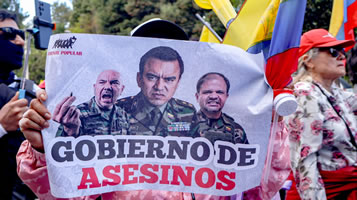
Police violence in Ecuador during protests by over 50 social organizations and unions against Noboa's austerity and deregulation measures
Dossier "We are mobilizing because the country cannot continue to live in the shadow of fear and insecurity. While the government announces security plans that do not exist in practice,
Deutsch (original) ·Auto-translated to English
dossier
“We are mobilizing because the country cannot continue to live in the shadow of fear and insecurity. As the government announces security plans that do not exist in practice, Ecuador has been forced into an unbearable reality: it is the most violent country in Latin America, ending 2025 with more than 10,000 murders and the highest rate of violent deaths in its history. (…) The wage increase for teachers and public servants is not a privilege: it is an urgent measure to restore purchasing power lost after more than a decade of frozen wages in the face of ever-increasing living costs. Adding to this injustice is increasing job insecurity caused by regressive reforms, layoffs and policies that weaken the rights won by generations of workers…” span.Message from the teachers' union UNE with photo gallery  (machine translated) of the large demonstration march that took place on March 13, 2026 together with more than 50 social organizations and was attacked by the police, see more:
- New union alliance and social organizations in Ecuador are again protesting against Noboa's anti-social policies with rallies in various cities

- Trade unions in Ecuador protest against Noboa's policies
“Quito. In Ecuador, workers, teachers, students and members of social organizations took to the streets on Thursday afternoon against the policies of President Daniel Noboa. Rallies took place in Quito, Guayaquil, Manta and Cuenca.
A newly founded platform made up of the “Frente Unitario de Trabajadores” (FUT), the “Unión Nacional de Educadores” (UNE), the “Frente Popular” and other unions in Quito called for the protest. They want to fight together against the government's policies.
Protesters are demanding job security, wages that reflect the rising cost of living, and improvements in health, education and safety.
They also declared that they would take to the streets to defend “the assets of Ecuadorians” held by the Ecuadorian Social Security Institute (IESS). On August 28, President Noboa estimated what he called “unused assets” in the form of Social Security real estate at around $2 billion and noted that their sale could contribute to the functioning of the IESS.
José Villavicencio from the UGTE union criticized the government's health care priorities: It is purchasing a $240 million digital system that will connect public health facilities and record patient data and medication, while hospitals are lacking medication. The President of the FUT, Edwin Bedoya, also criticized the fact that over 100 workers' organizations were not registered and therefore unprotected. UNE President Andrés Quishpe called for an end to the criminalization of social leaders like Guido Perugachi and deplored the persecution of journalists, doctors and women. (…)
Quishpe saw the march as the start of further joint actions with indigenous, farming and environmental organizations. The organizations announced that they would continue their resistance before the regional elections on November 29th.”Post by Lilith Mić from October 11th, 2026 in Amerika21 - MANIFESTO OF THE NATIONAL UNITY ASSEMBLY
“We, the social, trade union and popular organizations gathered in Quito on September 26, 2026, commit ourselves to strengthening unity and developing a common agenda to address the problems currently facing Ecuador. Starting from our various organizations and regions, we have created a platform for common struggle that brings together the demands of women, workers, youth, farmers, indigenous peoples, teachers, pensioners and the popular classes. Together we demand the right of society to organize, to participate and to demand concrete answers to our needs. (…)
We recall that the people of Ecuador have already expressed themselves clearly in the referendums: No to the establishment of foreign bases; No to hourly wage work; Yes to the life and protection of the Yasuní, Quimsacocha and the Chocó Andino. These democratic decisions must be respected and implemented by the government of Daniel Noboa.
For these reasonsThe National Unity Assembly has decided to proclaim October 8, 2026 a national day of resistance and mobilization in defense of freedoms, democracy, health, public education, decent work, security and sovereignty.
In addition, the assembly called in its resolutions to “defeat the government on the streets and at the ballot box” and not to cast a single vote for Noboa on November 29, 2026. This declaration is part of the political decisions adopted by the participating organizations, together with the commitment to strengthen the unity of the social, trade union and popular movement…” span.Report from the Unión Nacional de Educadores(National Association of Educators) to Plataforma de Lucha Unitaria (machine translated)
- Trade unions in Ecuador protest against Noboa's policies
- Ecuador: Criminalization through a transparency law – a means of exerting pressure against criticism
"Lizardo Zhagüi has two lawsuits going on at the same time. "My account has been frozen since September 2025, I am suspected of money laundering and terrorism. I am nothing more than a committed water activist," says the 64-year-old Ecuadorian, pushing his baseball cap with the water company's logo back on his neck. (…) David Fajardo Torres, is a lawyer and environmental activist, lives in Cuenca and, like Zhagüi, is a victim of the state His account is also blocked, and there are probably political reasons why the state is taking action against him. Fajardo Torres is a member of the "Cabildo por el agua", or "Assembly for Water" and advocates for the security of the Cuenca region's supply of drinking water - and thus against mining in sensitive regions such as the Páramos, but also in the headwaters of rivers and lakes (...) Two examples that are anything but atypical, according to Mario Melo, a long-time employee Dean of the Faculty of Law at the Pontifical Catholic University of Quito (PUCE), Melo had to deal professionally with the “Social Transparency Law” because he represents one of the civil society organizations, the Pachamama Foundation, whose accounts were frozen for over eighty days from mid-October last year (…) More than 100 organizations, including several with an indigenous background, such as the indigenous umbrella organization Conaie, but also a number of individuals, had their accounts frozen "We were involved in the protests against the cancellation of diesel subsidies by the right-wing Noboa government in September 2025," believes Melo.According to his assessment, the “Law for Social Transparency” has been essentially instrumentalized. The “Law for Social Transparency” is supposedly intended to prevent “money laundering” and the “financing of terrorist organizations.” (…) Esperanza Martínez from the environmental organization “Acción Ecológica” sees the primary goal of the law not as preventing potential money laundering and the financing of criminal organizations, but rather as criticizing the government’s mining strategy. »Daniel Noboa's goal is to establish mining in Ecuador like a dogma; He is doing everything he can to break down the immense resistance that exists at the local level against large mining projects. Article 4 of the law is intended to ensure this,” says the biologist and lawyer. The article prohibits all civil society organizations from criticizing officially approved mining and oil production projects. There is a risk of strict sanctions, including a ban on organizing for up to four years. For Esperanza Martínez and Mario Melo, Article 4 clearly violates Ecuador's progressive constitution. The Constitutional Court will therefore have to deal with this in the next few weeks.” Article by Knut Henkel from July 15, 2026 in Neues Deutschland online - More child labor, more poverty, more protests in Ecuador: The last nationwide march by the unions on June 13th against rising fuel prices and the cost of living
- More child labor, more poverty, more protests in Ecuador: confidence in the financial markets has increased. The population does not benefit from it
"...The Ecuadorian government is currently emphasizing the improvement of economic indicators and speaks of a stabilization of the national economy. However, many Ecuadorians complain about rising costs of living and a lack of improvement in their standard of living. According to official information, Ecuador's country risk has decreased, international reserves have increased and the financial markets' confidence in the country has increased. At the economic conference of the US Chambers of Commerce in Latin America and the Caribbean "Business Future of the Americas" (BFA) in Quito, Ecuador's President announced Daniel Noboa last week: “Today we can see how Ecuador, how the entrepreneurs of Ecuador and how the US look at a country that is growing against all odds, growing against all odds, is moving forward.” (…) However, critical voices doubt whether this development is reflected in the everyday life of the majority of the population. According to data from the National Institute of Statistics and Censuses (Inec), real household income increased by just 0.1 percent over the past decade, while household consumption expenditure fell by almost 10 percent. At the same time, official data shows that child labor in Ecuador has increased significantly over the last decade. Due to growing poverty and a lack of protective measures, over seven percent of children and young people between the ages of five and 14 are now doing exploitative work. This massively violates your fundamental rights.(…) Trade unions and social organizations are currently mobilizing against announced layoffs in the public sector, rising living costs and upward redistribution. Various trade union associations and social movements called for demonstrations in Quito over the weekend. The protests coincided with a rise in gasoline prices. At the same time, President Noboa suspended the special tax on alcohol during the World Cup. At a demonstration in front of the Ministry of Energy and Mines on Friday, Edwin Bedoya, chairman of the Fut trade union federation, denounced: “Beer has become cheaper, fuel more expensive.” He accused the government of pursuing economic policies that hurt ordinary people. The teachers’ union Une agreed and described the measure as “anti-people”. If the government does not give in, it will call for further protests.” Post by Hannah Dora from June 14, 2026 in america21 - UNE, FESE, CONASEP and UNEM are calling for a nationwide march on June 13th
“The National Union of Teachers (UNE), the Federation of Secondary School Students of Ecuador (FESE), the National Association of Municipal Teachers (UNEM) and the National Association of Public Employees in Education (CONASEP) announced in a press conference that they will file a constitutional challenge against Ministerial Decision 0045-A, arguing that it is a hastily adopted regulation that violates the rights of students and teachers. (…) In view of this situation, the UNE, FESE, UNEM and CONASEP announced a nationwide march from the IESS treasury to the Constitutional Court on Saturday, June 13, at 9:00 a.m., calling on teachers, students, parents and the general public to join this mobilization in defense of the rights of the educational community and the educational budget.” SpanishCall from the National Teachers Union(UNE) (machine translated), see for the reasons: - We are protesting against rising fuel prices and the high cost of living
“We at the National Union of Teachers (UNE) reject the renewed increase in fuel prices - an anti-people measure that puts a direct financial burden on Ecuadorian families and further increases the high cost of living.
Daniel Noboa's government is once again passing the crisis onto the population. As thousands of families struggle to cover the costs of feeding, transport, healthcare and education for their children, new economic measures are being imposed that make life more expensive and once again hit the lower and working classes.
The situation is clear: as of June 12, “Extra” and “Ecopaís” gasoline costs $3.31 per gallon, while diesel is $3.25 – in both cases an increase of 15 cents compared to the previous month. Added to this is premium gasoline, the price of which could be $5.60 or more depending on the gas station, an increase of 80 cents and even up to $1. This blow is particularly hard because the minimum wage only covers about 50% of the shopping basket, which is already worth over $800.
We know that when fuel prices rise, everything becomes more expensive - food, transport costs, staples - and that affects the economy of every single household. Mothers and fathers feel this, our students feel this, teachers feel this, the working population feels this.
This measure is part of a neoliberal policy that benefits big corporations, while public education is neglected, working conditions become precarious, rights are curtailed, and educational communities face insecurity, deteriorating infrastructure and a lack of financial resources.
We at the UNE will not accept that the population continues to pay for a crisis that they did not cause. We will not accept that a harsh austerity package will be imposed on Ecuadorian families while schools continue to suffer from unacceptable conditions, there is a shortage of teachers, students and teachers are threatened with insecurity and the government wants to impose new workloads on teaching staff.
In the face of the austerity package, the rising cost of living and the neoliberal policies of Noboa, we are responding with organization, unity and mobilization of the population. In the next few hours we will announce combat measures together with social and popular movements.
The UNE stands by the people, on the streets and in the fight!”SpanishJune 12 statement from National Teachers Union(UNE) (machine translated)
- More child labor, more poverty, more protests in Ecuador: confidence in the financial markets has increased. The population does not benefit from it
- Things are boiling in Ecuador: “Noboa out”: activists are aiming for a referendum on the impeachment of the president. He suppresses the protests violently
"The government of Ecuador's President Daniel Noboa is responding with repression to calls for the impeachment of the right-wing head of state and government. Since the beginning of this week, the country's political and social crisis has been worsening. On Tuesday, the police in Quito dispersed peaceful demonstrators with tear gas. Members of social organizations had called for the release of forms to initiate the impeachment proceedings against Noboa and Vice President María José Pinto in front of the headquarters of the National Electoral Council (CNE). Among the Shouting “Noboa out, out!” and “Removal now!”, the indigenous leader Leonidas Iza and the lawyer Washington Andrade handed over the formal application to the electoral authority. According to consistent reports, things escalated during the rally in front of the CNE headquarters: the emergency services used tear gas against the initially peaceful gathering, whose participants, including families with children, only demanded documents for a constitutionally required signature collection. Videos of the clashes demonstrate a new quality of government Repression, which had already been demonstrated by over 5,000 arrests during a nightly curfew in May, mostly for violating the curfew. "Gentlemen police officers, why was it necessary to use tear gas against elderly people and citizens who were exercising their legitimate right to protest?" asked journalist Elena Rodríguez Yánez on Tuesday on X.Iza, however, announced that if necessary he would take the resistance to the streets: "If they don't even respect their own mechanism, then we'll take to the streets." Two million valid signatures - 15 percent of those eligible to vote - are needed for the referendum. Surveys show that 70 percent reject the government and 61 percent actively support the process. As justification, the applicants referred to the devastating consequences of Noboa's policies for the majority of the population. This does not only mean the government's economic policy decisions, but also ongoing social uncertainty due to increasing social impoverishment and violence. (…)
In the first four months of this year alone, 2,778 murders were recorded - an average of 23 per day. This means that 2026 threatens to become the second most violent year in Ecuadorian history. At the same time, the social situation of the population is deteriorating. A UN report warns that millions of people are facing food insecurity and acute hunger. Many households will then only be able to afford a reduced number of meals. The consequences of economic policies that prioritize fiscal consolidation and structural adjustments, which social movements criticize as neoliberal shock measures, primarily affect poorer sections of the population. Adding to the tension this week is the death of activist Mónika Silva Koniuszek, who was found dead in her home in the coastal province of Santa Elena on Monday. The woman of Polish origin had for years denounced irregular land sales in which mayors and high-ranking officials were said to be involved...” Article by Volker Hermsdorf in the Junge Welt from June 11, 2026 - Police violence in Ecuador during protests against Noboa's reforms
"On Friday, March 13, police cracked down on a demonstration in the Ecuadorian capital of Quito. The protest, organized by the Frente Nacional, the United Workers' Front (FUT) and the National Union of Teachers (UNE), was against a series of measures, including the Ministerial Agreement MDT-2026-059, which allows the restructuring of the 40-hour week into shifts of up to ten hours per day. Union leaders say described this as “anti-employee”. Other points of contention include the Mining and Energy Law, which allows the mining of rock materials in the Galápagos Islands, as well as reforms to the Law on Territorial Self-Government (COOTAD), which could result in cuts to social programs at the municipal and prefectural levels. Protesters also criticized the recent FBI agreement with the US, which allows the permanent presence of FBI agents in the country. The Ecuadorians had already spoken out against the establishment of foreign military bases in the failed referendum in November 2025 - results that, according to the protesters, the Noboa government is now disregarding. (…) The protest took place in the shadow of a state of emergency. That same night, a curfew came into force in four provinces, an instrument that, according to communities, is increasingly being used to suppress protests (…) During the visit of international human rights organizations from March 2nd to 5th, 2026, the organizations reported with great concern about the human rights situation in Ecuador.(…) The organizations had also already documented the violence against the demonstrators: arbitrary practices against civil society organizations and violent suppression of peaceful protests in the context of the normalization of states of emergency. This is accompanied by the implementation of a security-oriented policy with increasing surveillance and militarization under the pretext of a serious security crisis as well as the erosion of judicial independence and the rule of law.” Contribution by Lilith Mić from March 19, 2026 at Amerika21 - SpanishCall from over 50 organizations at UNE to Manifiesto por la Vida, el Trabajo, la Educación, la Salud y la Seguridad
The postPolice violence in Ecuador during protests by over 50 social organizations and unions against Noboa's austerity and deregulation measuresappeared firstLabourNet Germany.