
Germany · labournet.de · 4h
Massive attacks on workers' rights since the 2017 labor law reform in Brazil
Deutsch (original) · Auto-translated to English
dossier
“The Brazilian parliament and the government have reformed labor law (CLT) and decided on massive cuts in workers' rights. On Wednesday, both chambers of parliament approved a government legislative proposal (PLV 21/2022) to change the home office regulations. In the future, employers will be allowed to provide employees working from home with work contracts and waive the need to monitor working time recording. The lack of control allows companies to ignore the maximum daily or weekly working hours of employees…”Article by Mario Schenk on August 8th, 2022 in Amerika21  and more from/about/after:
- End of the six-day week in Brazil: Senate committee votes for a reduction in working hours, the trade union associations want a decision in the plenary session before the election

“Senate committee votes to reduce working hours. Decision in the plenary session is only expected after the first round of voting
Last Wednesday, the Justice Committee of the Brazilian Senate approved a constitutional amendment to abolish the six-day work week. However, a planned vote in the full Senate did not take place. The decision is now unlikely to come until after the first round of the presidential election on October 4th. This brings the debate about reducing working hours further into the election campaign.The constitutional amendment provides for the maximum weekly working time to be gradually reduced from the current 44 to 40 hours and to guarantee two paid rest days per week. There are no plans to reduce wages. Two months after it comes into force, the maximum working hours will initially fall to 42 hours, and after a total of 14 months to 40 hours.
The Chamber of Representatives had already approved the reform in two rounds of voting at the end of May. The Senate now has to give its consent for final adoption. Since this is a constitutional amendment, at least 49 of the total 81 votes are required in two rounds of voting. (…)Ending the six-one week met with broad support among the population. According to a recent survey by the Futura Institute, 67.3 percent of respondents support abolishing the model. However, for 58.7 percent, a presidential candidate's stance on the issue does not influence their own voting decision.
Resistance comes primarily from parts of the economy. The industry association CNI warns of rising personnel costs, falling competitiveness and possible declines in production. He advocates leaving the design of working hours more to collective bargaining between companies and employee representatives.
The demand for an end to the six-one week was initially pushed by the movement Vida Além do Trabalho (VAT) around activist Rick Azevedo and has developed into a nationwide political issue in recent years. In Parliament, the demand was taken up by, among others, MP Erika Hilton (PSOL) and linked to existing initiatives to shorten weekly working hours.
The major Brazilian trade union associations now want to put pressure on the Senate so that the vote takes place before the first round of voting. They want to address members of the Senate in each state and demand a meeting with Senate President Davi Alcolumbre. This means that the working time reform is likely to continue to play a role in the presidential election campaign in the coming weeks…”Article by Emilia Bailer from September 7th, 2026 in Amerika21(“End of the six-day week becomes an election issue in Brazil”) - “March of the Working Class” on April 15th in Brazil supports Lula's bill for a 5-day, 40-hour week with wage compensation instead of the 6:1 shift system
- Brazil: Working hours are being reduced. Government wants to reduce weekly working hours - with full wage compensation. A further reduction is already being discussed
"Just a few years ago, the four-day week was being discussed in Germany. Despite the overproduction crisis, it is no longer part of the political discourse. On the contrary: top politicians are calling for an extension of working hours. The Brazilian government, on the other hand, is taking a different approach. According to the unions, it has recently implemented 70 percent of its demands. These include, for example, equalizing wages between the sexes and increasing the monthly minimum wage - to the equivalent of around 279 euros. President Lula da Silva, who himself opposed it in the 1980s demonstrated the six-day week, introduced a bill in the National Congress on April 14th that would reduce working hours to 40 hours per week without reducing wages. At the same time, proposals for constitutional changes are being discussed, which provide for a long-term reduction in working hours to 36 hours per week With this motto, she is calling for the “biggest May Day of all time” this year (…) Opponents of the cut, who sometimes even advocate increasing working hours to up to 54 hours, are countered by economic arguments: productivity could be increased; additional jobs would reduce unemployment in the country, according to economist Marilane Teixeira 73 percent of the population supports it.The low appreciation of labor and its exploitation are repeatedly described as the legacy of an economy that was long based on slave labor. In mid-March, Guilherme Boulos, the senior minister of the General Secretariat of the Presidency, emphasized that the counterarguments were similar to the voices that spoke out against the end of slavery in 1888. In contrast, there is the organized movement of workers in Brazil. They gathered on April 15 in the capital Brasília for the Working Class March. Among their 68 demands was the end of the six-day working week. The vice president of the national trade union federation CUT, Juvandia Moreira, made it clear: Lula had introduced the bill to reduce working hours in Congress, but the companies had the majority there. That's why mobilization is so important. The group Movimento Luta de Classes (MLC), the movement for the struggle of the classes, called for nationwide unity: "At a moment when the global conflict is intensifying and exploitation is increasing - but also the profit rate of the capitalists, the bankers, the industrial capitalists - it is necessary that the working class unites to build a major general strike in the country. From the north to the south, to implement the 36-hour week and promote the general increase in wages. Whoever should be in charge of work and those who work in this country is our class!” Article by Valentina Meyer-Oldenburg Torres in the young world from April 30, 2026 - The working class march brings thousands to the streets of Brasília
“The mobilization organized by the CUT and other trade union federations, in which representatives of various professional groups took part and which reaffirmed the agenda adopted at the Conclat, increases the pressure on Congress to reduce working hours and expand workers' rights
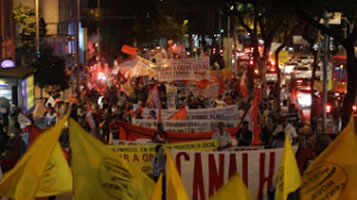
A day after the government of President Luiz Inácio Lula da Silva submitted to the National Congress the bill that provides for the abolition of the 6x1 shift model and the reduction of working hours without a reduction in wages, workers flocked to the streets of Brasília on Wednesday (15) in a march that combined mobilization and the feeling of victory in the historic demands of workers.
Right at the start of the rally, CUT national leader Sérgio Nobre declared that successes can only be achieved through pressure: "In history, no right has been given to the working class, but has always been won through stubborn struggle and massive mobilization. So that is exactly how we will enforce our demands." He also emphasized that the submission of the bill already represents an important step: “It is already a success because President Lula has just presented the bill to the National Congress as an emergency motion that abolishes the 6:1 ratio.” (…)
President Lula's government has presented the bill to reduce working hours and abolish the 6-to-1 shift schedule, but entrepreneurs have the majority in Congress. That's why this march is important, because that's how we made progress on other issues: through mobilization and pressure on the streets," said the union leader. (...)
"Once again, the right claims that Brazil will collapse if the abolition of the 6-day week is decided. But we know that it is the right that is ruining Brazil - those MPs who bow to the United States, impose a massive price increase on Brazil and deprive workers of their rights. Rosário also recalled that women will benefit most from the proposal, since they will have to work double and even triple working hours. (…)
The end of the 6×1 scale is at the heart of the debate
The main demand of the demonstration is the abolition of the 6x1 shift schedule, which the unions see as crucial to ensuring quality of life, social justice and increasing productivity. The bill introduced by the federal government in an urgent procedure provides for a reduction in weekly working hours to 40 hours without a reduction in wages. During a press conference, Minister Guilherme Boulos stated that “the end of the 6×1 shift model is a cry for freedom from Brazilian workers…”portug.Report by Walber Pinto, Rosely Rocha and André Accarini from April 15, 2026 at CUT(machine translated) with photos - Congress has until June to vote on Lula's proposal to abolish the 6x1 shift model. The vote must occur within 45 days of the bill's receipt in Congress. Two further proposals are currently being examined by the Federal Parliament. The reduction of working hours is a concern of the CUT and the other trade union federations
The struggle of the CUT and the other trade union confederations achieved one of its objectives last Tuesday (13), when President Luiz Inácio Lula da Silva signed a presidential message formalizing the submission of a bill to the National Congress with constitutional urgency. This bill provides for the abolition of the 6×1 shift model, guarantees two days of rest and limits working hours from 44 to 40 hours, without a reduction in wages. - See also thisDossier for 6×1 at CUT
- See also the dossier:“Delete apps”: Drivers in the Brazilian platform industry strike a promise of regulation
- Brazil: Working hours are being reduced. Government wants to reduce weekly working hours - with full wage compensation. A further reduction is already being discussed
- Labor law in Brazil is out of control using the example of agricultural corporations: The pressure on workers and labor legislation is immense
“Three juice companies have largely divided the market in Brazil between themselves. A labor lawyer warns of new market-liberal reforms
Rafael de Araújo Gomes is a labor prosecutor. It was only at the beginning of August that he moved into his new office on the 11th floor of an office building in Araraquara - right across from one of the city's largest employers with 250,000 residents. The logo of the juice company Cutrale is emblazoned not only on the stately chimney, which makes the juice factory noticeable from afar, but also on the huge factory hall. Countless pipelines run across the company's extensive area, delivering orange juice to Europe and the rest of the world. (…) Cutrale is a company that is not afraid to use lousy practices, reports Gomes: "One example: I defended the rights of pregnant women against Cutrale and sued the company." The verdict has been passed, only the amount of compensation payments is still being haggled over, according to the public prosecutor. »I have come to the conclusion that Cutrake's legal department carefully calculates what can be earned from violations of labor law. “We act from a purely economically calculated perspective,” explains Gomes, explaining his insights. This is not an isolated case in Brazil. (…)
»Brazil actually has good labor law legislation. All international agreements and conventions have been ratified, but we have seen immense setbacks in control," explains the public prosecutor. (…) »Our control system is weakened. We don't have enough inspections and too little has been invested in the technical equipment of the teams. “You need more expertise,” explains Gomes, who also criticizes the urban-rural divide. While in rich states like Sāo Paulo the number of cases of work in slave-like conditions is declining, for which mechanization is partly responsible, the situation is different in the neighboring state of Minas Gerais. A lot of coffee is grown there and still picked by hand. Cases of slave-like exploitation conditions during the coffee harvest are more common there than during the orange harvest in the state of Sāo Paulo. "In the last 12 months, there have been two or three cases in which workers were taken out of slave-like working conditions in the state of Sāo Paulo - there were 24 in the neighboring state of Minas Gerais," says Gomes. (…)
However, labor law lecturer Livia Miraglia from the University of Minas Gerias complains that the judiciary is too gentle on those responsible. In Brazil, the massive exploitation of pickers is often treated like a trivial offense instead of a serious crime, criticizes Miraglia. The laws are clear. If accommodation is inhumane, if there is debt bondage through the charging of exorbitant prices for accommodation, transport and food, if the legally fixed working hours are significantly exceeded and employees are held on farms against their will, then, according to the Brazilian labor law, working conditions similar to slavery exist. (…)
There are currently increasing initiatives from the business community to urge workers and employees to register as solo self-employed people. “There are initial examples in garbage collection,” reports public prosecutor Gomes. He warns that such legislative initiatives could set a precedent, like the one for Uber drivers, which is currently pending in parliamentary committees. Another stipulates that virtually any activity can be carried out as a solo self-employed person. For Gomes, such initiatives undermine labor legislation, but also the social security and pension systems. “We are threatened with a social rollback of immense consequences,” he warns. Younger workers in particular are not aware of this. Big companies like Cutrale do. Cutrale would be one of the first companies to introduce new employment contracts for solo self-employed people, predicts Gomes bitterly.” Article by Knut Henkel from September 17, 2025 in Neues Deutschland online(“Agricultural companies out of control: the pressure on workers is immense”) - In Brazil, workers' rights have been continually eroded since the 2017 labor law reform
“The Casa do Trabalhador (Workers' House) in the city of São Luís is a shadow of its former self. More than half of the 43 industry unions that once housed the large building with crumbling yellow walls in the northeastern state of Maranhão have closed their doors. “They had to close because they lacked the resources after the reform,” explains a volunteer from the Sindehotéis-MA hotel and restaurant union, one of the few establishments that continues to operate there as best as possible. “There are still representatives of domestic workers, civil servants and gas station employees,” says the pensioner, who occasionally volunteers for his former union.
Most unions lost 99 percent of their financial resources almost overnight and were only able to stay afloat thanks to the dedicated work of volunteers. Sweeping changes to Brazilian labor law over the past five years have significantly limited unions' ability to advocate for workers at the very time when workers needed their unions most.
Michel Temer, Brazil's former vice president who became president after Dilma Rousseff's impeachment last year, wanted to combat the country's economic crisis by "making the labor market and collective bargaining more flexible." He promised to create six million jobs within ten years.
Five years later, on the eve of the second round of Brazilian presidential elections, things are looking anything but rosy for workers in Brazil. While the recession and health crisis have hit the economy hard and pushed up unemployment and informal employment, many experts agree that labor law reform and President Jair Bolsonaro's subsequent policies have done the most damage to workers' rights.
In 2022, the International Trade Union Confederation ranked Brazil as one of the “10 worst countries in the world for workers.” In its January 2022 report on workers' rights and social protection, the OECD (Organization for Economic Co-operation and Development) writes that "Brazil is far from meeting the values, standards and commitments required to join the Organization" due, among other things, to "failures to protect the human rights of workers."
2017-2022: a bleak time for workers' rights
The consequences of labor law reform are too numerous to list. In almost all cases, however, workers' rights have been weakened: dismissal procedures have been made easier; fixed-term contracts with no guarantee of a minimum income were introduced; Subcontracting, which reduces employer responsibility and fragments the workforce, has been expanded; the hierarchy of norms in collective agreements was reversed; free access to labor justice has been restricted... and the list goes on.
According to a 2019 report by the Network for the Study and Monitoring of Labor Reform (REMIR-Trabalho), current legislation largely favors employers (…) According to the Brazilian Institute of Statistics (IBGE), almost 40 percent of the working population has neither an employment contract nor social protection. While the figure is already alarming at the national level, in some states in the Northeast region it is as high as 60 percent. After all, occupational accidents, forced labor and child labor have not decreased in the last five years, quite the opposite.
As a federal deputy, Jair Bolsonaro supported Michel Temer's reform. As president, Bolsonaro, whose government (2018-2022) includes ultra-liberal Economy Minister Paulo Guedes, pushed through a series of legislative and administrative changes denounced by labor rights activists. Occupational health and safety standards have been relaxed, exposing workers to greater risks, labor inspectorates have suffered drastic budget cuts, while several exemptions from employer contributions are depleting social security resources in the long term (Guedes has made no secret of his plans to privatize the pension system, among other things).
Undermining trade unions and social dialogue
The changes to Brazilian labor legislation were rapid and far-reaching, but above all without real consultation with employee representatives. This was no coincidence: one of the most important attacks on workers in the reform was the changes to the union funding system. The work of trade unions has so far relied on two permanent sources of funding: a government contribution via a tax and an employee contribution via a mandatory wage deduction. Proponents of the reform argue that it offers workers the freedom to unionize or not, to choose their union, and frees unions from dependence on the state by encouraging them to "land" their own members and become self-financing.
However, apart from the fact that this paradigm shift occurred without any support or a transition period, the implementation of self-financing was made practically impossible by the lack of human resources necessary to carry out the necessary field work, as the unions suddenly had to part ways with many employees. Widespread worker impoverishment has also contributed. (…)
Explosion of informal work and casual work
Despite the crippling effects of these reforms, workers' rights advocates have continued to organize. In May 2022, a coalition of representatives of various categories of low-income workers founded the National Movement of Workers Without Rights (Movimento Nacional dos Trabalhadores Sem Direitos), a grassroots union bringing together street vendors, delivery workers, waste recyclers, domestic workers (such as hairdressers and beauticians), etc. "There used to be small associations for workers in these categories, but they lacked an umbrella organization. Because they work in the informal economy, these workers cannot form unions in the traditional framework, for example by paying contributions," explains Maíra Vannuchi, one of the coordinators.
Although the movement is still in its infancy, it has benefited from the experiences of workers' organizations such as the Homeless Movement (MTST, Movimento dos Trabalhadores Sem Teto in Portuguese) and the Union of National Economy Workers (Unión de Trabajadores y Trabajadoras de la Economía Popular in Spanish), which emerged in Argentina and fights for the rights of those excluded from the formal market by neoliberal policies. "It's about getting back what was taken from these workers. They are the ones who keep the economy going," emphasizes Vannuchi. (…)
While employment “sem carteira assinada” (literally: “without a signature in the booklet” that records the holder’s labor rights) is at an all-time high, registered workers are often no better off. This is especially true following the introduction of a new legal provision that allows people to be hired and paid only for the hours they work, with no guaranteed minimum income and no scheduling. This so-called “intermittent work” is particularly common in manufacturing, tourism, event planning and hospitality, all sectors hit hard by the pandemic and experiencing mass layoffs. “Faced with economic uncertainty, employers have given up rehiring their former employees on monthly or even hourly contracts, in which at least the number of hours per week is fixed in advance,” explains Perreira da Silva.
This means that employees have no opportunity to plan their working hours or receive social support between jobs. If they get sick, they cannot receive paid sick leave because they are not part of the company's staff. They also cannot strike. “This is pure labor exploitation, like in the last century,” says Perreira da Silva, who has observed this phenomenon among bar workers on the São Luis coast, a sector heavily dependent on the fluctuations of the tourist season in the northeastern region of the country. "By subjecting workers to more flexible working hours, they lose some control over the organization of their own lives. The reform is based on the idea that economic life should take precedence over social life," says Darin Krein.
Employee rights on the ballot
On October 30, Brazil will decide the direction of its future. Although the stakes are high, the presidential campaign has focused not on serious issues of the economy, labor or social protection, but rather on name-calling and falsehoods. Former trade unionist and ex-president Lula da Silva promises to revise - although not completely reverse - labor law reforms, particularly those relating to access to labor justice and the autonomy of unions. He has also cited as inspiration the reforms of Spain's socialist government of Pedro Sánchez, which tightened the conditions for the use of temporary contracts and strengthened collective bargaining. According to initial economic data, the unemployment rate is beginning to fall and the number of jobs is increasing.
Lula's opponent, Jair Bolsonaro, who is currently running for re-election, is likely to follow the same path, relying on the rhetoric of the false choice between "jobs or rights." His “Chicago Boy” economy minister, Paulo Guedes, recently declared that one must “choose between a system with many rights and few jobs or a system with many jobs and selective rights.” Its program is based on the proposals of an expert report of November 2021, which include, in particular, the creation of a new form of simplified employment contract, which is no longer subject to the CLT (and therefore does not have the associated rights), with the aim of promoting rapid recruitment. The rights of employees would then no longer be guaranteed by law, but rather by an individual agreement between employer and employee. According to Sérgio Nobre, president of CUT Brasil, the largest union in Brazil and Latin America, the proposals in this report, undoubtedly drawn up “without any involvement of legitimate workers’ representatives,” aim to “complete the attack on the working class that began with the 2017 reform"." Machine translation from EnglishArticle by Mathilde Dorcadie from October 26, 2022 in Equal Times(“In Brazil, workers’ rights have been continuously eroded since the 2017 labor code reform”)
- see our dossier on the election in question:Bolsonaro versus Lula: Fear of political murders determines pre-election period in Brazil
- In theArticle by Mario Schenk on August 8th, 2022 in Amerika21 It goes on to say: “…Trade unions and left-wing parties fear that this could lead to a reduction in working hours and, ultimately, to a loss of wages. As a result of the changes, employees would have no legal options to defend themselves against excessive workloads. At the same time, forms of self-employment would replace traditional wage employment relationships and further atomize the workforce. In addition, the new law allows entrepreneurs to negotiate individual contracts with employees working from home without observing the usual industry or company regulations. Trade unionists warn that companies have more leverage when it comes to taking their own interests into account in working papers, pointing to previous experiences. (…) The opposition also points out that the government is introducing profound changes to the world of work through the back door. “The amendment abolishes labor rights and should therefore pass through parliament as an independent law so that a debate can take place,” criticized Senator Paulo Paim (PT). Left-wing parliamentarians also criticized the fact that the government factions prevented the debate on the project, which was unpopular among the population, by submitting the reform to parliament for a vote at short notice…”
- We are trying to get union statements - further information can be found at:
-
- https://g1.globo.com/politica/noticia/2022/08/03/senado-aprova-texto-base-de-mp-que-altera-regras-do-auxilio-alimentacao-e-regulamenta-teletrabalho.ghtml
- https://www.redebrasilatual.com.br/trabalho/2022/08/senado-flexibilizacao-leis-trabalhistas-calamidade/
- https://www12.senado.leg.br/noticias/materias/2022/08/03/aprovada-mp-que-regulamenta-teletrabalho-e-muda-auxilio-alimentacao
- https://g1.globo.com/politica/noticia/2022/08/03/senado-aprova-texto-base-de-mp-que-altera-regras-do-auxilio-alimentacao-e-regulamenta-teletrabalho.ghtml
See also:
- Modern Slavery: Exploited at Nestlé's Coffee Suppliers in Brazil
- Brazilian unions are mobilizing together against labor law reforms
- Brazilian unions are mobilizing together against labor law reforms
The postMassive attacks on workers' rights since the 2017 labor law reform in Brazilappeared firstLabourNet Germany.
Read the full story at the source →
Source: labournet.de