
World · labournet.de · · 2h
IG Metall before the metal collective bargaining round: Christiane Benner's program against industrial dismantling is a German copy of Trump's protectionism.
Deutsch (original) · Auto-translated to English
“…In the Handelsblatt interview from July 28, 2026, IG Metall boss Christiane Benner outlined her recipes for preserving jobs. Customs duties, local content, a commitment to growth sectors such as armaments and data centers – and a declaration of war on the pension issue. A closer look at the facts behind this program shows that it is far less combative than it sounds and, in crucial places, is simply a German copy of a failed US blueprint. (…) Anyone who supports an extension of working hours as a supervisory board member and at the same time as a union leader would have to advocate for a reduction in working hours will inevitably end up in a role conflict - forty years after the greatest success that their own organization has ever achieved with precisely this demand. (…) Locational nationalism promises short-term protection for its own workforce, but it is bought through competition between employees from different locations and countries - a game that the working class, no matter who gives in, can only lose in the long run…”Article by Jörg Wuttke from September 14, 2026– we thank you!
IG Metall before the metal collective bargaining round: Christiane Benner's program against industrial dismantling
– a German copy of Trump’s protectionism.
The metal and electrical industry is facing one of the most difficult rounds of collective bargaining in its history. Since 2019, 320,000 jobs have been lost and hundreds of thousands more are at risk, according to employers. Quite a few people are talking about a meltdown of the industrial core. In the Handelsblatt interview from July 28, 2026, IG Metall boss Christiane Benner outlined her recipes for preserving jobs. Customs duties, local content, a commitment to growth sectors such as armaments and data centers – and a declaration of war on the pension issue. A closer look at the facts behind this program shows that it is far less combative than it sounds and, in crucial places, is simply a German copy of a failed US blueprint.
Trumpian protectionism in EU guise
Christiane Benner calls for European tariffs on Chinese hybrid vehicles to protect German manufacturers under pressure. Their argument is not out of the blue: Chinese brands' share of plug-in hybrids sold in Europe reached a record 34 percent in June 2026, boosted by government subsidies three to eight times higher than in the OECD region, as well as an estimated undervaluation of the yuan of at least 40 percent. This is not fair market competition.
Only: Trump has already practiced exactly this policy - tariffs and protectionism as an answer - in the USA, with sobering results. Since Trump's "Liberation Day" tariffs in April 2025, 89,000 manufacturing jobs have been cut there, marking the third year in a row that employment in the sector has fallen. There is no trace of the promised relocation of production: the US trade deficit reached a record level in 2025. And who pays the bill? The tariff policy costs US households an average of around $2,400 a year - a sum that, according to Bank of America calculations, is already hitting around a quarter of all US households that live from paycheck to paycheck hard; According to Fed figures, a good third of Americans could not even afford an unexpected expense of $400. So anyone who expects tariffs to save the German auto industry should know this balance.
In addition, there is a double standard that Christiane Benner does not address: If the EU accuses China of distorting the market through subsidies, it should also look at itself. Direct EU agricultural export subsidies have been officially abolished since 2003, but the structural effects of European overproduction continue to be felt today: imported milk powder is passed on to processors in West Africa at up to 40 percent lower prices than locally produced milk - with the result of destroyed farm livelihoods and rural exodus.
Local Content: Also a copy of Trump’s wrong path
Benner's second demand – binding local content quotas for suppliers, anchored in the “Industrial Accelerator Act” – is also a matter of national protectionism imported from the USA. Depriving foreign manufacturers who build plants in Europe of the freedom to buy where it is cheapest is a classic market distortion, economically similar to a subsidy. The US experience with “Buy American” guidelines shows that such compulsory quotas rarely bring about the promised reindustrialization, but do increase costs and friction.
Christiane Benner's own position is also contradictory. She rightly criticizes the fact that local content rules remain toothless as long as free trade agreements such as those with Mercosur allow imports from third countries to be considered “European” - but at the same time calls for a “strict concentration” on the European market, which should function “unbureaucratically and with flexible quotas”. Strict requirements that are handled flexibly require exactly the bureaucratic review apparatus that it supposedly wants to avoid.
Benner's positively mentioned commitment to local content by the Association of the German Automotive Industry is also not convincing: the corporations there are anything but purely German companies, they maintain production sites worldwide and have taken part in the international location competition - workforces against each other in order to play off the lowest wages and worst working conditions - themselves. The national protectionism copied by Trump is just a continuation of this location logic by other means.
The rejected alternative: shortening working hours
What is striking: The most obvious means of actually securing jobs is almost completely missing from Christiane Benner's program. This exact method has already been proven to work once in the history of IG Metall. On May 14, 1984, 57,500 employees in 23 companies in North Württemberg/North Baden went on strike for the 35-hour week, followed a week later by tens of thousands in Hesse. Employers responded with lockouts that ultimately affected hundreds of thousands. Chancellor Kohl called the demand “stupid and foolish.” After seven weeks of the toughest labor dispute in northwest German post-war history, an initial reduction from 40 to 38.5 hours was agreed upon - the full 35 hours were only achieved in 1995, eleven years and several more rounds of collective bargaining later. The Nuremberg Institute for Labor Market and Occupational Research estimated the resulting employment effect at around one million jobs by 1992.
There is no sign of this willingness to fight today. Instead of relying on tariffs and quotas that only perpetuate the location ideology, a further reduction in working hours could have the same effect in view of today's productivity gains through e-mobility and AI as in 1984. Of all things, the IG Metall leadership has largely dropped this demand - and Benner personally is in a tangible conflict of interest: At Aumovio, where she sits at the table not as a trade unionist, but as deputy chairwoman of the supervisory board, exactly the opposite has been achieved It was decided to reduce working hours - an extension from 35 to 38 hours without compensation, i.e. a reversal of what was the cause of the strike in 1984. When she is asked whether this is a role model for the entire industry, she answers evasively with a reference to the importance of “tariff instruments”. Anyone who supports an extension of working hours as a supervisory board member and at the same time as a union leader would have to advocate for a reduction in working hours will inevitably end up in a role conflict - forty years after the greatest success that their own organization has ever achieved with precisely this demand.
Growth areas: Renewable energies create more jobs than armaments
Benner cites renewables, storage technologies, aviation and armaments as compensation for the losses in cars, metal and electronics. A look at the numbers puts the equality of this list into perspective considerably: The renewables industry currently employs 436,000 people - more than three times as many as the entire defense industry with around 135,000. The real scandal is not that too few jobs are being created in renewables, but rather that this larger, proven job engine is being jeopardized by the federal government's U-turn in energy policy, while at the same time billions are flowing into armaments financed by debt - of which, depending on the source, eight to eighteen percent go directly to US companies like Lockheed Martin anyway.
Unlike renewables, which are based on real civilian demand, employment in defense depends on a persistent, politically generated threat perception - an industry that profits from rearmament has a structural vested interest in escalation rather than detente because peace diminishes its business model. Even within the industry, the location logic that Benner criticizes in the auto industry is repeated: Ukraine has built up its own defense industry with a drone production capacity of around four million units annually, German companies such as Rheinmetall are already building their own plants there, while foreign competitors such as the Turkish manufacturer Baykar are doing the same. And as in the civilian economy, defense companies produce where it is cheapest and where the need is greatest. And in terms of needs, Ukraine is currently the perfect location for the defense companies - assuming the war continues for a few more years. An early end, relaxation and long-term peace would abruptly end the party atmosphere in the boardrooms of Rheinmetall and other large defense companies in view of the current excess profits - the war profit is most clearly visible on the stock market: Rheinmetall's share price has increased almost tenfold since the Russian attack on Ukraine in February 2022 - from around 97 euros to currently over 1,000 euros, an increase in value of around 970 percent and Rheinmetall achieved In 2025, a record profit of 1.84 billion euros with sales growth of 29 percent, and 40 to 45 percent is expected for 2026.
And even where new capacities are created in Germany, a basic problem remains: in peacetime, defense capital does not produce economic added value that could be reproductively reintroduced into the economic cycle, like investments in rail networks or energy infrastructure.
What is missing from the list of future fields: local public transport
It is also noticeable which field is missing from Benner's list of "future fields" - the most obvious one to think about climate protection and employment in the auto industry would be local public transport. At least part of IG Metall has already spoken out in favor of this path - in 2024, the Internationalism Working Group of IG Metall Berlin explicitly argued for the expansion of public transport and a reduction in private transport. There is no lack of structures: Since 2020, there has been a nationwide “Automotive Industry Future Fund” with one billion euros, as well as 27 regional transformation networks co-initiated by IG Metall, for example in Wolfsburg or Kassel. However, these networks aim to technologically renew the existing production model - the private car - and to minimize the production costs for it and not to expand production to include urgently needed local transport.
Data centers and the invented quantum computer
Christiane Benner calls data centers a “necessity” and points to the “third largest quantum computer in the world” in Jülich to support this. This number cannot be verified anywhere - in fact, Jülich operates the world's largest annealing quantum computer (first place in its category) and, separately, the fourth fastest classical supercomputer in the world. The benefits of increasing productivity through quantum computing as promised by Benner are questionable. A single qubit – the computing unit of a quantum computer – is susceptible to failure and repeatedly delivers incorrect values. In order to still get reliable results, you distribute the same information redundantly across thousands of qubits at the same time and constantly compare them against each other, similar to how you get a reliable average from a thousand inaccurate individual measurements by comparing them. Only this complex comparison turns many error-prone components into a single usable computing unit. The current state of the art is not sufficient for the broad economic productivity increase that Benner promises: Quantum computers do not bring any advantage for ordinary applications; their use is limited to a few special tasks - such as complex simulations in chemistry or optimization problems in logistics. The thesis that data centers and quantum computing could help to increase productivity in the short term and thus secure employment is a dream of the future and not a lever for today's employment crisis.
Even more problematic is what remains unanswered: Benner responds to the growing US resistance to the electricity requirements of data centers with a pure sovereignty argument, without mentioning that data centers already account for around four percent of German electricity consumption, and the trend is rising. What is missing is a concrete program: collective bargaining as a condition for the establishment of new data centers, mandatory further training for employees from shrinking industries, the obligation to use waste heat for district heating and additional renewable electricity.
Armament and peace: a contradiction that is managed rather than resolved
When asked whether the arms industry can compensate for the reduction in industry, Benner himself answers no - a maximum of ten percent of the lost jobs can be compensated for in this way; their actual goal must be “a future through diplomacy and peace”. Well said, just without consequence. The IG Metall statutes expressly commit the union to peace, disarmament and international understanding as an “unwavering principle”. In July 2026, IG Metall Berlin practically committed to converting the former Pierburg automotive supply plant into an ammunition factory for Rheinmetall, with 293 employees moving to the newly founded Rheinmetall Waffen Munitions GmbH. The responsible managing director of IG Metall Berlin, Ines Beeck, tries to do the balancing act with the formula that peace policy mission and interest representation “belong inseparably together”. The alliance “Say NO! - Trade unionists against war, militarism and truce” calls it more aptly the continuation of an opportunistic truce course - and points out that the second IG Metall chairman Jürgen Kerner had already promoted the auto industry's entry into defense production at a Handelsblatt congress in 2025 together with Bundeswehr and Rheinmetall representatives.
This is not an isolated case: In addition to Berlin, Rheinmetall is also converting a site in Neuss from civilian to ammunition production, the VW gearbox manufacturer Renk supplies gearboxes for battle tanks, at the VW Osnabrück plant, Rheinmetall, KNDS and the Israeli group Rafael are competing to take over the expiring civilian production, ZF Friedrichshafen is expanding its military business, Schaeffler is joining the drone manufacturer Helsing, Aumovio has 600 employees at the handed over to defense electronics manufacturer Hensoldt. At the last union conference, the IG Metall board explicitly defended arms deliveries to Ukraine and the 100 billion rearmament program in its leading motion - against motions from the rank and file that invoked the peace paragraph of its own statutes. A separate peace initiative by the union leadership based on its own statutes: none.
Defend with tooth and claw - big words, in the end just hot air
After the first top meeting of the social partners with the Chancellor in June, Christiane Benner emphasized “shared responsibility” and that “everyone has to do their part” - in the same breath she rejects any social cuts. The meeting was explicitly about social security reforms and ended without a result. If “carrying together” does ultimately mean concessions, that contradicts their own rejection of cuts; If not, it remains unclear what the unions contributed other than their no at this meeting.
When it comes to pensions, Christiane Benner is more specific: The pension commission's proposed removal of the zero-deduction pension after 45 years and the block model for partial retirement will be defended “with tooth and nail”. The rest of the package, which Social Minister Bärbel Bas herself calls a “total work of art”, remains secret: among other things, linking retirement to life expectancy, a mandatory capital pension with two contribution rate points, which, according to the employers' association, costs around 40 billion euros annually and, according to Commissioner Peter Bofinger, is likely to noticeably dampen the economy - up to 250,000 jobs could be at risk as a result. The capital is supposed to be managed via a state fund based on the Swedish model, but individual choice of fund opens the door for private asset managers, whose returns are often based on exploitation in low-wage regions - and this in the midst of global trouble spots and a possible bursting AI bubble on the stock exchanges. There can probably be no question of a safe capital investment here and little seems to have been learned from the failed Riester pension.
A historical comparison shows whether Christiane Benner's announcement that she will defend the pension without deductions after 45 years and the block model for partial retirement "with tooth and claw" is more than just combative rhetoric: In 1996, when Kohl wanted to cut continued wages in the event of illness, 350,000 people demonstrated in Bonn, 150,000 went on real strike on October 1st - in the end the cut remained Large parts of the industry are left with wasteful collective agreements. This was a “tooth and claw” defense. So far there has been no sign of a comparable mobilization against the current pension package - or against the reintroduction of an unpaid sick leave day, which was being discussed at the same time. The reaction to the attack on the 35-hour week at Mercedes has so far remained one day of action, a few hours of demonstration without strike pay, and no real production stoppage lasting several days. This is something fundamentally different than what happened in 1996.
The VW case: Wage cuts do not secure jobs
According to Christiane Benner, “everyone has to do their part” – the history of securing VW’s location clearly shows what this looks like in reality. In 1993, VW and IG Metall agreed on 20 percent less working hours with almost the same wages, in return for protection against dismissal - in 1999 VW returned to the classic three-shift system. The company unilaterally terminated the employment security scheme, which was established in 1994 and has been continually renewed since then, in September 2024. After a 70-hour marathon negotiation, a new commitment was agreed in December 2024 until the end of 2030 - “no factory closures, no operational layoffs”. IG Metall itself celebrated the agreement in its press release as the “Christmas miracle of Hanover”. VW paid out 4.5 billion euros in dividends to shareholders in the summer of 2024 - in the middle of negotiations about supposedly unavoidable savings. Instead, on the gift table for the workforce was the waiver of an agreed pay increase of 5.5 percent for the entire term as well as a one-off payment of 600 euros; the money saved was used to finance the company's own "socially acceptable" job cuts. In July 2026, less than 20 months later, the VW supervisory board will again be discussing the closure of up to four plants and the reduction of up to 120,000 jobs worldwide. Two commitments, two terminations, less than two years - and in between a wage waiver that in the end secured nothing except the next round of negotiations on workforce reductions.The same pattern is repeated at Porsche: 5,000 more jobs will be lost to “secure the location until 2035”, financed largely from the losses of the employees themselves, while the group increased its operating result from 1.01 to 1.38 billion euros in the first half of 2026.
Anyone who still speaks of the “power of collective bargaining partnership” in the face of these examples, as Christiane Benner did in the interview, is confusing a unilateral willingness to capitulate with an alliance of equals. Benner's formula that we have to “get through the crisis together” doesn't work either: it suggests a common fate for corporate boards and employees, where in reality one side pockets the profits while the other pays the bills. The fact that this language is nevertheless sold as realism is less a matter of personal naivety than the necessary linguistic product of a trade union policy that sees itself as a co-manager of the location rather than as a countervailing power to capital - an attitude that can also be seen in the upcoming collective bargaining round: Christiane Benner suggests more leeway for growth sectors such as armaments, and for the crisis-stricken automobile industry she urges "careful consideration" - a formulation that sounds combative and willing to compromise at the same time is weakening from experience The bargaining position of the collective bargaining committee. From a purely tactical point of view, compromises should only be made at the end of the negotiations, a necessary tactic that the employers' side appears to be much better at than the union leadership.
What could be learned from America - and what is not learned
What can German unions learn from the UAW success in Chattanooga? A legitimate question from the reporter - Benner doesn't answer it. Instead of drawing its own strategic lessons, it points to the misconduct of employers who did not adhere to the “neutrality requirement”. That may be true, but it is an excuse to the outside world, not an answer to the inside. It is precisely this pattern - placing responsibility externally instead of questioning one's own form of struggle - that runs through this entire interview.
The Chattanooga case provides concrete, learnable lessons. The collective bargaining agreement in February 2026 only came about after the workforce credibly threatened a real strike - not a one-hour rally during the early shift without loss of wages, as we saw at Mercedes in Germany. UAW President Shawn Fain traveled to the plant specifically to publicly contrast Volkswagen's $20.6 billion corporate profit with the below-average health insurance for the local workforce - a pointed, blatant profit-versus-employee campaign that you rarely hear from German union leaders. The result: 20 percent linear wage increase, immediate bonus, annual bonus, improved protection against dismissal, ratified with 96 percent approval. And that after two failed attempts at organizing in 2014 and 2019 - a decades-long, tough development process, not a sure-fire success.
Christiane Benner mentions none of this. Not a word about the meaning of credible escalation, not a word about the public focus on corporate profits, not a word about an independent negotiating committee elected by the base instead of centrally controlled collective bargaining commissions. Instead, it remains a reference to the misconduct of the other side - a convenient argument that does not have to change anything in one's own practice.
There is also a gap in Christiane Benner's praise for the US Inflation Reduction Act, whose linking of funding to collective wages should serve as a model for the German Tariff Compliance Act: The Federal Tariff Compliance Act, which has been in force since May 2026, expressly excludes delivery and procurement services for defense until the end of 2032 - exactly where the largest investments are currently being made. IG Metall called this “unacceptable” and left it with this one statement.
Falling collective bargaining coverage, falling membership numbers
When asked about declining collective bargaining coverage, Christiane Benner advocates “incentives for companies to enter into collective bargaining” - a remarkable reversal of the basic trade union principle: collective bargaining should no longer be fought for, but rather presented to employers as an attractive offer. What could be meant by “incentives” remains unclear – the obvious choice is the collective bargaining agreement with which IG Metall has tried over the last two decades to keep companies in collective bargaining agreements by making the collective agreement itself more perforate.
Christiane Benner also responds evasively to the declining number of members – most recently just over two million: demographics and job cuts cannot be explained away. These are symptoms, not a diagnosis. For decades there has not been a significant multi-day strike in the industry that would have demonstrated the real fighting power of the organization. Stagnant real wages, continued job cuts and increasing performance intensification are the result of a policy that increasingly sees itself as a co-manager of the company's success rather than as a countervailing force - and the falling number of members is the logical expression of a growing doubt as to whether its own organization is still consistently on the side of the employees.
Conclusion
From customs to local content to company location security, the same pattern runs through Christiane Benner's entire program: locational nationalism promises short-term protection for its own workforce, but buys it through competition between employees from different locations and countries - a game that the working class, no matter who gives in, can only lose in the long run. According to Christiane Benner, colleagues in the company applaud when people talk about “local value creation” may be true - but selective applause does not prove the political correctness of the demand, but only how effective the location logic works in the immediate interest of individual employees, even if in the long term it is directed against the interests of the class as a whole. From a historical perspective, local content is a variant of the same locational nationalism that also supports tariff demands and company location security: the attempt to play off the employees of one country or a plant against those of another in order to defend one's own position in the global competition of capital. This logic has historically not been the solution, but has regularly been the cause of deterioration because it increases the competitive pressure between workforces in different countries instead of overcoming it through solidarity.
Locational nationalism is essentially the same anachronism as the idea that the sovereign nation state can still independently determine its own fate in an economy that has long since been globalized. Both ignore the same reality: that capital, production and supply chains have long been internationally intertwined. The real alternative would not lie in better management of locational competition, but rather in overcoming it through a trade union policy that is once again prepared to seek conflict with capital not only nationally but also internationally. What the workers' movement has known since its beginnings is all the more true today: Proletarians of all countries, unite! And by the way: A united international perspective would also be the best antidote to the rise of the extreme right. National location policy, on the other hand, obscures the insurmountable fundamental contradiction between capital and labor - a national community ideology of "we're all in the same boat" that structurally points in the same direction as the economic nationalism with which right-wing parties in times of crisis woo precisely those employees who feel abandoned by their own union. In the 2025 federal election, the AfD achieved its highest approval rating among workers of all people - a circumstance that a union leadership cannot ignore, which is itself currently caught in a national logic of location, so that 100% of the divide and rule politics of capital follows, instead of opposing it with an international class struggle perspective.
Article by Jörg Wuttke from September 14, 2026 – we thank you!
- About the author: Jörg Wuttke is a freelance engineer, freelance author and recently also a YouTuber with theSystem Analysis Channel

 : “No social partnership fairy tales, no national campfire romanticism that obscures the fundamental contradiction between capital and labor - just facts, figures, a look beyond the national horizon and a clear stance. When politicians, company bosses or union leaders talk, it often sounds like shared responsibility, necessary compromises, and no alternatives. System analysis analyzes which of these is true.No “we’re all in the same boat.” But: Who really benefits? Who loses? And why is this so rarely stated openly? Fact-based, well-documented, with a clear stance: on the side of labor, not capital.”
This article can also be found there as a video series with similar content...
List of sources
Introduction
– Handelsblatt interview with Christiane Benner, July 28, 2026: “We defend pensions after 45 years with tooth and claw.”
– 320,000 jobs lost in the metal and electrical industry since 2019: Gesamtmetall press release “Loss of 15,600 jobs in the M+E industry in April” (as of April 2026); Statements by Total Metal Managing Director Oliver Zander, quoted in several media in June/July 2026.
Customs duties
– Market share of Chinese brands in plug-in hybrids in Europe (34%, June 2026): Industry evaluations of European PHEV registration figures for 2026.
– Chinese state subsidies (3 to 8 times higher than the OECD average) and yuan undervaluation (at least 40%): market analyzes on Chinese industrial policy in the automotive sector, 2025/2026.
– 89,000 US manufacturing jobs lost since “Liberation Day” (April 2025): US Labor Market Statistics (BLS data), press reports 2025/2026.
– U.S. trade deficit record 2025: U.S. Department of Commerce/Census Bureau, 2025 Annual Report.
– Costs of the tariff policy of around 2,400 US dollars per household/year: economists’ analyzes of the tariff effect (including Yale Budget Lab), 2025/2026.
– Share of US households “paycheck to paycheck”: Bank of America Institute (around 24%, 2025); Federal Reserve, “Report on the Economic Well-Being of U.S. Households” (about a third cannot cover $400 emergency expenses).
– EU agricultural export subsidies, abolished in 2003; Price difference for milk powder West Africa (up to 40%): Reports on EU agricultural policy and West Africa (including EU Commission classification as well as specialist literature and trade data).
Local content
– “Industrial Accelerator Act” and local content demands: Handelsblatt interview, July 28, 2026.
– Free trade agreement criticism (Mercosur et al.): Handelsblatt interview, July 28, 2026.
Reduction in working hours
– Strike 1984 (57,500 employees, 23 companies, North Württemberg/North Baden; expansion to Hesse; Kohl quote “stupid and foolish”; seven weeks of strike duration; result 40 to 38.5 hours; full 35-hour week only in 1995): historical reviews of the 1984 strike.
– Employment effect of around 1 million jobs by 1992: Institute for Labor Market and Occupational Research (IAB).
– Aumovio: Increase in working hours from 35 to 38 hours without wage compensation, Villingen-Schwenningen and Ingolstadt locations, since July 1, 2026, around 2,100 employees affected, supplementary collective agreement; Christiane Benner as deputy chairwoman of the supervisory board: 2026 business press reports on the Aumovio collective agreement; Handelsblatt interview, July 28, 2026.
Growth areas
– Employees in the renewable energy sector in 2025 (436,000, record, +4% compared to 2023): Study on employment in renewable energies, published in 2026.
– Employees in the defense industry (around 135,000 directly): industry/association information (BDSV etc.), 2025/2026.
– Share of 8-18% of arms funding to US corporations (Lockheed Martin and others): different information from the federal government/Bundeswehr (around 8%) and critical analysis (Militarization Information Center, around 18%), 2025/2026.
– Ukrainian drone production capacity (around 4 million units/year): press reports on the Ukrainian defense industry, 2025/2026.
– Rheinmetall new factory buildings in Ukraine; Baykar production on site: Press reports on defense investments in Ukraine, 2025/2026.
– Rheinmetall record profit 2025 (1.84 billion euros), sales growth 29% (2025), forecast 40-45% (2026): Rheinmetall annual report/quarterly statements 2025/2026.
– Rheinmetall share price development since February 23, 2022 (from around 97 to over 1,000 euros, approx. +970%): stock market data (including boerse.de, finanzen.net, wallstreet-online), as of September 2026.
Public transport / transformation networks
– Position paper from the Internationalism Working Group of IG Metall Berlin (2024) on the mobility transition: IG-Metall-Berlin-Papier, 2024.
– Automotive Industry Future Fund (1 billion euros, since 2020): Federal Government/BMWK information on the Automotive Industry Future Fund.
– 27 regional transformation networks (including ReTraSON in Wolfsburg/Braunschweig/Salzgitter-Peine): IG Metall information on transformation networks, 2020–2026.
– ZF future agreement Saarbrücken: Press/union reports on securing the ZF location in Saarbrücken, 2022–2025.
Data centers and quantum computers
– “Third largest quantum computer in the world” (Jülich): Handelsblatt interview, July 28, 2026 (quote Benner).
– Jülich: world’s largest annealing quantum computer (D-Wave, over 5,000 qubits); JUPITER as the fourth fastest supercomputer in the world / fastest in Europe (TOP500 list, June 2025): Forschungszentrum Jülich information, TOP500 list.
– Data center electricity consumption (around 4% of German electricity consumption): industry/energy statistics 2025/2026.
Armament and peace
– IG Metall statutes, principle on peace/disarmament/international understanding: IG Metall statutes text.
– Conversion of the Pierburg factory (Berlin-Gesundbrunnen/Wedding) to Rheinmetall ammunition production, transition by mid-2026, around 350 employees affected: World Socialist Web Site, February 20, 2026, “Pierburg becomes Rheinmetall: arms production in the center of Berlin”; IG Metall Berlin, original announcement June 6, 2025, “Pierburg GmbH becomes Rheinmetall Waffen Munitions GmbH”.
– Quote Ines Beeck (Second Representative and Managing Director of IG Metall Berlin): IG Metall Berlin, press release, “Rheinmetall in Berlin: Employees must not become pawns in the arms debate” (berlin.igmetall.de); quoted verbatim in Junge Welt, July 21, 2026, “Rheinmetall Berlin: IG Metall is committed to the armaments factory”.
– Alliance “Say NO! – Trade unionists against war, militarism and truce”, quote on the “opportunist truce course”; Reference to Jürgen Kerner (Handelsblatt Congress 2025): Statement from the “Say NO!” alliance, 2026.
– Further conversion examples: Rheinmetall Neuss site, Renk transmission for battle tanks, VW Osnabrück plant (Rheinmetall/KNDS/Rafael), ZF military business, Schaeffler/Helsing, Aumovio/Hensoldt (600 employees): respective company/press information 2025/2026.
– IG Metall trade union conference, key motion on arms deliveries/100 billion program: trade union conference documents/press reports.
Social partner meetings, pension, maternity leave
– Top meeting of the social partners with the Chancellor, June 2026: Press reports on the social partner summit in the Chancellery, June 2026.
– Pension Commission, 33 recommendations, quote from Bärbel Bas (“There is no cherry-picking now, it is a total work of art”) and quote from Chancellor Merz (“We cannot allow ourselves to remove or reject individual measures”): Kommunal.de, official transcript of the “Press conference by Chancellor Merz and Minister Bas on the report of the Pension Commission”, June 23, 2026.
– Linking retirement to life expectancy; Mandatory capital pension (2 contribution rate points, half): Pension Commission report/press reports 2026.
– Costs of the capital pension (around 40 billion euros/year according to the BDA): employers’ association-BDA assessment, 2026.
– Peter Bofinger (Pension Commission member) on dampening economic effects; Study on up to 250,000 jobs at risk: press interviews with Bofinger, 2026.
– Waiting day proposal (Economy Minister Katherina Reiche, autumn 2025): Press reports autumn 2025/2026.
– Comparison 1996 (Kohl cut in continued wages, 350,000 demonstrators in Bonn, 150,000 strikers on October 1st, 1996): historical press/union documentation of the labor dispute in 1996.
- Mercedes attack on the 35-hour week (expansion to 40 hours without wage compensation for around 108,000 employees in Germany; postponement of the special payment of 18.4% for 90,000 employees; protest on July 3, 2026 with around 33,000 participants according to IG Metall, around 16,000 according to the company): ZDFheute, July 3, 2026, “Savings plans at Mercedes: Tens of thousands of employees protest”; Industry magazine, August 2026, “Mercedes-Benz: Does the 40-hour week lead to job cuts through the back door?”; Group profit decline in 2025 (10.4 to 5.33 billion euros): ibid.
The VW case
– Securing the VW location in 1993 (20% less working hours) and returning to the three-shift system in 1999: historical VW/tariff history documentation.
– Termination of the employment security scheme by VW that has been in place since 1994, September 2024: World Socialist Web Site, September 2, 2024, “Factory closures and layoffs at VW”.
– New VW commitment December 2024 (until the end of 2030, after a 70-hour negotiation marathon): Euronews, December 20, 2024, “Union reaches agreement with Volkswagen to avoid plant closures”; Designation “Christmas Miracle of Hanover”: IG Metall press release December 2024 (quoted in LaborNet Germany, among others).
– VW dividend summer 2024 (4.5 billion euros): Press reports on the VW general meeting/dividend distribution 2024.
– Waiver of 5.5% wage increase and 600 euro one-off payment as part of the December 2024 agreement: collective agreement details, press reports December 2024.
– VW Supervisory Board consultations July 2026 on the possible closure of up to four plants (Emden, Zwickau, Hanover, Neckarsulm), cuts of up to 120,000 jobs worldwide according to Bild newspaper: Euronews (de.euronews.com), July 10, 2026, “Volkswagen is negotiating over 100,000 job cuts and plant closures”. (Note: The VW supervisory board ultimately agreed on a savings package with 50,000 jobs on September 3rd/4th, 2026; the four plants remain in existence with an unclear perspective - see ZDFheute, September 4th, 2026, and 20 minutes, September 3rd, 2026, as an update after this article went to press.)
– Porsche: Cuts 5,000 jobs, “Securing the location by 2035”, operating result from 1.01 to 1.38 billion euros in the first half of 2026: press reports/Porsche half-year report 2026.
What could be learned from America
– UAW collective bargaining agreement VW Chattanooga: preliminary agreement February 7, 2026 (Reuters, February 19, 2026 for final vote, “Volkswagen workers ratify first UAW contract, marks win for labor in the South”); Voting result 96% approval, 20% linear wage increase over the term: UAW.org, press releases February 2026; German-language classification including Cavallo quote: IG Metall Wolfsburg (igm-bei-vw.de), February 20, 2026.
– Previous failed organizing attempts in 2014 and 2019: historical UAW/VW Chattanooga reporting.
– Shawn Fain, campaign citing VW Group profits; first organizing vote April 2024 with 73% approval (“3 to 1”), previous failed attempts in 2014 and 2019: UAW.org, “UAW Reaches Tentative Agreement with Volkswagen in Chattanooga,” February 2026; “Volkswagen Workers Make History, Ratify First Union Contract,” UAW.org, February 2026.
– Federal Tariff Compliance Act, in force since May 2026, exception for defense procurement until the end of 2032; IG Metall criticism (“unacceptable”): legal text of the Federal Collective Bargaining Act; IG Metall press release 2026.
Collective bargaining agreement and number of members
– Statement by Benner on “Incentives for companies to enter into collective bargaining agreements”: Handelsblatt interview, July 28, 2026.
– IG Metall membership number at the turn of the year 2025/2026 (around 2.015 million, falling for the seventh year in a row, compared to 2.27 million in 2018): IG Metall annual balance sheet, January 2026.
– 180,000 planned company discussions, three-digit new admissions: Handelsblatt interview, July 28, 2026.
Conclusion
– AfD approval of around 38% among workers in the 2025 federal election: post-election analyzes/statistics for the 2025 federal election by professional group.
Note: All facts and figures were checked as part of the research for this article via press reports, company and association information as well as official institutions (Federal Statistical Office, Gesamtmetall, IG Metall, Federal Government). For individual points (such as the share of US defense funds or the methodological basis of Benner's “ten percent” statement) there are different or incompletely published calculation bases; This uncertainty is made clear in the running text.
________________
For the current background see especially:
- Dossier:Metal and Electrical Collective Bargaining Round 2026: “The situation is extremely differentiated... What should we demand?”
- Dossier:Resistance to the consequences of the profit crisis for the car workforce is growing
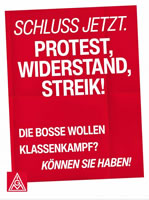
- Dossier:Resolution of the IG Metall shop stewards Mercedes Benz Untertürkheim: "Stop now. Protest, resistance, strike! The bosses want class struggle? They can have it!"
- Dossier:“Savings program” and increased efficiency thanks to electric cars also at Daimler – temporary workers first…
- Dossier:Clear-cutting at VW from 2024? Car manufacturer plans billions in cuts to increase “efficiency”.
The postIG Metall before the metal collective bargaining round: Christiane Benner's program against industrial dismantling - a German copy of Trump's protectionism.appeared firstLabourNet Germany.
Read the full story at the source
Source: labournet.de