
World labournet.de
Women in Argentina against the chainsaw, femicide and machismo: “Ni una Menos” (Not one less)
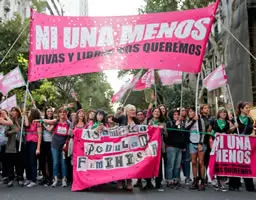
Dossier “Once again, the women and various educational workers of CTERA have joined the feminist and transfeminist movement and under the slogan “Ni una Menos”.
Deutsch (original) ·Auto-translated to English
dossier
“Once again, the women and various educational workers of CTERA have joined the feminist and transfeminist movement and, under the slogan “Ni una Menos” against femicides, transfemicides and transvesticides, throughout the country, within our CTA-T and through all the grassroots organizations of CTERA, have accompanied this demand that took to the streets 9 years ago. (…) “Hate and hunger kill”, violent, xenophobic, misogynistic, discriminatory, denial, anti-feminist and LGBT+-hating discourses are what circulates every day in our society, emanating from those who govern us, a government that is committed to emptying public policies with a gender and diversity perspective in terms of human rights…” From the SpanishCall to the education union CTERA(machine translated) on nationwide women's protests on June 3, 2024 - see more on the topic and background:
- “Nos falta Nancy”: Education union CTERA called for a nationwide teacher strike and protests across Argentina on October 29th following the femicide of teacher Nancy

- Femicide against teacher leads to protests in Argentina
“Buenos Aires/Esquina. Across the country, the Confederation of Teachers' Trade Unions (CTERA) in Argentina called for a national day of mourning and strikes last Thursday following the femicide of teacher Nancy Godoy. Protesters marched through the streets in several provinces, including Buenos Aires, Corrientes and Córdoba, raising awareness of the teacher's murder with banners and signs that read "Nos falta Nancy." The case also brings into focus the conditions under which teachers work in rural regions. Godoy himself had spoken out against the abuses.
The 52-year-old was deputy head of rural school number 626 in Paraje El Malezal in the subtropical Corrientes province in northeastern Argentina. She stayed there during the week as the journey home took up to three hours. There is often no mobile or satellite reception in this area. Her last report to one of her sons was about a week before they reported her missing on October 7th. The police found her body last Wednesday. According to the preliminary autopsy report, she had stab wounds and defensive injuries. Five people were arrested, three are being investigated for femicide, and two of the three have been ordered indefinite pre-trial detention. The public prosecutor's office is investigating two other suspects for homicide or making false statements. The family's lawyer, Gustavo Briend, spoke of an "act of absolute barbarism" and believes that several people were involved. He called for a possible sexual assault to also be investigated. The judiciary also pursues this hypothesis. (…) CTERA takes up Godoy's demands and denounces them throughout the country. She emphasizes that the population is often unclear about the conditions under which teachers work. She blames the Corrientes government and President Javier Milei for the “precariousness, isolation and vulnerability.” Their demands include fairer wages and more dignified working conditions. She also calls for the Godoy case to be dealt with quickly and transparently. According to Sonia Alesso, general secretary of the union, the case shows that teachers in rural areas often have hours-long commutes during which they have little contact with their families.
CTERA takes up Godoy's demands and denounces them across the country. She emphasizes that the population is often unclear about the conditions under which teachers work. She blames the Corrientes government and President Javier Milei for the “precariousness, isolation and vulnerability.” Their demands include fairer wages and more dignified working conditions. She also calls for the Godoy case to be dealt with quickly and transparently. According to Sonia Alesso, general secretary of the union, the case shows that teachers in rural areas often have hours-long commutes during which they have little contact with their families.”Article by Lilith Mić from November 3rd, 2026 in Amerika21
- MASSIVE NATIONWIDE CTERA STRIKE AND NATIONWIDE DAY OF MOURNING TO DEMAND JUSTICE FOR THE MURDER OF NANCY GODOY
“The Association of Education Workers of the Republic of Argentina (CTERA) held on Thursday, October 29, a massive nationwide teachers' strike and a national day of mourning with demonstrations and actions across the country to demand justice for the murder of our colleague Nancy Estela Godoy, a teacher from a rural area in the province of Corrientes.
In Buenos Aires, CTERA, together with trade union and educational organizations, gathered in front of the Corrientes provincial building to demand the investigation of the crime and the establishment of all responsibilities.
During the rally, Sonia Alesso, Secretary General of CTERA, took the floor and expressed the deep sadness and indignation of the Argentine teaching community at the murder of Nancy. She reiterated the call for justice and the need for the state to ensure decent and safe working conditions for all education workers, especially those who work in rural schools.
Also speaking were María Laura Torre, Secretary General of SUTEBA, and Antonella Bianco, Equal Opportunities Officer of the UTE, who joined the call for justice for Nancy Godoy…“ Spanish.CTERA report dated October 29, 2026with photos of the protests (machine translated) - See alsoReport and photos in La Izquierda Diario
- Femicide against teacher leads to protests in Argentina
- Argentina: Eleven years of resistance against femicide and patriarchal violence - mobilized again in numerous cities by the murder of 14-year-old Agostina Vega
- Protests in Argentina against femicide after the murder of a 14-year-old: In Argentina, a femicide is committed every 31 hours on average
"Sparked by the murder of 14-year-old Agostina Vega, thousands of people mobilized on the streets against femicide in numerous cities in Argentina on Wednesday. The Vega case shocked the country not only because of the violence itself, but also because the alleged perpetrator was already known to the police as a perpetrator of violence against women. The mobilization also points to the social and structural problem of violence against women: on average, a femicide is committed every 31 hours. Vega disappeared during the night of May 23 in Córdoba. A week later there was the sad certainty that her body was found in a suburb. The results of the autopsy indicate that Vega was sexually abused and suffocated before she was dismembered (…)
During Wednesday's protests in Buenos Aires, tens of thousands gathered in the Plaza de Mayo and in Rosario (Santa Fe province), the protest march filled ten blocks. In Córdoba, thousands gathered despite the rain for a march led by Agostina Vega's family members. There were also marches across the country in smaller cities. In Agua de Oro, a small town with around 3,000 inhabitants around 40 km north of Córdoba, several hundred people took part in a march. The collective Ni Una Menos (Not One Less), founded in 2015 in response to the femicide of 14-year-old Chiara Paez, says that the government is complicit in its inaction: "Under this federal government in Argentina - and there are examples of this in the provinces too - the lives of girls hardly count for anything," adding that they have "classified this femicide as organized negligence on the part of the state." In 2012, femicide was added to Argentina's penal code as an aggravating circumstance to recognize gender-based violence as a form of structural violence. However, President Javier Milei and his government want to abolish the offense again: at the World Economic Forum in 2025, he called the law an “absurd, radical feminist concept”. According to Ni Una Menos, the alleged inaction also takes place in the provinces and municipalities: Not only the Federal Security Minister Ajelandra Monteoliva, but also Juan Pablo Quinteros, Security Minister of the Province of Córdoba, do not speak of a femicide in the Vegas case. The responsible public prosecutor, Raúl Garzón, initially did not classify the case as femicide.Meanwhile, since the femicide of Agostina Vega, there have been at least two other femicides in the same week, of 17-year-old Dulce María Beatriz Candia in Misiones province and Noelia Romero, 30, in Buenos Aires.” Contribution by Bastian Greshake Tzovaras from June 5, 2026 at Amerika21 - Argentina: Eleven years of resistance against femicide and patriarchal violence
"Eleven years after the first Ni Una Menos demonstration, the fight against patriarchal violence and the grief over the recent femicides of Agostina, Dulce and Noelia have once again mobilized thousands of people in Argentina. Since its inception, the feminist movement Ni Una Menos has been drawing attention to gender-based violence and femicides. Every year on June 3rd, it calls for nationwide mobilizations. The focus of this year's protests was the demands for a justice system with a gender perspective, more ESI (comprehensive sex education) and the right to a life free from violence. The voices of the crowded Plaza del Congreso reverberated far beyond Buenos Aires and resonated in many parts of the country (…)
The femicide of 14-year-old Agostina Vega in Córdoba by her mother's former partner was a decisive trigger for women, queer people and men to take to the streets again this year to demand an end to macho violence and patriarchal justice. The demand for a state and a judiciary with a gender perspective takes on additional urgency under the government of Javier Mileis, which denies gender-based violence. In recent days, marked by the news of three femicides, these demands have become particularly tangible: The murders of Agostina, Dulce and Noelia could have been prevented if the justice system and the state had not looked the other way. This is exactly what Argentine society demanded again on Wednesday, June 3rd, eleven years later, while Patricia Bullrich tried to downplay the importance of the demonstration the day before. (…) The central rally began at around 6 p.m. and ended with the reading of a document by the musician Cazzu, the actress Thelma Fardin and the journalist Liliana Daunes. Even after dark, people still streamed into the square. (…)
This year there were a particularly large number of children on the pitch, as well as young men. (…) In the morning, the group Atravesados por el femicidio (Affected by Femicide) began their annual installation. Relatives had embroidered more than 200 names of murdered women onto a purple banner that was spread out in the square. This year, the group unveiled a new banner for the march. After lunch, they walked around the square and handed out butterflies with the names of their murdered relatives. Most are not only calling for an end to the femicides, but also for the implementation of the Ley Brisa - a law to protect children whose mothers have been victims of femicides - as well as the processing of the many outstanding court cases. (…) The example of Buenos Aires shows the extent of the problem: six out of ten homicides of women in the capital are femicides. Between 2015 and 2024, 200 women were intentionally killed there; 62 percent of these cases were classified as femicides. The crimes most often occur in the domestic environment: two out of three femicides were committed in the victim's home. (…) For Julieta, education is one of the most important levers to prevent violence: "We have to educate. And we have to educate all genders. The phrase 'take care of your daughters' is omnipresent, but educating boys is just as important. Men and new masculinities must support this fight that supports feminism. This is indispensable because it is about fundamental rights: education, dignified and paid work." (…)
Flor Guimaraes is a travesti-feminist activist. She came to the demonstration with the same poster that she had with her at the first Ni Una Menos in June 2015: “Stop travesticides!” "In the face of machist violence, it is urgent to organize ourselves, as we did many years ago. Today with more strength than ever, in the face of the hatred, cruelty and precarity that trans women, travestis and other queer people are subjected to. It is important, it is necessary to shout loudly and together: 'We want to be alive, ni una menos', 'Stop death from hate crimes', 'Stop machist and patriarchal violence'." (…)
In a global reality in which – as Gabriela Borrelli Azara says – “violence and macho power are openly evident and whose maximum representatives are figures like Milei or Trump,” the question arises: How can Ni Una Menos become a reality? “I don’t think there is an immediate stop to macho violence, but I believe in what we are doing today,” said the writer and poet. "I believe in the perseverance, in this great conviction that we have in Argentine feminism in the defense of life. I think now is the moment to unite the struggles of pensioners, students and all those affected by macho violence - a violence that condemns us to hunger and kills our girls. Our determination to defend life is a way forward."German edition of the SpanishAgencia Presentes report dated June 3rdwith lots of photos from the protestat the Latin America News Pool on June 5, 2026
- Protests in Argentina against femicide after the murder of a 14-year-old: In Argentina, a femicide is committed every 31 hours on average
- In Argentina, a femicide will be committed every 28 hours in 2025: 38th Plurinational Meeting with March Against Transvesticide denounces Milei's attacks on gender politics
- Women from all over Argentina: “Oppression creates rebellion”
“Women from all over Argentina travel to Corrientes to unite their resistance against the Milei government at the plurinational meeting
Olga collects the last women in front of a kiosk on the feeder road to the northbound Buenos Aires highway. It's Friday evening, rush hour traffic. Only when all 40 participants are sitting on the bus can she breathe deeply. She has been working towards this moment for months. The organization of the annual trip to the »38th. Plurinational meeting of women, lesbians, trans people, transvestites, bisexuals, intersex and non-binary people" was particularly difficult this year because of the ongoing economic crisis under President Javier Milei. "But we never give up," she says of the group from Laferrere, one of the poorest districts of the Argentine capital. Olga Arcadia Gomes, the full name of the 70-year-old organizer of the trip, will hardly sleep this weekend in November. But the feat is worth it, as she knows from 35 years of experience: “This trip strengthens my soul,” she says.
Departure for Corrientes
For many, the meeting is the only time of the year when they can escape everyday life and get to know other parts of the country. Since 1986, the emancipatory event with tens of thousands of participants has taken place in a different Argentine province every year. This time the approximately 17-hour journey takes you to the northeastern town of Corrientes. (…)
Their concerns are particularly urgent under the current government, whose privatizations, social cuts and liberalizations are making the lives of the most vulnerable even more difficult. Nobody on the bus voted for Javier Milei - and there is also agreement among the around 70,000 participants at the meeting in Corrientes: the president has to go. Chants of “Fuera Milei!” (“Milei out!”) are filling the streets of the provincial capital this weekend. He stands for the abolition of the women's ministry, for the sell-off of indigenous lands, for solidarity with the USA and imperial interests, for police repression and the dismantling of the welfare state and the public system. (…)
The current government is the most violent since the military dictatorship from 1976 to 1983 - making this year's meeting successful all the more important. During the planning stage, the Milei-friendly provincial administration placed numerous political and bureaucratic hurdles in the way of the organizers.
At the heart of the event are 116 workshops on topics such as gender health, indigenous land struggles, law, identity, sexuality and resistance. They are accompanied by demonstrations, a cultural program and opening and closing ceremonies. (…)
The format is reminiscent of the UN World Conference on Women in Beijing in 1995, in which feminist demands were linked to environmental, anti-imperialism, distribution and nutrition issues. The meeting with around 50,000 participants resulted in UN Resolution 1325 “Women, Peace, Security”, which has not yet been fully implemented in any country. The “Encuentro,” as the plurinational meeting is called in Argentina, continues this tradition. With 50,000 to 200,000 participants every year, the event has made itself heard for decades. Laws on legal abortion and the movement against femicide “Ni una Menos” (not one less) have their origins here. As was the case in Beijing, it's about much more than women's rights - it's about a new world order, as labor rights activist and Encuentro co-founder Nina Brugo (82) explains: "Feminism is for all genders, because it's about justice." (...)
Dispute over labor rights
The group is also backed by the CCC (Corriente Clasista y Combativa), a political and trade union organization that advocates for the interests of the working class and is close to the communist party PCR. The rights of the working class are particularly in focus in Argentina given the planned labor market reform. After parliamentary elections at the end of October, Milei can govern with additional legislative power from December 10th - and one of his key reforms attacks the hard-won rights of the working class. The planned "flexibilizations" are reminiscent of debates in Europe: longer probationary periods, shorter notice periods, twelve-hour days, cuts in maternity leave, restrictions on the right to strike, easier dismissals - in short: policy for companies and large corporations. The government is prioritizing the interests of corporations and imperialist powers that want to enrich themselves from Argentina's natural resources, it said in the opening speech. The so-called “incentive regime for major investments,” which allows multinational corporations to legally avoid taxes and undermine state sovereignty, was just the beginning. Labor market reform and the liberalizations demanded by the International Monetary Fund would drive Argentina, the largest IMF debtor, further into the arms of the financial elite. “All this will only bring more hunger, pillage and cruelty to our people. We know from experience that women, LGBTQ+ people, children and young people are the first to suffer,” explains the speaker.
The participants in Corrientes know: They have to defend their rights themselves. Thousands of people therefore join in the battle cry: “Poder popular!” (Power to the common people!). With the plurinational meeting, women and diverse people have created a movement over the decades that appears to be unique in the world. It unites old and young, rich and poor, the educational elite and the agricultural sector, indigenous people and capital city residents. Everyone is proud of the event…”Article by Laura Helene May, Corrientes, from December 2nd, 2025 in ND onlineand from her quite supplementary: - “Common enemy is in Buenos Aires” – How feminists are mobilizing against Milei
"After election victories, President Milei wants to make even more radical cuts. But civil disobedience and resistance have a tradition in Argentina. A visit on site.
Corrientes - "What a moment! Despite everything, we managed the meeting!" – no one can ignore this battle cry this weekend in the Argentine provincial capital of Corrientes. More than 70,000 participants came from all over the country. Despite the economic crisis, despite days of travel, despite the heat, despite bureaucratic hurdles and precisely because of the policies of the radical liberal President Javier Milei.
For 38 years, Argentina's women, lesbians, transvestites, trans people, bisexuals, intersexuals and non-binary people have been organizing themselves at the annual “Encuentro plurinacional” (German: plurinational meeting) in a uniquely grassroots democratic form. What's special: old and young, rich and poor, city dwellers and farmers, indigenous people and migrants come together here. It is an event that breaks boundaries of birth year, geography, skin color and social class. Their concerns and everyday problems differ, but everyone agrees on one point: Milei must be stopped. “Fuera Milei!” (German: Raus Milei!) is therefore another slogan that is echoing from many throats this weekend.
Civil resistance against colonialism, imperialism and state violence has a tradition in Argentina. Until 2019, the event was called the “National Women’s Meeting”. In principle, everyone who is not heteronormative cis men is welcome today. Everyone who suffers from the current balance of power. In addition to demonstrations and cultural events, 116 workshops are the core of the “Encuentro”. The topics range from labor law, access to education and specifically female health issues to questions of identity, the disenfranchisement of indigenous peoples and the selling out of the country to US corporations.
“Our peoples were victims, our peoples are victims today too,” says Nina Brugo, labor lawyer and “encuentrera” from the very beginning in one of the workshops at the meeting in the central Argentine province of Corrientes (November 21st to 24th). She tells of the first meeting in 1986 in the center of Buenos Aires, shortly after the end of the Argentine military dictatorship. “Nobody expected 1,000 women back then,” remembers the 82-year-old. Today the meeting has cult status and has taken place every year except for two pandemic years. Laws on legal abortion in Argentina and the Latin American-wide “Ni us Menos” movement against femicide have their roots here.
Tens of thousands undertake the arduous journey every year. They travel thousands of kilometers in buses through the eighth largest country in the world, sleep on the floor of schools in each venue, wash themselves with buckets and cook in improvised communal kitchens. The trips are organized by trade unions, social associations or privately. The important thing is that everyone arrives somehow and is there for the opening event on Saturday at the latest. Until the final act, every Monday at noon, they will get to know sisters from all over the country, exchange ideas about the issues that are close to their hearts and, above all, realize that their individual problems are not an isolated case. (…)
Women from the most geographically and socially remote places come to the meeting and learn to defend themselves against violent macho men, exploitative bosses and greedy large corporations. Older participants repeatedly describe how regular participation in the event over the decades has changed their awareness of family, sexuality and exploitation. Lawyers from Buenos Aires meet displaced indigenous people, doctors meet rape victims, students meet farmers. The connections that have been made at this meeting for decades are like a spider's web that spans the whole of Argentina…”Article by Laura May from December 2nd, 2025 in the FR online - First day of meeting with march against transvesticide: “In Argentina, in 2025, a femicide will be committed every 28 hours.”
“The opening document calls for “talking about Loan Peña” and denounces Milei’s attacks on gender politics.
“We want to talk about Loan, we continue to demand that he be found alive, because his disappearance has revealed the vulnerability that children and young people suffer in our province,” are the first words of a very lengthy document that the organizers of the meeting read out, while many hold up the photo of the 5-year-old boy who disappeared last year while going orange-picking after a family dinner in a rural area of Goya. Immediately afterwards, the chant “Fuera Milei” (Away with Milei) is heard, which leads to another important part of the document, in which it is denounced that the current government is the most violent since the end of the dictatorship, that it attacks pensioners and people with disabilities, that it has completely undermined all gender-specific measures and that it openly declares itself anti-feminist: “In Argentina, in 2025, a femicide will be recorded every 28 hours. For “Each of these deaths is the responsibility of a state that dismantles policies, cuts budgets and maintains impunity,” another part of the document says.
“It's important to come to the meetings to recharge your batteries that you can't find anywhere else but here,” says Miranda. She doesn't belong to any organization, is 45 years old, and came to Corrientes with three feminist friends to pay homage to a ritual that they have been practicing since their first visit to Mar del Plata in 2015. They come from Entre Ríos and this time the meeting was a complete success for them…” span.Report from November 24, 2025 in Página|12 (machine translated) - 38th Plurinational Meeting. Let us once again rebel against male violence and Milei's reforms.
“On November 22nd, 23rd and 24th, the 38th Plurinational Meeting of Women, Lesbians, Transvestites, Trans, Bisexuals, Intersexuals and Non-Binary People will take place in the city of Corrientes. Below we reproduce the statement of the feminist socialist group Pan y Rosas, which will participate with comrades from different provinces of the country. ..” span.Post by Bread and Roses from November 20, 2025 at La Izquierda Diario(machine translated)
- Women from all over Argentina: “Oppression creates rebellion”
- Triple femicide shocks Argentina
“The victims are two 20-year-olds and a 15-year-old girl. Investigators are investigating a connection to drug gangs. Video is said to have been shown in a closed group
The news of a triple femicide in brutal circumstancesshockedsince last week the Argentine public. The victims were two 20-year-old women and a 15-year-old girl. They were tortured before their deaths while the procedure was allegedly broadcast live in a closed group on social media with 45 spectators. It is controversial over which platform this should have happened. (…)
Although Argentina has a high number of femicides annually, this case shocked the public. On Saturday September 27th a large demonstration took place in Buenos Aires,organizedfrom the Ni Una Menos collective, which has been protesting against violence against women for years…”Contribution by Miguel Arndt from October 6th, 2025 in Amerika21 - Feminism in Argentina: A lot achieved, now at risk: the right to abortion and protection against gender-based violence are at stake
“Ni una menos” is the feminist slogan that has spread from Argentina to the whole world since 2015. “Not one less,” as the translation goes, stands for the confrontation with femicide, i.e. the killing of women because of their gender and in the context of patriarchal power relations. The campaign began in March 2015 with a reading marathon in memory of the victims of femicide. After the murder of a 14-year-old, journalists and artists organized demonstrations in 80 Argentine cities in June 2015. (…)
Since 2019, even the Ministry of Gender, Women and Diversity has taken a new approach, says Escales. Women were not only cared for in emergency situations, but rather a state program was intended to ensure their financial independence in order to escape violence. Further successes of feminists who work closely with the LGBTI movement (LGBTI stands for lesbian, gay, bi, trans and intersex people) included the introduction of the right to same-sex marriage in 2010 and the right to a legal, safe and free abortion at the end of 2020. To fight for this, 700 groups networked for 15 years. The green scarf they used also became an identifying symbol in the fight for sexual and reproductive rights in Germany. The slogan “Ni una menos” is also used by the timidly emerging movement against femicide in Germany. (…)
Since right-libertarian President Javier Milei took office in December 2023, social and feminist achievements have been at stake. (…) Milei is proclaiming a “culture war”, especially against gender and diversity issues, in order to reverse the progress of the past few years, says Mariela Belski, the managing director of Amnesty International in Argentina: “The government is cutting all programs on gender-based violence against women, on preventing underage pregnancy, on health care in the context of sexual and reproductive rights and on comprehensive sex education.” (…) The human rights organization CELS criticizes that the government is ignoring international agreements to prevent, punish and eliminate violence against women and the UN Convention on the Elimination of All Forms of Discrimination against Women. In November 2024, Argentina refused to sign G20 and UN declarations on gender equality and against digital violence against women and girls. Milei sees himself as part of an extreme right-wing alliance led by US President Donald Trump. He agitates against all social, ecological, feminist, democratic and human rights-oriented politics, which he refers to as gender ideology, cultural Marxism, left-wing collectivism or wokism. When Milei linked LGBTI+ with sexual violence at the World Economic Forum in Davos in January, it sparked major protests in Argentina and around the world.The extreme right, which is a movement by the rich for the rich, particularly attacks the queer feminist movement “because we are emancipatory and anti-capitalist and because we do not remain silent in the face of the attacks on us,” says Escales. And she remains optimistic. The feminist movement has staying power and a more important history than Milei.” Article by Ute Löhning in the Amnesty Journal from August 12, 2025(“Feminism in Argentina: A lot achieved, now”) - On the 10th anniversary of the Ni Una Menos struggle, the weekly march of pensioners became one of social struggles and movements
- Unite the fight against cruelty: the Ni Una Menos collective joined the march of pensioners
“Yesterday the demands against the libertarian chainsaw were united. People with disabilities, Garrahan doctors, university students and scientists gathered outside the convention.
Yesterday's Congress was the scene of the Argentina that ignores Javier Milei, around which sectors came together with different demands but with a common point: the indifference and brutality of the government of La Libertad Avanza, which measures its objectives only by the budget deficit. Yesterday the square was full of people: pensioners, like every Wednesday, but also people with disabilities and carers, Garrahan Hospital staff, students and scientists.And Ni una menos (NUM), the collective that celebrated its tenth anniversary on Tuesday, mobilized and decided to demonstrate yesterday to unite the struggles. And of course it did, once again feminism demonstrated the capacity for mass mobilization by welding together the CGT and the political parties, from Peronism to the Left. Contrary to what happens every week, when small groups of pensioners and protesters are gassed and beaten, the security forces commanded by Patricia Bullrich were not on the streets, but observed the mobilization from behind the fences with which they blocked traffic on Avenida Entre Ríos between Hipólito Yrigoyen and Miter. “It is the struggles from below that today feel the urgency of a call for unity that connects all conflicts faced with accommodation and cruelty,” says the NUM’s final document.
While the leader of the feminist collective walked through Solís, lining up behind the unions and political parties, the Curas de Opción por los Pobres (Priests of the Option for the Poor) walked along the side with a group of pensioners. Nearby, numerous posters hung on the fences calling on Congress to pass the disability emergency - one of the issues debated in the chamber along with the salary increase and pension moratorium - and others calling for the Garrahan. They were all summarized in a Super Wednesday of demands. "Today we update the meaning of our transfeminist struggle in solidarity with the retired people. They are the ones who sacrifice their bodies every Wednesday to the oppression of the fascist government and its accomplices," concluded Liliana Daunes. “The cry of Ni Una Menos, marks the will to transversalize and unite struggles,” they added in the document. At the head of the NUM was Nina Brugo, a historic fighter for women's rights and diversity, who wore two photos of Nora Cortiñas on her chest. (…)
The General Confederation of Trade Unions (CGT), various political parties, including La Cámpora, Patria Grande, the Frente Renovador, the Movimiento Derecho al Futuro of Governor Axel Kicillof and the Left, have also mobilized. In addition to the two Centrales de Trabajadores Argentinos, the Unión de Trabajadores de la Economía Popular and the Corriente Clasista y Combativa.” (…)
Behind a banner reading “No pensioner less”, Nora Pereira argued that the only way out was collective. "What frightens me most is that barbarism and cruelty have become naturalized. Barbarities have become naturalized, such as being bullied by a president and having a 12-year-old boy with autism as an enemy," she lamented. Nora's pension is not enough and she constantly has to make cuts: "It's like playing Generala, you keep crossing out. First the doubles, then the Generala, the poker, the full house, until you get to a really extreme situation." In her personal list, Nora crossed out various aspects of her daily life: "First you cross out things like the Wi-Fi in your house and hanging up at your neighbor's, then you cross out important things like leisure activities, and finally, when you run out of lockers, you say: What should I have for dinner? I'll make do with what's there"." SpanishReport from June 5, 2025 in Página|12: Unite the struggles against cruelty: Ni Una Menos collective joined the march of pensioners (machine translated) - Ni una (lucha) menos: Thousands of people united their demands in Congress
“Ten years have passed since the great mobilization “Ni Una Menos” against femicide and all forms of sexist violence. In a gathering, we decided to celebrate this by surrounding retired women with solidarity and calling to unite all struggles. The reading of a document agreed upon by various feminist organizations marked the end of a day that had begun early with protests by disability workers and the families who need their services…” span.Report by Andrea D’Atri from June 5th in La Izquierda Diario  (machine translated) with lots of photos and videos
- 10 years of Ni Una Menos: “Not one less” became “Not one less without work and home”
“The 10th anniversary of the first Ni Una Menos demonstration in Buenos Aires will take place not on June 3rd but on June 4th to fight together with pensioners, people with disabilities and workers against the extreme right-wing Javíer Mielei.
Yesterday marked the tenth anniversary of the beginning of the feminist movement “Ni Una Menos” (Not One Less). On June 3, 2015, 250,000 Argentines gathered in the Plaza del Congresso to demonstrate against a series of high-profile femicides. These demonstrations spread globally and took Latin America by storm in particular. They took on such historical significance. In Argentina it led to the expansion of the infrastructure for women affected by violence and the introduction of abortion rights. Although the anniversary was actually yesterday, Ni Una Menos is demonstrating in Buenos Aires to mark this important anniversary today, Wednesday, June 4th…”Report by Nathan Wille from June 4th, 2025 in class against class - For the weekly protests by pensioners see the dossier:Ultra-right Javier Milei will be the new president of Argentina – if Bolsonaro and Trump congratulate...
- Unite the fight against cruelty: the Ni Una Menos collective joined the march of pensioners
- Milei is canceling support programs for victims of femicide and protection against domestic and sexual violence
"Women and girls last. This is how to run a campaign that supports macho violence. Most of the canceled programs were developed after the horrific femicide attempt on Ivana Rosales. This case was among the first dealt with by the Inter-American Commission on Human Rights (IACHR). One of them, for example, was the accompaniment of children orphaned by the femicide.
Justice Minister Mariano Cúneo Libarona announced on Friday the cancellation of 13 programs aimed at protecting women and diversity. He described them as “ideological” and “Kirchnerist”. This is a campaign measure to strengthen the hard core and its anti-feminist voters in the run-up to Sunday's elections (local elections in Buenos Aires, editor's note).The ministry's official statement said these programs were "unnecessary." The programs include strengthening social institutions for gender and diversity, primary schools for training in gender and diversity, “Macachas and Remedios” - territorial institutions for the comprehensive protection of people in the context of gender-based violence - as well as the provision of urgent support and immediate comprehensive assistance in cases of extreme gender-based violence.
Sandra Pettovello, the Minister of Human Capital, justified the measure by saying that many of these programs are ineffective, unnecessary or ineffective. However, these programs are critical to thousands of people across the country and are implemented on a federal basis.
"We should not lose sight of the fact that these are policies that came from a body that was only recently created and is therefore still in its infancy. But above all, they were a response to structural and historical inequalities. We absolutely had to reinforce them, not eliminate them," Estela Díaz, Minister of Women, Gender Policy and Sexual Diversity of the Province of Buenos Aires, told this newspaper.
The programs that have now been formally abolished followed a paradigm in the area of gender-based violence that emphasized a comprehensive approach to combating violence. The focus was on prevention and strengthening the economic independence of women in violent situations. In addition, local structures in the area of gender were created and strengthened in order to anchor these measures throughout the country.
This decision also ignores the State's obligations: it is not respecting the commitments it made before the Inter-American Commission on Human Rights (IACHR) in the case of Ivana Rosales. Rosales is a woman from Neuquén who was a victim of violence and died years later from her ex-partner's injuries. These obligations included measures to accompany, protect and care for victims. (…) Part of these commitments was the Urgent Support and Immediate Comprehensive Assistance Program in Cases of Extreme Gender-Based Violence (PAU), which was among the 13 canceled programs. It aimed to provide rapid government assistance to family members or relatives of victims of femicide, transvesticide and transfemicide. It offered financial support, psychological assistance, legal advice and assistance in applying for economic reparation provided for in the so-called Brisa law. It worked in conjunction with the National Economic Reparation Program for children and youth whose parents had died as a result of domestic or gender-based violence. Other programs that were discontinued, such as the Territorial Strengthening Program, were used to build shelters for women who had to flee their homes due to the high risk to their lives. The “Menstruar” program aimed to ensure access to menstrual hygiene products for low-income people, as their lack can lead to school absenteeism and other difficulties in everyday life.(…) Most of the programs whose cancellation was announced this Friday no longer had a budget since Javier Milei took office. Others have not been implemented despite an allocated budget last year and until now in 2025.
The National Economic Reparation Program for Children and Youth currently reaches approximately 1,200 minors. As of July last year, the total number of beneficiaries was 1,241, 53 fewer than the previous year. The total amount allocated was minuscule from a budgetary perspective. For De la Vega, all of this shows "that these decisions are very limited in terms of household impact - and who could need more protection than a child who has lost his mother?"
Abolition – de facto or formal – was already underway. The abolition of the Ministry of Women's Affairs was one of the first measures taken by the current government. With this announcement, Minister Cúneo Libarona probably wants to distract from other, more worrying issues - after all, there are elections in the city on Sunday. Because since December 10, 2023, these policies have been abandoned…”editorialEditorial from May 17, 2025 in Pagina|12(Spanish, machine translated) - Argentina: Where violence against women should be a private matter again.
“Argentina has long been considered a model country for women's rights. Now the government under Javier Milei is systematically dismantling them. But there is resistance.
The woman came in and immediately collapsed crying. Her ex-partner smashed the kitchen with an ax and burned her clothes. She asked for blankets for herself and her six-year-old son to protect themselves from the cold. “We advised her to file a report,” said Camila Martínez, who works as a psychologist in a women’s shelter in a small town in Buenos Aires province. “But she didn’t want that.” (…) “Normally we would have offered her a social program that supports women in such cases,” says Martínez. “But that doesn’t exist anymore.” Argentine President Javier Milei has severely cut or completely abolished almost all state aid for women affected by violence. (…)
Argentina has long been considered a role model for women's rights in Latin America. The protest movement against femicide Ni Una Menos (Not One Less) began here. In Argentine criminal law, femicides have been a separate offense since 2012 – unlike in Germany. In 2020, thousands in the streets wearing green bandanas cheered Congress' legalization of abortion. Other countries on the continent followed: Colombia decriminalized abortions in 2022, and Mexico decriminalized abortions in 2023. But since December 2023, Milei, a radical right-wing libertarian president who fights feminism as an ideological enemy, has been in power in Argentina. He calls feminists “murderers with green scarves.” Step by step he is dismantling what generations of activists have fought for. (…) President Milei is increasingly toughening his tone towards women and queer people. At the World Economic Forum in 2024, he described government aid that supports women in violent situations as “unnecessary expenditure”. Argentina subsequently became the only country to vote against a UN resolution condemning violence against women and girls. (…)
At his second appearance at the World Economic Forum in Davos in January 2025, Milei then brought homosexual people close to pedophilia. He described so-called wokeness as a “cancer” that must be eradicated. Feminist and queer organizations in Argentina reacted with horror. A few days later, thousands of demonstrators gathered in Lezama Park for an asamblea, a meeting. “Milei wants us to hide, but we will take to the streets,” a woman shouted into the microphone. Tens of thousands of people then protested in Buenos Aires at the beginning of February. “Our lives are in danger,” read the protest posters. Since then, various organizations have met every Saturday in the park to discuss strategies to resist the government's actions. Some are calling for regular demonstrations. Others try legal action. (…)
“So many things happen at once,” says psychologist Martínez from the women’s shelter. “The government is dismantling the entire state.” Together with feminist collectives, they collect donations for women who experience violence. Her team organizes workshops in various neighborhoods to get closer to affected women who no longer come to the women's shelter on their own initiative. “We do what we can to help,” says Martínez. To fill the gaps left by the Argentine state under Milei.” Article by Sophia Boddenberg from April 27, 2025 in Zeit online - LGBTIQ+ protests against Milei: “They didn’t expect us”
“Since the anti-fascist and anti-racist LGBTIQ+ Pride demonstration on February 1st, a wind of democracy and empathy has been blowing through the streets of Argentina. More than two million people [red. Note: LGBTIQ stands for lesbian-gay-bi-trans-intersexual and queer, the number of participants in the protests was determined using a map checking tool by the LGBTIQ+ Assembly] demonstrated in the South American country and around the world under the motto “Milei - enough is enough!”. Argentine society said “Never again” to fascism, racism and the hiding of sexual orientation or gender identity.
Gabriela Mitidieri is a historian, lecturer and works at the human rights organizationCELS. She is an employee of the Institute for Gender at the Faculty of Philosophy and Literature at the Universidad de Buenos Aires (UBA) and was involved in organizing the first anti-fascist, anti-racist LGBTIQ+ gathering. In the interview, Mitidieri gives perspectives on antifascism, the history of LGBTIQ+ struggles in Argentina and the mood after the impressive antifascist and antiracist pride demo on February 1st. The interview was conducted by Lía Ghara and appeared inSpanish original in the SOY format of the Argentine daily newspaper Página12, with whose kind permission we are adopting it…”Interview outPage 12 on February 7, 2025in the translation by Susanne Brust and Ute Löhning in the Latin America news pool - Feminist siege: Despite Milei's clear-cutting policy, 80,000 women and queers meet at the Plurinational Meeting in Argentina
“Once a year, a city in Argentina becomes the scene of feminist protests, debates, performances and parties. The 37th Plurinational Meeting of Women and Queers took place in October 2024 in San Salvador de Jujuy. It is the capital of the northern province of Jujuy, which made headlines in 2023 because residents resisted an undemocratic constitutional change. 80,000Feminists supported their protest – and laid siege to the city. (…) The meeting becomes an anti-fascist outcry against this right-wing radical. He is an avowed enemy of women and queers, and his policy of social cutting has caused even more people in Argentina to fall into poverty. (…) The central demonstration of the meeting will take place on Saturday evening. It is overshadowed by a terrible event that becomes known shortly before it begins. Another femicide in Jujuy: 68-year-old Natividad Cañizares was stabbed to death by her ex-husband, a former police officer…”Article by Alix Arnold in ila 482 from February 2025 – we thank you!
 Theila 482 from February 2025 focuses on “Feminist Interventions” – we recommend the entire issue and, ideally, a subscription!
- Also see the current reports on the topic: “Milei agitates against feminism and gender diversity – it’s not just the queer feminist movement that is protesting with an anti-fascist and anti-racist march across Argentina on January 31st” in the dossier:Ultra-right Javier Milei will be the new president of Argentina – if Bolsonaro and Trump congratulate...
- After the abolition of the Ministry of Women's Affairs, the Subsecretariat for Violence Prevention is now also dissolved - women's organizations in Argentina are filing a class action lawsuit
“They are demanding that the government, particularly the Ministry of Justice, report on how the state's obligations to prevent violence against women are being met.
Faced with the uncertainty created by the dissolution of the Undersecretariat for the Prevention of Violence and the dismissal of 85 percent of its employees, women's organizations have filed a class action lawsuit against the government, and in particular against the Ministry of Justice, with a request to communicate how the State's legal obligations to prevent violence against women will be fulfilled. In the libertarian kingdom, this policy was left to the minister Mariano Cúneo Libarona, then defender of ex-governor José Alperovich, recently sentenced to 16 years in prison for abuse and rape. The abolition of the area has a major impact on the operation of the free hotline 144, which was set up a decade ago and receives an average of 340 calls daily. On Friday, 42 percent of the hotline's employees were laid off. "One of the guards has been staffed with only two people. It is impossible to cope with all the demand," Fernanda Fuentealba, secretary general of ATE, the former Ministry of Women, Gender and Diversity, told Página 12. The video calls for accessibility for deaf people were immediately ignored.
The lawsuit is a declaratory action and was filed by the Latin American Team for Justice and Gender (ELA), Ni Una Menos (NUM), the Foundation for the Development of Sustainable Policies (Fundeps), Mujeres por Mujeres (MxM) and the Foundation for the Study and Research of Women (FEIM). “We demand certainty from the national executive,” Soledad Deza, a lawyer from Tucumán and president of MxM, told Página 12. They demand clarity about which body will be responsible for complying with legal obligations regarding violence, which prevention, support and access to justice programs will remain in force and, above all, how the obligations arising from international regulations and treaties to which Argentina is a party will be fulfilled. In particular, they are wondering which body will be responsible for compliance with the national law 26,485 on comprehensive protection for the prevention, punishment and elimination of violence against women, since even the Subsecretariat for the Protection against Gender-Based Violence has been dissolved, as shown by the recent wave of dismissals this weekend. The same uncertainty exists regarding the Micaela Law and the Law on Free Legal Representation for Victims of Gender-Based Violence.
The lawsuit was filed on Friday and presented to the Federal Administrative Court No. 1, presided over by Judge Enrique Alonso Regueira. It is expected that he will decide on the admissibility of the lawsuit and the admissibility of the precautionary measure in the next few days. This is the first time a class action lawsuit of this kind has been filed in the Milei era. (…)
Denial and femicide
Although President Javier Milei and his government deny gender-based violence, in the first half of this year there were 136 femicides and related femicides against women and girls, 3 lesbiancides, 1 transvesticide and 11 related femicides against adult men and children. This emerges from a new report by the Observatorio de Femicidios en Argentina “Adriana Marisel Zambrano” (Observatory of Femicides in Argentina), led by La Casa del Encuentro. Key data shows that 151 daughters/children were left motherless and that in 6 out of 10 cases the attacker was the victim's partner or ex-partner. Most of them were murdered at home: 58 percent.
This Sunday, the national government announced the dismissal of 685 employees who worked in the remnants of the Ministry of Women, Equality and Diversity. Through the Network In other words, this government is ignoring the commitments made by the Argentine state to address the problem of gender-based violence. In doing so, it ignores and denies the structural causes that, as stated in the international conventions incorporated into the national constitution and in the laws passed by Congress, have to do with the inequality and historical discrimination against women in society by the men who consider them part of their property. In the most extreme cases, the abuse ends with the woman being murdered…” span.Article by Mariana Carbajal from July 2nd, 2024 in Página|12(machine translated) - Feminist Protest in Argentina: Against Femicide, Against Milei
“Thousands of people demonstrated against violence against women. The focus of the protest this year was the president's anti-feminist policies.
Thousands of people demonstrated in Argentina on Monday against gender-based violence against women and girls and demanded justice for victims of femicide. In Buenos Aires in particular, numerous women, especially young ones, marched in front of the congress building in the center of the capital. The protest is also directed against President Javier Milei's rigorous austerity policies. "In the face of the hatred and cruelty of this government, we are organizing ourselves and building networks that support us. As we did nine years ago, on this June 3rd we say: Not one less," says the final declaration. “Ni Una Menos 2024” was the ninth edition of the protest on June 3rd. A broad alliance of feminist and LGBT+ organizations, grassroots social organizations and neighborhood assemblies called for this. (…)
Milei abolished the women's ministry
However, the anger and horror have hardly subsided. On the contrary: at the beginning of May, three lesbian women were killed in an arson attack in Buenos Aires. The alleged perpetrator had previously threatened her several times and finally threw an incendiary device into her accommodation in a family hotel. According to the “Adriana Marisel Zambrano” femicide observatory, in the first five months of the year there were already 127 victims of gender-based violence, including 114 femicides, three lesbians and one transvestiticide. “Nine years in which statistics do not decrease, and now with an absent state that has no interest in measures to combat and prevent gender-based violence and with an Undersecretariat for Protection against Gender-Based Violence that seems to have no voice,” the Observatory said in a statement. The Undersecretary of State for Protection against Gender-Based Violence, Claudia Barcia, is still an unknown person. She doesn't give interviews. Immediately after taking office in December, libertarian President Javier Milei abolished the Ministry of Women, Gender Issues and Diversity and placed the Undersecretariat, which is now responsible for protection against gender-based violence, under the Ministry of Justice. This is not only criticized by the Observatory for Femicides…” Article by Jürgen Vogt from June 4th, 2024 in the taz online - Against the chainsaw and machismo: “Ni una Menos” (Not one less): Nationwide women’s protests on June 3rd
“Once again, the women and various educational workers of CTERA have joined the feminist and transfeminist movement and, under the slogan “Ni una Menos” against femicides, transfemicides and transvesticides, throughout the country, within our CTA-T and through all the grassroots organizations of CTERA, have accompanied this demand that took to the streets 9 years ago.We education workers raise our voices to denounce the ultra-right policies of the national government, an economic adjustment that increases unemployment and hunger, worsens the living conditions of our people and increases fragmentation and social inequality.“Hate and hunger kill”, violent, xenophobic, misogynistic, discriminatory, denialist, anti-feminist and LGBT+ hating discourses are what circulates every day in our society, emanating from those who govern us, a government that is committed to emptying public policies with a gender and diversity perspective in terms of human rights.More than 80% of us are women working in education and a very high percentage of us are breadwinners, that's why we say:No to lifting the retirement moratorium;Decent pensions for everyone;return of the FONID;Full implementation of the Comprehensive Sexuality Education Act with a gender and diversity perspective in all schools in the country;Leave of absence due to gender-based violence;Public measures and budgetary resources for the prevention and elimination of violence. prevention, advice and protection mechanisms;We demand compliance with the Micaela Law;We demand that the transvestite-trans work quota be fulfilled;No to more flexible work;No to the Basic Law, an end to the DNU!“ SpanishCall to the education union CTERA(machine translated)
Basic information:
- #NiUnaMenos and #3J
- The homepage ofAHORA QUE SÍ NOS VEN (Agrupación feminista)
- And the Twitter accounts ofMumLa (Mujeres de la Matria Latinoamericana) andLa Revuelta Colectiva Feminista (Feministas. Aborto libre legal y feminista)
- the“Ni Una Menos” campaign (German: “none more” or “not one less”)
See also on LabourNet:
- Dossier:Argentina's new abortion law is progress: say the women who fought for it for so long and also a look at those who criticize it
- And generally our dossier on current politics:Ultra-right Javier Milei will be the new president of Argentina – if Bolsonaro and Trump congratulate...
- From 2021:[Argentina] Strike against patriarchy and violence: The feminist strike movement “Ni una menos” united struggles against machist violence and economic exploitation
- June 2019:The right-wing government in Argentina also has a fighting program: with poor prospects, as hundreds of thousands are demonstrating against the abortion ban
- March 2019:A historic women's day in Argentina
- March 2019:In the fight against Argentina's right-wing government, women's alliances and unions are mobilizing for a strike on March 8th
- And in all our dossiers on the women's strike (full text research)
- And worldwide the dossier:International fight against violence against women not only on Orange Day November 25th
The postWomen in Argentina against the chainsaw, femicide and machismo: “Ni una Menos” (Not one less)appeared firstLabourNet Germany.