
World · labournet.de · · 2h
Argentina's new abortion law is progress: say the women who fought for it for so long and also a look at those who criticize it
Deutsch (original) · Auto-translated to English
dossier
“…On the night of December 29th to 30th, 2020, abortion was finally legalized in Argentina. An estimated 20,000 people spent the evening on the streets of Buenos Aires singing, celebrating and demanding a yes vote. An hour before sunrise, the Senate finally voted: there were 38 yes votes, 29 no votes and one abstention. Argentina is now the sixth Latin American country to legalize abortion without restrictions in the first 14 weeks of pregnancy. (…) This victory is the result of a long struggle of the Argentine feminist movement. - from thePosted by Ana Rivera on December 30, 2020 at Class vs. Class  (“After decades of struggle in the streets, Argentina legalizes abortion”). See further articles assessing this victory as well as the rejection in 2018, which make it clear how strong the “Green Wave” movement was and is, and an example of the opponents of this legislation from the government of a larger neighboring country...
- On the day of action on September 28th, women from Argentina to Mexico are demonstrating for the right to abortion - in Buenos Aires criticism is also directed against Javier Milei's politics

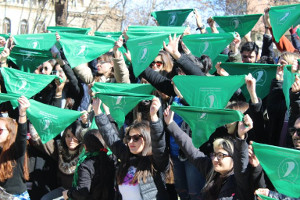
“Women's organizations are taking to the streets in many cities in Latin America on the Global Day of Action for Access to Safe and Legal Abortion. In Buenos Aires, activists from the National Campaign for the Right to Legal, Safe and Free Abortion waved the movement's green handkerchiefs in front of Congress. They were directed against the policies of the ultra-right President Javier Milei, which, according to them, are systematically undermining women's health care.
In keeping with this, the research project Proyecto Mirar of the Center for State and Society Studies (Cedes) presented its on the same day, Monday (September 28).Annual report  before.
Since Milei took office in 2023, the budget of the state program for sexual health and responsible reproduction has fallen by 57 percent. The state bought significantly fewer contraceptives.
The number of women receiving this treatment is expected to fall from 1.2 million (2024) to an estimated 63,000 in 2026. The authors estimate that 240,000 unwanted pregnancies, 112,000 abortions and 452 maternal deaths could have been avoided. These are model calculations, not recorded cases. The authors of the report also noted that access to legal abortions has so far remained in Argentina. In 2025, 87,603 terminations were registered in the public sector in 20 provinces, with no significant change compared to the previous year. The provinces make this possible. The Ministry of Health has stopped purchasing medication for abortions, and 13 provinces have since financed it from their own resources…”Article by Manuel Rank from October 1st, 2026 in Amerika21
- For background information, see #safeabortionday: Worldwide and nationwide action day 'Safe Abortion Day' on September 28, 2026 in the dossier:[Global Overview] Fight for Abortion Rights: How Ultra-Conservatives Interpret Human Rights
- Regression and resistance: Restricting access to abortion in Argentina
“The filmBelen“, Argentina's entry for the 2026 Oscars, tells the story of a 26-year-old woman who suffered a miscarriage in a hospital in Tucuman province in 2014 and was sentenced to eight years in prison in 2016 after being found guilty of illegal abortion. Her case sparked a nationwide campaign to decriminalize abortion that became known as the “Green Tide” after the green scarves protesters wore.In December 2020, the Green Wave won: abortion was legalized upon request up to the 14th week, and later also in cases of rape or danger to the woman's physical or mental health. (…)
“Belen” is causing a stir at festivals. But in every interview, director Dolores Fonzi warns that this hard-won right is being eroded under President Javier Milei, elected in December 2023.
“Murderous Abortion Agenda”
Milei combines radical economic libertarianism, aggressive austerity measures to shrink and restrict the state, and conservative, anti-feminist rhetoric. (…)
The safe abortion program suffered a major setback. In 2024, the federal Ministry of Health (MoH) suddenly stopped distributing pregnancy tests, drugs and abortion supplies to provinces, including 106,000 units of the medical abortion pills misoprostol and mifepristone that were scheduled to be delivered. Suddenly each province, with different procurement capabilities and budgets, had to purchase its own supplies. The large discounts for pooled national procurement were lost. (…)
The Ministry of Health has also suspended training and technical assistance on safe abortion, a significant setback for provinces with many health workers who conscientiously object to abortion and too few trained providers. These measures have exacerbated geographic and economic inequalities in access to reproductive health between rich and poor provinces. (…)
It is alarming that private centers for vulnerable pregnancies, which are not part of the Ministry of Health, have sprung up in public hospitals to offer anti-abortion advice. Users reported misinformation about the effects of abortion, invasions of privacy, aggressive questioning, and harassment through unwanted follow-up calls. (…)
At the beginning of November, Milei and high-ranking cabinet members received the American preacher Franklin Graham at the Casa Rosada, the seat of the government. Graham, a key religious supporter of U.S. President Donald Trump and a longtime activist against abortion and same-sex relationships, held two well-attended rallies in Buenos Aires last month. Although the LLA does not currently have the necessary votes to repeal the law, it is expected that abortion services and rights will be subject to further restrictions.” EnglishArticle by Mercedes Sayagues from December 10, 2025 in healthpolicy-watch(machine translated) - “We are still urgently needed.” The “Socorristas en Red” network has been organizing abortions in Argentina for more than ten years - the new opponent: the Milei government
“Socorristas means “rescuers” in German. The “Socorristas en Red”, a feminist organization founded in 2012, supports women, girls, trans* men and non-binary people in Argentina on a voluntary basis so that they can have a comparatively safe and inexpensive abortion themselves using tablets. With the two active ingredients misoprostol and mifepristone, this usually works without any problems until the twelfth week of pregnancy. »We oppose the health system, the justice system, the state system and the call of “Don’t get involved”. Between 2012 and 2024, we accompanied between 12,000 and 15,000 people every year. So a total of between 150,000 and 160,000,” says activist Ruth Zurbriggen. An impressive number. (…)
»Abortions are not a “lesser evil”, there is nothing to be ashamed of. They’re just part of life,” says Ruth Zurbriggen. “We laugh, cook and eat together and watch a film in between,” is how she describes this type of social gathering. Following the abortion, the Socorristas arrange doctors for follow-up examinations. (…)
The mobilizations under the motto #NiUnaMenos (in German: Not one less) against sexualized violence, the feminist strikes on March 8th and the broad support for the annual nationwide women's meetings that have taken place since 1986 were able to make women's right to self-determination over their bodies a central social issue. »The real change, in my opinion, was that abortion was being talked about, not just publicly, but also in private. At family dinners, grandmothers, mothers and aunts revealed their secrets. Not everyone had the same opinion, but the topic was literally on the table. There was no going back,” said activist Ruth Zurbriggen. The campaign to legalize abortion had now grown to over 500 organizations across the country. (…)
The Danger Javier Milei
Are the socorristas even needed now that abortion is legal in Argentina? Ruth Zurbriggen was convinced at the event in Berlin: »We are still urgently needed. On the one hand, the contents of a law do not communicate themselves. Many don't know their rights. And then the political signs today are completely different than when the law was passed.« (…)
The Ministry of Women, Gender and Diversity was abolished. Medicines are no longer provided by the state government, but the public health system is left to the provinces. This applies not only, but also to the drugs used to carry out abortions. The provincial governments have very different economic structures and are often politically conservative. Of course, other than feminist concerns are also affected by the cuts, but Milei is not "only" neoliberal, but also extremely conservative. »His government is part of a global anti-gender movement; it stands for an authoritarian project. Their enemies are feminists, trans* people, but also indigenous peoples, environmental movements and social movements. At some point the government will take action against the legalization of abortion, that is clear, the only question is when. We have to be prepared, stick together and network internationally.«…”Report from Socorristas in Red, magazine ila and news pool Latin America on March 6th, 2025 in ND onlineabout the event “Abortion Support in Times of a Global Right” organized by the magazine “ILA” from Bonn and the media project “Nachrichtenpool Latin America” e. V. to Berlin, see:
- [Back before 1921] Prison sentences of up to six years possible: Argentine government wants to abolish the right to abortion“Argentina's President Javier Milei wants to abolish the right to abortion. In Argentina, legislation could revert to 1921 levels. Even women who have been raped should be denied abortion.
After the failure of his most important legislative proposal, Argentina's President Javier Milei now wants to abolish the right to abortion. His extreme right-wing party “La Libertad Avanza” brought a corresponding proposal to parliament, as the newspaper “Página 12” reported on Thursday. Abortion after rape should also be banned, which would set the legislation at the level of 1921. The new draft only allows abortion if there is an acute risk to the mother's life. Abortions in the first 14 weeks of pregnancy have only been legal in Argentina since 2021. (…) Abortion in the first 14 weeks was only legalized by parliament in Argentina at the end of 2020, after a broad movement had fought for it for years. If the mother's health is at risk or after rape, an abortion can also take place later under current law. The Milei MPs' draft envisages a prison sentence of one to three years for the women affected. However, the judge can suspend the punishment depending on the motivation and circumstances of the abortion and the woman's subsequent attitude towards her crime. The health worker who performs the abortion reportedly faces one to four years in prison, and six years in prison if the woman dies.” RND report from February 8, 2024 - Will the Liberal anti-legal abortion bill fall faster than the omnibus bill?
“The bill to repeal Law 27610, which has regulated access to voluntary abortion since its adoption in December 2020, has reached the Chamber of Deputies under file number 5172-D-2023. Another libertarian nonsense that we must combat with struggle and mobilization. We had just returned from the meeting of self-proclaimed neighbors when the chats exploded with the news: La Libertad Avanza has presented a bill to repeal the law on voluntary abortion. Wednesday, 10 p.m. Just a little more than a day after the Milei government's scandalous political defeat with the omnibus law in the Chamber of Deputies, neighborhood assemblies, trade union and student groups and left-wing parties celebrated in the streets.
The bill to repeal Law 27610, which has regulated access to voluntary abortion since its adoption in December 2020, was introduced in the Chamber of Deputies under file number 5172-D-2023. In an excess of patriarchal fundamentalism, the bill does not propose to return to the legal situation before 2020, but directly to the legislation before the Penal Code of 1921, which already introduced the figure of abortion with impunity in cases where the life or health of the pregnant woman was in danger or when the pregnancy was the result of rape. This libertarian mania to take us back a century in one fell swoop!...” span.Article by Andrea D’Atri from February 8, 2024 in La Izquierda Diario(machine translated) – see our dossier for background information:Ultra-right Javier Milei will be the new president of Argentina – if Bolsonaro and Trump congratulate... - [Film] The man attacks – femicides in macho land
“Argentina is a macho country. Machos used to whistle at their skirts and grope their secretary. Their violence was considered “normal,” committed out of “passion.” That's over, the legislation has changed; However, they do not prevent the increase in femicides, 329 in the last year. Today, Argentinians are making careers in politics and business. Abortion has just been legalized. The new experience is celebrated on the streets: if women organize themselves, women can change something. So far it has been about gender issues. Will the social issue be on the agenda soon? For a long time, Argentine feminism, imported from Europe, was a middle-class issue that men laughed at. Instead of taking part in the housework, they paid a cleaner. Only when people from the trade unions and social movements joined in did things pick up speed. Today the movement is at a crossroads…”Film by Gaby Weber from May 22nd, 2021 on YouTube 
- “It’s the law!” by Alex Wischnewski on December 30, 2020 in Jacobin Magazine on the significance of this success and upcoming disputes, among other things: “…The activists' greatest criticism is directed at the inserted conscience clause, through which medical staff can refuse to perform an abortion based on personal beliefs. In other countries, this restriction has proven to be a major hurdle to implementing formal law. In Italy, around 70 percent of all doctors refuse abortions for reasons of conscience. However, it was precisely this restriction, as well as the president's personal commitment, that ultimately increased the chances of the law. In 2018, then-President Mauricio Macri was still actively working against its adoption. (…)The success of the feminist movement will probably ensure that the campaigns of theanti-derechosbecome even stronger and more vehement in order to use the conscience clause to undermine the actual implementation of the right that has been won. That's exactly why this success is not the end of the movement. The feminist movement, for its part, has also announced that it will not be satisfied with this, but will instead use the historic breakthrough as an impetus for more: “queremos cambiarlo todo” – “we want to change everything”. Nevertheless, the law is a symbolic success that should not be underestimated, which means the recognition of a human right for women too, the recognition of their right to self-determination and their autonomy. In addition to describing it as a social issue, the feminist movement has never allowed any doubt that the legalization of abortion is also a deeply anti-patriarchal act. More than that, it is a success that confirms the strength of the feminist movement in legal form. With effects far beyond Argentina…”
- "Argentina. Dimos un gran paso, pero la lucha sigue" by Mabel Bianco on January 3rd, 2021 at Resumen Latinoamericano is a short contribution by the chairwoman of the Fundación para Estudio e Investigación de la Mujer, in which she once again emphasizes that this has been a fight that has become stronger since the fall of the military dictatorship - and that will continue because it is a fight for the democratic right to decide for oneself...
- “GREEN WAVE SHOULD BECOME A TSUNAMI” in issue 531/532 (September/October 2018) of Latin America News was an interview by Bettina Müller with the activist Yanina Waldhorn (on the occasion of the debate in parliament at the time, when the majority of the Senate rejected it), in which she emphasized: “…The arguments come from those we call “anti-rights (anti-derechos),” who describe themselves as “pro-life.” Her campaign is closely tied to the Catholic and evangelical churches, which had a major influence on the senators in the run-up to the vote. Among other things, they meant that a woman could give her child up for adoption after birth if she didn't want it. In addition, according to them, the law is unconstitutional and abortion is murder. // What was and is the mood in the movement now? // The senators' no vote was a hard setback after so many months of constant mobilization, several activities per week, panel discussions, roundtables, etc., all in addition to work, because campaign engagement is not paid. Nevertheless, we are very proud of what we have achieved, because something like a consensus has now spread throughout society that abortion should no longer be criminalized. There is no place in Argentina today where the topic is not discussed. Our symbol, the green cloth, hangs on thousands of backpacks and bags across the country. // When can the law next be voted on? // We can propose the law for a vote again next year. However, the composition of the Parliament and the Senate will change with the elections in October 2019. The newly elected representatives will then take up their positions in December, with the work of Parliament beginning after the summer holidays in March 2020.The question therefore arises for us as to whether it makes sense to present the project to the same representatives who have already spoken out against it, or whether it would be more advisable to wait for the new composition of the legislative bodies. We will now discuss this as a campaign, but we have no doubt that we will present the law again. Until then, we will remain active and present on the streets…”
- “Aborto: una lucha que será ley” on August 4, 2018 at argentina.indymedia was a compilation of numerous reports, statements and interviews with activists on the parliamentary debate at the time, all of which emphasized that “if not now, then in the future” - the fight would by no means be over even if there was a current defeat in parliament, just as it would not be over if the law was passed...
- “Bolsonaro critica legalização do aborto na Argentina” by Fabio Murakawa on December 30, 2020 at Valor reports the comment of the Brazilian ruling right-wing radical that there will never be “something like that” in his government (and in doing so once again ignores the constitution, which prohibits comments on domestic political decisions by the governments of other countries)…
- Further out of thePost “After decades of struggle in the streets, Argentina legalizes abortion” by Ana Rivera on December 30, 2020 at Class Against Class : “…In 2018, Argentines organized massive demonstrations to fight for this right, and theNational Campaign for Legal, Safe and Free AbortionThe proposed bill was approved by the Lower House but subsequently rejected by the Senate, despite the hundreds of thousands who protested in the streets of Buenos Aires and across the country in support of the law. Now, after decades of struggle, there will be no more cases like that of Belén, who was jailed for murder after a miscarriage. There will no longer be hundreds of nameless people dying every year as a result of unsafe and clandestine abortions...”
See also:
- from June 2019:The right-wing government in Argentina also has a fighting program: with poor prospects, as hundreds of thousands are demonstrating against the abortion ban
- from March 2019:In the fight against Argentina's right-wing government, women's alliances and unions are mobilizing for a strike on March 8thas well as A historic women's day in Argentina
The postArgentina's new abortion law is progress: say the women who fought for it for so long and also a look at those who criticize itappeared firstLabourNet Germany.
Read the full story at the source
Source: labournet.de