
Politics · Labour Hub · · 2h
“The redistribution of wealth is essential if we are to have the resources to grow the economy”
English (original) · Read in Deutsch ⇄
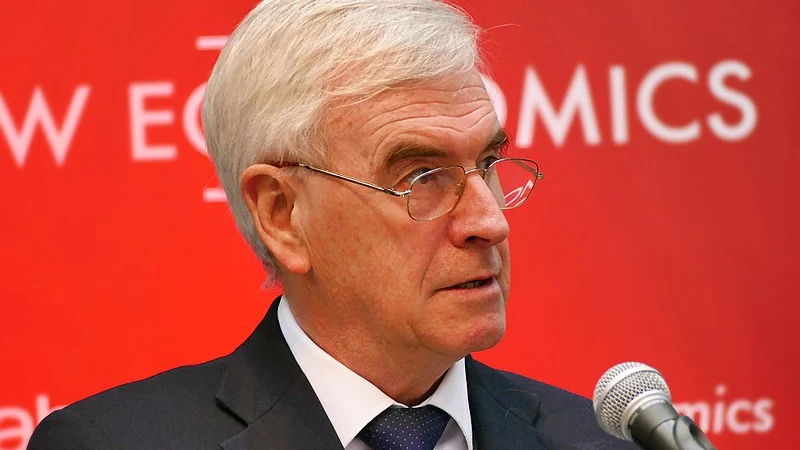
Ahead of speaking at the Arise meeting, A Fork in the Road Moment: For an Irreversible shift in the Balance of Power and Wealth at Labour Party Conference, John McDonnell MP shares his thoughts on the subject.
There has undoubtedly been a change of culture in the Labour Party with the arrival of Andy Burnham to the leadership. Unfettered open political discussion has been restored.
We have no illusions about this. We don’t know for how long, how far it extends and whether that debate will result in influence for the left and change in action.
When the likes of Adam Smith, Ricardo and Karl Marx were writing, their subject area was always described as political economy, never just economics.
Economic analysis could never be separated like some separate science from politics and the political environment in which it was studied.
Clara Mattei wrote her recent brilliant book subtitled “Economics is Political” to remind us of this.
It’s why we wanted to return in this meeting on the economy to the political discussion of the redistribution of both power and wealth.
On the progressive left we warn time and again that we operate in the most politically, socially and of course environmentally dangerous moment since the Second World War 80 years ago, and maybe even beyond that.
Richard Seymour in his unique book Disaster Nationalism quotes Robert Paxton’s depiction of a climate for fascism. It’s when there is “a sense of overwhelming crisis beyond the reach of any traditional solutions.” That’s why the blackshirts are on our streets again and Reform could soon be in government.
With stagnant wages for over a decade, 14 million in poverty, public services privatised, outsourced and stretched beyond their limits and the threat of Ai displacing millions of jobs, our society becomes the breeding ground for the far right especially because the Party that was founded to offer a political and economic alternative has become seen as incorporated into this failing, crisis ridden system.
Hovering above all this are the rapidly, emerging threats, now a reality, of climate catastrophe, as fire and flood engulf whole regions threatening homes and food supplies and the arrival of a warmongering partnership of a clearly demented narcissist in the White House and a brutal self-serving dictator back in the Kremlin.
So, in the face of all this, there has to be a sense of urgency in our government – urgency about the redistribution of power and wealth to give us the resources to tackle these threats.
This has to be at every level, nationally to the locality, from the Treasury to the firm.
Policymaking at the national level has to get its act together.
Growing the economy is the prime economic objective of the government but won’t be achieved if left to the market as we have seen and it won’t be achieved if our economic institutions continue to work separately, uncoordinated and without a clearly planned and coherent strategy.
That’s why we have long advocated the establishment of a National Economic Strategy Body, bringing the Bank of England in from the cold and harnessing the power of the Treasury, a fully funded, scaled up National Investment Bank and having trade unions and employers at the table.
Although the Bank of England’s independence would remain, its remit should be widened beyond inflation targeting to encompass explicitly the securing of long term, patient investment in reindustrialisation and employment and tackling poverty and climate change.
It’s role in setting policy for investment could help shift the power from shareholders to stakeholders and shift the investment priorities of UK financial institutions and pension funds from their obsession with land and property to productive output, as analysed in his recent New Statesman article by Michael Jacobs.
If we are to fulfil Andy Burnham’s ambition of growth in every postcode, it means planning and policymaking at the local level with community wealth-building via local authority partnerships empowered and funded.
Action is also needed at the level of the firm if we are to enable people to secure the benefits of a growing economy. It’s obvious that means full employment rights including sectoral collective bargaining across the whole economy, a clear definition of worker to halt gig economy exploitation and the restoration of the right to take sympathetic action.
That’s why taking back ownership, not just control, of essential services like water and energy is critical if we are to invest and create an economy of service rather than profiteering.
Developing alternative forms of ownership, including co-operation and workers’ control, needs to be on the agenda.
To create this economy for the many, the resources are readily available but often in the wrong hands and as a result are not serving the interests of the country.
That’s why the redistribution of wealth is essential if we are to have the resources to grow the economy and fund our welfare state.
Prem Sikka, Andrew Fisher, the tax justice campaign, the Patriotic Millionaires, the Wealth Tax Commission and many others have set out in considerable detail a programme of tax reforms that would deliver a great deal more than the resources we need.
These include taxing capital and dividends at the same level as wages, taxing dividends paid to foreign investors, taxing share buy backs, reform of council tax, land value tax, exit tax, financial transaction tax, an end to paying interest on bank reserves and a wealth tax on multi-millionaires.
Ironically the bond markets are playing a revolutionary role in forcing the government towards adopting a programme of redistributive taxation.
By seeking to ensure that the government abides by its fiscal rules of not borrowing for day to day spending, balancing the books and borrowing only to invest, while the government knows its MPs won’t vote for cuts, the bond markets have left the Chancellor with little option but to raise taxes on the wealthiest and the profit-laden corporations and banks.
In this political environment the task of the progressive left now is pretty obvious.
First, wake more people up to the urgency of the political situation with the risk of a far right government, whether its Reform or a coalition of Reform and Badenoch Tories.
Second, to develop in more national and local detail the alternative economic strategy that is now emerging on the left and to dominate the intellectual space that has opened up for us.
Finally, to mobilise throughout our labour and trade union movement to set this government on the right course.
It’s all in our hands now. The dark night under Starmer may not be fully over but there are definite signs potentially of a new dawn.
John McDonnell MP was Labour’s Shadow Chancellor from 2015 to 2020.
A Fork in the Road Moment – For an Irreversible Shift in the Balance of Power & Wealth” event in Liverpool – is at 6.30pm,Monday September 28th, in the Ziba Bar on the Ground Floor at the Racquet Club Hotel, 5 Chapel Street, Liverpool, L3 9AG http://bit.ly/shiftpowerliverpool
Main image: John McDonnell MP. Author: Sophie Brown, licensed under the Creative Commons Attribution-Share Alike 4.0 International license.
Read the full story at the source
Source: Labour Hub