
Anti-fascism Labour Hub
Anti-fascism from below: resistance to far-right flag campaigns
A new report from the Institute of Race Relations warns that mainstream political parties have created a permissive environment that has allowed intimidatory far-right flagging campaigns to develop, a
English (original) ·Read in Deutsch ⇄
A new report from the Institute of Race Relations warns that mainstream political parties have created a permissive environment that has allowed intimidatory far-right flagging campaigns to develop, and that, in the absence of effective government action, it has been left to local communities to defend their neighbourhoods.
The report involved interviews with community organisers and activists from a number of English cities. It provides in-depth analysis of the context and development of ‘Raise the Colours’, which brought thousands of Union Jacks and St George’s flags to public spaces across the UK, which was accompanied by increased levels of anti-migrant, Islamophobic and racist violence.
In a context of a lack of government action and limited action from local authorities, it has largely been left up to local communities to respond to flag campaigns. This has included the forming of local groups to remove flags from unauthorised public spaces, the monitoring of racist violence, the dissemination of posters and visual materials to signal welcome and solidarity, the pressuring of local authorities to take action, and the organising of community hubs to address essential needs.
The report finds that ‘Operation Raise the Colours’ has backfired at the community level. Its efforts to divide communities had the opposite effect as communities have come together to defend their neighbourhoods from far-right encroachment.
“Local councils across the country have had varying responses to the flags,” notes the report. “Whilst some councils have upheld and enabled unauthorised far-right flag campaigns, other councils have taken action to remove the unauthorised flags which has provoked a backlash from Reform UK and the right-wing.”
The report explores who is behind the flag-raising operation in a variety of localities. It places the project in a context of escalating vigilantism, with the formation of 28 anti-migrant vigilante groups across the UK in the last eighteen months and a rising tide of racist violence. The group Hope not Hate tracked a total of 251 demonstrations mainly outside hotels for people seeking asylum in 2025 alone.
But the wider context, as highlighted in IRR’s report Enforcing Britishness, is that since Reform UK’s gains in the local May elections in 2025, the Labour Party and the Conservatives have been in a ‘race to the bottom’ in order to out-Reform Reform on immigration policy and rhetoric. On the issue of flags directly, Labour government figures have minimised their intimidatory impact, while right wing politicians have been enthusiastic about the campaign.
Motivated by government indifference, local communities have taken the initiative. “Local groups began to form specifically around coordinating the removal of flags such as ‘Lower the flags Shrewsbury’ and ‘Stirchley is for everyone’ in Birmingham, with anti-fascists in Brighton creating a zine called a ‘flag busters manual’ which shares techniques on how to remove them,” says the report. “As locals began to share their anger and collectivise their techniques, mass public deflagging events took place.”
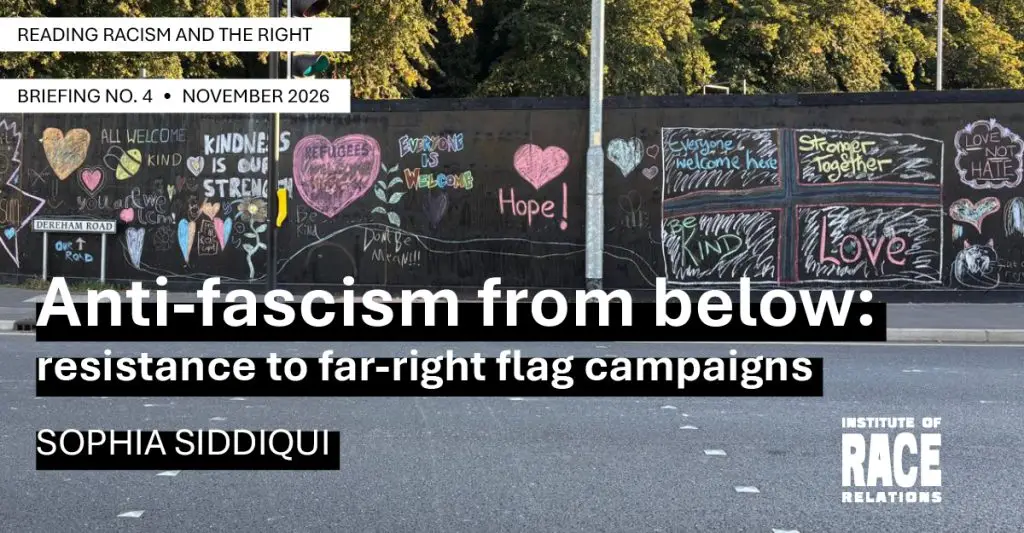
“Whilst many locals got ladders out and removed flags and racist graffiti,” it continues, “others explored creative campaigns including art projects that customised flags with messaging stating ‘everyone welcome’ in Manchester, the chalking of inclusive messages on pavements such as ‘everyone’s street’ in Norwich, and flying international, regional and rainbow flags on lampposts as a riposte to the erection of St George’s flags in York.”
IRR Researcher Sophia Siddiqui, who authored the report, said: “With the evolution of flagging campaigns into far-right vigilantism at the ports of Kent and Portsmouth, and now the targeting of property believed to be houses of multiple occupants (HMOs), it is urgent that we learn from and build on the insights of communities who feel the brunt of far-right violence in everyday life. This report provides the first step in that learning process.”
Anti-fascism from below: resistance to far-right flag campaigns can be downloaded here.