
Germany · Lower Class Magazine · 1970-01-01
If things are to go further - A criticism of anti-revisionism in the communist movement
Deutsch (original) · Auto-translated to English
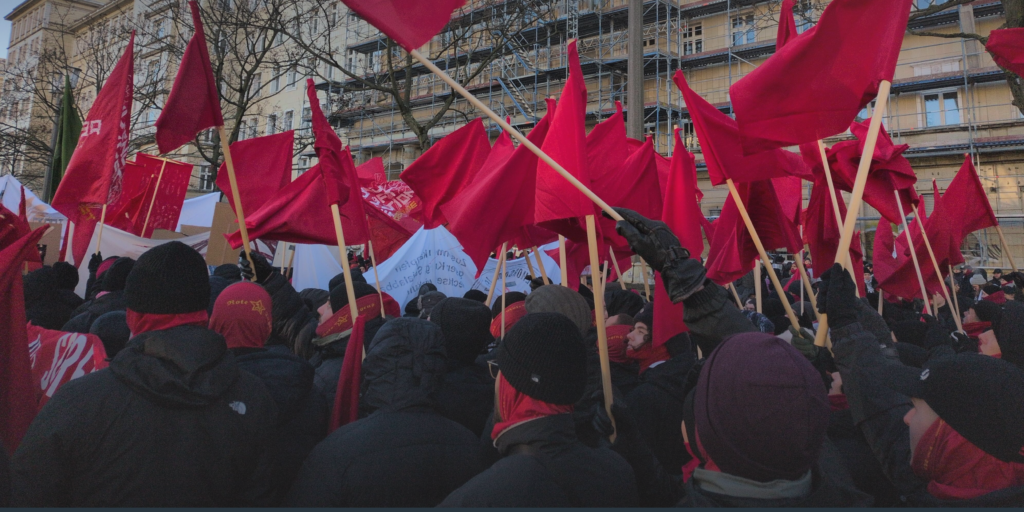
This text is a contribution to the debate on the tendency of anti-revisionism within the communist movement.
The author himself was an active part of a communist project in the making for a long time.
The article should therefore also represent a self-criticism of one's own practice and not just point the finger at others.
By David Meyn We, the communist left in Germany, are currently experiencing an upswing.
The number of people joining our movement has increased noticeably, at least among young people.
Organizations such as Perspective Communism or Communist Construction are the ones that have shaped the image of the radical left nationwide over the last four years.
And rightly so.
And despite all the potential that these organizations have within them, stagnation is becoming more and more noticeable, not to say: the possibility of these projects failing is palpably in the air.
Despite the increasing popularity, the social influence is not increasing.
In addition, the flow of movements is enormous and the ability to bind people over a longer period of time is missing.
In addition, the first divisions are shaking more and more cities.
But why is that?
What is the increasing danger of failure of our project of post-autonomous communist organization?
This text is intended to help shed light on this question in terms of its content.
To do this, we should take a moment to consider another, parallel development that everyone will have noticed.
This development could very well be described as a “condensation of the identity” of our movements.
The hammer and sickle are celebrating a real rebirth.
The attachment of open areas to certain denominations of anti-capitalism is increasing.
Answers to the questions and problems of our society are becoming increasingly simple and general.
Books and discourses written and conducted after 1950 are becoming irrelevant.
A self-image grows that sooner or later is described, or can be described, with the term anti-revisionism.
Anti-revisionism – what is it?
Anti-revisionism means that we do not support a doctrine (vision), e.g.
B. that of Marxism, can go back if we want to understand reality.
Not only that, but it is also a self-description of those who, unlike others, have recognized the truth in it.
Now this mountain riff only became a real battle concept in history when different interpreters of Marxism fought over their interpretive sovereignty.
From then on, all those organizations that, in contrast to other comparable organizations, represent the only truly anti-capitalist Marxism will describe themselves as anti-revisionist.
And therein lies the big problem, because communism and anti-revisionism mean the same thing.
Unfortunately, the dynamic of anti-revisionism is that you can only give yourself this definition.
It is in the nature of the matter that no one can come along and say: “Those are the anti-revisionists!”, because that implies: You yourself are not in possession of the truth and are therefore actually not in a position to judge who is anti-revisionist and who is not.
But this means that being a communist becomes a matter of self-definition and no longer a practical reality.
If we understand communism not as an emancipatory analysis that has to assert itself in practice, but as a way of self-definition, we thereby declare it to be an absolute truth, an article of faith.
As dialectical thinkers, which we should all be as Marxists, we see straight away: Anyone who starts from the absolute is buying into problems.
Because the absolute, by definition, knows no contradictions.
But anyone who proclaims the absolute truth in a world whose principle of movement is contradiction can no longer be able to develop themselves or anything further.
That is why the only dynamic that the Absolute knows is that of administration and no longer the development of reality.
Administration – that is sorting out, masking or making unrecognizable the contradictions that would negate a claim to absoluteness by definition.
What this means in concrete terms can be shown very well.
We will see that this corresponds to some of the experiences we can have in our movements and that the whole thing is not just theoretical blah blah.
On the one hand, administration is increasingly turning away from practice in society.
The practice is increasingly being replaced by active demarcation.
Acting through tactics.
Because self-determination is the only thing that counts, action loses its meaning compared to management.
The goal that distinguishes us as the communist left by being the organization of our class precisely because we are able to act most sincerely and productively for our class and the democratic community has disappeared.
We do not gain our identity from our actions and the strength of our will, but increasingly from our boundaries.
With this self-definition through demarcation and not through practice, we lose community, whether we like it or not, and replace it with unity.
And with that we also lose the opportunity to become a visible part of the community in our society in which our class lives.
So it's no wonder that despite increasing followers, social influence remains low.
But this administrative dynamic also finds expression in other phenomena.
For example, the inner coldness and isolation can increase in organizations where community is replaced by unity.
The necessity of hierarchies in practice then becomes authoritarian reality in many places.
The strong Antifa justice ultra, displaying its superiority, becomes the new and only prototype of the communist movement.
A communism machine, as unassailable as absolute truth itself.
The losers are those whose own interest does not coincide with that of standardization.
In this context, women all too often have to bury their hopes of security within the movement and, in some places, forgo organizing their interests independently.
The fact that the community falls short of the claim of unity has even gone so far in some organizations that the concept of patriarchy has been debated or even rejected entirely.
This move away from the acting community towards a delimiting unit can also be noticeable externally.
Slogans consisting of empty or inaccessible phrases accumulate and remain limited to bad propaganda in which one shows off one's (non-existent) effective power.
Agitation becomes the only measure of success and the ultimate goal of the anti-revisionist organization.
It goes without saying that this comes from the additional gain in followersThe organizational development potential that arises within remains unused, because for anti-revisionism the gain in members is not an expansion of opportunities, but fulfills exactly the opposite: everyr follower represents one less contradiction and is merely an expression of a successfully managed reality.
It is therefore inevitable that our organizations can increasingly take on the character of political prepperism.
The hoarding of supporters who ultimately rot until they have decided to leave and every other political activity is then primarily preparation for Day X.
Statements such as “our time has simply not come yet” or “society is not ready yet” are increasing and one asks oneself “Where is the uprising?” for which we are preparing and which scientific Marxism, whose dialectic we have shelved, has prophesied for us.
Unfortunately, according to its own claims, anti-revisionism is no longer able to recognize the painfully fought truth that the PKK has made available to us in its self-criticism.
Namely that the self-criticism in “Beyond the State, Power and Violence” (book by Abdullah Öcalan (2004), note d.
editorial team) does not represent a rejection of centralization, but rather an insight.
The realization that where organizational principles are declared to be natural laws, where anti-revisionism becomes the determining factor of one's own reality, power also within the organization acquires a self-worth that can ultimately only end in one thing: self-destruction.
Well it is what it is and our movement is at a crossroads.
Ultimately, it is also up to us whether we develop our identity by exchanging our common strengths or not.
Because learning from each other is the easiest, first step away from anti-revisionism and towards a more powerful movement.
And there is a lot to learn.
For example, from the perspective of communism, how fruitful an open and movement-oriented concept can be; from communist construction, how to a lively and productive cadreInternally, this can include women's own organization; or from the Communist Leagueinside, who is fully capable of reconciling the need for Marxist organization with the community of diverse struggles.
So if we are serious about our cause, we have to swallow the bitter pill and recognize that communism is a question of success and not of identity or tradition and we should make sure that we do not stand in our own way on this path to success.
Photo: Private The post If Things Should Go Further – A Critique of Anti-Revisionism in the Communist Movement appeared first on Lower Class Magazine.
Read the full story at the source →
Source: Lower Class Magazine