
Germany · Lower Class Magazine · 1970-01-01
If things are to go further, then with a keen eye on history - an answer to David Meyn's anti-revisionism criticism
Deutsch (original) · Auto-translated to English
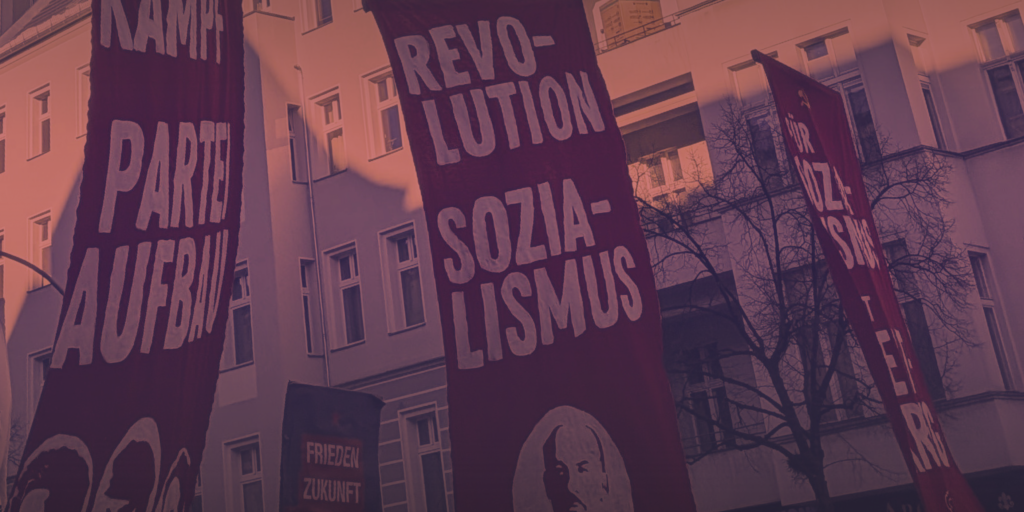
This text is a response to the debate contribution If it should go further - A criticism of anti-revisionism in the communist movement.
The author of this text has been part of the communist movement in Germany for several years and sees himself as an anti-revisionist.
The following response to the debate contribution emerged from a discussion between the author and other people.
By Max K.
First, I would like to thank the author of “If Things Should Go Further,” David Meyn, for raising some questions that are worth discussing beyond organizational boundaries.
How do communists manage to inspire, organize, educate and retain people?
What problems and pitfalls are there?
These questions are particularly relevant in the current phase of the communist movement in Germany, in which circles and groups are finally sprouting up again in all sorts of cities and attempts are being made to develop a living practice.
I cannot answer the questions raised by David Meyn either in this text or alone.
My point is about something much simpler: I not only don't see the anti-revisionism that the author identified as a problem as a problem, but rather as a necessity for any fruitful discussion of the organization's questions.
And David Meyn is partly right when he criticizes the dogmatism of people who like to give themselves shiny labels.
However, he loses himself in the concepts.
Twice anti-revisionism Anti-revisionism – what is it?
Anti-revisionism is a political self-designation and line of criticism within the socialist or communist movement.
Communists who describe themselves as anti-revisionist thus place themselves in a double tradition of Marxism.
The first began around 1900.
The old revisionism within the movement, which was then still called social democracy, was a self-confident designation of more theoretical actors who wanted to “take a fresh look” at the fundamentals that had been established by Marx and Engels, i.e. to subject them to a “revision”.
The fundamentals that were primarily at stake were those of class struggle and dialectics.
Revisionists like Eduard Bernstein claimed that class struggle was not the engine for the creation of a new society.
Instead of fighting, socialism could be achieved through cooperation.
Bernstein does the same thing with dialectics, which he calls a “metaphysical construction,” which is just a philosophical echo of his denial of the fundamental contradiction in society.
Rosa Luxemburg and other revolutionary Marxists vehemently disagreed.
Works such as “Reform or Revolution” by Luxembourg and also “What to do?” by Lenin turn against these forms of revision of the class struggle and therefore themselves form ideological pillars for any further debate on the question of the class struggle and its organization.
The term revisionism has played a role ever since and, from the perspective of Leninist communists, especially in the Third International, referred to self-proclaimed Marxists who wanted to ignore, weaken or otherwise relativize the class struggle.
Incidentally, the denial or weakening of the class struggle is not always openly expressed.
That's why every criticism of revisionism has to fight its way through all sorts of phrases and concepts, i.e. reveal it.
Differentiation can only be achieved through revealing criticism and should not be a self-assurance of identity.
The term anti-revisionism was revived again in the so-called Great Debate from the mid-1950s.
On one side was the Chinese Communist Party (CCP), with Mao Zedong as the central figure.
Allied with it was the Party of Labor of Albania (PAA) with Enver Hoxha as chairman.
On the other side were the parties around the Communist Party of the Soviet Union (CPSU) under its then Secretary General Nikita Khrushchev.
The CCP and the PAA accused Khrushchev and the CPSU of rejecting class struggle in the debates over the direction of the international communist movement in the 1950s.
The Cold War was in full swing at the time and the USA had bloodthirsty and impressively demonstrated the power of its nuclear weapons in Japan.
Khrushchev and others claimed that the threat of nuclear weapons had created a completely different world situation in which revolutions now had to be primarily peaceful and strategic cooperation with imperialism had to be carried out on a world level in order to prevent war.
Mao, Hoxha and a few others vehemently contradicted this, because imperialism creates war and can ultimately only be defeated through class struggle, whether on a global scale or in a single country.
They used the term revisionism polemically, accusing Khrushchev and others of behaving in the same way as Bernstein.
In doing so, they placed themselves in the tradition of Lenin.
In this way they created their own direction in communism, which had armed struggle, the active embrace of revolutionary and militant movements and the criticism of bureaucratism and cynical geopolitics in its blood.
This direction followed Lenin and others' criticism of revisionism, but on a contemporary level, and thus answered the questions of the time; In doing so, she further developed Marxism in polemics and at the same time defended it.
The debate also focused on other questions, such as the relationship to Yugoslavia under Tito, which had left the socialist camp, and the question of the assessment of Josef Stalin, who had died relatively recently at the time and who was made famous by Khrushchev's secret speech on the 20th century.
The CPSU party conference was massively attacked.
In the books “The Polemics on the General Line of the Communist Movement” and “Proletarians of All Countries Unite Against the Common Enemy!” The CCP opposed many of the positions of various communist parties.
I want to highlight just one of these disputes here, namely the CCP's criticism of Palmiro Togliatti, the leader of the Italian Communist Party.
With proper parliamentary support, this should reintroduce the line of social democracy into the communist movement, i.e. compromise and alliance with the bourgeoisie under the heading of “national peculiarities”.
This special path should lead his heirs, the so-called Eurocommunists, who took the opening to bourgeois politics to a self-dissolving extreme, to the fact that today they haunt Italian politics in the form of perfectly normal social democrats, co-managing NATO and helping to build the EU.
In my opinion, the “Polemics” and other texts of the CCP today play a very minor role within the German communist movement compared to Lenin and Luxemburg.
In the 1960s and 70s, however, they were hot shit for communists who were repulsed by the legalism of the Moscow-oriented CPs and perceived the Soviet Union as increasingly bureaucratized and acting on a global level in a similar way to the USA.
This is how the world communist movement split.
From the perspective of the CCP page, it was divided into anti-revisionists and revisionists.
Of course, the CPSU did not adopt these terms.
Armed struggle and parliamentarism One can see this second anti-revisionist movement of the 1960s, in whose tradition people who today use the term anti-revisionist want to stand, as the starting point of almost all armed parties and movements that still play a role today.
Various actors such as the PKK, the DHKP/C, the MLKP, the TKP - ML, the MKP (all from Northern Kurdistan and Turkey), the Zapatistas of the EZLN from Mexico, the CPP from the Philippines and the CPI (Maoist) from India will sooner or later be part of this tradition, although not all of them describe themselves as communists or even as anti-revisionists.
It is similar with many armed groups that no longer exist today, such as the RAF, the Brigate Rosse from Italy, the CCC from Belgium and the GRAPO from Spain.
As in every political tradition, there are also hundreds of failed projects and parties, like most K groups in Germany.
Anti-revisionism is obviously not a guarantee of success.
As far as I know, there is no fighting party or group that follows the tradition of Khrushchev or the CPSU.
Rather, these parties continue to pursue various legal strategies and, above all, parliamentarism.
Depending on how parties and groups classify themselves, you will also want to add a lot of detailed positions and additions.
Entire groups and parties even want to turn the tables on history and even claim that Mao and the CCP are revisionists.
Regardless of these positions, the definition of anti-revisionism within the communist movement emerged as mentioned above and if individual groups see it differently, they are simply lying to themselves.
Dogmatic and undogmatic But back to the actual topic.
As always, the communists in Germany can be divided into different strategic lines, traditions and approaches.
It has always been that way and perhaps the most sensible thing here is to honestly wish everyone success, to seek unity wherever possible and to fight together.
The stupidest thing is sectarianism, i.e. primarily seeking demarcation without or with very weak justification.
The most desirable thing here would of course be if the different approaches discussed with each other on an equal footing (and not for the sake of polemics), but unfortunately this actually happens very rarely (or very little publicly).
But what is the real problem?
David Meyn claims, based on his own definition of anti-revisionism, that sticking to this term would lead to all sorts of mistakes, including bureaucratic dealings with one's own organization members.
I would agree if he had used and elaborated on the term dogmatism here instead.
Although this is also controversial, it fits much more closely with the described problems of too strong an identity and a rejection of real movements (such as the women's movement).
Dogmatists want to create “pure” organizations; they derive the truth of a statement, a practice or a strategy not from the real world, but from concepts and texts.
In extreme cases, they neither run away from nor follow the movements, but instead stand offended on the sidelines.
Incidentally, there are plenty of these dogmatists in anti-revisionism.
These are people who, for example,
Simply repeat Stalin's or Hoxha's texts and not worry at all about how Leninism can be specifically applied in Germany, because for them it is simply omnipotent because it is true.
Point, out, end.
Dozens of party cults were born this way and quickly died due to the lack of concretization of their own analysis or survive as zombies, especially in the centers of imperialism.
Defending Stalin is obviously not enough.
But dogmatism is not loyalty to principles and here David Meyn tends to fall into another mistake: he deduces from the use of symbols such as the hammer and sickle, the linking of open areas with a more direct anti-capitalism and the preoccupation with communist theory before 1950 that there are people in the communist movement for whom the identity is more important than the movement, simply because they do the above.
David Meyn even pretends that the above actions inevitably lead to bureaucracy, low social influence and patriarchal views.
His position sounds as if we should instead position ourselves as broadly as possible in terms of content, take something positive from all approaches and, above all, learn from each other.
In doing so, he simply reverses the dogmatism of the anti-revisionists that he criticizes by opposing it with an equally dogmatic anti-dogmatism that doesn't even know what it really thinks is good - but it shouldn't be dogmatic.
David Meyn talks about the consequences of defining yourself as an anti-revisionist.
He says this leads one to see oneself as possessing absolute truth.
Everyone doesn't want to propagate absolute truths.
Everyone is somehow self-critical and yet convinced of their positions.
But of course, if you have a position and differentiate yourself from others, then it can quickly become sectarian and preachy.
Here too, the tradition of anti-revisionism knows ways and means to get out of this dilemma.
Mao and others did not develop or find positions and truths on the drawing board.
Above all, they listened to people, embraced what was progressive, rejected what was reactionary, and tried to weaponize the ideas and feelings of the people they wanted to liberate.
Instead of propagating general truths that a small circle cooks up for themselves, many anti-revisionists actually went among the people and tried to learn from them.
They still do that today.
Whether in the Indian hinterland among desperately poor farmers or in the slums of Manila.
I think it's important to pay attention to the flaw that David Meyn raises, but I don't think it's built into the DNA of anti-revisionism.
Dogmatism is a laziness of thought and movement that anti-revisionists have been fighting against for decades, although some unfortunately fall victim to it themselves.
Openness There may be people for whom identity really is more important than the actual goals of communism.
But why are anti-revisionism and openness opposites?
Why can't one have an identity that is anchored in history but open to alliances, collaboration and self-criticism?
Why can't a principled identity primarily consist of an openness to movements, a willingness to apply and expand Marxism and the ability to form alliances?
I would argue that it was above all anti-revisionism that remained open to class struggles and that did not want to form political influence through parliaments, but aimed at empowering the oppressed.
Who has a rich and bloody, flawed and inspiring history that still hasn't been fully explored.
On the other hand, the parties that focus on parliament can only talk about the class struggle in theoretical terms and can only turn their noses up at the women's movement, queer struggles and political resistance movements (be they climate or antifa groups), but are happy to continue doing so.
In the end there are always exceptions, and also the theorists who wrote in parties loyal to Moscow, and even these parties deserve to be treated honestly and to be examined for merits and mistakes.
But it was primarily people from the anti-revisionist movement who kept communism alive as a movement when the Warsaw Pact collapsed in 1991, China had long since declared the market to be the highest principle and in the imperialist centers only people and dissident thirds were allowed to speak of it.
Heroically and sadly failed people's wars in Nepal and Peru or ongoing ones in the Philippines and India, a connection with the national liberation struggles such as in Turkey and Kurdistan or simply the maintenance of communism as a militant and revolutionary practice in the imperialist centers of the world - all of this is attributable to anti-revisionists.
Back to the 2000s With David Meyn we tend to find an opinion that was much more widespread in the radical left movement in the early 2000s and 2010s.
Namely a distrust of clear principles, hammer and sickle and clear language.
This mistrust is justified.
Many K groups in Germany have failed resoundingly.
In the best case, its members were absorbed into political resistance movements and the Red Aid after the collapse of the organization; in the worst case, they became crazy anti-Germans and imperialist Greens.
In between you can find everything, from the disbanded party structure in the Left Party to the outlived K-Group, which serves its own truth in isolation from the rest of the communist left.
The K groups have their own history of sectarianism and mistakes that need not be repeated.
But also experiences and problems that will play a role again today.
Why not record and address this story?
There is a form of dogmatism that wants to dogmatically avoid anything that arouses anti-communism, makes it clear in which tradition we stand, and rigidly embraces any left-wing tradition that was in any way critical of Lenin, Stalin or Mao.
Leftists don't need this dogmatism any more than they need distrust of feminism, the queer movement and migrant self-organization or inward-looking organizations with the truth.
Much more interesting than the discussion about the content and supposed consequences of various terms would be an argument about the errors and merits of the last great upswing of communism in Germany and the world.
Because this way we could perhaps predict what problems await in the future.
Instead of acting as if no position on the past is a correct one, it would be important if more people actually dealt with our past.
Nobody should avoid books that were written after 1950, show coldness towards people, only manage movements and reject the concept of patriarchy.
As already mentioned, openness between organizations is not a contradiction to principles.
If we want to go further, we should look at our history with a keen eye and at the same time take up the movements of the current time, organize them and empower people to do this themselves.
Thanks to Marx, some people in Germany and certainly around the world are already doing that.
Photo: Private The post If things are to go further, then with a keen eye on history - A response to David Meyn's anti-revisionism criticism appeared first on Lower Class Magazine.
Read the full story at the source →
Source: Lower Class Magazine