
Germany Lower Class Magazine
The Kids Are All Riot – Gen Z against changing times and reasons of state
After the social media algorithms were full for weeks of a mix of insurgent-revolutionary scenes and teenagers dancing TikTok dances in front of overwhelmed [ ] The article The Kids
Deutsch (original) ·Auto-translated to English
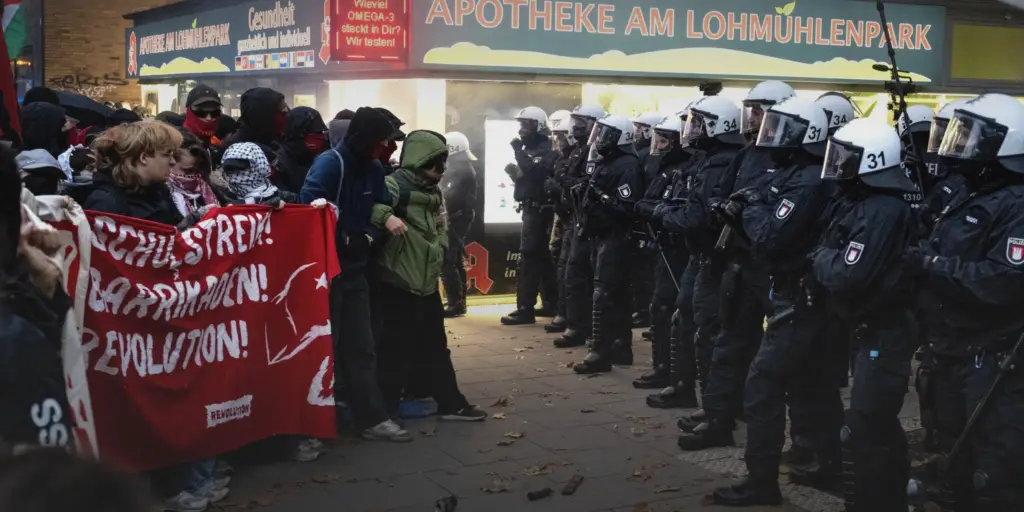
After the social media algorithms had been full for weeks of a mix of rebellious-revolutionary scenes and teenagers dancing TikTok dances in front of overwhelmed cops from France, Albania and Co., the time had finally come on Saturday: After initially anonymous AI-generated calls online had declared October 31st as the deadline for the spark of revolt to finally spread to Germany, demonstrations were organized in over 30 cities. In view of developments abroad, this day was awaited with great excitement from various quarters. While the revolutionary left largely seemed to expect that the mood that had been sparked online would stay online, politicians and the press warned that the downfall of our civilized order would begin this Halloween, and in the classrooms of major German cities there were discussions about what people would grab from the Media Markt shelves first when “the revolution starts”.
None of these predictions seem to have entirely come true. In fact, it is no exaggeration to say that the “Gen Z rules” protests have brought the largest organic youth demonstrations to the streets since Fridays for Future and could be the start of a relevant new movement with much greater significance. And even though attempts are now being made with all their might to use the images from Frankfurt, Hamburg and Cologne to prove that the previous scaremongering was completely justified, the completely untouched chipboard facades that suddenly appeared everywhere in large and small cities and were meekly taken down again in order to allow everyday consumption to flow freely again on Monday remained more cause for amusement on the Internet and among passers-by than necessary protective measures against the revolutionary mob.
Scaremongering or real fear?
But the fear that was fueled in advance is real. It is not the fear of a population that has to worry about their own safety and inner cities, even if they try with all their might to claim that. It is the real fear of a ruling class that a mood is actually spreading among German youth that is directed against the conditions in which they are being prepared in increasingly ruined schools to be the offspring of the class from which the last drop of life (= work) strength is now being squeezed out in order to finance the war in which they are also to be burned as cannon fodder. Because with such youth, Germany's current imperialist aspirations would actually be difficult to achieve. Accordingly, not only is the fear of those in power very real, but also their desire to prevent such a movement against their policies.
The repression is also just beginning
All major media companies demonstrated this willingness in the run-up to the day of action, trying to delegitimize the protests as quickly as possible. The massive and aggressive police presence is further evidence of how serious the German state is in its desire not to allow a genuine new youth movement to emerge. Despite all the joy at how strong the revulsion against this state's politics was on Saturday, we must not ignore the fact that the reaction of the ruling class will become much stronger. Historically, strengthening and sometimes militant resistance movements have always been a reason for an escalating reaction. This is not an argument for allowing the division as a movement to be created by media incitement, but we must honestly assess how ready we are to deal with the escalating dynamics of growing repression and radicalizing protest. Otherwise, there is a risk that the German repressive apparatus will be further intensified, without us as a movement really getting any closer to our goals.
It would be a mistake to underestimate how effective the Federal Republic of Germany is already at suppressing radical protest. The fact that an escalation often threatens legal consequences that restrict the rest of life and not just physical violence from the cops already means that such escalations come primarily from those young people who underestimate these consequences. As a movement, we cannot simply celebrate when young people run into stores completely unprepared, unmasked and easily identifiable in public in order to get at least a small improvement in their material situation with a pair of expensive sneakers. It is precisely these young people who are now becoming the target of media and political agitation, always associated with the most disgusting racist enemy images, who are increasingly becoming target number 1 on all sides of the political establishment. These young people in particular must be assured of our full solidarity, whether that means opposing the public agitation or holding back the 15-year-old next to them before he runs completely unmasked in front of the nearest surveillance camera to commit a crime. We must not simply let the most vulnerable parts of our youth movement fall into the open, neither by encouraging them to expose themselves to dangers that many of us consciously prefer to avoid, nor by accusing them of being subjected to the racist incitement of the state and the press.
Incitement and distancing to the point of insignificance
The fact that the horror of criminal migrant youth is now being increasingly emphasized publicly is not new. We have known this from the political right for a long time, and with the derailments surrounding the genocide in Gaza, many other circles, even on the supposedly left-wing spectrum, have adopted this image of the enemy. We must also be aware that these “migrant young people”, who are marked as culprits and enemy number 1 in politics and the media, are the scapegoats of today for the German ruling class, German imperialism and the racist incited parts of German society. A constructed “migrant milieu” is increasingly explicitly blamed for everything that goes wrong in this country - from anti-Semitism to “there are no dentist appointments” - in order to divert the population's anger about the conditions and social cuts away from their root causes - the classic scapegoat strategy. This means that social groups marked as migrant a.k.a. “foreign” are also the most vulnerable targets, which will be attacked more and more explicitly in a racist manner in the future. Pogroms, murders, deportations and hostility are created and actively accepted with this discourse, as the racist attack on October 23rd in France, in which 26-year-old Pengo Bossio Wangi was murdered by a fascist, clearly shows. The left in general has the task of supporting and defending these social groups that are marked as scapegoats and enemy images. These are our migrant young people, these are our people.This is the reason why we do not distance ourselves from the riots and not because the looting was a politically revolutionary act. It must be about building a movement of political resistance and fending off the attacks and agitation against our migrant class brothers and sisters.
Allowing division to occur can be an effective death knell for a genuine class struggle movement. The strength of our movement depends largely on its unity. In France, the state is being forced to make more and more marginal concessions and (so far) hollow promises because it is unable to drive a wedge between the school blockades from the most diverse social classes, the trade union movement and the young people from the banlieues. The method of these attempts at division is not new and it is used by those in power against a variety of left-wing movements from reformist to revolutionary mass movements.
After enough agitation, the bourgeois public is building pressure on the movement to distance itself from its supposedly problematic parts and to apologize for the violations of the bourgeois rules of the game. A separation is made between the supposedly acceptable protest movement, which - as long as it plays according to the bourgeois-democratic rules - would be taken seriously, and the "troublemakers", the "foreign looters", the "left-wing extremist violent criminals", the "terrorists", "anti-Semites", etc., who would ultimately do the most harm to the well-behaved and peaceful demonstrators.
This attacks the social acceptance of social struggles, but only becomes truly effective when, in the second step, the movement itself begins to lose itself in moralizing discussions about what is acceptable, responds to bourgeois demands, distances itself from this and that and ultimately divides itself into insignificance. While until then the thrust was clearly directed against the prevailing order, which is driving all of our lives further and further into shit, from this point onwards most of the discussions revolve around who is now damaging the actual purposes of the movement, who is betraying whom and where exactly the dividing line of distancing should actually run. This makes it easy for the state to subject the particularly unpleasant and dangerous parts of the protest movement to massive repression and fob off the rest with the smallest of concessions or simply wait until it dismantles itself without having achieved anything. That's why it would be the biggest mistake if young people across the board gave in now and accepted the demands for distancing and condemnation.
Does the revolution begin on the shoe rack behind the shattered window?
Nevertheless, the task of revolutionary forces is not to just unconditionally celebrate and romanticize everything that happens in the way of riots and looting. If a bunch of young people in Frankfurt break the windows of some shops and stock up in the Snipes store, then that is not a revolutionary act. It is not a damage that we have to regret, but we should also not have the illusion that many of the young people did this out of a political-revolutionary consciousness. Sure, it's exciting to break the rules together like this, but in the end, most people's main motivation is simply to either get cool shoes or to earn a few euros with them on classified ads. We don't have a problem with that, but at the same time the left should understand this correctly and not romanticize it as revolutionary.
The extent to which these acts are made the center of the discourse is ultimately solely in the interest of those in power in order to continue to incite agitation and division and to dispel the really threatening sentiment among young people against austerity, militarization and the police.
In a society in which it seems essential for many young people to improve their material situation by a few euros or a shiny status symbol, store looting will always occur when a large mass of people are on the streets and resolutely oppose the police. The escalating protests create opportunities, but this system creates the need for these acts all by itself. It is therefore crucial not to simply support the shift in discourse by getting lost in lengthy discussions about the moral legitimacy of looting, no matter how precisely you evaluate it. Instead, the focus must be on building a growing movement, preparing for this state's repression to be far from exhausted, creating viable organizing, and remaining in solidarity with one another.
Signs of a new quality of struggle
Because while a lot of the media revolves around the nightly events in Frankfurt, a lot of other things happened on October 31st, which is an absolutely positive development, especially when compared to the last major youth movement: There is a growing awareness among young people that it is not enough if we just ask politely that politicians take us seriously. Across cities large and small, it was often noticeable on Saturday that there was a much angrier mood, an awareness that the contradiction to the prevailing politics is more fundamental. Given the size of the protests, it was striking how united an attitude against the police prevailed, regardless of whether fireworks were set off, instructions were ignored, spontaneous outbursts were attempted or anti-police slogans were shouted. This is certainly a result of the reach with which videos of unjustifiable police violence from abroad, but especially from Germany since Saturday, are spreading on social media.
The importance of social media, especially TikTok, remains striking. Above all, it seemed as if much of the smear campaign in the mainstream media outlets was bypassing the young people themselves. The scaremongering was mainly made up of videos that made fun of the boarded up shop fronts. It is encouraging to see how much the ruling class is losing its grip on young people. Even if the protests have not yet reached the scale that we need, they show a clear development in the awareness and willingness to resist among the youth of our class.
Photo:Benjamin Lehmann
The postThe Kids Are All Riot – Gen Z against changing times and reasons of stateappeared firstLower Class Magazines.