
Germany Lower Class Magazine
A World to Win! – Interview about the conference and the demands of internationalism in the 21st century
“In times of the worsening global systemic crisis and in view of its direct effects on us in this country, we want a new [ ] The article A World to Win! - Interview about the conference
Deutsch (original) ·Auto-translated to English
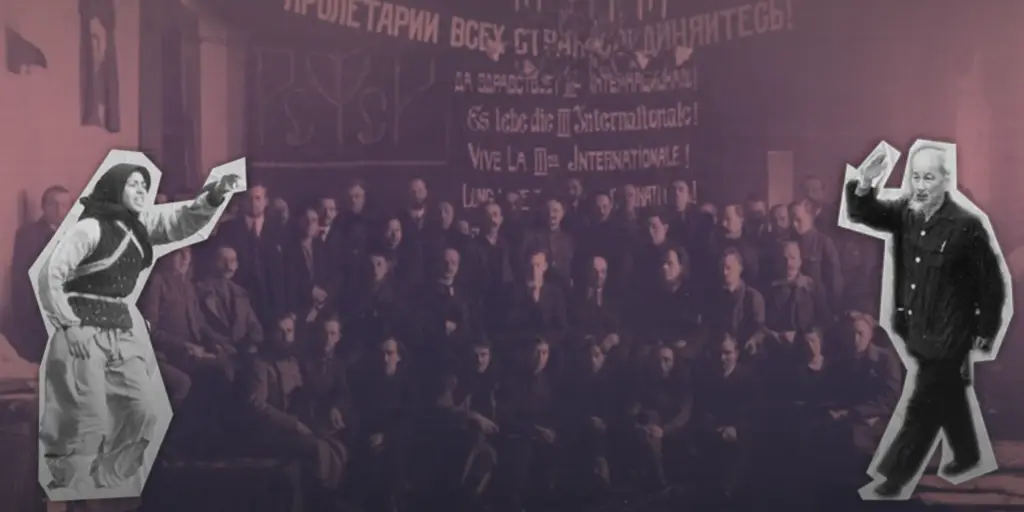
“In times of worsening global systemic crisis and in view of its direct impact on us here, we want to initiate a new debate about internationalist practice and orientation here in Germany. We ask ourselves how our claim can be realized in practice that is oriented to the specific circumstances.” – po promotes the conference “A World to Win”, which will take place in Berlin next weekend on the occasion of the 109th anniversary of the October Revolution.
We speak to Ayşe from the League of Communists1in Berlin and Lena from YUNA – Democratic Youth2, which are hosting the conference together with the Academy of Democratic Modernity.
The conference “A World to Win” will take place in Berlin next weekend. Can you give us an insight into what's planned?
Lena:The conference will last a whole day and is divided into three blocks: At the beginning we invited Brigitte Studer, who will present her research on KomIntern. Of course, we will be able to ask questions from the audience to find out together what lessons we can learn from the past. In the second panel, Torkil Lauesen shares his analysis of global capitalism and his perspectives with us. What becomes very exciting, especially with regard to a specific practice in the centers of imperialism.
Ayşe:The panel that follows is an expression of what we are trying to do with the entire conference: we look not only at the history of the imperialist era of capitalism, but also what the meaning of internationalism was in the imperialist crises. What has our internationalist practice been like in Germany in the last few decades and what should future internationalist work look like? On the one hand, we see the imperialist world situation and have many internationalist experiences. If we look at Kurdistan, for example, a change is taking place. Therefore, the concrete analysis that we come to together on the day must also lead to the way our practice looks, so to speak, adapting to it. And we will bring this together on the podium, also from our different experiences and perspectives.
What do you see as the challenge of proletarian or socialist internationalism today?
Lena:What we perhaps first have to say fundamentally about understanding internationalism: Due to globally organized capitalism, we also need an international strategy. There are many problems with this. We have to emphasize the subjective situation, i.e. the situation of the forces we organize: Even if we see that there is an upswing among the socialist forces, we are not as broadly positioned and firmly anchored. It takes a well organized social movement to actually enter international relations with any relevance. Another problem is the separation that we experience as young people, women and workers based on national borders and other boundaries of power.
Ayşe:Yes, I would share many of the things Lena mentioned. I would also add that if you look specifically at the working class, the problem is its extreme heterogeneity. Not only within the global goods and production chain, but even here in the companies in Germany, we see: Okay, there are actually different positions in every company, there are permanent employees, subcontractors, very precarious people who cannot even formulate a common interest in a company. When you look at this across national borders, it's even worse.
In Germany we have the problem that we were actually dealing with a large-scale labor aristocracy. Especially where there is actually a lot of power at work: the people who sit at the expensive systems at BMW and Mercedes and Volkswagen, where a lot of added value is produced in just a few seconds, are of course the people who are most satisfied because there is great protection against dismissal, they get a very good salary and so on and so forth.
Historically in Germany, this meant that for a long time there was no need to fight for one's own subjective interests. In addition, the subjective conditions, i.e. our organization, do not correspond to a fight that is necessary. With the challenge also comes the possibility that, as the social compromise here in Germany and in Europe disappears in a certain way, this class will slowly come into the fight here too. And at the same time there is an ever-increasing ideological standardization of various socialist or left-wing radical organizations. As a result, they are increasingly able to formulate a common goal. And perhaps the development of this socialist movement also corresponds to the development that could lie ahead for the German working class.
In the beginning, the League of Communists made a lot of reference to Torkil Lauesen's program, especially in his definition of the relationship between center and periphery. To what extent is this differentiation still necessary?
Ayşe:This is a very exciting question because there is a lot of debate going on in our country at the moment. And I think many of the comrades who came in with this fresh reading of Torkil Lauesen rightly emphasized solidarity and also the common struggle with the so-called periphery. Likewise, I believe that our understanding of capitalism in the organization has grown from understanding capitalism not as a system in the sense of: “Yes, the workers are poor or something like that,” but rather that it is about the global networking of the struggle of every worker, in which you can actually almost shake hands with the worker in Bangladesh. And that's a really nice thing.
Personally, however, I would now disagree with Torkil Lauesen on many things, because the way in which we have to understand global capitalism and its crisis and, above all, how we have to define ourselves within it, is actually no longer possible with the vocabulary that Torkil Lauesen gives us. I think Torkil Lauesen's analyzes also lead to a certain extent in not being able to recognize his own working class as a revolutionary subject, but only as an extra in a revolution that is supposed to happen elsewhere in the world. This also leads us to a great deal of inactivity. I think solidarity is not enough.
What are the problems in Germany regarding the development of practical, material, international solidarity?
Lena:International solidarity must not be limited to fundraising, providing resources or local participation. In Germany, solidarity movements, for example for Palestine or Kurdistan, are often fragmented. There is a lack of shared perspectives and stronger networking. Internationalism also means connecting problems with politics and the economy in Germany and building an alternative here. Because solidarity that is limited to specific crises can ebb as soon as the situation changes, as is currently evident in Palestine. Instead, it requires an understanding of the issues as part of a shared system.
Ayşe:One thing I would add is this: Personally, it now bothers me when we talk about international solidarity. It is not solidarity, it is a necessity for a struggle to be built in an international chain. So who am I to show solidarity towards other countries? There is a lot more struggle there, a lot more understanding about your own subjective situation. We have to get to the point that it is an international necessity to set the relationship that I find myself in with the working class and the fighting movement around the world. I reject this term: solidarity.
A panel will primarily deal with history. A long time has passed since KomIntern was dissolved and a lot has changed. What is the relevance of looking into history?
Ayşe:I would say that it fundamentally advances our understanding to take a look at KomIntern. Because the KomIntern was not just a platform in which various communists exchanged ideas with each other, but also a foreign instrument of the Soviet Union. The main thing was to continue the revolution of 1917 and ensure its survival. Although national liberation played a role – particularly in colonized countries – it was not central. A lot of space was taken up by the debate as to why the working class in England was pacified and how it could fight together with the colonized working classes.
When we look at the Comintern and its debates, we see that it was actually about the struggle of the respective working classes and not primarily about national independence or political resistance movements. Today things are different. For a long time our politics was based on the logic of political resistance movements. As a result, our internationalism has also shifted: we support the national liberation of oppressed nations - which is important. At the same time, the view of the overall context of world capitalism has become weaker. This also loses focus on how working classes worldwide relate to the global capitalist class and to each other and what strategies can be derived from this for a common struggle.
But now that we are working more and more with the category of the working class and thinking about class relations, this “muscle” is being strained again. And for this it is absolutely necessary that we start and see that the debates that we necessarily have to have now were already held 100 years ago.
Lena: There is of course an attempt to make us a socialist movement without history. We have to counteract this. And regarding the relationship to the liberation struggles in the colonies: It was also the International in which an understanding of anti-colonialism was concretely strengthened. It is very important to look at what the experience of the strategy of such a broad socialist alliance looked like because we assess that such broad alliances are necessary again today. And what's more, it's just very exciting for us to get to grips with the way KomIntern is organized, because it was simply a concentration of experiences that we rarely find anywhere else in the world, but also specifically in Germany.
Is there anything else you want to tell our readers? The last word is yours.
Lena:You are all cordially invited to Berlin next weekend. As young comrades, but also as comrades
With much more experience, we want to share our reflections and think further. We look forward to the discussion!
Thank you both!
Photo:https://en.wikipedia.org/wiki/Communist_International
- Ayşe organizes herself in the League of Communists, an organization that has existed since 2021. The BDK is concerned with learning from the experiences of past communist organizational attempts, continuing revolutionary traditions and learning from international struggles. In Berlin, the organization Gegenmacht is building reproductive district shops in Neukölln, Wedding and Lichtenberg as well as the first media projects such as
Headwind on. ︎
Lena organizes herself with Yuna - Democratic Youth, a nationwide socialist youth organization that is active in various cities and rural areas. Yuna wants to make a contribution to building a socialist youth movement in Germany and is particularly opposed to rearmament and the ongoing preparations for war.︎
The postA World to Win! – Interview about the conference and the demands of internationalism in the 21st centuryappeared firstLower Class Magazines.