
Politics · Lower Class Magazine · 1970-01-01
Be there where there is fighting – interview with “Time to act!” Alliance about the protests against the AfD party conference in Erfurt
Deutsch (original) · Auto-translated to English
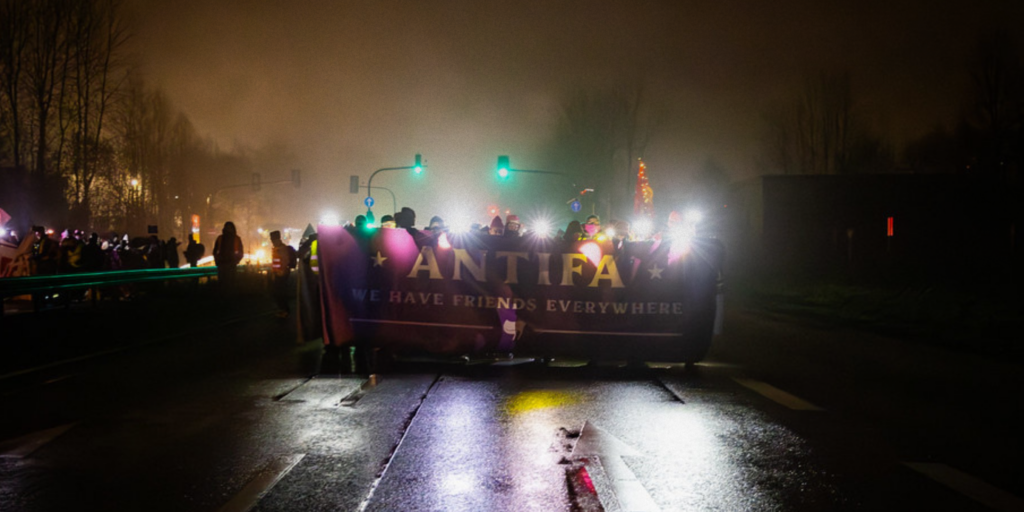
The nationwide AfD party conference is taking place in Erfurt this weekend.
As at previous party congresses, a wide spectrum from civil alliances to revolutionary organizations are calling for the protests.
Even though there have already been clear criticisms of campaigns such as “Oppose” and their alliance and action approach in the past, the usefulness of such forms of protest is now being questioned in its entirety, at least within the communist landscape in Germany.
The “Time to act!” alliance was formed two years ago. Let's talk about the ongoing debate and why they are mobilizing for the protests in Erfurt.
Can you introduce yourself to our readers?
The anti-fascist alliance “Time to act!” was created around the state elections in Thuringia, Saxony and Brandenburg in early autumn two years ago. In 2024 it seemed entirely realistic that the AfD could win one of these elections.
In view of this potentially qualitative development, there was an attempt to bring together fighting anti-fascist structures from different tendencies.
Under the title “Time to act!” A call was made to the anti-fascist movement, which still forms the basis of our alliance today.
In short, it was (and is) an attempt to contribute to the creation of a common front against the growing right-wing and fascist forces in this country, starting from the state of the struggle and the existing structures.
At the same time, we should also learn from the experiences of the anti-fascist movement of the last decades.
We didn't make the big breakthrough in 2024, maybe we were a bit naive back then.
In view of the reactionary developments, we had assessed the willingness to fight together across flow boundaries as higher.
As is well known, there was no AfD state government at that time.
The call gave rise to the “Time to act!” Alliance, an alliance of anti-fascist and revolutionary groups from northern, western and southern Germany as well as from Berlin and Magdeburg.
Two years after the first “time to act” call, legal developments have progressed further and elections are coming up again in the fall, this time in Saxony-Anhalt and Mecklenburg-Western Pomerania.
The advanced legal development will then also be reflected in the bourgeois parliaments. 40 percent and more for the AfD is within the realm of possibility.
The AfD in the parliaments, the right-wing realpolitik of the rest of the bourgeois bloc and the brutalized social discourse are one thing, the other is the rise of militant fascist structures in West Germany as well.
Just to throw some highlights.
What we want to say: The need for a militant anti-fascism that pushes back political opponents and at the same time fights for anti-fascist consciousness is obvious.
As an alliance, we want to do our part to ensure that this fight is carried out in an organized manner.
It's about networking, exchange, learning from each other and of course coordinating practice.
As an alliance, we are still at the beginning of many things.
We bring together different perspectives and experiences.
As an active person there, I will also answer your questions.
However, not all of it is generally representative.
That much should be said first.
There is criticism from various quarters about the mobilization for the AfD party conference in Erfurt?
Why did you decide to work locally?
Yes, we are also among the critics (laughs).
Criticism is not a bad thing, but is useful in the debate in search of the right path.
Our main contradiction to resistance lies in its political conception and the resulting practical proposal: withdrawal of content in favor of a political breadth, the limitation of one's own resources in the hope of... yes, of what actually?
There are plenty of examples from the older and more recent past that such an approach ultimately remains toothless.
We, on the other hand, think that the multifaceted fight against right-wingers and fascists combined with a profound criticism of the normal state of society can be continued.
In addition, many of us come from below, from the immediate, from doing things ourselves.
We can do little with the choreographed campaign, the opaque apparatus behind it and the impossibility of more comprehensive discussions and decision-making.
We cannot and do not want to hide the fact that the Resist Campaign manages to move people and is currently organizing the largest anti-fascist mass protests in the Federal Republic of Germany.
One thing is what the approach is on a conceptual level, but the other is what results from it in practice.
We were in Essen, Riesa and Giessen.
The picture on the street is different from the one painted online and, to some extent, from what the apparatus would like.
We met people who are ready to fight against the fascist threat and are doing so.
Certainly in an inadequate way, but where is that supposed to come from?
Didn't the radical left largely withdraw from this defensive struggle with flags waving in the 10s and keep their experiences to themselves?
Some of the people who are mobilized by resistance are looking for places where the right-wing development can be fought and are open to ideas about how this can happen.
On the street we encountered conviction and seriousness.
To be honest, ignoring this fact would be quixotic.
Maybe that's what happens when, instead of being part of the struggles, you develop anti-fascist strategies primarily at your desk.
We don't know.
In any case, our approach is to be where the fighting is taking place.
Not to be absorbed into the political concept - that's exactly why we're running our own campaign - but to support the people.
For us, it's about doing our part to make it a success; in concrete terms, it's still about preventing a party conference and about offering people a more extensive offer.
An offer of how to fight.
This offer will be needed, especially to prevent thousands from getting stuck in reformist approaches after the end of the large-scale resistance mobilizations or from sitting at home frustrated and thinking: You can't change anything anyway.
You don't just prevent a reactionary mass party by fighting it.
That's right.
But you also prevent them by fighting them.
That will happen in Erfurt.
Certainly inadequate, certainly not crowned with complete success.
But you have to start somewhere, right?
We come from the fight on site, the concrete conflict.
This is and remains necessary.
But the opponents are positioning themselves nationwide, so it's only logical that we too pool our strengths and learn at one point or another.
Such events are also an opportunity on another level: the vast majority of activists come from the generation of grid protests - experiences have to be recreated for us too.
One argument is that a popular front is formed from above, i.e. within the alliance there is cooperation with forces that, like the Greens, are the biggest warmongers.
However, there is no popular front from below.
What do you think about that?
We are aware of the discussions on this and are following them closely, but our approach is different.
As a fighting anti-fascist movement, we think there is potential for building our own front, a united front from below.
Specifically, a pole that actively fights against the fascist danger on different levels and in many social and actual places.
A front based on the recognition that fascism is a form of class rule.
Naturally, this approach takes an anti-militaristic stance; warmongers of all stripes have no place here.
Effective anti-fascism is ultimately in contradiction to the bourgeois state.
Parts of our alliance have good experience with the trade union base, with company structures, with neighborhood initiatives, with self-organizations of people who are directly threatened by the Nazis, with subcultural associations, with resistant young people and much more.
In the end, what is crucial is not membership in this or that organization, but rather the willingness to fight together on an equal footing under the key points outlined above.
To be serious.
You notice: Our approach is not to have a purely theory-based discussion.
We cannot be indifferent to what part of the ruling bloc does.
But: Only time will tell whether there will be a popular front from above and we are certainly not the ones who have a big influence on it.
What we can do is make an offer to everyone who is actually serious about fighting together.
In anti-fascist groups, in anti-fascist alliances, in the united front from below.
This is the only one that can do something lasting against the fascist danger.
This fight is small-scale and not always pleasant due to the social majorities and increasing repression.
But we think there is potential for the idea of anti-fascist action to expand massively and become a factor.
The Correctiv millions simply cannot find any actual answers from the firewall advocates.
What methods do you want to use to give the protests a different character?
Well, we can't let you see the match schedule now (laughs).
Maybe this much: We share the goal of everyone who goes to Erfurt that day.
It's about offering tangible resistance to Höcke and Co.
We are therefore a visible part of the actions and also part of the planned blockades.
At the same time, we try to remain realistic.
The police will ultimately enforce this party conference; we find the illusions fueled by opposition rather unfortunate.
The event cannot be prevented, it will certainly be delayed.
The police have already announced that they will contain and attack the protests.
We think it is right that there is a debate in the anti-fascist movement about not simply accepting these attacks stoically.
The same applies to a possible presence of right-wing forces in Erfurt on the day itself.
The street is a crucial place of social debate, we want to do our part to ensure that it is on the 4th.
July belongs to the anti-fascist movement.
How do you understand social anti-fascism in companies and neighborhoods and what does it need today?
It is often criticized that anti-fascism has no real basis in the classroom, since mobilizations mainly take place and there is little about work and awareness-raising in the companies?
Maybe first something more general: The profound crisis of capitalism is currently shaking bourgeois society and developments are beginning to take over.
At the same time, the prospect of a different, more solidarity-based society is currently on the agenda for very few.
The reaction is on the trigger.
AfD and Co succeed in charging and channeling people's discontent with racism.
We don't need to explain at this point that fascist politics never has the well-being of the working class in mind.
For us, this also means we have to fight for these people.
Of course, in the end it's about a left-wing, anti-capitalist perspective.
But the first step towards this can be to not fall for the right-wingers.
The fact is, this anti-fascist awareness is currently not a given in the class, that's why we have to struggle and fight.
Where people are, where they live, work and spend their free time.
By being there, by addressing the class interests behind the shift to the right.
That, for one thing.
The other is the question of whether we discuss this work against mobilizations like the one in Erfurt.
Or whether that’s exactly what we use them for.
Who is on the street in Erfurt?
Aren't there also thousands of starting points, people of our class, to whom we can give this idea?
Of course that's not enough, but for us it's sometimes discussed in a somewhat simplistic way: there's the mobilized left-wing resistance movement and where the class is completely different.
Without going too far out of the window: an empirical study in Erfurt would not confirm this division.
Again, so that people don't misunderstand us: Erfurt is not the key moment, we just have little use for the absolute rejection of resistance to right-wing meetings and think that there are arguments for a constructive intervention even from the perspective formulated in the question.
Mobilizations like the one in Erfurt are, as we have hopefully made clear enough, part of anti-fascist work.
It is true that a lot of energy has gone into such projects over the last decade and a half.
But a lot of experience has also been gained; several generations of young people and, in recent years, increasingly older people have (re-)politicized themselves and become part of the fighting anti-fascist movement.
The experiences gained must be evaluated and adapted to the new conditions.
Some of the energy and resources must necessarily flow into the “battle for minds” around anti-fascist consciousness.
There isn't much experience on this from the last few decades, so the entire anti-fascist movement has to set out to work on something.
It is absolutely right and important that the company regains a more important role in the left-wing discourse.
Not only because it is a central place for raising awareness, but also because right-wing structures are gaining a foothold there.
The fight against the latter could be a concrete starting point.
The same applies to the resistance to the attacks from above, the announced social robbery and the factory closures.
We should do a lot to ensure that there is a basic anti-fascist consensus here; it won't happen on its own.
These could be concrete ideas, approaches and starting points and that is what the debate has to be about - the abstract necessity is known to everyone.
The question of “How?” the movement hasn't made any progress yet.
What does antifascism need against the background of concrete fascisation today?
Which earlier concepts are still relevant and what needs to change from the classic Antifa work of the past three decades?
Phew, you've just hidden a big term in a question that we would probably be a little more careful with... But let's not get hung up on that, maybe that's a topic for another conversation.
Unfortunately, we don't have a patent solution for the coming period, but we would like to broaden our horizons a little.
Antifascist practice has existed since the fascist movement existed.
If we learn, it will be from the struggles of the last 100 years, not just the last three decades.
The period of the 1920s and 1930s seems particularly interesting to us because fascism became a mass phenomenon there in a profound crisis.
The analyzes of the German anti-fascists after the defeat in 33 are valuable, as are the experiences of the autonomous anti-fascist movement of the 80s and 90s.
There is also a wealth of experience internationally.
The view must be: What worked?
What mistakes were made?
What can be transferable, what adjustments need to be made?
We are not nostalgic, but we respect our own history and think that examining it can be helpful.
Far from copy-and-paste, mystification and know-it-alls.
A ready-made strategy for here and now may be on various desks.
Sorry, we can't resist the swipe.
Our approach is more to approach the questions using the right method.
We learn as we go forward and it's time to take a few steps.
Finally, a little more concrete: Perhaps we are repeating ourselves here, but the direct fight against fascist structures - at all levels and with everything that is necessary for this - as well as an offer to everyone not to fall for the reactionary idea, these are the two essential aspects for us.
This fight must always be linked - all generations agreed on this too - with the perspective of a society beyond capitalist exploitation and oppression.
This character is essential, but it should not be a prerequisite for individual participation.
Is there anything else you would like to tell us?
Mhm, if you're already asking, let's take the opportunity to zoom out a bit at the end.
No matter how depressing the view towards the AfD and Co may sometimes be, the social situation is not.
The circumstances begin to dance.
The multiple crises create a time of chaos in which no social force can be certain of its existence.
There is also scope for action on our part that was not there just a few years ago.
There is no progressive automatism towards a better society, but one thing is certain: without actively pushing back the fascist danger, no revolutionary struggle can be won in the age of late capitalism.
And: On the 6th
Elections will take place in Saxony-Anhalt in September 2026.
The comrades there organize a campaign in advance and invite you to concretely support them in this phase.
There should also be actions after the election.
Thanks for the conversation!
The article Being there where there is fighting – interview with “Time to act!” Alliance about the protests against the AfD party conference in Erfurt appeared first on Lower Class Magazine.
Read the full story at the source →
Source: Lower Class Magazine