
Germany · Lower Class Magazine · 1970-01-01
The turning point is becoming digital
Deutsch (original) · Auto-translated to English
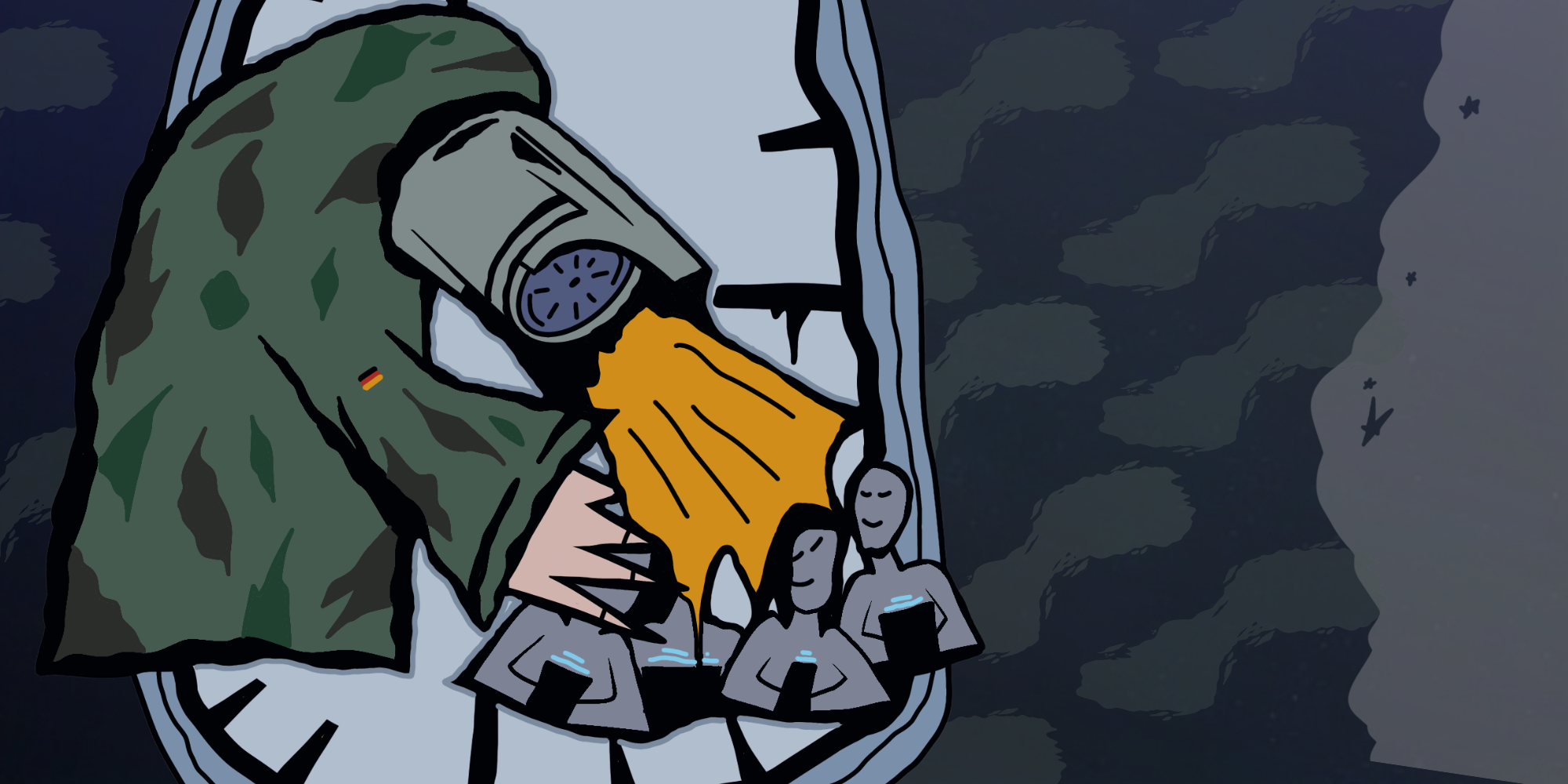
The Esc-It collective about states and their surveillance In recent years, technical infrastructure for monitoring individuals and society as a whole has been expanded in full view of everyone.
Where fundamental rights still stand in the way, the legal foundations are pushed through parliaments as quickly as possible.
Because under the guise of the “turning point” in Germany, not only the military is being upgraded, but also the police and secret services, who have not only been allowed to hack around since July of this year, but have also been allowed to search live video streams from public cameras and social media for faces.
The status quo is not yet a full-fledged panopticon, but current developments are clearly leading in this direction and are being pushed forward hand in hand by states and right-wing tech companies.
Only a civil society that is sensitized to the social consequences and real threats posed by modern surveillance systems will be able to defend itself against them.
With our contributions we want to participate as a collective.
In addition, however, we aim not to explain issues surrounding surveillance and repression in a technocratic way, but rather to make them accessible from an internationalist and class-conscious perspective.
The current expansion in the Federal Republic of Germany General acceptance in society for the expansion of the military was limited in the Federal Republic from the beginning and despite occasional calls for military “modernization” it always remained cautious.
When it comes to surveillance and control measures, however, the state had significantly more leeway; think of the professional bans of the 1970s and 80s.
But the Snowden revelations marked a break: resistance from civil society and parts of the state itself scandalized the basic ideology of mass surveillance and fought for important protective mechanisms.
As is well known, the 2022 Ukraine War ushered in a new era. 500 billion for the Bundeswehr” adorned the headlines for months.
Anton Hofreiter shouted the names of various weapons systems so often in the Bundestag and talk shows that even the last people with stomach aches finally shouted “Let the Leos go.”
The change in times also reached the battlefield of domestic politics in a similarly aggressive, but less loud way.
Legal hurdles and their loopholes The multiple attempts to officially legitimize data retention - the unrestricted storage of Internet traffic for investigative purposes - by the EU Parliament continue to fail.
However, the executive bodies can easily evade such parliamentary control, for example by purchasing and evaluating huge data sets on the open market from so-called data brokers.
In this way, legal hurdles are avoided until the respective foundations for monitoring are created.
This is clearly shown by the example of the new federal and state police laws, as well as the radical secret service reform, in which the Office for the Protection of the Constitution and the Federal Intelligence Service are to be upgraded to “real” secret services.
Prominent internet activist voices rightly describe these developments as the introduction to the age of automated surveillance.
The danger at train stations in particular is being aggressively promoted to expand AI-supported camera surveillance.
Critics hardly have a say in the debate, and the social consequences of these developments remain deliberately overlooked [1] .
If you have nothing to hide, you don't have to fear anything. What a full-fledged surveillance apparatus is capable of and what it does to the society that suffers from it has been impressively demonstrated in the last century using the example of numerous dictatorships, from the Brigada Político-Social under the Franco regime to the Nazi Gestapo.
Now the USA, with its technically advanced ICE, is showing how these excesses can be overcome in the 21st century.
Century can look concrete and at what rapid speed results can be achieved.
The lack of mass protests against the current Trump administration clearly shows how dangerous chilling effects accompany the authoritarian expansion. “Democratic systems” are based on the principle that state power is limited and controlled.
The argument “Those who have nothing to hide…” reverses this principle: it is no longer the state that has to justify its intervention, but rather the citizens their privacy. “Saying privacy is unimportant because you have nothing to hide is like saying freedom of speech is unimportant because you have nothing to say.” [2] .
When it comes to surveillance from a neoliberal perspective, reference is often made to all-encompassing surveillance states such as China, North Korea, or Iran.
This usually puts the reprisals in their own country into perspective.
Nevertheless, there are now efforts in neoliberal states to keep up in the race to develop the most powerful surveillance instruments.
Nobody intends to build a surveillance state, of course.
Last but not least, in the case of NSU 2.0, we were all able to testify that the authorities concerned are not able to handle the power of these surveillance technologies responsibly.
The misuse of these tools is not an isolated incident, but shows a systemic problem among people who have this power in their hands.
From police officers who search the data of celebrities or private acquaintances in official databases to the Vatican, which had a critical journalist monitored.
Global dimension of the brave new world This column will particularly focus on the global consequences of the growing private-state surveillance complex.
New technology does not arise in a vacuum and not only requires highly qualified engineers, but above all it needs one thing: training facilities.
Because "bureaucratic hurdles" too often paralyze development in the large industrial nations and politicians are reluctant to turn their own electorate into guinea pigs, the industry looks for its training places in places where people don't look too closely: Western Sahara, Uganda, and Palestine, which are occupied by Morocco, are just a few examples of this.
The consequences of these new digital weapons hit people in the global south under dictatorships and other autocratic regimes much faster and harder than here in Germany and the EU.
Because Palantir and Co. find it difficult to test their systems in their entirety on civil society in the global North, these mostly Western companies first sell their systems to states that not only want to test these technologies, but also immediately want to use them as weapons.
The “successes” there subsequently serve as selling points in industrialized nations.
Against surveillance and controls Experience has shown that digital issues, especially surveillance and repression, give many people a feeling of powerlessness.
This is based not only on the extensive possibilities for surveillance, but also on our lack of understanding and ignorance about the background of the technologies we use every day.
Even though there is an extremely active online political scene, especially in German-speaking countries, its reach often remains confined to a limited radius.
Internet politics is an extremely fast-moving international field in which fundamental things can change from one day to the next.
This makes it quite difficult to stay up to date in this area, even for us.
You will always find numerous sources in our texts, especially netzpolitik .org or fragdenstaat.de.
These portals do excellent research work and make an enormously important contribution to internet policy education.
We don't want to and can't do this work twice.
Our job should only be to draw our audience's attention to the relevant topics and to explain why they are relevant to our political work.
As “techies” we find ourselves in a male-dominated domain in which many of us have completed training or studied.
Professional fields reproduce certain narratives and characteristics among colleagues.
“IT people” are often connoted with know-it-alls, arrogance, social incompetence, etc., which of course has a deterrent effect on others and people therefore tend to avoid this field.
These narratives are no coincidence, but more on that in another post.
Ultimately, it is important to us to build a bridge between a widespread deterrence of “technology” and a courageous interest in modern technologies.
We want to lead the discourse on these topics with a self-critical and emancipatory approach so that digital self-defense and empowerment is established as a form of collective responsibility and practice - because we are only safe if everyone is safe. esc-it is a collective that provides digital security content for political activists.
The website https://esc-it.org is intended to serve as a collection of knowledge for active participants and trainers, where current threats, countermeasures and recommendations for “best practices” are documented.
Sources: [1] netzpolitik.org: Showcase into the future of police work [2] netzpolitik.org: Edward Snowden on “I have nothing to hide” The article The turning point is digitizing appeared first on Lower Class Magazine.
Read the full story at the source →
Source: Lower Class Magazine