Germany · Lower Class Magazine · 1970-01-01
The reorientation of the KPÖ - 2nd part of the conversation with Robert Krotzer, KPÖ city councilor in Graz
Deutsch (original) · Auto-translated to English
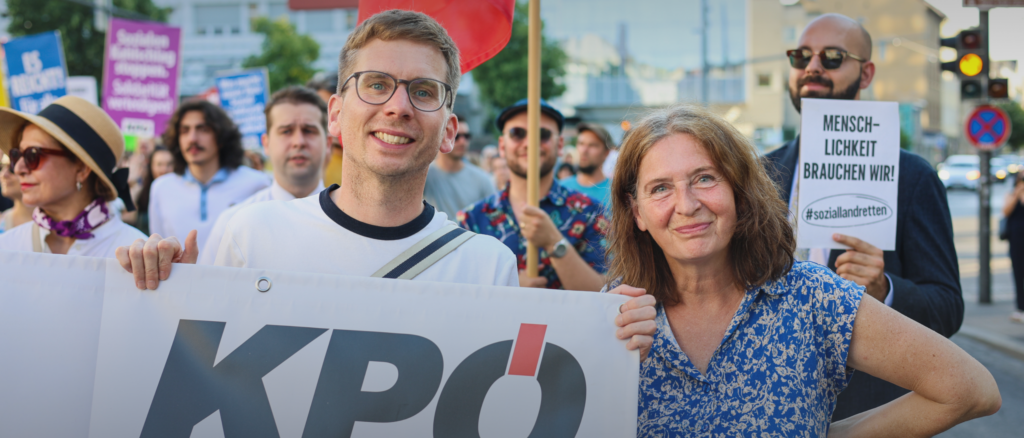
Below we publish the second part of the conversation with Robert Krotzer, who has been a city councilor for the KPÖ Graz since 2017 and is responsible for the areas of health, care, integration and employment.
Before joining the Graz city government, he taught as a teacher in a comprehensive school, was a local councilor of the KPÖ and federal chairman of the Communist Youth of Austria (KJÖ).
Part One: Building Socialism at the Local Level?
Interview Tim Krüger The question of socialist and communist parties' participation in government, be it at the local or state and federal levels, is not entirely uncontroversial even within one's own camp.
Another example is the challenge that the Left party will most likely face in September this year after the election to the Berlin House of Representatives.
In your experience, if you decide to govern as a left-wing party, what should you pay attention to so that you don't fall into a trap?
It is difficult to give advice from a Graz and Austrian perspective.
Graz, like most other Austrian cities, has a proportional government.
This means that the KPÖ has been both a government and opposition party since 1998.
With around 10 percent of the vote, a party automatically has a seat in the city government.
This meant that we were both members of the government and the leading opposition party.
This means that you can gain a lot of experience and implement achievements without the big dilemma of government coalitions, namely that you are in a way trapped.
This means that we not only voted against all the deteriorations that happened under the black-blue city government before our time in power, but also carried out many mobilizations and educated the population. In 2021 we were suddenly in the situation of having to appoint the mayor and form a progressive coalition.
The big difference was that as the Communist Party we had 28 percent, the Greens were the second strongest party in the coalition with 17 percent and the Social Democrats had nine percent.
This balance of power has been crucial to a policy of social progress.
Conversely, I can say that we had previously rejected the possibility of participating in government as a smaller partner several times.
As early as 2003, the KPÖ would have had a majority with the then still powerful SPÖ and the Greens, while the ÖVP was the strongest party.
However, the comrades decided against participating in the government because the Social Democrats did not want to categorically rule out privatization.
From 2015 to 2016 we had a two-year budget partnership with the ÖVP and SPÖ, whereby we as the KPÖ went into the negotiations with a clear plan.
In the interests of the population, we have defined ten points as a red line and set these as conditions.
We posted these conditions publicly and said: Either this will be met or there will be no budget with us.
This worked well over the two years.
For example, the price of the annual public transport ticket was halved, new municipal housing was built and green spaces were created. In 2017 there was a large movement from the population against the construction of a hydroelectric power plant on the Mur on the southern outskirts of Graz.
A project for which thousands of trees in the city were ultimately cut down.
As the KPÖ, we have supported the protest movement from the beginning.
At that time, the ÖVP wanted to demand our consent and would have offered us generous concessions in other areas in return.
But that was out of the question for us and the budget partnership fell through.
In a constellation with bourgeois parties, there will always be sticking points where you have to be able to clearly determine what constitutes the profile of a communist party, what the population elected us for and which positions we must never give up.
That's why these red lines exist for us and will continue to exist in the future: Our positions and attitudes are more important to us than positions and offices.
Because if we were to support certain things to the detriment of people, then we would no longer be able to look the people who have trusted us in the eye.
You said earlier that socialism certainly cannot be achieved at the local level alone.
What role does local politics play in your party's long-term strategy and what do you think about the question of government participation in general?
There is also sometimes vehement rejection and sharp criticism from parts of the extra-parliamentary left of any form of left-wing politics within the bourgeois state apparatus.
I think here you have to differentiate between government participation at the federal level, where as part of a bourgeois coalition you would also become part of the bourgeois government and state apparatus, and the local level.
At the local level, the character of rule is much more indirect; conversely, there is potential for resistance as well as certain scope for creativity in the sense of solidarity politics and an orientation towards the common good.
There is also a very broad wealth of experience from European communities and cities that were and are governed by communist parties - for example in Portugal, Greece or France.
We say we want to shape a city alongside the population, strengthen orientation towards the common good and solidarity.
It makes a difference whether you are responsible for a municipal health department or head a ministry at the federal level.
At the local level you have a much more direct exchange with the population.
As the KPÖ, we have stated that we want to use this project to strengthen self-confidence from below and class consciousness.
We are also criticized by the local elites for this.
They couldn't believe it in 2021 and now the supposed "nightmare" continues for them.
So that they no longer have access to the city's resources and opportunities, that there are no longer one or two bourgeois parties that, in combination with the Chamber of Commerce, the Industrial Association, the real estate companies and a few rich upper middle class families, can do everything between themselves.
That definitely makes a difference and a lot is possible at the local level.
What role does municipal work play in a broader communist strategy?
Here I come back to the fight against powerlessness and resignation that I mentioned earlier.
It's about making it visible that things can be different.
This can become tangible locally in the community and our example is already radiating far beyond Graz.
In Austria, many progressive-thinking people, but also many people who are frustrated and disillusioned with the ruling political caste, perceive our project positively.
It is a glimmer of hope for many people.
Anti-communism is also present in Austria and has not been overcome in Graz either.
But it is precisely here that it is important that people can experience a communist mayor who is completely different from all the other politicians.
We make people's problems our own concerns and that no longer exists in the entire technocratic political and media bubble.
A nurse plays no more of a role than an assembly line worker or a cleaner.
That's why people no longer feel represented there.
In fact, they are not represented either.
Through our work, people outside of Graz are also aware that there is a political force that articulates the interests of the working population.
And it shows that the many supposedly “little people” united together can be stronger than the representatives of big money.
This opens up new intellectual space to discuss what the Communist Party stands for and what “this communism” is actually all about.
We understand that party building can only happen from the bottom up and that has not worked well in recent years.
In addition to Graz, we have been anchored in many Upper Styrian industrial cities for decades and were able to hold our own even during the difficult phase of the 90s and 2000s.
At the same time, we succeeded in making the KPÖ the second strongest force in Salzburg and also in Innsbruck and St.
Pölten was able to move into the local council.
We are now represented in more than half of the Austrian state capitals and in the last election in Vienna the KPÖ achieved a strong four percent and is now represented in all district parliaments.
Why is building the party from the bottom up and anchoring it in the community so important?
Because we as a party can learn an enormous amount from this.
Of course there is knowledge from the books, from the classics, from Marx, Engels and Lenin and the writings based on them.
The time of social isolation in the 90s and 2000s, the niche existence that one had to lead, shaped many parts of the left in their theory and practice.
Things were different in other periods of the workers’ movement.
Daily contact with people was the oxygen of the parties, regardless of whether we look at the KPD in the Weimar Republic, the Communist Party in France after the Second World War or where there are still mass communist parties, such as the PCP in Portugal, the AKEL in Cyprus or the KKE in Greece.
In German-speaking countries, we hardly find a similarly broad base of support for a Communist Party among the population as in Graz.
Therefore, it was and is important for us to find ways and means in which we can play a role in people's everyday lives, so that people can, in the best case, perceive us as representatives of their interests and become active themselves.
It's no longer about a niche existence, about building a trendy bar or organizing an alternative district.
For example, I'm thinking about my living environment: It's a classic working-class district in a small Austrian city.
You don't see any red flags or hardly any left-wing graffiti here, but the Communist Party received 54 percent of the vote here.
You don't see it right away, but it means that we were able to reach the minds and hearts of many people here and in many other parts of the city.
This is our oxygen for the party to grow further.
If we want to expand this across Austria at the local level, then of course we still have a lot of room for improvement.
To do this, for example, we need to further develop company and union work.
Even if we have had initial successes in some areas and have been able to establish ourselves, this does not yet apply to other areas.
Sometimes the KPÖ Graz is viewed from an external left perspective as a kind of finished, completed product.
But we don't see it that way ourselves.
We continue to grow every day and you also have to make sure that you don't fall back again.
Even if we are well positioned at the local level, we still have an incredible amount of work to do, to learn and to develop at the company and union level, for example.
How have you tried to position yourself so far in operational work and beyond local politics?
We have the union left-wing bloc GLB-KPÖ as representation in companies and the Chamber of Labor, as well as a KPÖ working group on health and care, where we organize a special professional group organization.
The large nursing protest movement at the beginning of the year in Graz and Styria against the announced reduction in the nursing key in nursing homes was very important for us.
In general, we try to reach people specifically based on their specific life circumstances, including schoolchildren, students and young workers.
We do this in collaboration with the comrades from the youth association.
At this point it is important to emphasize that the KPÖ does not work alone, but we also try to reach different parts of society through our friendly organizations.
Of course, youth organizations play a large and crucial role.
Above all, the Communist Youth of Austria (KJÖ), but also the Communist Student Association (KSV) and the Young Left played an important supporting role in the election campaign.
A result of 35 percent would not have been possible if we did not have the support of all generations.
We notice that there is a breath of fresh air and an openness to anti-capitalist and Marxist ideas, especially among young people.
I think there is certainly such momentum in Germany too.
A significant number of young people know that capitalism cannot offer them a future worth living.
They are looking for something new and as the Communist Party and communist youth organizations we have a responsibility to this generation.
The search for a better world can also be absorbed by neo-fascist or religious-fundamentalist forces that try to lure young people with their promises of meaning and salvation.
This is why youth work plays such an important and crucial role.
From your statements it is clear that the prerequisite for today's success was the process of reorientation and renewal of the KPÖ after the historic defeat of the socialist and communist movements in the 1990s.
I think it is not wrong to claim that the discussion about a realignment of socialist politics in the 21st century.
century continues.
Can you tell us a little about how this process of reorientation in the KPÖ went?
In the 90s there were different currents in the KPÖ.
Some openly wanted the KPÖ to be dissolved or renamed and socially democratized.
Fortunately, this wing was not able to prevail.
But the disputes remained between this tendency and those who said that we want to renew ourselves but remain a Communist Party, so that Marxism remains a compass and tool for us.
The core of this line was the KPÖ Graz and the KPÖ in Styria.
We have rejected the course towards a transformational left, a pure alliance left.
This course was extremely popular in the 90s and 2000s.
At that time, the end of parties and party-like organizations in general had been proclaimed.
These ideas were also popular in parts of the KPÖ.
When I joined the Communist Youth at the beginning of the 2000s, I sometimes had the feeling that parts of the party wanted to apologize, that their name was KPÖ, that they were even a party, and so on.
Instead of a Marxist orientation, the leadership at the time wanted to go broader politically and, as it was called at the time, create civil society alliances.
With the result that the alliance partners were extremely few and often gone again quickly.
Because, conversely, they did not want to work with a KPÖ that lacked its own compass.
The Styrian KPÖ has taken a different path along the line 'A useful party for everyday life and the major goals of the workers' movement' and has developed a new practice.
This has not proven to be completely wrong over the years and now decades.
We have maintained our Marxist compass and have not slipped into left-wing arbitrariness or career orientation.
We are primarily concerned with our ability to form alliances with the population.
Our most important coalition is always with the population.
Unfortunately, many left-wing parties have forgotten this at some point and are only active in parliamentary operations and committees.
Nevertheless, it took a very long time to implement this orientation at the national level.
One could believe that when the KPÖ was at 20 percent for the first time in 2003 and even the CIA asked the US embassy in Vienna what was going on in Graz, that the federal party would also have said: Well, the way forward can't be that wrong.
But it actually took almost 20 years and only with the penultimate federal party conference of the KPÖ did a general reorientation take place.
Concepts such as the clear focus on social issues, focus on the issue of housing or the salary cap, including criticism of the high salaries of the political caste, which lives far apart from the population.
I am also convinced that a Communist Party must find a language that is understood by the population.
She is not allowed to talk to people in a learned language, but above all she should listen a lot, ask how people are doing and understand where the problem is.
Derived from this, there needs to be a concrete practice where people who want to get involved politically can dock.
It takes creativity and catchy ideas and sometimes completely new ways of reaching people.
And very importantly, it shouldn't be devoid of fun.
Organizing in a Communist Party can and should be fun.
It is very important what you radiate and how you approach people.
A culture of solidarity within your own organization is essential.
If we want a different society, then it is important that we look at each other within our own organization and, despite the need for criticism and the attempt to always improve, we treat each other well.
Another important point is the efficiency of an organization.
So if I spend 80 percent of my time making internal criticisms and holding debates, then only 20 percent are left for exchanges with the population.
Communists often underestimate the fact that we first have to learn ourselves.
And not just from theoretical texts, but also from conversations with people about their living situation, their working conditions, their view of the world, why they come to this or that conclusion.
Among the over 43,000 people who have now voted for us in Graz, a minority has a pronounced Marxist worldview, but still many people share many of our points of view and can do something with our ideas.
It is therefore important for us to combine our theoretical knowledge with knowledge of people's living conditions, to really understand what people's everyday consciousness is like and how we can influence it positively.
One last question about the organization of the KPÖ.
A training text on your website states that the KPÖ is also developing a long-term cadre policy.
Now the term “cadre” is also a highly contested and controversial term.
What do you as the KPÖ understand by this?
There are already very different interpretations and interpretations of it.
In my opinion, you have to be careful not to fetishize the concept of the squad.
Ultimately, what should a Communist Party cadre be?
Someone who is prepared to take on a lot of responsibility.
And of course, this ideally also requires skills and abilities that the comrades have acquired themselves and learned together.
Otherwise it will go down the drain with all the responsibility.
So to put it this way, as the KPÖ Graz and Styria, we actually don't bother with the concept of the squad that much.
There are functions in our party and it is important that they are exercised.
And of course a party must always ensure that as many of its members and sympathizers as possible develop as many skills and abilities as possible and, above all, self-confidence in their actions and in dealing with people.
This ideally creates as many arms, hearts and brains of the party as possible.
You should also make sure that you do not have a wrong understanding of hierarchy.
For us as the Graz KPÖ, it is very important that everyone does everything.
So that Elke as mayor or I as city council wash the coffee cups together, that we serve beer at our parties and events or that we fold up the tables the next day and help clean up.
When we talk about cadres, it is particularly important to note that a cadre must not be too ashamed of any work or even assume that it is better than someone else.
Because from this point on things can only go in the wrong direction.
The article The reorientation of the KPÖ – 2.
Part of the conversation with Robert Krotzer, KPÖ city councilor in Graz first appeared on Lower Class Magazine.
Read the full story at the source →
Source: Lower Class Magazine