
Germany Lower Class Magazine
People seem to be waking up more every day - interview on the protests in Albania
“I'm busy at the moment will write in the evening” my comrade from Tirana writes to me when I ask him for a situation report. He also sends a photo of burning barricades and a street, i.e
Deutsch (original) ·Auto-translated to English
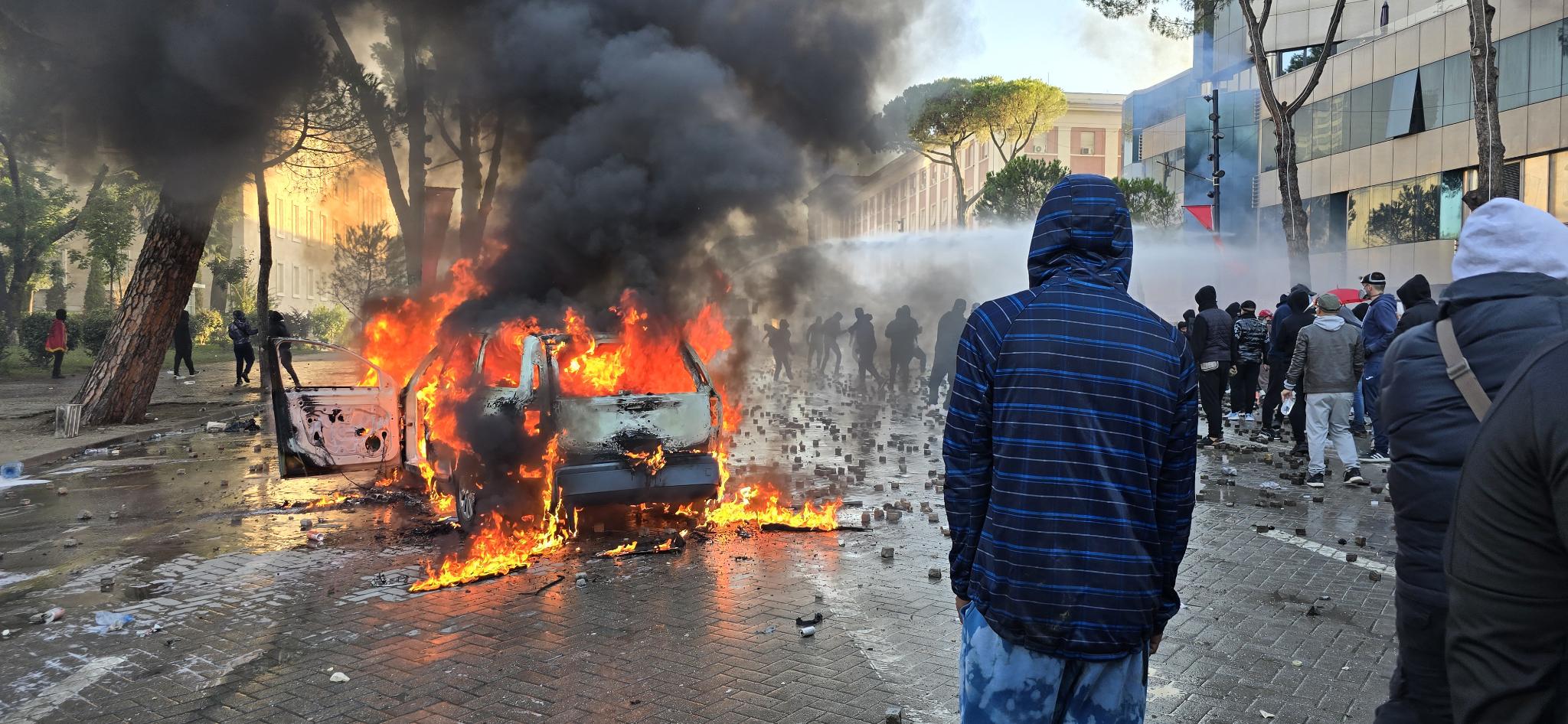
“I’m busy at the moment will write in the evening”my comrade from Tirana writes to me when I ask him for a situation report. He also sends a photo of burning barricades and a street in which more paving stones are flying than Merz has hair on his head. I look at the photo and think to myself, it could just as easily be Lyon, Marseille, Brussels or Madrid. So there are fires again in various places in Europe. But what is going on in Albania?
To get more insight, I ask Sokol from Tirana. Sokol Hazizi is 43 years old and has been working as an architect for over 20 years. The genocide in Gaza led him to join the protests and organize. First for an end to the war in Gaza and the liberation of Palestine and gradually beyond:“I also started to become more interested in our domestic politics because through that conflict I kind of got a broader view of the world and how everything is connected.”
Now he has been part of the current protests since day one.
Thank you Sokol for the opportunity for the interview. Here in Germany the media reports almost exclusively on “brutal violence on the streets of Albania”. Can you give us a quick overview of what's actually going on there now?
It's brutal, it's very bad. It's scary to watch. Now it really started on October 13th. I saw the stones flying through the air in front of me. And the police immediately used water cannons, tear gas and pepper spray.
And then this sheer violence - with batons and kicks against the young people until they lie on the ground. It is violence in every form. And what strikes me most compared to other riots I've seen in Europe is how unprofessional the whole thing was. It was chaotic, the police were very disorganized and acted very brutally against the young people. And then, after the first clashes ended, the police were present everywhere on the streets.
The civilian police are also a problem because their actions are incomprehensible. They don't wear badges. They do not disclose which unit they belong to. They just attack or tell people to disperse and then start hitting them.
And it's not just about violence, but also about intimidation. What they're already doing is basically a curfew, it's not an official curfew, but you know that if you go out at night, police or plainclothes officers will track you down, beat you up, probably take you to the police station, and then you'll stay there at least overnight. These aren't things I make up. These are reports, especially from young people.
And also in a seemingly small way: When I took my child to kindergarten and was on the way back home, I saw dozens of police officers in front of the Partizani High School who were supposed to make sure that the students couldn't leave the building to join the protests. And that was around nine in the morning. But I think that benefited the young people because they saw the police officers stationed there and then went straight to the main square to demonstrate.
Who is actually on the street? Who is behind the Flamingo protests?
Yes, that's a pretty good question, because the flamingo as a symbol wasn't created consciously here. The flamingo was a symbol that emerged in the early days - a symbol that embodies the fight for nature and the fight for the preservation of protected areas, namely thatArea Vjosa-Narta, where the Kushner resort
I would also say that I am part of the movement. But it's not like The Flamingos is a fixed group. Our only belief was that this government must go. She's done enough damage, she's ruined enough, and it's time for a big change. And I can tell you: Even though I'm on the left myself, many of the people there were right-wing or apolitical; They were people of different religions and from the most diverse population groups in Albania.
The origins were the protests regarding the nature reserve, and I'm now reading in the newspapers here that it's about a change of government. Is that true, or is there more to the protests now?
Law 21-24 (The law that allows the development of the nature reserve for the benefit of large investors, editor's note),
The point has now come where the fight is taking on much larger proportions than originally.
The images circulating on the Internet could just as easily come from France, Spain or Italy. Do you see a connection to other protests that are currently taking place?
It's funny you mention that because just yesterday I saw a video and at first I thought it was some main street in France or something. And when I looked at it a second time later, I realized that it was our main street here in Tirana. So yes, there is probably a pattern.
There is something going on that is connected. I think this is something of a global reaction to this type of government that is now spreading across the Western world. So suddenly, during this second term of Trump, we are seeing a shift towards authoritarianism throughout the Western world - also known as the "free world", which is quite ironic to say the least.
We are at a point where politics is no longer just local. Because of globalization, we have a globalized political landscape. And the reaction to this is also globalized, because our students here have peers in other countries, they communicate with each other and exchange experiences. So I think that the struggle is also becoming more globalized in some ways. And one must not forget that the Albanian diaspora plays a major role in this. We either get information on the Internet or we absorb this influence through the diaspora. Because every time they communicate with us, they tell us what is going on in France, in Spain and in Germany, how people react and what the interaction between the population and the government there is. So yes, you could say that we are influenced in some way in this matter.
But I would say that this is also a two-way influence. Because when the flamingo protests began, there were actions in Italy in which reference was made to the flamingo protests and a large part of a protected area in Sardinia was to be saved.
And now there is another example in Puglia, Ostuni (Italy). The people there also relate to the movement here. So yes, you could say that we have influenced to some extent the movements that have taken place in Italy.
So this highlights the fact that everything is connected, whether we want it to be or not. Because this globalization of politics, this globalization of information, has effects in all countries.
Will these protests get bigger? I mean, they've gotten bigger. We protested peacefully for 135 days. Then there were isolated clashes with police as people gathered around the Parliament building as laws were being passed that we as a people opposed, and yet they continued to be passed.
So yes, I think the protesters are determined, insisting on their demands and trying every possible form of protest to be heard.
So you can see that something like a ritual has developed: every day before the clashes, when both sides line up in front of the Ministry of Education, older people come in front of the riot police, talk to them and try to reason with them. These are very emotional conversations and we have seen many police officers moved to tears during these speeches, but after that the violence continues as usual. And every day it gets worse.
What else would you like to tell our readers?
I would like to leave the following message to your readers: most Albanians are really looking forward to joining the European Union. And the reason for this joy about joining the European Union is that most Albanians have already been abroad in Europe - in Italy, in France or wherever.
We know what it's like to live in Europe, to be part of Europe. We know the benefits that membership of the European Union could offer us. But what's happening now is that we're being offered a very bad deal. EU Commissioner von der Leyen came here a few weeks ago - I would say in the middle of the hottest phase of the peaceful protests, and she had the audacity to hold a press conference with our Prime Minister Edi Rama, where she praised the implementation of the reforms that the population is against in the streets. And it is suggested to us that this agreement is for us.
This is not how we want to be admitted to the European Union. These deals would have to be made with the Albanian population. But it feels as if Rama is making deals with Europe behind closed doors. Basically, he's granting them favors just to somehow put Albania on the European map - under a strange condition. There has actually been talk that we might be admitted to the European Union, but under a special condition, not as a full member and so on. So yes, we will gladly sacrifice our EU membership so that our voices are heard here in Albania and there is change. Because what this dictator is doing doesn't correspond to the European spirit, does it? Or is that the European way? If that's the European way, then it's not for us. Then you can keep them and take Rama with you. We want real democracy here.
The postPeople seem to be waking up more every day - interview on the protests in Albaniaappeared firstLower Class Magazines.