Germany · Lower Class Magazine · 1970-01-01
The Ceuta case – A blueprint for European isolation propaganda
Deutsch (original) · Auto-translated to English
They will come, the day is not far, From the neglected cities And at night, in London and Bern, they will tear us from our beds of love.
We will wake up, as always too late, When they stand in the doorway, To see, paling, the sharpest kitchen utensil In their hands. …Europe's army on the coast stands firm, Defending the empires of the rich, Up to the eyes in the dune sand, Up to the mountains of corpses.
Europe's armies haven't fired yet.
But what happened on the last days of July 2026 in the Spanish exclave of Ceuta on the northern tip of Morocco comes very close to this dystopian scenario from the song “They will come,” which the left-wing musician Hans-Eckardt Wenzel and the author Steffen Mensching (both from GDR) wrote back in 1990.
Heavily armed soldiers on the beach and “mountains of corpses” – at least we’ve come so far!
It is estimated that more than 100 people drowned when, in the last days of July 2026, tens of thousands of desperate people tried to swim the almost six kilometer long stretch from Morocco to Ceuta in order to bypass the border on the mainland, which was secured with high fences, barbed wire and sensors.
They were mostly young men, but also women and children.
They all risked their lives to escape hardship and misery in Morocco and other African countries and to make their dream of Europe come true, of a humane life.
Hysteria immediately broke out in the EU states, but not because of the shockingly high number of refugees who drowned.
The political class in the European metropolises went berserk in the face of the news and images from Ceuta - as if the day had come that Wenzel and Mensching had prophesied almost four decades ago, the day on which the poor and exploited would no longer ask and beg, but would take by force what was due to them, as the song says: They silently show us the bills for the bill that we cheated them out of and sleep in front of our garage door in ceiling castles and Camping.
The chair placed in front of the door for them, they will smash it with a grin.
They finally get the bread for the world without asking, asking.
EU Commission President Ursula von der Leyen fumed: “The pictures from Ceuta are unacceptable.” One cannot allow “someone to come to the EU without adhering to our rules”.
The “dangerous border crossings” must stop “immediately”.
Italy's proto-fascist Prime Minister Giorgia Meloni spoke of "shocking" images, said: "Italy will not stand idly by" and called for Spain to be excluded from the Schengen system.
The right-wing Czech Prime Minister Andrej Babiš joined the call, complaining about Madrid's “scandalous” migration policy.
Here's a little digression: In the last few days, a thesis has been debated that is not without a certain degree of plausibility.
This states that a geopolitical alliance of the USA, Israel and Morocco staged or controlled the spontaneous migration of migrants to Ceuta.
The aim would therefore be to divide the left-wing, anti-Israel government and the EU.
The German corporate media and public broadcasters immediately condemned this theory as a conspiracy theory.
And the ARD journalist Georg Restle was banned from the assembled press because he had shared a post in which this theory was advocated.
But this article is not about the possible triggers of the spontaneous migration movement, but about what they triggered at home and abroad.
So further in the text: The CSU man Manfred Weber, head of the conservatives in the EU Parliament, demanded that Spain “immediately ensure order”.
The border protection organization Frontex must “take command on site” if Spanish Prime Minister Pedro Sánchez “is not able to control the situation”.
France is tightening its border controls with Spain.
French President Emmanuel Macron pledged support to Spain.
Lithuania's Foreign Minister Kęstutis Budrys called the situation in Ceuta a "wake-up call for Europe" and wrote on social media: "Europe's security begins at its external borders." Polish Prime Minister Donald Tusk called for Ceuta's border to be secured militarily and asylum procedures to be tightened.
Madrid should follow the Polish approach on the border with Belarus (for your information: Poland built a high wall there reinforced with barbed wire, border troops are hunting for refugees, dozens of migrants have already died of hypothermia, hunger and exhaustion in the swampy border area).
This is just a sample of the political reactions to the events in Ceuta.
Needless to say, not a single government even thought about accepting the migrants who had reached Ceuta, granting them asylum and dispersing them among the EU countries.
Completely unthinkable!
The absurd hysteria demonstrated once again that the Nobel Peace Prize winner EU now has practically no scruples when it comes to sealing off “Fortress Europe” from the have-nots from the African continent who supposedly threaten “our” prosperity and internal peace.
The reactions of the EU states also illustrated once again the moral depravity and mendacity of the European bourgeoisie, who do not care at all about the fate of the underdogs outside European borders.
In any case, hardly a word is said about the people who drown while fleeing in the Mediterranean - this year, according to estimates, there have already been around 1,000.
If the media brings relevant news, then at most it will only be in the news columns.
The hype surrounding the events in Ceuta appears completely grotesque when you look at how modest the German public's reactions to the entry into force of the Common Asylum System of Europe (CEAS) on December 12th.
June was canceled.
This event, which had a drastic impact on European asylum policy, was virtually ignored, was at most dutifully reported on by the corporate media and was widely interpreted as a long-overdue agreement between the EU states on common rules.
Criticism of the CEAS only came from the “usual suspects”, i.e. Pro Asyl, refugee councils, Diakonie, Caritas et cetera.
As Pro Asyl aptly stated, this “reform” was the “historic low point for refugee protection in Europe”.
For example, refugees can now be held in closed camps at the external borders while they go through fast-track procedures in which there can no longer be any question of careful examination and constitutional standards.
For von der Leyen and the majority of EU heads of government, the events in Ceuta were a good opportunity to do everything they could to defame Spain and its prime minister, whose migration policy they consider to be too liberal.
Before it was even clear what had triggered the spontaneous hike, 22 EU states and heads of government, including Chancellor Friedrich Merz (CDU), accused Spain in an open letter.
In the letter, they described the “legalization of a very large number of irregular migrants” in Spain as a false incentive to make their way to Europe.
The background: The Sánchez government recently gave several hundred thousand people in the country without papers the opportunity to legalize their residence.
This includes the many harvest workers who supply European supermarkets with fruit and vegetables.
However, the Spanish government proved in Ceuta that its migration policy is not that liberal in an “emergency case”.
Spanish Defense Minister Margarita Robles said the army had “3,000 soldiers ready” to support the Civil Guard, police and the population in Ceuta.
Media reported that soldiers from the Spanish army blocked access to the beach in Ceuta for migrants and did not allow them to land.
A little later, the Spanish newspaper El País said: “Spanish soldiers are helping the young people return to their country.”
What was meant was that soldiers armed with pistols and batons threatened the refugees in order to force them to turn around.
The people who had made it to Ceuta were also coerced into returning to Morocco using perfidious means.
The city closed all bars, restaurants and shops across the board, and locals refused to sell food and drinking water.
Spain sent soldiers and heavy military vehicles to cordon off the port promenades, borders and supermarkets.
Anyone who tried to apply for asylum was made clear that it was hopeless because Morocco is classified as a safe country of origin under the new EU asylum rules.
Of course, the German Interior Minister Alexander Dobrindt (CSU) also insisted on simulating a sharp reaction to the events.
He announced that internal border controls would be extended beyond September.
Madrid must “immediately” ensure that European external border protection is guaranteed and that “illegally entered migrants” are returned to Morocco.
The successes in pushing back “illegal migration” must be maintained and expanded. “We are continuing the migration transition with control, course and a clear edge,” said the minister.
Ultimately, all of these reactions from European politicians were not surprising and in the end, despite all the differences, there was agreement again, according to the motto “pack fights, pack gets along”.
At an emergency meeting on the 4th
In August, the sharp criticism of Madrid was withdrawn, instead Spain's crisis management in cooperation with Morocco was praised and it was noted that none of the around 72,000 refugees who made it to Ceuta had reached the Schengen area, i.e. mainland Europe.
Everything was fine again, “Fortress Europe” had held up.
Ultimately, the German media's reporting on the events is significantly more consequential and damaging, but at the same time also more revealing than the politicians' reactions to the events in the exclave, although the sober word "reporting" is not entirely appropriate here.
The German corporate media, especially the fascist tabloid Bild, created a hype about the “rush of migrants” that far exceeded the hysteria and agitation of EU politicians and had no other purpose than to spread fear and panic and provoke memories of the “flow of refugees” of 2015/16. “Migrants overrun Spanish port city” was a lurid statement in Bild, “Thousands of migrants are storming Ceuta – Now the military is coming” or “Ceuta: Apparently radical Islamists among migrants who have arrived”.
The texts online and in the printed editions were repeatedly illustrated with images of hundreds of young men rushing towards the camera.
In his podcast, Bild's deputy editor-in-chief Paul Ronzheimer interviewed “migration researcher” Gerhard Knaus, who is one of the key figures behind Germany's restrictive asylum policy.
The Bild man did not hesitate to ask Knaus what he had to say to the many people “who remember the refugee crisis of 2015 and its consequences.” “If we have learned anything in the last ten years, it is the power of these images and the political power of these fears that we have to respond to.
“Not with phrases, but with action,” was Knaus’ answer.
Unlike back then, there was “no threat of a new flow of refugees,” he added: “But the pictures are frightening.” It couldn't be more perfidious!
The pictures don't scare you - the pictures scare you and do it very specifically.
The fact that Knaus made such a statement to a representative of the Bild newspaper, which is at the forefront of this scaremongering, can only be described as grotesque.
The daily newspaper Junge Welt summed up the whole fuss like this: "Bild, that's the business in this media gutter, stirs up fear and disgust for strangers who, so the story goes, threaten our prosperity." And further: “The threat that is more than just insinuated here reverses the true situation.
People are risking their lives out of sheer desperation to reach Spanish territory in Africa in the hope of receiving asylum in the EU.” As usual, Bild didn't shy away from distortions and bold lies. “The migrants could now come to Germany so easily,” headlined the dirty paper at a time when most of them had already returned to Morocco, adding that “the majority” of the refugees “might reach mainland Europe sooner or later.”
That's exactly what AfD leader Alice Weidel had claimed the day before: "Their destination is probably Germany," she claimed without any evidence about the migrants in Ceuta.
Bild made the following calculation as “proof” for its claim: “From Gibraltar in southern Spain to Stuttgart it is less than 2,700 kilometers.
The journey takes around 22 hours by car.
With buses via Madrid and Paris it takes at least 40 hours.” However, the migrants were not in Gibraltar, which is known to be on the southern tip of Spain.
You can only get there from Ceuta by boat or helicopter, and there are strict controls when you leave.
And as I said, the Spanish authorities as well as those of the EU have long since assured that not a single one of the refugees who made it to the exclave made it to the Spanish mainland.
The events shortly before the important elections in Berlin and eastern German states were probably very welcome for many people, as they were another great opportunity for the AfD.
Of course, the party's federal spokeswoman, Alice Weidel, was among the first to comment at the end of July.
“It must be ensured as quickly as possible that those who invaded Ceuta illegally are deported directly,” she said in a statement: “They must never enter the European continent.” The events of the past few days have once again demonstrated one thing with great clarity: the Bild newspaper and its journalistic environment, the Springer publishing house as a whole, are among the major drivers of legal developments in Germany.
They are the most powerful supporters of the AfD and if a politician from this party is elected prime minister in Saxony-Anhalt, they will have achieved their milestone.
Given such prospects, one could almost long for the fulfillment of the dystopia that Wenzel and Mensching imagine in their song “They will come” quoted at the beginning.
Here are some more verses from it: They will use long steel rods to break up the shiny cupboards in order to build children's coffins for the next case of cholera.
They drag the dead babies with them and all their infections and open the doors of the television stations with a mighty kick.
Give us, cry out, the images that occupied our dreams.
Their eyes are full, their bellies are empty.
We were the very last ones.
They were called barbarians on the radio, criminals, animals, seducers, they set the galleries on fire, with works by Goya and Dürer.
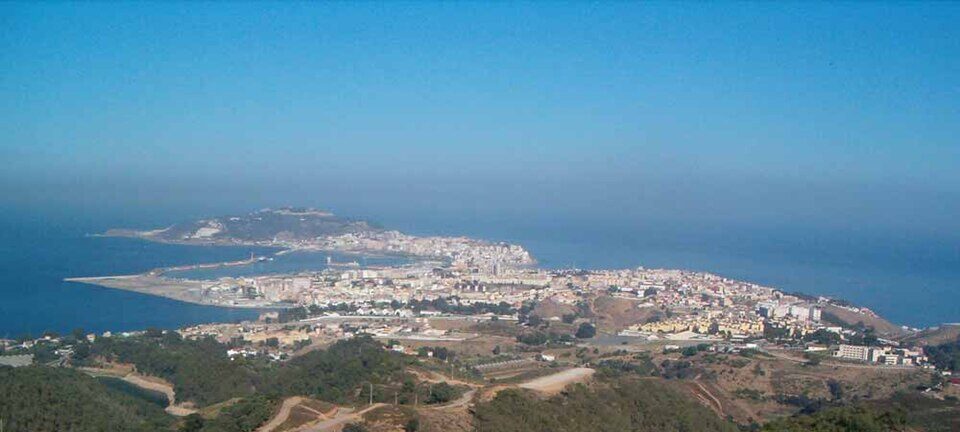
Photo: https://commons.wikimedia.org The post The Ceuta Cause – A Blueprint for European Isolation Propaganda appeared first on Lower Class Magazine.
Read the full story at the source →
Source: Lower Class Magazine