
Anti-fascism Jacobin
South Africa’s ANC Is Collapsing. The Far Right Is Rising.
The African National Congress is losing its working-class base. The beneficiaries: parties of the Right. South Africa’s local elections expose the fallout of three decades of economic failure — and th
English (original) ·Read in Deutsch ⇄
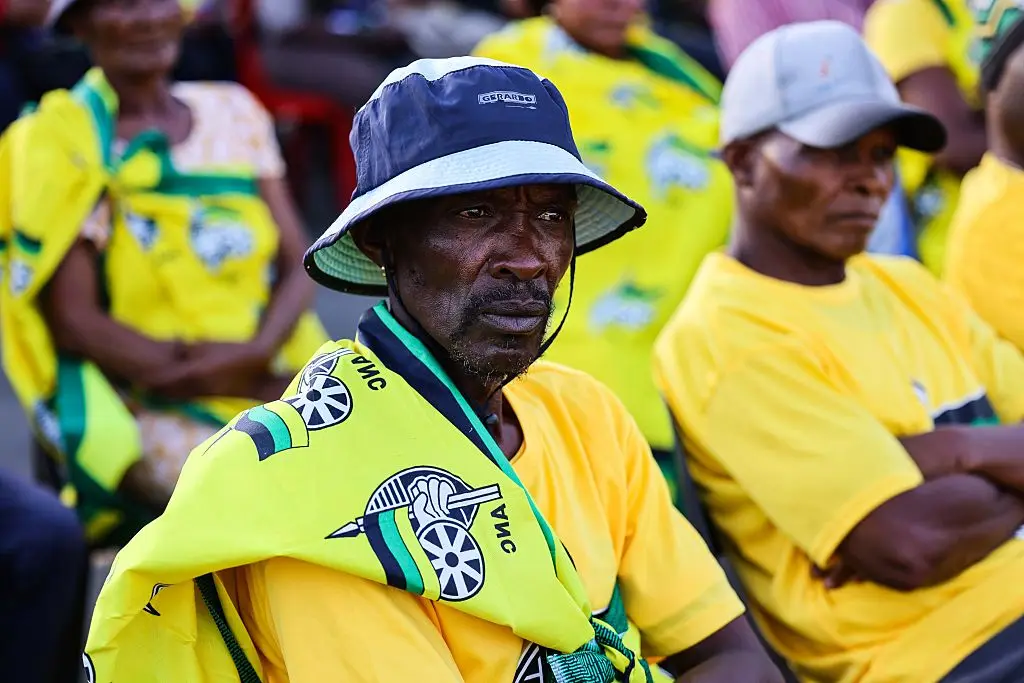
While the global left celebrates the recent successes of the Workers’ Party in Brazil and the Democratic Socialists of America in the United States, the African National Congress (ANC) has suffered a historic collapse in South Africa’s November 4 local government elections. After three decades of mass unemployment, deepening inequality, corruption, and economic policies that have failed the working class, the former liberation movement is losing its political authority. The principal beneficiaries of the ANC’s electoral rout are parties of the Right, including an increasingly powerful far right that has built its project around aggressive and often violent xenophobia.
With more than 70 percent of votes counted, the ANC’s national share of the vote fell to around 32 percent. The ANC is not expected to retain an outright majority in any major city, and the center-right Democratic Alliance (DA), historically the principal party of the white liberal establishment, is making substantial gains and is projected to become the largest party in most of South Africa’s big cities. Former President Jacob Zuma’s Zulu nationalist uMkhonto weSizwe Party (MKP) is on track to be the largest party in Durban. The far-right ActionSA has made a strong showing in Johannesburg and Pretoria and is likely to be the second-largest party in Pretoria, with the ANC in third place.
The central question is not only why the ANC has lost so much support. It is why the suffering and anger of the working class have failed to produce a powerful democratic socialist alternative, and why the Right has been so successful in presenting itself as the answer to a crisis created by the existing economic and political order.
The ANC’s Historic Failure
The defeat of apartheid was an extraordinary achievement. We won universal suffrage, democratic institutions, constitutional rights, and legal protections for workers. Those victories were won through generations of sacrifice and collective struggle, and they must be defended. But political apartheid was defeated while the economic structures inherited from apartheid remained largely intact.
The liberation movement historically brought together different classes and social groups united against racial oppression. That unity was indispensable to apartheid’s defeat. But national identity does not abolish class contradictions. Instead of using democracy to transform the ownership and control of the economy in the interests of the majority, the ANC increasingly became an instrument through which a new elite could enter and benefit from the existing economic order.
The ownership and control of the commanding heights of the economy were never fundamentally transformed. Land ownership remained extraordinarily unequal. The former Bantustans, created as reservoirs of cheap African labor, were never provided with the productive economic foundations needed to overcome their inherited poverty.
Over time, the ANC came to treat the advancement of an emerging black capitalist class as evidence of economic transformation. A narrow layer of businesspeople accumulated wealth, in some cases extraordinary wealth, through access to political power, state contracts, and opportunities created by the Black Economic Empowerment policy, while the overwhelming majority remained excluded from meaningful economic power.
The ANC’s adoption of neoliberal economic policies in the 1990s deepened this problem. The language of economic liberation gave way to investor confidence, competitiveness, and market reform. Brutal austerity, liberalization, and dependence on private investment displaced the redistributive ambitions of the liberation struggle.
We were repeatedly told that economic growth would eventually deliver employment and redistribution. We were also told that redistribution must wait for economic growth and the development of the productive forces. But if redistribution had to wait while productive capacity developed, why did South Africa simultaneously deindustrialize?
We have become what I have described as a “warehouse economy.” We export raw materials and insufficiently processed mineral wealth, allow other countries to manufacture finished products, then import those products for domestic consumption. We export jobs embedded in raw materials and import unemployment embedded in finished goods.
Factories have closed while warehouses have remained open. South Africa continues to extract enormous mineral wealth without developing the productive industries capable of turning that wealth into decent employment on the scale required.
It is a very painful fact that, after decades of mass unemployment and deindustrialization, the poor are now poorer and more numerous than under apartheid. In the second quarter of 2026, South Africa’s official unemployment rate stood at 33.6 percent. Including people who want work but have stopped actively searching, the rate was 43.8 percent. Among young people age fifteen to twenty-four who were in the labor force, unemployment reached 62.8 percent.
This crisis has meant the destruction of hope for millions of people. It has also been accompanied by the weakening of the organized working class. Mass unemployment undermines bargaining power, makes workers afraid to exercise their rights, and encourages casualization and precarious employment. A worker who knows that thousands of unemployed people are desperate for a job is in a much weaker position to resist exploitation.
The crisis has also fragmented the working class itself. Millions of people are unemployed, casually employed, working in the informal economy, or moving between different forms of insecure work. Traditional trade unions organize only a section of this wider class.
The working class cannot be reduced to people fortunate enough to receive a regular pay slip. The unemployed, precarious workers, labor-broker workers, informal workers, women carrying the burden of unpaid care, and young people who have never had secure employment must all be part of the social movement capable of transforming South Africa.
At the same time, the combination of austerity and extreme corruption has resulted in the decay of the state and the collapse of public services. Municipalities have become centers of patronage, political competition over tenders, and the accumulation of private wealth. Water systems collapse, roads deteriorate, sewage flows through communities, and public transport becomes increasingly unreliable. It has become normal for even middle-class areas to go for weeks or even months without water, while the poor live among stinking piles of uncollected refuse.
The crisis is also visible in the ANC’s conception of the state. A developmental state cannot simply outsource development and then claim the credit. It requires public institutions with the capacity to plan, build, maintain infrastructure, and provide services directly.
South Africa has developed a system in which government contracts out essential functions while state capacity deteriorates. The result is an expanding network of contractors, consultants, and intermediaries whose accumulation depends on public expenditure, while the institutions responsible for serving the people become weaker.
The tragic reality is that the ANC’s neoliberal policies have not simply failed to resolve the economic crisis. They have also undermined the credibility of the very idea of democratic transformation, opening the door to right-wing demagoguery.
Corruption and the Destruction of Political Authority
Economic failure has been compounded by the degeneration of political leadership. The ANC once insisted that leadership required exceptional qualities: political understanding, integrity, discipline, courage, humility, service, and sacrifice. Its own document, “Through the Eye of the Needle,” expressed the idea that leadership should be earned through commitment to the people rather than acquired through personal ambition.
Today the competition for leadership largely revolves around factions, access to resources, control of organizational structures, and the distribution of positions. Political office has become a route to private accumulation.
This cannot be understood merely as a series of individual moral failures. It is connected to a political culture in which access to the state and public wealth becomes a route to private economic advancement. Where the public sector is treated as a source of tenders and contracts rather than an instrument for meeting social needs, the distinction between political leadership and business accumulation becomes blurred. The result is a profound loss of moral authority.
When working people see leaders acquiring enormous wealth while unemployment rises, schools deteriorate, hospitals struggle, and the water supply fails, they inevitably begin to lose confidence in the institutions that claim to represent them. The ANC’s electoral collapse is therefore not mysterious. It is the political expression of a much deeper social, economic, and organizational failure.
At the same time, trade unions have been divided, and some have become very corrupt, as corrupt as the ANC. The capacity of unions and community organizations to develop working-class leaders has weakened. Organizations have often concentrated on internal contests or debates between established political figures instead of building the democratic power of ordinary people. Political education, once central to the union movement, has declined. With the exception of Abahlali baseMjondolo, the two-hundred-thousand-strong movement of the urban poor, community organizations have lost much of their former strength, with many collapsing completely.
The Right Advances
A rapidly growing Right has been very successful in redirecting legitimate popular anger away from those responsible for generalized social suffering and toward African and Asian migrants. Fascist organisations such as Operation Dudula and March and March have built movements around violent hostility toward African migrants. In communities devastated by unemployment, crime, and failing services, they offer a simple explanation: foreigners are responsible for the crisis. Political parties have increasingly adopted the same language. Like many centrist parties elsewhere in the world, the ANC made a profound error of political judgment in indulging organized xenophobia rather than opposing it.
The two parties that have surged forward in these elections, ActionSA and the MKP, have both actively supported the xenophobic street thuggery that forced up to 150,000 migrants, including refugees and other documented migrants, from the country in a matter of months.
This right-wing mobilization, which includes fascist elements, does not only target migrants. It increasingly argues that South Africa has too many rights, that the Constitution should be changed to do away with some of these rights, and that strong leaders should be freed from democratic constraints.
The result is a political paradox. South Africa faces one of the most severe crises of unemployment and inequality anywhere in the world, yet the electoral beneficiaries of popular anger are largely forces advocating policies that will deepen inequality as they redirect anger toward vulnerable minorities.
Renewing the Left
The Left is also in crisis. For decades, the South African Communist Party (SACP) presented itself as the socialist component of the ANC-led alliance. Yet it remained politically committed to governments that implemented austerity, privatization, and other neoliberal policies. Its leaders participated in those governments while continuing to speak in the language of socialism and working-class liberation. The contradiction between revolutionary language and participation in the administration of neoliberal capitalism became increasingly difficult to ignore.
This contradiction has never been satisfactorily resolved. Earlier this year, the SACP proposed convening a “Conference of the Left,” inviting organizations including the ANC and Zuma’s MKP, which had been on the streets with the xenophobic mobs. How could a conference claim to unite the Left while including a governing party responsible for decades of neoliberal economic policy and a political formation associated with state capture, ethnic chauvinism, and xenophobia? The independent South African Federation of Trade Unions (SAFTU) considered the invitation carefully and decided not to participate. Other progressive organizations, such as Abahlali baseMjondolo, took similar positions.
Working-class unity is indispensable, but it must be based on principles and a shared program. A Left that abandons its defining commitments in pursuit of alliances with corrupt or reactionary organizations will not resolve the present crisis. It will only deepen it.
Rebuilding Independent Working-Class Power
The answer cannot be to demand that workers and the poor continue supporting political organizations that have repeatedly failed them. Nor can we respond to the advance of the Right with moral denunciations while leaving the underlying conditions of life unchanged.
South Africa needs a new working-class political project rooted in a credible program of economic transformation. But no program, however coherent, will succeed without organized social power. A genuine working-class political alternative must emerge from renewed organization, political education, democratic debate, and collective struggle.
The principles of such a movement cannot be negotiable. It must be independent of employers and the capitalist state, committed to socialism and worker democracy, and resolutely opposed to racism, xenophobia, sexism, patriarchy, and ethnic chauvinism. It must be internationalist in its outlook and rooted in the everyday struggles of workers and poor communities.
Rebuilding working-class power also requires reconnecting workplace struggles with those of communities. Water is a workers’ issue. Electricity is a workers’ issue. Public transport, housing, health care, education, gender-based violence, and the climate crisis are all workers’ issues.
The struggles of an employed factory worker cannot be separated from those of an unemployed young person, a mother trying to feed her children, a shack dweller fighting for water, or a community resisting the destruction of its environment.
The organizations capable of creating a new political alternative will have to emerge from these connected struggles.
South Africa’s democratic transition was a great victory for popular movements across the world. The possibility that its political future could now be shaped increasingly by xenophobic and authoritarian forces should concern everyone committed to democracy, equality, and international solidarity.
This article originally appeared in Jacobin, a democratic socialist magazine publishing long-form essays and analysis on politics, economics, and culture. Subscribe to the print edition for $20 a year.