
World Jacobin
Portland’s Socialists Have Built a Political Machine
While New York City gets much of the media attention, the Democratic Socialists of America chapter in Portland, Oregon, has quietly built a local political powerhouse over the last few years.
English (original) ·Read in Deutsch ⇄
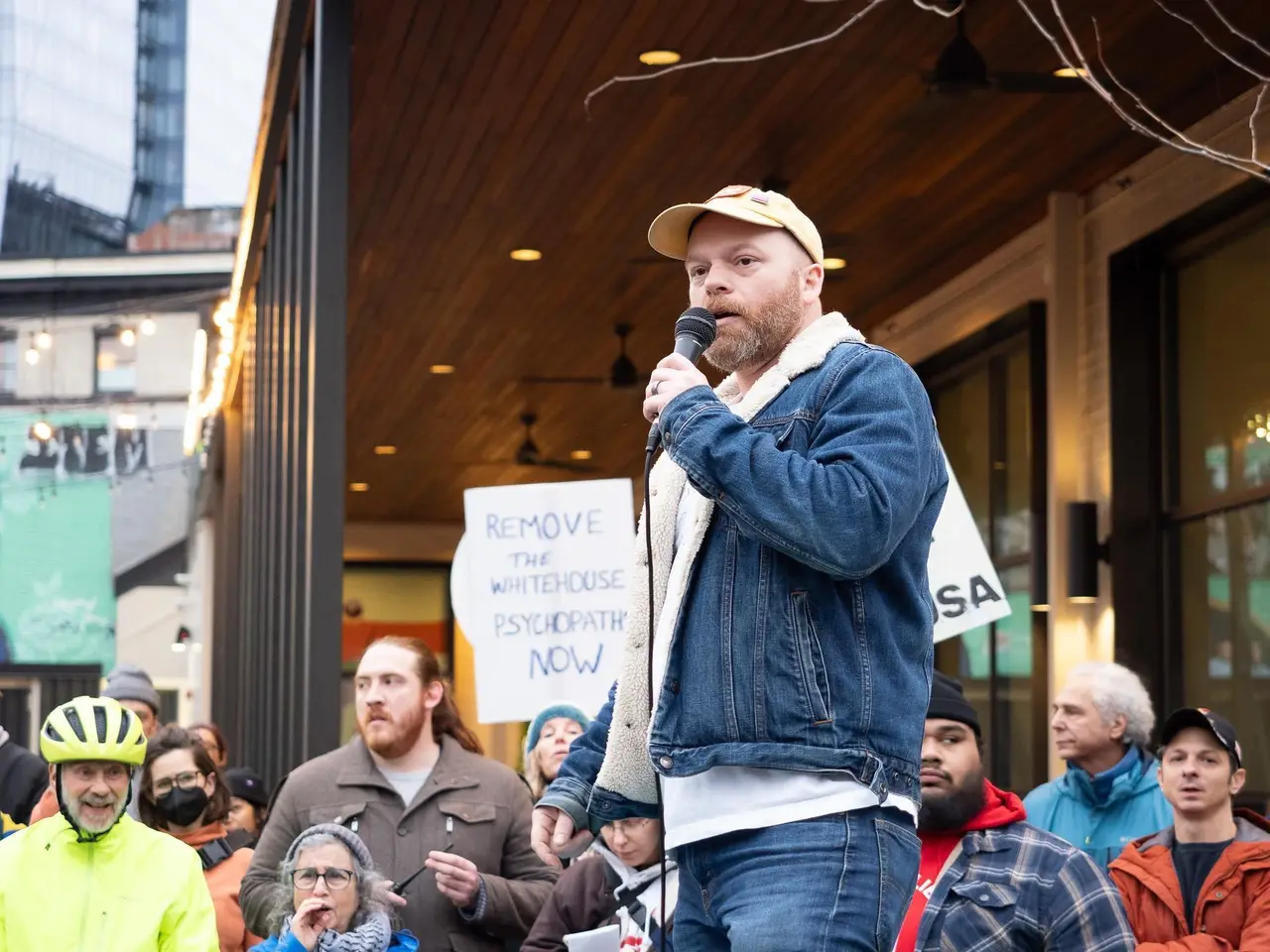
Over the last two years, the Portland, Oregon, chapter of the Democratic Socialists of America (DSA) has developed a reputation for punching far above its city’s weight.
The chapter sits just behind the New York, Los Angeles, and Washington, DC, chapters in terms of size, and roughly one in two hundred Portlanders is a member (compared to about one in 530 New Yorkers). Today one-third of Portland’s city council actively participates in the group’s Socialists in Office Committee (SIOC); this election cycle, the chapter ran candidates for state and county office. Yet for most of the chapter’s history, elections weren’t a focus, and candidates for office were often kept at arm’s length.
“For a significant period where I was involved, a number of people just believed that candidates couldn’t do anything for you,” said Dave Coburn, the chapter’s former Electoral Working Group cochair. “People really only wanted to do things via ballot measure.”
That would start to change with the fallout of Portland’s long-lasting George Floyd protests. The protests supercharged existing frustrations with the city’s political status quo — and created an opening for outsiders to achieve significant electoral victories.
Electoral Reforms Open the Gates
Few American cities experienced 2020 like Portland. For almost a year, the city’s downtown saw sustained demonstrations and an intense response from local and federal law enforcement. The protests and ensuing criticism of the aggressive actions taken by local police hobbled the tenure of moderate Democratic Mayor Ted Wheeler and energized popular calls to reform the city’s commission, its governing body at the time.
In 2022, voters approved Measure 26-228, changing Portland’s legislative structure from four at-large commissioners to a twelve-member city council drawn from four multimember districts elected with ranked-choice voting. Combined with a small donor public financing scheme enacted in 2016, this system significantly lowered the bar for political participation in the 2024 election.
In many ways, the new electoral format catered well to DSA’s strengths. Smaller-district and multimember elections benefited candidates who could mobilize large field operations while also being able to hold a clear lane within a crowded field — unlike in previous elections, candidates would only need 25 percent +1 to win. Similarly, ranked-choice voting allowed candidates to pick up votes from coalition allies, benefiting those with platforms that spoke to a wide range of voters, while the matching funds program helped campaigns critical of the city’s traditional donor class to compete.
These reforms came right as Portland DSA was trying to revitalize itself. The pandemic had seen a sharp downturn in the chapter’s membership, and organizers began looking for opportunities to rebuild their capacity.
One came as part of a push to establish universal pre-K that the chapter had initiated in mid-2019 with the goal of getting a measure on the November 2020 ballot. A month after the Universal Pre-School Now! (UP Now!) coalition submitted the proposed language for the measure, pandemic restrictions were enacted in Oregon, hampering signature collection. Simultaneously, UP Now! faced competition from a more moderate universal pre-K project at the county level called Pre-School 4 All (P4A).
That summer, the chapter threw itself into building support for the campaign and managed to collect more than 32,000 signatures. Its success facilitated a merger with an updated P4A in order to avoid both proposals appearing on the ballot and potentially failing due to voter confusion. The unified measure passed overwhelmingly and marked one of Portland DSA’s first real electoral wins. Both of the chapter’s future 2024 city council candidates, Mitch Green and Tiffany Koyama Lane, were involved in the effort.
“It was an interesting test of our organizing ability,” said Green. “We were able to pass that, and that built the foundations for our city council races.”
The chapter also saw large success during the 2021 Nabisco strike and the 2023 Portland teachers’ strike, when its members organized fundraisers, held rallies supporting strikers, and walked picket lines. Both periods brought in new members and reactivated existing ones. The work also surprisingly helped convince the chapter to take another look at running candidates, according to Coburn.
“Having some elected officials weigh in on the side of the strikers proved to be more impactful to the strikers than many of us thought it would be and also ended up sometimes being more impactful on negotiations than many of us thought it would be,” he said.
Entering City Council
By the time candidates began announcing their campaigns in 2024 under the new system, Portland DSA was well positioned to run. It had proven it could manage a strong ground game, had built a name for itself among the city’s progressive ecosystem, and, importantly, felt that it could recruit strong candidates.
Still, worried about potentially overextending itself, the chapter only endorsed two candidates, Green and Koyama Lane. However, when the dust settled, not only had both won, but so had two more DSA-aligned candidates who hadn’t received the chapter’s endorsement.
“I think we were concerned about endorsing other folks who were progressive but were not close with DSA,” said Carolyn Roderique, the current cochair of Portland DSA. “But the election showed that we had so much more of a lane than we expected.”
Within a single cycle, DSA had gone from no representation in city politics to holding a third of the council. Two additional progressives were also elected, forming a larger progressive bloc nicknamed “Peacock.”
“It’s short for progressive caucus (P-Cauc),” explained Green. “And then, also, peacocks are an ostentatious bird.”
Following the election, Portland DSA created a Socialists in Office Committee in order to coordinate with councilors and facilitate an ongoing dialogue.
“There have been a ton of benefits [to having the SIOC],” said Koyama Lane, who was up for reelection this year. “Just having that time where we can share what’s upcoming, give a heads-up . . . and then also for them to bring back questions to us too.”
The SIOC has also helped the chapter’s candidates cement their status as a bloc, which has helped amplify their power within city council and during elections. In addition to Koyama Lane, Green, and Angelita Morillo — one of the DSA-aligned candidates who did not receive the chapter’s endorsement in 2024 — also faced reelection this year. All three won.
“[Being part of the SIOC] made it so like me, Angelita, and Mitch — people [could] just donate to all three of us at the same time through DSA,” said Koyama Lane.
Increasing Political Success
As members of the city’s legislative branch, DSA’s city councilors have focused on oversight and accountability.
“We’ve got councilors grilling the city administrator on why [they] didn’t disclose a bunch of housing money and why [they are] spending that on sweeps instead of rental assistance and that sort of thing,” said Green. “We’ve been fighting very publicly and racking up wins.”
Those victories — including banning AI price-fixing and fining the landlord behind the South Portland US Immigration and Customs Enforcement (ICE) facility — appear to be feeding Portland DSA’s popularity.
According to reporting by The Oregonian, recent polling has found that the DSA has a 61 percent approval rating among Oregon Democrats, with 44 percent of Portland voters saying that the group’s endorsement would make them more likely to support a candidate.
For Portland DSA members, these numbers reinforce the validity of the lessons they say they’ve taken from their recent victories. These have included using elections as opportunities to build capacity, consistently reactivating members through regular engagement, and publicly identifying opponents.
“I think one of the things that has been exposed through all of the successes that the DSA has had is actually bringing out the bad guys,” said Colleen Carroll, a chapter member working on the campaign of Nathan Ong Norris, who ran this year as a Portland DSA–endorsed candidate for Multnomah County commissioner. “Naming the villains who are harming our communities and keeping us from having the things we want, I think, has been a huge part of the project.”
This article originally appeared in Jacobin, a democratic socialist magazine publishing long-form essays and analysis on politics, economics, and culture. Subscribe to the print edition for $20 a year.