
World Jacobin
In Turkey, When Does a Joke Become a Crime?
Comedian Deniz Göktaş spent 88 days in a high-security prison for insulting Turkish President Recep Tayyip Erdoğan. He turned his sentence into a punch line, but the chilling consequences of the case
English (original) ·Read in Deutsch ⇄
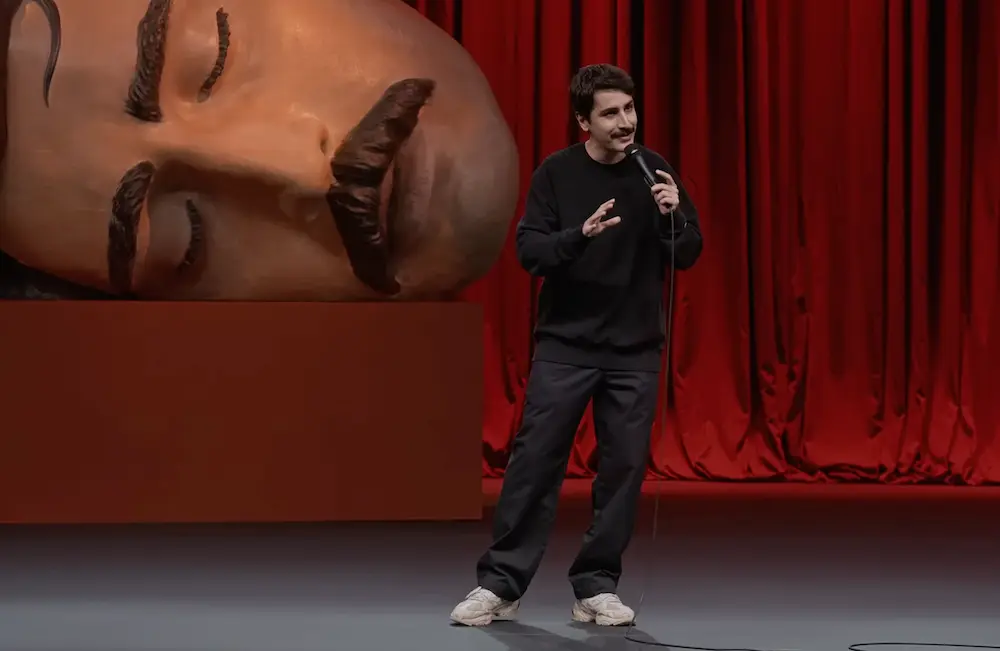
Have you ever made a joke that offended someone? Maybe they took it personally or stopped speaking to you. A joke can put strain on a relationship or leave someone feeling isolated. But what if the consequences for a joke go far beyond social fallout? What if a comedy performance lands you in a high-security prison cell? For Deniz Göktaş, this question is no longer hypothetical.
Until recently, Göktaş performed for relatively small audiences, playing bars in Kadıköy, an Istanbul district known for political satire, and occasionally in university halls elsewhere in Turkey. He was part of a niche comedy scene.
Things changed when he took his show to one of Istanbul’s most prominent stages and uploaded the performance to YouTube, opening it to a much wider audience. He knew the show might attract attention. Not just because of the words he spoke onstage, but also because the title and stage image played on a grisly visual gag. Ölü Deniz (“Dead Sea”) was a dark play on his first name, Deniz (“Sea”), while an enormous, sculpted image of his face lay on its side as if decapitated.
What began as a night of laughter would end with Göktaş spending eighty-eight days behind bars in a high-security prison. His case exposed not only the limits of free expression in Turkey but also the fraught relationship between political satire and political power.
The Charges
The thirty-two-year-old comedian was detained at Istanbul airport on July 2, after his ninety-minute special was released on YouTube. Prosecutors cited passages from the performance in bringing charges: insulting President Recep Tayyip Erdoğan, inciting public hatred and hostility, and praising crime or criminals.
At his first hearing, on September 28, 2026, Göktaş addressed the court:
“As a comedian, seeing that sentences can have such a powerful impact makes me proud. But as a citizen, I am saddened by my country’s record on freedom of expression.”
He said he worried the case would discourage others from performing and lead them to censor themselves.
The court ordered his release after sentencing. By then, he had spent eighty-eight days in pretrial detention. He told the court he had been held in a cell without sunlight or contact with other prisoners at Çorlu Karatepe High Security Prison, a facility known in Turkey as a well-type prison.
The court acquitted him of praising crime or criminals. It convicted him of insulting the president and, because public hatred and hostility were not established, reclassified the incitement charge as insulting religious values. The sentences were eleven months and twenty days and seven months and fifteen days, respectively.
The case raised a question beyond the sentences themselves: How had a comedy performance been transformed into a criminal prosecution? Göktaş’s defense argued that prosecutors had removed the alleged offenses from their original context onstage, but the heart of the matter was a dispute over how a comedian’s words should be interpreted.
Jokes About Politicians Are Not the Same as Political Comedy
While Göktaş was still in prison, I spoke with his friend and fellow stand-up comedian Emre Günsal.
Günsal distinguishes Göktaş’s comedy from much of what passes for “political humor” in Turkey. A comedian can get an easy laugh simply by mentioning a politician, referring to a current scandal, or repeating a political cliché the audience already agrees with. In Turkey, Günsal says, that is the least risky kind of political comedy.
Göktaş’s work is more deliberate. He combines political satire with social observation, using comedy to say something about the political climate, social tensions, and the shrinking space for free expression. The result can be both funny and cathartic for those who feel alienated or frustrated by the society in which they live. Günsal considers Göktaş one of the leading figures of this tradition in Turkey today.
This may help explain Göktaş’s appeal among young people and audiences opposed to the government. Günsal describes Göktaş’s work as a form of emotional release, then trails off: “Seeing someone stand onstage, knowing millions of people will watch, and say the things that others are afraid to say openly because of what might happen to them. . . . ”
Göktaş made a similar point in an interview with The New York Times after his release. He recalled a viewer writing beneath his performance that watching it made them feel as though they lived in a free country. The comment, he said, captured exactly what he had hoped to achieve.
But he was modest about comedy’s political power. Humor, he suggested, can help people feel understood, given them motivation and the courage to speak, and offer psychological support.
Plus Ça Change
Political satire and state power has a long and vexed history in Turkey.
In 1946, two of the country’s best-known writers, Sabahattin Ali and Aziz Nesin, founded Markopaşa, a socialist-leaning satirical newspaper that sharply criticized class inequality and the government of the day. The paper faced distribution restrictions, pressure on printing houses, confiscations, closures, and criminal prosecutions. Its writers and cartoonists were arrested or forced into exile. Markopaşa remains one of the most important examples of socialist and oppositional humor in Turkey.
In later decades, political satire found new forms in cabaret theater and humor magazines, including the work of Ferhan Şensoy and the satirical magazines of the 1990s and 2000s. By the time of the 2013 Gezi Park protests, irony and satire had become prominent forms of political expression.
The protests began with opposition to plans to redevelop Gezi Park near Istanbul’s Taksim Square. The government framed the unrest in terms of hooliganism and terrorism. Many protesters, meanwhile, used humor and irony to defy the government’s account of the movement. Researchers have documented how humor and satire became a form of dissent in an environment where traditional media were subject to tight control.
In his courtroom defense, Göktaş placed himself in this tradition, invoking Aziz Nesin, Rıfat Ilgaz, Ferhan Şensoy, and Turkey’s major satirical magazines. Then he reached back to Nasreddin Hodja, the legendary Anatolian folk figure whose stories have circulated for centuries. Traditionally dated to 1208–1284, Hodja occupies a place in Anatolian culture somewhat comparable to the traditions of folk wisdom and social satire in American humor.
Göktaş distilled the connection between that tradition and contemporary Turkey into a single sentence: “If Nasreddin Hodja were doing stand-up today, half his show would be about President Recep Tayyip Erdoğan.”
Göktaş argued that calling Erdoğan, who has governed Turkey for more than two decades, a “dictator” was political characterization, not an insult. As the country’s most powerful political figure, Erdoğan should be expected to face satire and harsh criticism, he said. He argued that politicians must be open to ridicule as well as praise.
The language of this debate is not new in Turkey.
A few days ago, I came across a street bookseller on the narrow Kadıköy street where Deniz Göktaş had performed stand-up for years. Among the books on the shelves was Görülmüştür, a collection by journalist and writer İlhan Selçuk, published in the 1980s.
Leafing through it, I found an essay titled “Freedom of Thought and Tolerance.” One sentence stood out: “Where freedom of thought does not exist, tolerance is nothing more than an empty word.”
Selçuk’s point resonates in the Göktaş case. If political or religious satire is tolerated only as long as it offends no one, can that be called freedom of expression?
How Does a Court Interpret a Joke?
One of the clearest examples of this problem was Göktaş’s joke about “divers.”
Prosecutors treated it as an insult to women who wear modest swimwear because of their religious beliefs. In court, Göktaş said he used the audience’s expectations to set up the joke. He described people emerging from the sea with their hair concealed and their bodies covered in black clothing. The audience, he said, assumed that he was describing women wearing modest Islamic swimwear. Then came the punch line: “f–king divers.”
The case raised a basic question: Can a stand-up performance be judged solely by a written transcript, stripped of its context onstage?
Göktaş invoked American comedian Lenny Bruce, who had faced similar problems. Bruce satirized the courts with the line, “In the Halls of Justice the only justice is in the halls.” He was repeatedly arrested and prosecuted on obscenity charges during the 1960s. In 1964, a New York court sentenced him to four months in a workhouse. He remained free while his appeal was pending and died in 1966 without serving the sentence. Thirty-seven years after his death, in 2003, New York governor George Pataki granted him a posthumous pardon.
Bruce’s trials showed how words spoken by a comedian onstage should not be evaluated independently of their delivery, facial expressions, timing, and relationship with the audience.
Göktaş argued that tone of voice, pauses, physical performance, audience reactions, and the surprise of the punch line all help make up a joke’s meaning. He compared evaluating a stand-up performance by its transcript to understanding a film by listening only to its soundtrack.
Clear and Present Danger
To better understand how Turkish law treats the line between satire and incitement, I spoke with Professor Tolga Şirin. Göktaş was still being held in a high-security prison.
For Şirin, any legal assessment had to begin with context.
“What does it mean within a stand-up performance?” he asked. A legal assessment, he said, must account for irony, exaggeration, satire, and the possibility that a comedian will deliberately lead an audience in one direction before reversing its expectations. Evaluating a few sentences only according to their literal meaning can exclude other reasonable interpretations and privilege the harshest possible criminal reading.
Şirin stressed that this was not merely an aesthetic question: “The fact that a statement offends or disturbs some people is not sufficient in itself.” Context matters particularly to the charge of inciting public hatred and hostility. Under the Turkish Penal Code, the offense requires more than a statement that people find offensive. It also requires the emergence of a clear and imminent danger to public safety.
Prosecutors cited complaints submitted through CİMER, Turkey’s online public petition and complaints system operating under Turkey’s presidency.
In his defense, Göktaş addressed the 185 complaints submitted against him. He argued that the overwhelming majority of complainants had never watched his full performance but had instead reacted to selectively edited clips circulated on social media. He described the backlash as an artificially orchestrated campaign.
For Şirin, the complaint count alone could not establish a legally significant danger. Otherwise, organized groups could make speech they disliked into a punishable offense simply by launching petition campaigns.
“Public peace is not measured by the number of people who are offended,” he said.
Göktaş said he performed Ölü Deniz 198 times over approximately three years, before more than a hundred thousand people in cities across Turkey, without receiving complaints about the statements in question. According to him, the controversy began only after the performance was uploaded to YouTube and short clips started circulating on social media.
“What development has caused a statement made and made accessible months ago to suddenly create a clear and imminent danger today?” Şirin asked.
When I asked whether the prosecution could affect other comedians and artists, Şirin’s answer was unequivocal: “This is absolutely an act of intimidation.”
According to Şirin, Göktaş had pushed against the fear surrounding political figures and sensitive subjects that many people hesitate to joke about. In Şirin’s view, the proceedings could deter other comedians and artists from crossing the same boundaries.
“We Have Cancel Culture — and Jail”
Günsal’s account shows how the chilling effect described by Şirin can manifest itself on the stand-up stage.
Small comedy venues in Istanbul have long provided spaces where comedians can speak relatively freely. The risk changes when a performance circulates on the internet. Jokes lose their original context and reach a much larger audience.
After Göktaş’s arrest, Günsal saw comedians grow more reluctant to post political sets.
He believes the greater problem is not simply censorship but the inability to tell where the line lies. “There is no clear line telling you, ‘Say this and you go to prison, but you can say that,’” he explained. Even careful comedians cannot know how their words will later be interpreted. The uncertainty can result in performers ruling out jokes before they have even written them.
Günsal knows that risk firsthand. In April 2020, he was arrested after a clip from one of his performances circulated on social media. The case involved comments about Mustafa Kemal Atatürk, the founder of the Turkish Republic, and the historical religious figures Rumi and Shams of Tabriz.
He spent eleven days in prison. In 2021, he was sentenced to three years and five months; the sentence was suspended. Six years later, while Deniz Göktaş was behind bars, Günsal tells me that political comedy had become both more difficult and more necessary.
After his release, Göktaş told The New York Times that he never regretted releasing the performance during his time in prison, not even for a second. As his popularity grew, he said, he had more to lose and began censoring his own material even before his arrest.
Asked about American comedians’ complaints about cancel culture and online backlash, he replied: “I don’t want to brag, but we have cancel culture — and jail.”
Choosing to Stay
There is another revealing detail in the Göktaş case.
When the investigation began, he was abroad. According to his courtroom defense, he cut his vacation short and returned to Turkey rather than fleeing.
He said that most of his close friends had moved abroad because they no longer saw a future in the country. He had been trying to persuade them to come back.
Günsal described this decision as one of the qualities he most admired in his friend. Günsal believes Göktaş could perform stand-up in English and appear regularly on stages abroad. But Göktaş does not want to build a new home somewhere else. That determination to keep calling Turkey home is something Günsal admires.
Deniz Göktaş is no longer in prison. But the impact of his case cannot be measured solely by his release on September 28. Perhaps the more telling measure will be the jokes not written, the performances never uploaded to the internet, and the comedians who censor themselves before finishing a sentence because they cannot predict where the legal boundaries lie.
The Göktaş case is not merely about whether one comedian crossed the limits of free expression. It is also a struggle over who gets to draw those limits in Turkey.
This article originally appeared in Jacobin, a democratic socialist magazine publishing long-form essays and analysis on politics, economics, and culture. Subscribe to the print edition for $20 a year.