
Politics · Jacobin · · 3h
Greece’s Neo-Nazis Are Back
English (original) · Read in Deutsch ⇄
For over seven years after it entered parliament in May 2012, Golden Dawn was at the heart of Greece’s political life. Its rise was accompanied by scenes that should have made its character unmistakable. During the June 2012 election campaign, MP Ilias Kasidiaris assaulted two female left-wing politicians live on TV, while numerous other key members were documented openly expressing admiration for Adolf Hitler.
Beyond parliament, something far darker was taking place. Golden Dawn was not simply an extremist political party but, a Greek court would later establish, a criminal organization orchestrating a web of violence. Its notorious assault squads terrorized migrants and political opponents across Athens, and its members were implicated in some of the most infamous killings of the period, including the murders of antifascist rapper Pavlos Fyssas and Pakistani migrant worker Shahzad Luqman.
The judicial crackdown that followed in September 2013 led to one of the most consequential political trials in modern Greek history. Beginning in April 2015, the proceedings dragged on for more than five years before, in October 2020, Golden Dawn was found to have operated as a criminal organization. Most of its senior leadership received prison sentences of around thirteen years.
Kasidiaris is returning to a very different Greece from the one in which Golden Dawn first surged in 2012. Some of the ideas that once marked his party as an extremist outlier have since entered the political mainstream. Golden Dawn may not have an active political presence anymore, but the soil that allowed it to take root is still there.
The Trial and Its Aftermath
Golden Dawn always cast its leaders as political prisoners, and portrayed the trial as a politically motivated witch hunt. Nikos Michaloliakos, Golden Dawn’s founder, was allowed to leave prison for house arrest on health grounds in September last year, less than five years after his jailing following the verdict. Last Tuesday, Kasidiaris walked free too, less than six years after receiving a thirteen-and-a-half-year sentence for directing a criminal organization.
In the past six years, Kasidiaris has been very busy. After his own party “Hellenes” was barred from the 2023 election, he backed the previously unknown Spartans, propelling them instantly into parliament with just one viral tweet. In 2025, Greece’s Special Highest Court ruled that he had effectively acted as the party’s concealed leader. But when he was considered for release, this political activity apparently did not count as a disciplinary violation, raising serious questions about how such conduct was treated by judicial authorities.
The differences between Golden Dawn and Kasidiaris’s later political vehicles are deliberate. He has largely abandoned overt Nazi symbolism, despite his documented neo-Nazi past and swastika tattoo, instead repackaging his politics in the language of ultranationalism. Hellenes, for example, called themselves defenders of Greek national sovereignty, while the Spartans avoided explicit identification with Golden Dawn — although several of their 2023 candidates and MPs had previous ties to that party.
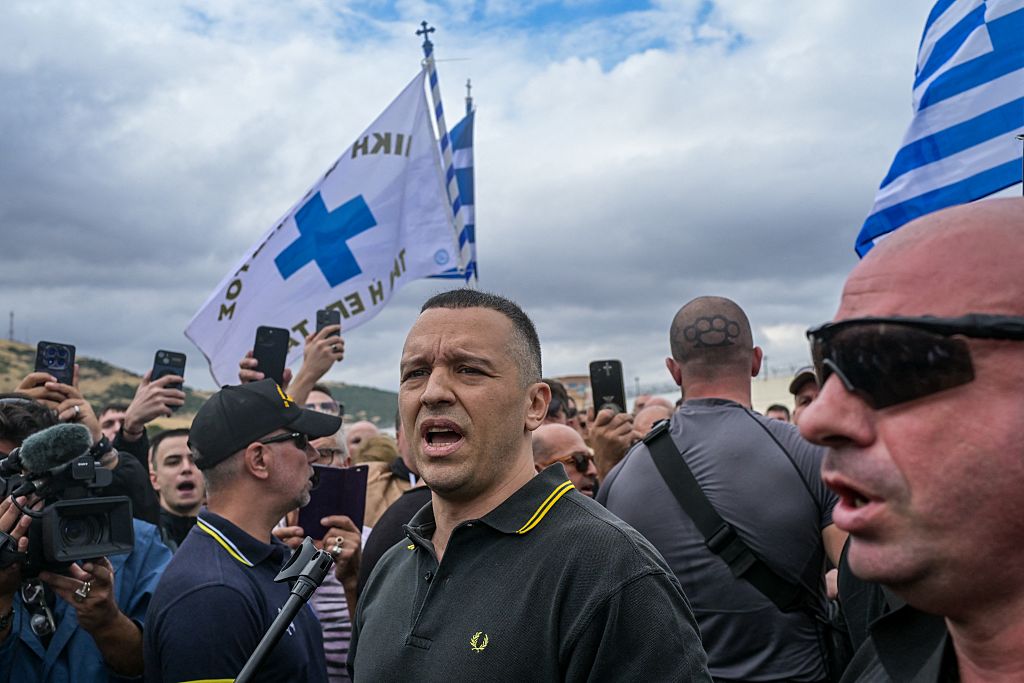
Last Tuesday, Kasidiaris walked out of Domokos Prison to cheers from dozens of male supporters, posing for photographs and selfies before announcing his return to the “front line” of Greek politics. Wearing a black Fred Perry shirt — a brand whose black-and-yellow polo was notoriously appropriated by the Proud Boys — he promised the emergence of a new “powerful national party.”
That return may already command considerably more support than the published polling suggests. I have confidentially reviewed the raw datasets of two separate polls privately conducted by major Greek polling companies over the past month, both of which tested support for a hypothetical Kasidiaris-linked party. One poll put the figure at around 6 percent, the other at 8 percent. Neither appeared in the companies’ published results, however, with both effectively buried within vaguely defined “other” categories. However, a smaller polling firm released its findings on September 21, suggesting that Kasidiaris could secure up to 17 percent of the vote.
Withholding figures of that magnitude from public-facing polling risks obscuring politically important information. A convicted neo-Nazi is returning from prison with an electoral constituency potentially large enough to reshape Greek far-right politics and revive a movement many believed had been defeated.
Fertile Ground
Thirteen years ago, as Golden Dawn was establishing its position during the height of the crisis period, sections of the Greek commentariat openly wondered whether the country needed a “more serious” version of the neo-Nazi party. In September 2013, journalist Babis Papadimitriou — who would later become a New Democracy MP — publicly asked why a “more serious Golden Dawn” could not support a conservative governing coalition.
In many ways, that wish has since been realized. Successive governments under Prime Minister Kyriakos Mitsotakis and his right-wing New Democracy have elevated politicians who passed through the far-right ultraorthodox LAOS party into some of the most powerful positions in the state. Adonis Georgiadis, once a LAOS MP, is today both health minister and a vice president of New Democracy. Thanos Plevris, another former LAOS politician, has been Greece’s minister for migration and asylum since 2025.
Plevris is also the son of Konstantinos Plevris, one of the most notorious figures of Greece’s postwar far right, a Holocaust denier who has openly described himself as a Nazi and fascist. Thanos’s own record on migration is grim. In 2011, he argued that border protection could not exist without deaths. In the same speech, he advocated denying undocumented migrants food, water, health care, and social assistance, with the explicit aim of making life in Greece so unbearable that it would deter others from coming. Plevris also announced a doctrine of “prison or return” for people without a right to remain and described arrivals from North Africa as an “invasion.”
These are precisely the kinds of ideas that once distinguished Golden Dawn from Greece’s conventional right. Golden Dawn’s migration politics rested on deterrence through dehumanization of migrants as an existential threat to the nation. What was politically radioactive in 2012 can now be spoken from inside a government ministry almost without consequence, a sign of how much of Golden Dawn’s political language has seeped into the state itself.
Seen against the broader European mainstreaming of the far right, Greece is far from the exception it is sometimes portrayed as being by media outlets broadly sympathetic to the government. Golden Dawn disappeared, but the far-right political space became very populated. Greek Solution and the ultraconservative Niki are still represented in the Greek Parliament and Voice of Reason in the European Parliament. MPs elected for Spartans are still sitting as independents after the party’s group collapsed following the ruling by the Special Highest Court.
The far-right field may soon become more crowded still. Right-wing former Prime Minister Antonis Samaras has spent much of this year teasing the prospect of yet another party, recasting himself as the aggrieved guardian of the nation. His speeches increasingly revolve around denunciations of the “woke agenda,” delivered with the theatrical indignation of a politician apparently determined to present yesterday’s culture-war slogans as an urgent national emergency.
A Trojan Horse
In August, Kasidiaris’s brother Alexandros, himself a former Golden Dawn member, filed a declaration with Greece’s Supreme Court establishing a new party. It was formally unveiled on September 21 as the Alliance of Greeks. Little is known so far beyond the identities of a handful of leadership figures and prospective candidates, while Ilias Kasidiaris has yet to clarify what role, if any, he will play.
Under the electoral framework introduced in 2023, constitutional experts argue that he cannot formally lead a party until 2033. Nor is simply installing somebody else as leader necessarily enough, as the Supreme Court can examine a party’s real leadership and disqualify it if Kasidiaris is found to be directing it from behind the scenes.
But perhaps much of the damage has already been done. Kasidiaris has repeatedly demonstrated how insufficient these restrictions can be. Could a convicted neo-Nazi continue conducting politics from prison? He did. Could his statements circulate through social media while he remained incarcerated? They did. Could he boost another party into parliament while formally remaining outside its leadership? The Spartans provided that experiment. Even Elon Musk entered the story in July, publicly criticizing Kasidiaris’s continued imprisonment.
In 2023, writing in the Greek left-wing newspaper Efimerida ton Syntakton, I argued that the Greek state was living under the illusion that legal restrictions alone could prevent Golden Dawn’s political return. One of the main government figures defending the 2023 legislation designed to block Kasidiaris was Makis Voridis, then interior minister. Decades earlier, Voridis had led the youth wing of EPEN, the far-right party founded from prison by former dictator Georgios Papadopoulos — taking over a position previously held by Golden Dawn founder Nikos Michaloliakos. The man helping construct the legal firewall against Greece’s neo-Nazis thus came from a political tradition with deep roots in the country’s junta and its successors.
The conditions that allowed Golden Dawn to enter parliament in 2012 did not disappear when its leaders entered prison. Greece has spent years treating neo-Nazism as though it were principally a legal problem. Yet Kasidiaris’s journey exposes the limits of that approach. Parties can disappear while their networks survive.
Greece is a country with a remarkable history of resistance to fascism but also an extraordinary capacity for forgetting how deeply Nazism has remained embedded within its political life. Kasidiaris’s return shows that the political environment around Golden Dawn changed sufficiently that many ideas once associated with a neo-Nazi organization no longer sound as politically alien as they did fourteen years ago.
Legal barriers may still prevent Kasidiaris himself from appearing on a ballot. However, they cannot dismantle the political and social constituency waiting for him outside the prison gates.
Read the full story at the source
Source: Jacobin