
World Jacobin
Austerity Is Now the Central Conflict in Brazilian Politics
Lula da Silva beat Flávio Bolsonaro to win a fourth term as Brazil’s president. Political scientist André Singer says the hardest fight is still ahead: Brazil’s bourgeoisie wants harsh austerity, and
English (original) ·Read in Deutsch ⇄
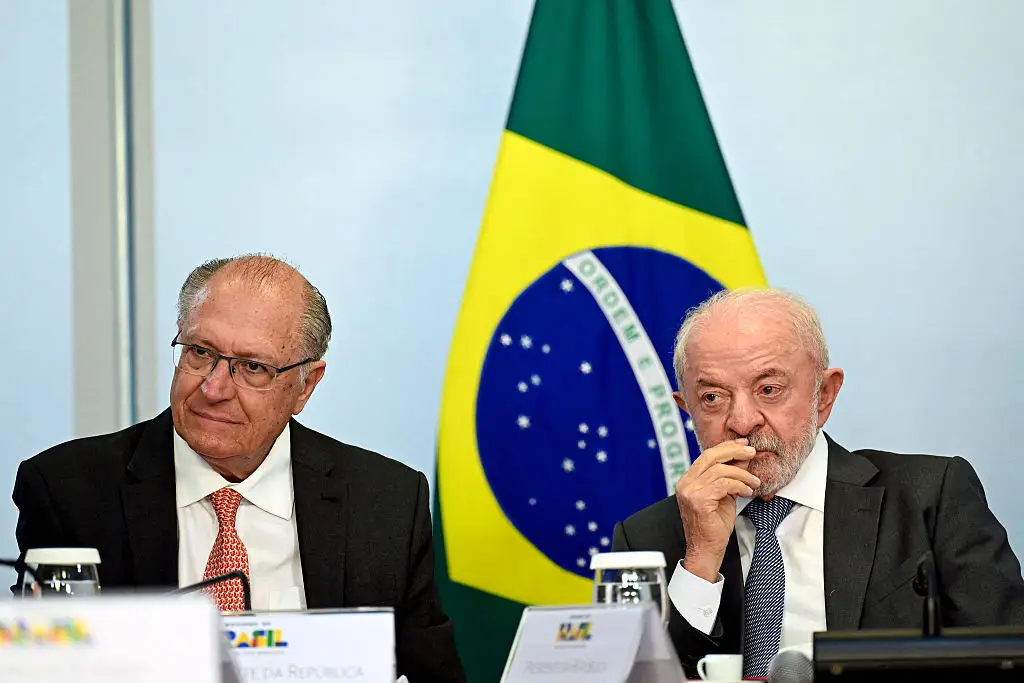
On October 4, Senator Flávio Bolsonaro, the son of former president Jair Bolsonaro, finished the first round of Brazil’s presidential election nearly two points ahead of President Luiz Inácio Lula da Silva. Three weeks later, Lula turned the result around and won a fourth term in the October 25 runoff. In between, left-led demonstrations filled the streets of hundreds of Brazilian cities. The government also banned online betting, backed a forty-hour workweek, and raised the benefit of Bolsa Família, the cash-transfer program for poor families that Lula created in 2003.
Few analysts know Lula’s political project better than André Singer. A professor of political science at the University of São Paulo, Singer served as Lula’s spokesperson from 2003 to 2007 and press secretary from 2005 to 2007. He developed the concept of Lulism in Os sentidos do lulismo (2012) and O lulismo em crise (2018), and his new book, Impasse: O Brasil diante da onda reacionária, came out in August.
After the runoff, Singer spoke with Catarina Príncipe and Aldo Cordeiro Sauda for Jacobin about Bolsonarism as autocracy with a fascist bias, the Brazilian bourgeoisie’s silence during the campaign, and why the second-round mobilization was not populism. He also discussed the fight over austerity that awaits Lula’s fourth term.
Catarina Príncipe
You’ve written about the idea of an “autocracy with a fascist bias” to understand the phenomena of Donald Trump in the United States and Jair Bolsonaro in Brazil. Could you explain this idea further?
André Singer
Honestly, I can’t speak directly about Trumpism, because I don’t have enough expertise. So I’ll talk about Bolsonarism, the experience from which I formulated the idea of an autocratic tendency with a fascist bias. Studying the Bolsonaro presidency of 2019–2022, one can show empirically that he tried to reshape Brazil’s institutions in the direction of an autocratic regime.
One of the major conflicts during his term was over the independence of the Federal Police. For an American audience: The Federal Police is equivalent to the FBI. It is a national police force for the country’s major security problems, because everyday problems fall to the state governments.
But the big questions of corruption, organized crime, drug trafficking, and arms trafficking are all the Federal Police’s business. That is why a convention that successive presidents have observed since the return to democracy in the 1980s is so important: guaranteeing the Federal Police’s independence. The president of the republic appoints the director, but presidents have made a practice of appointing directors who have a certain independence from themselves.
Bolsonaro made a point of violating that convention and appointing a Federal Police leadership at the service of his own political interests. I’m describing this because it is the most evident case of all: he tried to manipulate the Federal Police to concentrate power.
Why do I say this autocratic tendency has a fascist bias? Because I find in it certain elements in common with historical fascism. Why don’t I say it’s fascist tout court? Because there are many elements that don’t correspond.
Let me give one element in common: the activation, through propaganda, of the unconscious of the masses. It is a kind of advertising that aims to hook the voter, the citizen, and the supporter through unconscious identification rather than rational argument. That doesn’t mean there aren’t also arguments of a material nature, material interests; I’m not saying it is merely a technique aimed at the unconscious. But I think this is very typical of fascism and not of the nonfascist right.
What isn’t in common with fascism? For example, there is no political party organized into militias, as in Italian fascism and then German Nazism. There is also no warlike rhetoric, in the sense of external war: Bolsonarism has a very strange nationalism of submission to the United States — something hard to understand. But it has no rhetoric of confrontation with other countries or of territorial expansion, an important element of historical fascism.
Since some elements are in common and many are not, I proposed a way of understanding the Bolsonaro phenomenon. We are facing an autocratic tendency — that is proven — with a fascist tendency that we still need to test. Meanwhile, there is a more general theoretical problem: the concept of fascism isn’t well defined.
Strange as it may seem, that is the problem we have to face: arriving at a concept of fascism that lets us understand the present situation. Obviously we are interested in understanding history, but with a view to the present and the future.
Catarina Príncipe
In an interview, I heard you distinguish between fascism from below and fascism from above. Which class does this autocracy with a fascist bias mobilize most?
André Singer
Marxist-inspired thought has already made clear the characteristics of historical fascism, and one stands out: fascism is a movement that comes from below, not from above. Leon Trotsky first made that contribution, in his writings on Germany, and it still holds; it is a fundamental distinction.
Bolsonarism has this characteristic: it comes from below; it is not a movement of the ruling class. It draws in the middle strata, but it quickly spreads to intermediate popular layers, which form its backbone. So in Brazil today, the far right penetrates from below.
Catarina Príncipe
How do you analyze the relationship between the ruling class and politics, given the existence of what you call two cross-class coalitions: the Bolsonarist “confederacy” and the Lulist “concertación”? What is the composition of these two coalitions?
André Singer
I call one the “confederacy,” by a certain analogy with the nineteenth-century American case, and the other the “concertación,” by analogy with Chile after Augusto Pinochet. I developed these two hypotheses to understand the 2022 election. So I’ll answer with 2022 in mind, then briefly go through the changes in 2026.
The idea of the confederacy was that a coalition of agribusiness entrepreneurs and service sector entrepreneurs in the cities formed. Certain evangelical denominations, which represent a kind of Brazilian Bible Belt, joined them. These denominations account for about 30 percent of the Brazilian electorate, and Bolsonarism has repeatedly won 70 percent of their vote.
In the 2022 election, the whole of the security forces joined these two components, the entrepreneurs and the evangelical Bible Belt, from the armed forces down to the regional (state) police forces. These forces represent a large contingent. Besides everyone formally engaged in security work, Brazil has an enormous army of private security guards, because public security can’t cope with the very serious crime problem.
These three tracks of the confederacy, so to speak, created an enormous corridor through the interior of the country. It runs from the north of Rio Grande do Sul to the south of the North Region, through the interior of São Paulo and Minas Gerais, the country’s most industrialized states. That corridor aligned with Bolsonarism, which largely explains its significant electoral power. In addition, the evangelical Bible Belt gives Bolsonarism a very strong bridgehead in Brazil’s large metropolitan regions.
In 2026, there was a change: because of the failed coup attempt, the armed forces pulled back. They had been very important because Bolsonaro, a former army captain, went through the military academy with the men who, by coincidence, made up the high command when he took office. He brought them into the government, and so the armed forces were deeply committed to the Bolsonaro government.
That is no longer the case. You can’t identify anyone of note from the armed forces in the campaign of his son Flávio Bolsonaro. But we know that the police forces backed that candidacy discreetly, rather than explicitly, as they had with Jair Bolsonaro’s government.
I call it a confederacy, although it has no connection with slavery. But it does have this connection: it divided Brazil. It united the interior, as if against the big cities, even though, I repeat, the evangelical denominations have influence in the big cities.
You also notice a certain prejudice against the Northeast and an underlying ideology that a more modern Brazil would be better off rid of a more backward Brazil. It is a kind of implicit ideology, which sometimes shows up more, sometimes less.
As for the concertación: the name came to me because, to build the coalition that sustained him, President Lula made an alliance with sectors of the old Brazilian Social Democracy Party (PSDB). Until 2018, the PSDB had been the main rival of Lula’s Workers’ Party (PT). The current vice president, Geraldo Alckmin, headed the sectors willing to join. The PSDB as a whole has shrunk to a small party, and it stayed neutral: it backed Lula neither in 2022 nor now.
But the alliance with Alckmin represented a union with former PSDB sectors willing to form the democratic front. So, as in Chile, the two great adversaries came together: in Chile, the Socialist Party and the Christian Democratic Party; in Brazil, the PT and the PSDB.
Along with this party coalition, there was an important class coalition. Lulism represents the base of the Brazilian social pyramid, as everyone knows. But the alliance with this faction of the PSDB also brought in what I call the cosmopolitan bourgeoisie, the most modern sector of the Brazilian bourgeoisie, which backed President Lula in the second round of 2022, not the first. That was very important both for his victory and for the future of the government.
In this 2026 election, that sector of the bourgeoisie did not speak out; it stayed neutral and backed neither Flávio Bolsonaro nor President Lula. João Moreira Salles — founder of Piauí magazine, an important filmmaker, and an heir to one of Brazil’s biggest banking families — wrote a very powerful article on the importance of that silence.
The consequence of that silence was the acceptance, practically until the last minute, of a Flávio Bolsonaro victory. An extraordinary movement reversed that in this year’s second round. To conclude for now: the cosmopolitan sector of the Brazilian bourgeoisie, which stayed silent, is no longer explicitly present in the concertación.
Catarina Príncipe
You define Latin American populism as a mass phenomenon: in certain circumstances, classes take the form of multitudes with little or no class organization, connecting people and leader directly. Was this type of populism what secured Lula’s victory? And how can we reconnect this expression of the multitude with more sustained class organization?
André Singer
I think the concept of populism doesn’t apply to the second-round victory. It’s a very interesting question, and it’s going to give me some work, because I’ll have to develop something more sophisticated to account for the phenomenon.
But at first sight, I think we had a social explosion — let’s call it that — without the characteristics of populism. It was more organized and more conscious of its aims than the populist phenomenon implies.
To be clear, my theoretical framework is Ernesto Laclau’s old definition, from 1978, not that of the so-called second Laclau. It is a good one for thinking about populism in Latin America and, of course, in Brazil too.
Why do I say the explosion is more conscious and more organized? More conscious because it aimed, first, to stop the far right. Flávio Bolsonaro won [the first round] by 2 percentage points and immediately began putting together his government and saying he would change the Constitution. That was a tactical error, even from his own standpoint: it had such an impact that the democratic sectors of Brazilian society immediately began to speak out and organize.
That is one side of the phenomena. The other is a feeling that President Lula needed a fourth term, because the government itself began to change during the campaign. It isn’t obvious, but President Lula changed the campaign in mid-September without saying so: he began to take measures.
One event seems revealing to me. On September 11, at a rally in Porto Alegre, he said, “I know you are finding products expensive at the supermarket,” referring to coffee and beef. That is very significant, because until then the government had not addressed the population’s material needs directly.
From then on, the president not only spoke to those needs but began taking measures. For example, he raised the Bolsa Família benefit, which the government had not adjusted in four years, and he banned online betting, the “bets.” Remember that Brazil is living through a triple crisis: a cost-of-living crisis, a crisis of household indebtedness, and, on top of it, an epidemic of bets.
People began gambling wildly, partly to earn extra income to pay off debts. Since betting companies design bets so that the great majority lose, people ended up worse off. President Lula faced great resistance to the ban. First, many companies are involved, and long-term legal contracts were already in place; second, soccer clubs, which are very popular and important in Brazil, depended to some extent on sponsorship from those companies.
The other very important decision was the switch from six workdays and one day off (6x1) to five and two (5x2), cutting the workweek from forty-four to forty hours: probably the greatest labor victory since the 1988 Constitution. Congress passed it, but everyone knows it was the president’s initiative and that he committed himself to it. Structurally, of course, it is even more important than the betting ban. But the ban has symbolic meaning, because the president decided on it during the campaign: an act of boldness and courage in defense of the popular economy.
Alongside it, the government took two measures to restructure the debts of the popular classes, and others such as free public transit on weekends, which speaks directly to the young people who took to the streets. What I mean is that all this is not populist rhetoric; these are actions. It is what I call a change in the character of the government.
Finally, these sectors that took to the streets are not completely disorganized. The demonstrations took place in hundreds of cities, but the largest, and most unprecedented, were in São Paulo, the country’s biggest metropolis. I have been comparing the two October demonstrations in São Paulo, on October 11 and 24, with the great right-wing demonstration for the impeachment of President Dilma Rousseff in March 2016. There had been no demonstration of this kind for at least ten years.
The Left led these demonstrations, although they were not only of the Left. They formed a democratic front, with centrist sectors and possibly even a democratic right: individually, people may have gone out to defend democracy. But the leadership clearly belonged to the Left, and these are possibly the largest left-wing demonstrations in Brazil’s history.
The Brazilian left has organizations: the PT, the Socialism and Liberty Party (PSOL), the Communist Party of Brazil (PCdoB), the student organizations, the cultural associations, the unions, the neighborhood associations, and the popular movements, especially the Landless Workers’ Movement (MST) and the Homeless Workers’ Movement (MTST). On the center left, you have the Socialist Party of Brazil (PSB) and the Labour Democratic Party (PDT). In short, Brazil has an organizational structure, and it mobilized. So, from these two angles, I wouldn’t describe this as a populist phenomenon; something different happened.
Aldo Cordeiro Sauda
This year, you observed a pendular movement by the cosmopolitan wing of the bourgeoisie toward the far-right candidacy, the opposite of its support for Lula’s election in 2022. Internationally, US foreign policy shows the same pendular movement: sympathy for Lula under Joe Biden in 2022, explicit support for Bolsonarism under Trump in 2026. To what extent does the Brazilian ruling class’s shift toward Bolsonarism express mere deference to Washington?
André Singer
As far as I understand, the sector I call cosmopolitan — in the American case, the big technology companies — backed Biden in 2020. In 2024, it wasn’t very clear to me what they were doing, but they didn’t seem to back Trump either, with the exception of Elon Musk.
Yet when Trump took office, all of them were there. In the Brazilian case, though, it seems plausible that a conversion of the American cosmopolitan bourgeoisie to the far right influenced the Brazilian bourgeoisie. Until the last minute, there was a certain expectation that this sector might speak out in favor of President Lula.
That sector committed itself to democracy in 2022, in a movement broader than support for President Lula. In August 2022, at a demonstration in São Paulo, those business leaders issued a letter. They said they would not accept, under any circumstances, a refusal to recognize the election result — exactly what the White House said.
Those two positions were very important in keeping most of the armed forces from joining the coup, because the military knew it could not govern without that support. So you see: there is a Brazilian phenomenon. A link to a transformation in the United States is a possible hypothesis.
Catarina Príncipe
Our understanding of the question is that the Brazilian cosmopolitan bourgeoisie is staying neutral now because of the political change in the United States from Biden to Trump. At the time of the coup attempt, the Biden presidency was very important in stopping it from going forward. Now, with Trump, there might be some attempt at direct intervention in Brazilian politics.
So, part of the cosmopolitan bourgeoisie doesn’t want to take a position today, to avoid a falling-out with US policy and with a possible Bolsonaro victory. It’s less a direct mirror between fractions of the bourgeoisie.
André Singer
Then I’ll take advantage of your interpretation to add something that makes the problem more complex. The major point of division between that sector of the Brazilian bourgeoisie and Lula’s third government is the fiscal deficit. That sector demands a big cut in public spending, which in its view would have to fall on pension benefits, and it wants to delink them from the minimum wage. The Brazilian Constitution links the two, so raising the minimum wage in real terms also raises all benefits.
The other target is the constitutional floor for health and education: the Brazilian Constitution requires that a certain share of annual tax revenue go to health and education, and this cannot go down. The bourgeoisie’s aim is to remove that floor from the Constitution, so that this spending falls.
So, we have a very serious issue: on one side the pension system, all the retirees; on the other, the two main social policies that form the social core of the 1988 Constitution, health and education. That is the main problem. We still don’t know whether there is also a certain caution or a desire to align with the American cosmopolitan bourgeoisie.
Aldo Cordeiro Sauda
National sovereignty took center stage in the campaign, perhaps for the first time since the return to democracy. What role did this issue play in the second-round turnaround against Flávio Bolsonaro?
André Singer
The Trump administration’s offensive against Brazil — the tariffs and its direct or indirect intervention in the elections — has put national sovereignty on the agenda. Trump justified the first tariffs by saying that Brazil was persecuting his preferred candidate, Jair Bolsonaro.
Brazil today does not have a very strong nationalist current. A nationalism is now starting to grow, because the global situation has changed and the country faces political-economic aggression — let’s call it that. So nationalism has come onto the agenda, but in my opinion — and I may be wrong — it has still not become a central issue.
Catarina Príncipe
Lula wants to transform the Brazilian economy by investing in the green economy, infrastructure, and artificial intelligence (data centers) and by using Brazil’s resources in rare metals and minerals. How much room for maneuver does he have to do this, given the New Fiscal Framework, the Lula government’s 2023 fiscal rule capping annual spending growth at 70 percent of revenue growth? How should we think about his government’s relationship with the bourgeoisie in this fourth term and the new balance of forces?
Do you believe the bourgeoisie will tend to deepen its conflict with the PT, intensifying the pendular movement? And in this context, what happens to the mass mobilization from below that we saw in the second round?
André Singer
I think this is the central point regarding the fourth term: what the outcome of this conflict will be. The stock market fell nearly 14 percent the day after the election. As I have been saying, the market has no vote, but it has money, and its message is clear: if you don’t cut public spending, we’re leaving.
The question of fiscal adjustment is truly central, because the bourgeoisie is demanding harsh austerity. In my opinion, the demand for austerity is the fundamental issue in Brazilian politics today, but in general nobody puts it openly: it remains an implicit debate. That is partly because we are not managing to politicize the problem, to make the popular classes, the working class, aware that this is what is at stake. This is the main confrontation.
This organizes Brazilian politics. In my recent book, Impasse: O Brasil diante da onda reacionária, I tried to show that this issue splits the democratic front in two. It is, as Americans say, an elephant in the room: everyone treats it as if it didn’t exist. I felt that my role was to bring it to the surface; obviously I can’t do that alone, but I can contribute to some extent.
The conflict is immediate, because the transformation Brazil needs, which runs through reindustrialization, is a gigantic task. Brazil is an enormous country, and you don’t change a structure of this order without major investment.
This transformation can’t rely on public investment alone; there must also be private investment. But we have to think with the instruments we have. Perry Anderson says Keynesianism no longer works, so we need to create new mechanisms; but until we have them, I’ll use the old ones. The state will have to induce this development process, although it also has to bring in other investors.
There is, therefore, an incompatibility between the country’s needs and this radical cut in public spending, which goes in the opposite direction. This is the central point. Even if the terms of the debate were not clear, I think the large demonstrations in hundreds of Brazilian cities point toward the government having this commitment. We’ll have to follow events to see how it unfolds.
Catarina Príncipe
Your earlier book defined Lulism as “combating poverty without confronting capital.” Can Lulism go beyond itself, and does it want to? Is there room to do so today, given the current party arithmetic in Congress? And how can the Brazilian left organize to force it to take measures that go beyond welfarism?
André Singer
I’ll start with Congress, which I think is simpler. In the Congress that takes office in 2027, the far right has grown, not at the expense of the Left but of other forces on the Right. In the Chamber of Deputies, it went from 91 to 121 deputies, out of 513 seats.
That is significant: since the return to democracy, we would hardly find such a large single-party caucus. But it decides nothing on its own. What we will have is permanent negotiation, which is already happening: Lula’s third government already negotiated permanently with what we in Brazil call the Centrão.
To be clear, the Centrão is the established right, the traditional right, so to speak. It generally holds the majority in Brazil’s National Congress, because the Brazilian electoral system reproduces small local oligarchies that tend to dominate legislative elections.
This is structural in Brazil, and it will continue. President Lula has specialized in negotiating with those sectors. The third term was the most difficult in this respect, because Congress gained power from what we in Brazil call the “secret budget” (orçamento secreto) [budget amendments through which lawmakers steer federal funds without disclosing who requested them]. Even so, the president managed to pass his two boldest proposals.
The first was the income-tax exemption for those who earn up to R$5,000 (about US$940) a month, offset by a levy on those who earn more than R$50,000 (about US$9,400). The Chamber of Deputies approved it unanimously. The second was the change of the work schedule from 6x1 to 5x2, which we have already discussed. The Chamber had already approved it unanimously, and the Senate has just passed it by an overwhelming majority.
This shows that such negotiation is possible. The traditional right makes concessions on one side and concessions on the other. Its concession to the far right is an effort to reduce the sentences the courts imposed on Jair Bolsonaro and on everyone they convicted of taking part in the 2022 coup attempt, and that effort will expand.
It will probably have real consequences: the far right will try to make it possible for Bolsonaro to run in 2030. I think that is its outlook. I repeat, it won’t achieve this without the support of the Right, but depending on the back-and-forth negotiations, it could happen.
I now turn to the problem of the Left. The Left should not leave the democratic front. The central problem in Brazil, as in many countries around the world, is to isolate the far right and reverse its advance toward power everywhere.
Looking at the long term, we are witnessing a gradual, slow, but constant advance of the far right, sometimes faster, sometimes slower. If the far right comes to power and consolidates itself around the whole world, the working class will suffer a tremendous setback in every respect.
Our task, then, is to avoid this by isolating the far right and defeating it as an alternative for power in Brazil. For that, we have to stay in the democratic front. But two incompatible economic programs divide the democratic front.
We have to fight explicitly inside this democratic front for our position to win a majority. I’m convinced that democracy depends on the majority of the population recognizing in it an answer to their problems; if it doesn’t, it won’t last. That is the best contribution the Left can and must make to the defense of democracy.
Lulism, as I characterized it, is a movement that seeks to combat poverty, which is fundamental in Brazil, without confronting capital. I stand by that definition. But political reality is dynamic. We and all the other actors are facing new situations, so new things are bound to happen.
As you know, we can’t predict the future; we can only see tendencies. I would end by saying that a popular commitment is in Lulism’s nature: it depends on a popular base; it is a popular movement. Beyond that, only the political process will tell.
This article originally appeared in Jacobin, a democratic socialist magazine publishing long-form essays and analysis on politics, economics, and culture. Subscribe to the print edition for $20 a year.