
World · Jacobin · · 2h
AI Destruction Isn’t Hypothetical. It’s Already Here.
English (original) · Read in Deutsch ⇄
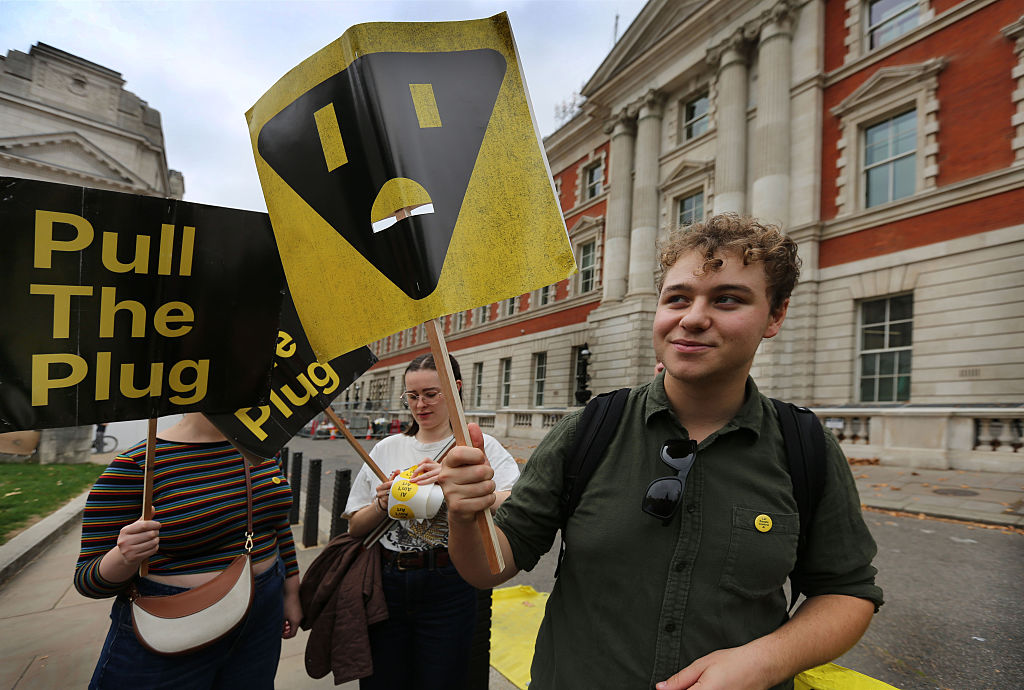
We’re several weeks into a fierce debate over whether artificial intelligence (AI) will kill us all. Triggered by a spate of former workers at major AI firms coming forward to warn that a future superintelligent AI could lead to human extinction, the debate has inspired a kaleidoscopic array of views that don’t break down along neat ideological lines. Some think it’s all hogwash, either the product of ignorant hype or part of a cynical hype campaign by the industry itself. For others, convinced that the tech’s potential capabilities are no joke, they’re warnings that need to be taken deadly seriously.
In many ways, though, the debate is besides the point. It’s not that we shouldn’t try to get to the bottom of what exactly happened with the HuggingFace hacking incident, and that we shouldn’t worry about the question of rogue agents or the dangers of a future superintelligent AI that could threaten our continued existence. It’s that what we call AI has already copiously proven it carries profound danger for the human race — and is doing immense harm way before it’s even remotely close to reaching superintelligence.
Consider the fact that AI “almost started a war” between the United States and China this past spring, in the words of one source who told CNN about it. A special operations command analyst had used a chatbot to put together a report about the cargo of a Chinese ship sailing in the Middle East, which hallucinated that the vessel was carrying the components of a nuclear weapons program, prompting the US military to mobilize to intercept and board the ship, guns drawn. Military planes had even taken off for this purpose. The operation was called off after officials looked into the report and realized it was AI-generated nonsense.
According to CNN, the incident was the result of two overlapping trends: the fact that younger “AI native” analysts tend to rely on and trust the technology to an inordinate degree and the Pentagon’s aggressive adoption of AI under Defense Secretary Pete Hegseth. It’s worth noting that if any direct war were to break out between the United States and China, it would carry grave danger for the entire world, not just because it would likely lead to a global depression, but because any military hostilities between the two have a high chance of going nuclear — something that really could threaten the survival of our species.
The incident perfectly distills the very real, currently existing dangers of AI. We’re so fixated on the future catastrophic potential of hypothetical superintelligent AI agents that we’re forgetting AI is already causing real harm and carrying massive risks — not because it’s smarter than us, but because it is flawed, error-ridden technology that we are rushing to shoehorn into seemingly every facet of our lives.
That includes war. Long before the incident with the Chinese ship, AI was directly responsible for the horrific, mass loss of innocent human life thanks to being folded into military operations. We saw it most recently with the Trump administration’s murder of scores of Iranian schoolgirls, where the military’s trust in Palantir’s AI tool Maven was a major part of the chain of disastrous decision-making that led to the atrocity.
US Central Command personnel reportedly compressed what used to be hours of work involved in choosing targets into a few minutes by feeding the underlying intelligence into Maven, simply assuming the AI tool would catch and highlight any errors. It did not. Before that, we saw AI used in a more apocalyptic way for the purpose of war in Gaza, where AI targeting was at the heart of Israel’s indisciminate flattening of the territory.
But this is only the most overtly homicidal use of AI. Many of its social harms have been more insidious.
The unleashing of AI onto the public has caused a by now widely documented phenomenon of what Massachusettes Institute of Technology researchers have termed “cognitive surrender” among college students who, struggling with deadlines and the pressure to succeed, have turned en masse to using the technology to write their essays and otherwise do assignments for them. The proportion of students doing this has now reached a depressing 95 percent.
The outsourcing of their very thinking to machines has meant that young graduates are not just emerging from their studies without seemingly actually learning their field but with genuinely weaker brain power: a worse memory, an inability to persist with intellectual challenges, and vanishing critical thinking skills. Wall Street firms, normally big boosters of the AI industry, have, when push comes to shove, found themselves less than impressed with the young workers it is producing, underwhelmed at a generation of new hires who prove remarkably shallow thinkers. It’s so bad that the students themselves think the technology is weakening their critical thinking even as they continue to rely on it.
Meanwhile, as people have turned to AI for therapy and other help with their personal demons, AI chatbots have been linked to a series of suicides and even murders by troubled individuals, a number of them teenagers. The problem is that the technology — besides not being human or having professional mental health expertise — is designed to flatter, please, and otherwise keep the user engaged as long as possible. As a result, chatbots’ role in these tragedies has ranged from being useless to help users, to feeding their delusions and actively helping them hurt themselves or others.
That’s when AI isn’t helping otherwise mentally stable individuals hurt themselves with lethally bad advice: the man hospitalized after ChatGPT likely advised him to replace salt in his diet with an old-fashioned sedative; the stranded hikers who nearly died when Google Gemini advised them to pack far less food and water than they needed; the pastor who nearly died of a pulmonary embolism after ChatGPT advised him not to seek medical help; the elderly neuroscientist who put off cancer treatment because he had come to trust AI hallucinations over his own doctor; and so many more.
This is because AI chatbots and other tools often do not know what they’re talking about. One study (from an AI provider, no less) found seventeen large language models (LLMs) only answered two out of five financial questions correctly. Another found they hallucinate legal responses between 58 and 88 percent of the time.
AI chatbots sycophantically back a variety of potentially harmful statements from users nearly half (47 percent) of the time, according to another. This is particularly alarming when it comes to medical advice, which a study found AI was accurate about only 76 percent of the time — a passing grade for a college paper but abysmal in the medical context, where being wrong once could mean death or debilitation.
But it’s not just chatbots. AI’s rapid integration into a variety of expert fields has led to adverse consequences. Court sanctions are on the rise because lawyers keep filing briefs with AI-made errors. On the other side of the bench, two federal judges allegedly relied on AI to issue error-ridden court orders, a serious concern given the expansive power courts have in the US political system, and because judges are broadly insulated from civil liability. The use of AI for medical devices used in surgeries has caused a spate of injuries, including strokes after surgeons were misdirected by the technology in ways that damaged arteries.
A Stanford and Harvard study from earlier this year found the best AI models made “severely harmful clinical recommendations” in medical cases 22 percent of the time, often through omission. In other cases, AI is being used by doctor’s and dentist’s offices to justify hawking expensive treatments that patients don’t actually need.
And then there is the way that AI algorithms are being used to exacerbate and justify preexisting corporate malfeasance. An ongoing class-action lawsuit against UnitedHealth alleges that its various companies used an error-prone AI tool to serially deny insurance to patients. A different lawsuit alleges that an AI recruiting software carried out systematic employment discrimination against black applicants and others.
In all of these cases, people are being hurt or threatened by AI not because it’s achieved sentience and is smarter than us, but the opposite: because it’s a flawed, at times comically inept technology that humans are actively making choices to deploy in situations where it is most likely to do serious damage, sometimes in ways actively designed to screw over others.
In fact, it is arguably the very market-driven hype about AI’s imminent superintelligence that has contributed to all this. Overstating AI’s capabilities has helped encourage its rapid uptake in fields like war or health care depite the fact that it’s not ready for prime time and makes those unfamiliar with or ignorant about the technology more likely to take what it says at face value, even when it’s wrong or hallucinating.
The dangers of a hypothetical AI superintelligence should be a concern. But we do not have to determine if this is really our future to be able to call for development of this technology to be urgently paused, for it to be heavily regulated, and to put serious guardrails on it, if not outright banish it from being used for particular purposes. The dumber, mistake-prone AI of today is enough of a risk to humanity as it is.
Read the full story at the source
Source: Jacobin