
World · In Defence of Marxism · · 2h
Spain: violent eviction leads to explosion of anger over housing
English (original) · Read in Deutsch ⇄
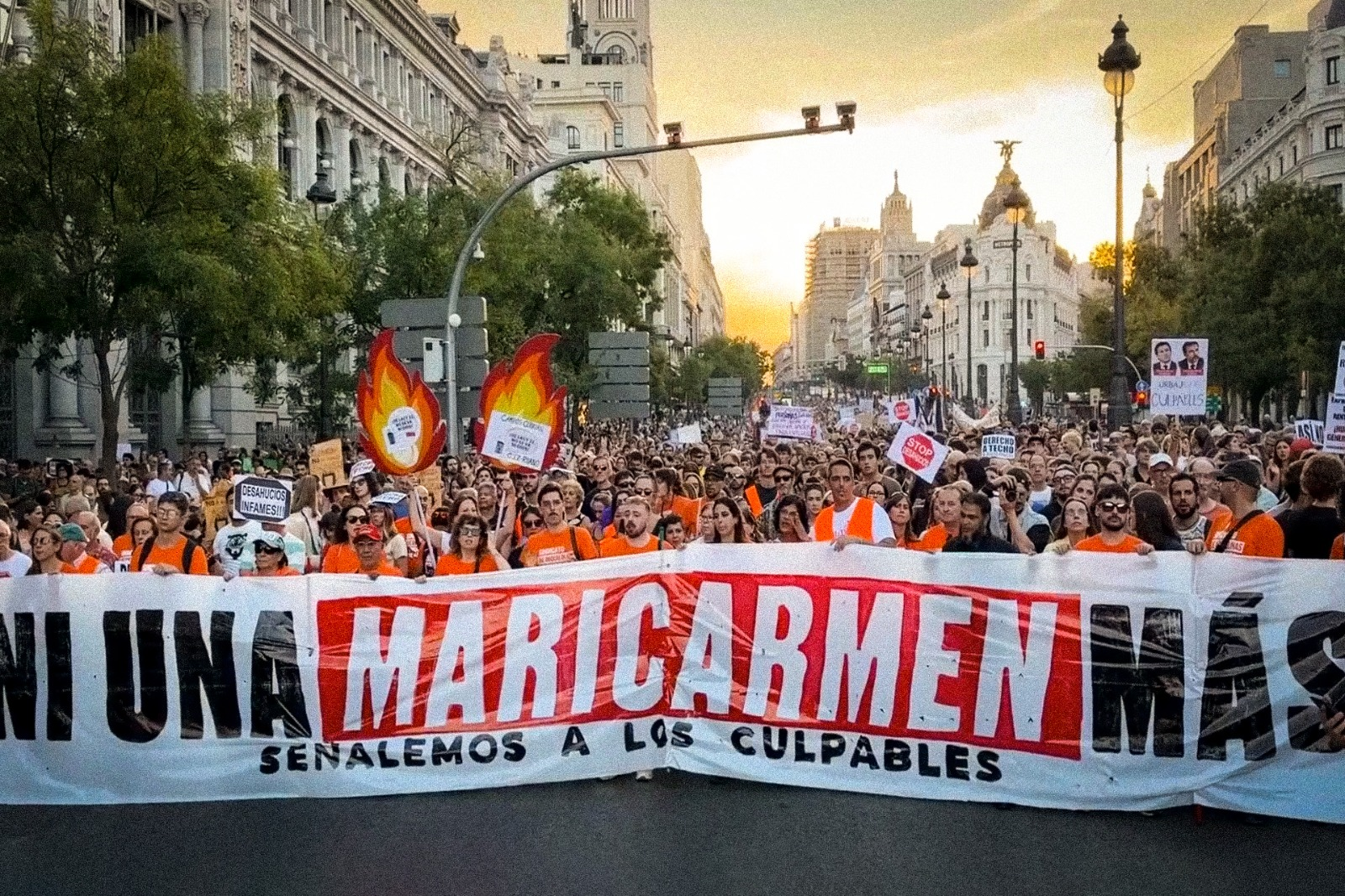
Over the last week, the name Maricarmen has taken over headlines in Spain. This 87-year-old disabled woman had been living in her Madrid apartment for 71 years until her brutal eviction last week.
There has been an outpouring of sympathy for this innocent woman and her steadfast struggle against a predatory investment fund. It has catalysed the deep anger and frustration that has been accumulating for several years in Spanish society as a result of the ongoing housing crisis.
With Madrid’s central plaza, Puerta del Sol, now occupied by a campout, the government of Pedro Sánchez is scrambling to pass some measure to quiet down the movement.
Last week was not the first time the state has attempted to evict Maricarmen. Having lived in a flat in the Retiro district of Madrid for her entire life, her apartment was purchased by the investment fund Urbagestión, which sought to raise her rent by over 400 percent (from €500 to €2,650). With her limited pension, there was no way she would have been able to afford this.
Eviction proceedings began. The first three attempts to evict her were halted by pressure from the housing movement. But after a series of legal proceedings and appeals, the Supreme Court finally ruled in March to terminate the lease. It argued that the tenant’s level of disability fell below the threshold legally required to maintain protection. This ruling demonstrates the arbitrary and dehumanising character of the judicial system, which is nothing but another tool serving the capitalist class.
Some of the police "techniques" used yesterday to enforce the eviction of Maricarmen in Madrid. She'd lived in the flat for 70 years, always paid rent. Riot police, including helicopter, was used under the authority of Pedro Sanchez government. pic.twitter.com/fVBjExC7jb
On Wednesday, 23 September, the eviction was to be carried out. Everyone was prepared for a decisive confrontation. The night before the planned eviction, over 500 sympathetic neighbours organised by the Tenants’ Union camped out peacefully, ready to stop the police from accessing the building and carrying out the eviction.
At 6:00am, a grotesque police deployment of 15 vans, a helicopter and dozens of officers came in with full force to violently disperse the crowd and tear-gas the building. They brought down Maricarmen on a stretcher so she could be delivered in an ambulance straight to the hospital.
Images of the event sparked an immediate wave of outrage, with simultaneous protests held that very afternoon in a dozen cities across the country. Over the next few days, the social temperature continued to rise, leading to a mass mobilisation on Saturday, with over 200,000 participants in Madrid. Protestors demanded a solution to the housing crisis and threatened a general strike.
Saturday’s protest ended with a campout in Puerta del Sol, Madrid’s central plaza and the seat of the autonomous, regional government. Organisers are demanding the central government pass a ‘Maricarmen decree’ by Tuesday, including an end to speculation in the housing market, indefinite (auto-renewing) rental contracts, and an end to evictions.
Naturally, this sequence of events has terrified the bourgeoisie, which is now scrambling to bring down the temperature of the struggle. Indeed, one cannot help but be reminded of the 2011 Indignados movement, the last major occupation of Puerta del Sol, which took place in the wake of the 2008 financial crisis.
Under capitalism, housing is simply a commodity like any other, not produced to fulfil a human need but merely to generate a profit. But given the crisis of overproduction, it’s more attractive for the capitalist class to use housing for the sake of
speculation, rather than building the millions of affordable homes that workers need.In Spain, four million homes lie completely empty, and are mostly owned by big banks and investment funds. They are mere chips in a casino of speculation. In addition, more than 350,000 apartments have been funnelled into the more profitable industry of short-term tourist lets: this represents a full 10 percent of the rental market.
Madrid: 300,000 march for housing rights and to protest callous eviction of 83 year old Maricarmen. Activists have now started a protest camp in Puerta del Sol. Anger against ruling PSOE - IU government. Shouts of "general strike". pic.twitter.com/XRoX5uM2Vl
As a result of this senseless, unproductive activity, the cost of buying or even renting a home has soared far beyond the purchasing power of the average worker’s wages. While wages in Spain have risen by 10.8 percent since 2008, housing costs have skyrocketed by 54 percent in the same period. By the end of 2025, average rents had reached an all-time high of €1,176 a month – 98.7 percent of the average young worker’s salary! Madrid is one of the most-affected areas, where a home costs 2.3 times more today than it did in 2014.
Unsurprisingly, the housing crisis has become a focal point of the class struggle in Spain. The country’s economy is only chugging along on the basis of the tourism industry, which creates precarious seasonal jobs and gobbles up a significant sector of the housing market.
In this suffocating situation, over 25,500 evictions take place annually. Everyone can see that Maricarmen’s eviction is not an anomaly, and that the problem goes beyond the cruelty of Urbagestión. Just last week, a 54-year-old woman took her own life five months after being evicted from her home in L’Hospitalet (Barcelona). This is the true, unmasked face of capitalism.
Maricarmen’s eviction was simply the final straw: the especially heart-wrenching nature of the images was accidental, but it expressed a deep underlying unrest in society that was waiting to explode.
All of this is bad timing for Isabel Díaz-Ayuso, the right-wing President of the Community of Madrid, who has been enveloped in a whole series of scandals surrounding the housing sector for years. In her personal life, the various fraudulent activities in which she, her family and her partner have been engaged have enabled her to acquire several penthouses worth over a million euros each, in one of the most affluent neighbourhoods in Madrid.
Her track record in government has been no different. As one of the most enthusiastic sycophants of the bourgeoisie, she welcomed investment fund BlackRock to host its investment forum in Madrid last October. She’s always looking for ways to transfer public wealth to private investors, like attempting to sell 3,000 units of public housing to Goldman Sachs-Azora for €201 million, before being blocked by the Supreme Court.
Most recently, it was revealed that Ayuso’s government had quietly acquired a penthouse for €6.3 million – right in front of her home! The purchase was carried out through a real estate company owned by the Madrid region, but none of this was revealed to the public.
Although her retinue tried to sell it off immediately after the news broke in late July, the damage was done. Ayuso has had her back against the wall, trying to provide an explanation. She initially claimed that the regional government intended to use it as temporary office space, even though the property is strictly for residential use.
Corruption is rampant in Ayuso’s government. A new scandal emerges every month.
An 87-year-old woman has been forcibly evicted from her home of 70 years in Madrid, sparking clashes between Spanish police and protesters who tried to stop her eviction. pic.twitter.com/N5hXdHfcL0
Meanwhile, the working class in Madrid is under attack on all fronts, particularly in the education sector, to say nothing of healthcare. Meanwhile, over the summer, the largest forest fire in Spanish history ravaged an enormous area west of the city, filling the air with ash.
Now it’s late September, and rent is due next week – then this poor old lady gets evicted.
Naturally, people have connected the brutal eviction of the defenceless Maricarmen with Ayuso squandering government funds on a penthouse worth millions so she can play tin-can telephone with her mom on the other side of the street. On the night of the eviction, 10,000 people gathered outside ‘Ayuso’s penthouse’ to protest.
Sánchez and his entourage have tried to use the current atmosphere to cast blame on the right and bolster his own reformist credentials. This is just days after his photo-ops with Zohran Mamdani in New York. Some PSOE politicians even cynically showed up to pose for photos at the rally outside Ayuso’s penthouse.
Sure, in the last few years, the government has passed a series of mild measures to mitigate the housing crisis. But since the housing question mainly falls within the purview of the autonomous communities, the lack of a bold plan enforced from the national level has meant the right wing – which dominates 12 out of 17 autonomous communities – has been able to dig in its heels.
While this is an Achilles’ heel of an already weak set of measures, it’s also a way for the PSOE to eventually redirect blame on the right wing for the crisis. In reality, the government’s half-measures, youth vouchers, and housing subsidies are ineffective, as Maricarmen’s eviction has demonstrated.
So, when Ayuso claps back – trying not to break character while pretending to care – that the central government has had eight years to act on this crisis and has chosen not to… she’s right! As recently as two weeks ago, the PSOE blocked a bill by Sumar – the reformist party with which it governs – that sought to ban companies and investment funds from purchasing residential property.
Sánchez and his entourage have tried to use the current atmosphere to cast blame on the right and bolster his own reformist credentials / Image: European Parliament, Flickr
So, the right-wing regional government blames the left-liberal central government and vice versa, while the reformist left gets brownie points for putting something on the table… which is summarily discarded.
This game of hot potato reflects their fear of being the target of this wave of anger surging up from the working class. They all know that none of them have done anything of substance to mitigate this crisis, as both ruling parties serve the same masters. But workers are seeing through this. Both parties have already been completely discredited.
The incident has exposed the two-faced nature of the current government and the whole of the capitalist state apparatus, from the executive to the judiciary. It has been proven that we cannot trust any institution or rely on any law: when you are faced with the interests of a multimillion-dollar fund, their profits are always prioritised over people’s lives.
In this context, the masses find themselves with nobody to turn to. While Vox on the far right does not have the same appeal as its European would-be analogues, left-wing parties like Sumar and Podemos are discredited, uninspiring non-entities that have already been put to the test – and failed.
Subordinated to the liberal left, the ‘radical’ left cannot offer the bold programme needed to solve the crisis. They do not believe that it can actually be carried out. Through parliamentary activity alone, to be sure, it cannot.
Yet there is a deep thirst for such a programme. The recent election results in Berlin, where Die Linke won on the basis of a programme of expropriation, clearly show this mood in society, particularly in the section of the population hardest hit by the housing crisis: young, urban workers.
But without anyone to catalyse this mood, workers have been directing their own struggles, displaying enormous strength and greater boldness than their would-be leaders. Over the summer, thousands of workers at a major Airbus factory in Madrid went on an all-out strike, voting down a milquetoast agreement reached by the main unions behind the backs of workers. At the same time, an all-out strike in the education sector in Madrid has been called for 14 October.
With the housing crisis becoming ever more acute, a number of major protests have occurred in the last couple of years. At the forefront of these has been the Tenants’ Union.
The Tenants’ Union mainly organises rent strikes with a narrow range and scope, provides various types of support for cases like Maricarmen’s, and organises direct action to stop evictions. While this work is certainly valuable, their political programme stops short of the far-reaching measures necessary to deal with the housing crisis, such as expropriating investment funds. In fact, this is a symptom of their limited strategy of making appeals to the government and bourgeois institutions.
Last year they were involved in organising massive protests that were held simultaneously across the country, which brought hundreds of thousands into the streets. While this shows the deep-seated malaise in society waiting to be given an expression, the organisers see these protests as an end in themselves, a way to ‘pressure’ the government on a single issue.
But it’s precisely this limited perspective that lets the ruling class breathe a sigh of relief – after workers are done letting off steam for the day. Indeed, after those massive protests, all that steam dissipated into thin air. Nothing came of it, except perhaps the lukewarm measures that have already been passed.
Now the Tenants’ Union has set up camp in Sol under the slogan: ‘If [the Maricarmen decree] isn’t passed, this government won’t make sense anymore.’ But when did it make sense? It was the central government – the so-called ‘most progressive government in history’ – that mobilised the National Police to carry out this eviction. All of this has happened under its purview, according to the driving logic of the capitalist system.
View this post on Instagram A post shared by Sindicato de Inquilinas de Madrid (@inquilinato_madrid)
As far as this decree goes, not only does the PSOE already pooh-pooh the bolder proposals from Sumar, the conservative Junts and the PNV in the government’s coalition will further water down its scope. Not to mention that they don’t even have a majority in Congress. Besides, what kind of sympathy could be expected anyway from a Congress where 85 percent of MPs are homeowners – including Pedro Sánchez himself and his Housing Minister – while 20 percent are landlords owning three or more homes and receiving rental dividends?
They cannot pass a Maricarmen decree, but only a Frankenstein’s decree that will inevitably entail significant concessions to the right, like tax relief and subsidies for ‘affected’ landlords. These are just more backdoor methods for funnelling money from the working class into the hands of the wealthy.
Yet, there is no clear plan for what to do when the government inevitably fails to meet these demands.
Meanwhile, the movement is advancing according to its own logic. Over the past several days, protests have been sprouting up spontaneously across the country. In Barcelona, barricades were assembled at a protest, though an attempted campout was quickly dispersed. In other cities like Grenada and Málaga, small campouts have formed.
All of this has caught the state off guard. In Madrid, even Ayuso didn’t immediately crack down on the camp because she’s afraid of the reaction, but as of Tuesday she’s given them an ultimatum to leave by Thursday. They’re betting on their decree to dissipate the movement and give them an excuse to clear out Sol of protestors.
Some elements in the Tenants’ Union, unsure of where to go next as the matter gets out of hand, are already preparing the people for disappointment. In one very telling scene at a rally on Monday, before the contents of the proposed government decree were even revealed, one activist in Madrid said to the assembly:
“From the Tenants’ Union we’d like to convey a message, which is: We’ve already won!
“We’ve won because we’re here… and we know that whether or not they give us indefinite rental contracts… we are organised!… And when this is over – because we know this is just another means to pressure institutions and to say that power is in the hands of the organised people…
[Deafening boos; chants of ‘We – are – staying!’]”
Instead of wasting energy making appeals to actors with no interest in changing anything, the Tenants’ Union should focus its efforts on persistently calling upon unions to mobilise, starting with the CCOO and UGT. Working-class organisations – especially the largest ones – must fight against these attacks by business owners and governments.
Yet the union bureaucracies have played their usual role so far: expressing verbal solidarity with the campout and calling on parliamentary groups ‘to act with courage’ to hand out further crumbs.
If the union leaders are unwilling to fight, we must appeal directly to the rank and file, creating pressure from below that forces these leaders into action. This already happened in Spain and in Italy less than a year ago with the strikes in solidarity with Palestine.
The housing movement has enormous potential – millions have taken to the streets for this cause over the past year. But the issue cannot be dealt with in isolation. We must connect it with other struggles affecting the working class: cuts to public services like education and healthcare, precarious employment and low wages, the climate crisis, warmongering and genocide, etc.
View this post on Instagram A post shared by OCR - Organización Comunista Revolucionaria (@comunistas_ocr)
We need a revolutionary programme with clear, firm demands – foremost among them expropriation without compensation of all vacant housing held by major property owners: banks, investment funds, and real estate companies. We demand a ban on the purchase of apartments for the rental business as well as a ban on tourist rentals.
In order to build quality, affordable housing, we must also expropriate – without compensation – the major banks and construction companies that have amassed obscene profits. We must put them under workers’ control, and launch a state-run public housing construction plan based on real social needs.
And, of course: we demand a permanent end to evictions! Coordinate and unify the struggle for housing across the entire country! For us to live, capitalism must die!
To those for whom this programme seems too bold, we say: what is utopian is to think that any ‘realistic and practical’ reforms could be applied in a context of capitalist crisis, where the ruling class has no choice but to apply further cuts.
Capitalists and their political allies will not simply hand over any of these measures. We can only win them through organised struggle. Our task is therefore to build a revolutionary party that can channel these outbursts of anger and turn this steam into the power that can topple this rotten system.
Read the full story at the source
Source: In Defence of Marxism